Billiards & Snooker — 04 · Where the White Goes
Post 03 controlled the white on a straight pot. Most pots are cuts, and on a cut the white goes off to the side. This lesson shows where: the square line, the 30° rule, follow and screw on a cut, how power and the cut angle change the path, how much speed the white keeps, and two checks before every shot: in-offs and kisses.
Series map. ★ Basics: 01 Cue action and elevation → 02 Aiming and potting → 03 Tip and power → 04 Where the white goes (this post) · ★★ Club: 05 Side spin → 06 Cut and side into pockets → 07 Cushions → 08 Doubles · ★★★ Advanced: 09 Escaping snookers → 10 Multi-ball shots → 11 Safety → 12 Position play · ★★★★ Hard: 13 Break-building → 14 Special shots · Reference: 15 Rules, tactics and practice · ★★★★★ Pro: 16 Cue-ball control.
Learning Outcome
- Find the square line on any cut, and send the white along it with a stun.
- Send the white a little forward (stun run-through) or about 30° forward (rolling).
- Use power and the cut angle to predict how follow and screw bend the white.
- Know how much speed the white keeps on full, half and thin cuts.
- Check the white's path for a pocket (in-off) and for other balls (kisses).
Chapter 1 — The square line
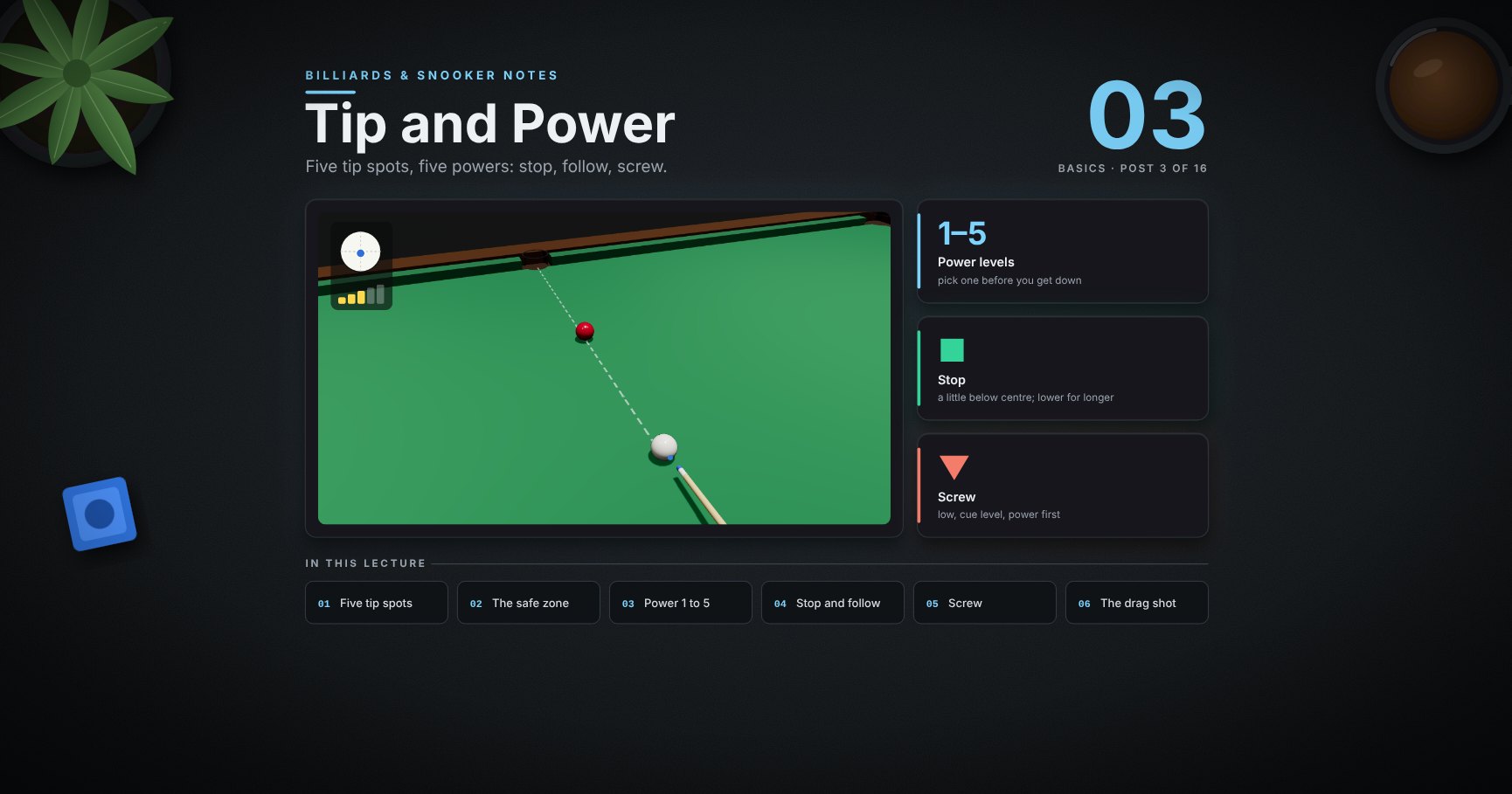
1 · Three tips, three paths
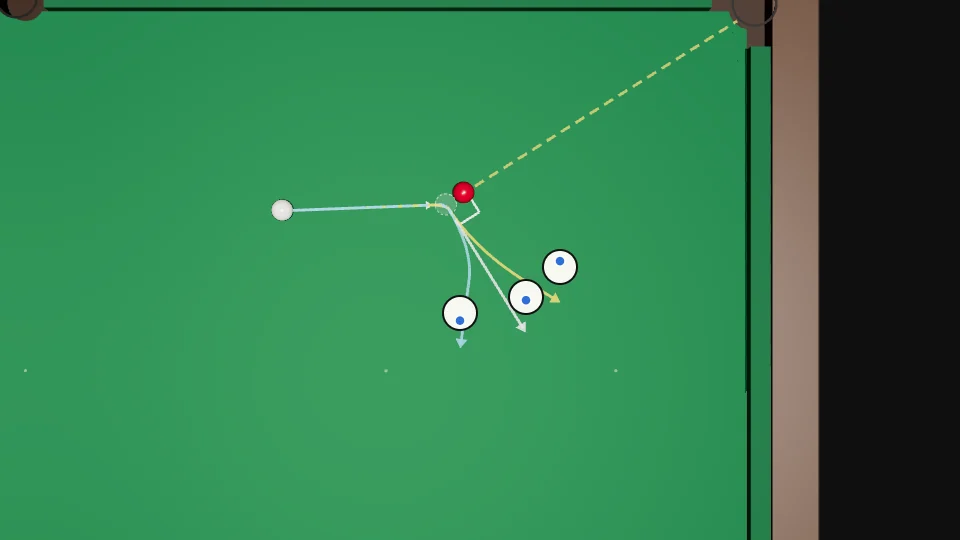
The same pot, the same aim, three tips:
| Tip | The white goes… |
|---|---|
| ▲ above centre (follow) | forwards, bending away from the square line |
| ■ a little below (stun) | along the square line, at a right angle to the red's path |
| ▼ low (screw) | back, behind the square line |
The square line (the small white square) is your anchor. Find it first, then decide: forwards of it, on it, or behind it.
2 · Stun run-through on a cut
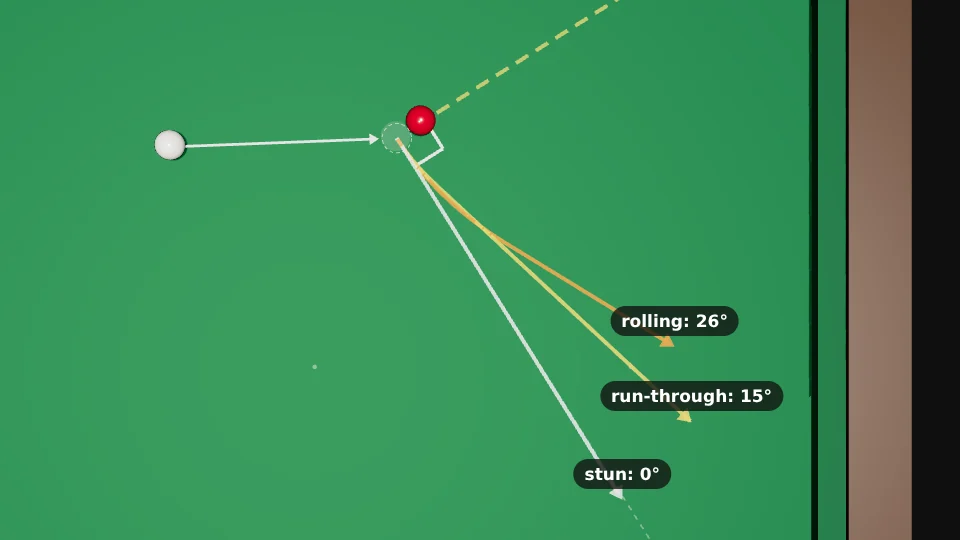
Between stun and follow there is a whole range. In the model, half ball, power 3, white 40 cm away:
| Tip | The white ends… |
|---|---|
| 0.19 R below centre (stun) | on the square line |
| 0.04 R below centre (stun run-through) | 15° forward of it |
| 0.35 R above centre (rolling) | 26° forward of it |
Trick: need the white just a little forward of the square line, for a red a few inches from it? Stun run-through: hit just below centre, a little higher than your stun spot.
3 · Rolling white: about 30°
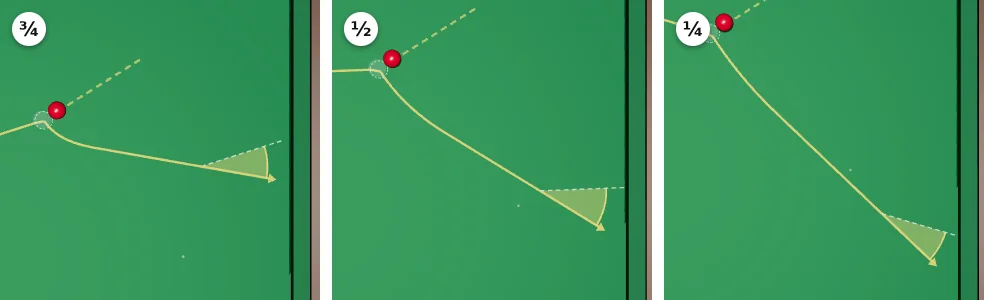
When the white is rolling (hit above centre, or slow from far away), it ends up turned about 30°, a third of a right angle, from the line you sent it on. That holds for most cuts from ¾ ball to ¼ ball. In the model: ¾ ball 28°, ½ ball 34°, ¼ ball 27°.
Trick: lay your cue on the table along the white's line, then turn it a third of the way to a right angle. That is where a rolling white goes.
Chapter 2 — Follow and screw on a cut
4 · Watch it: follow on a cut
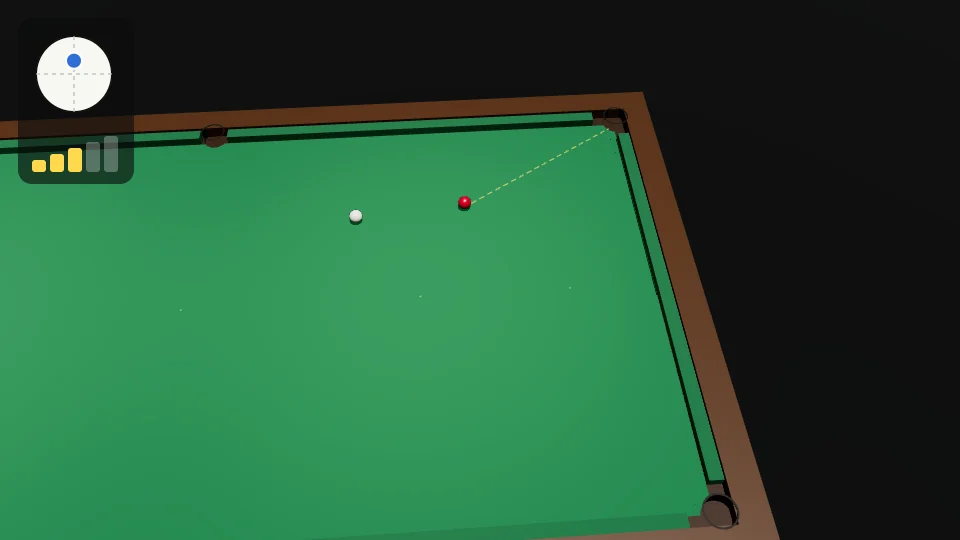
The white starts along the square line, then the topspin grips and bends it forwards.
5 · Watch it: screw on a cut
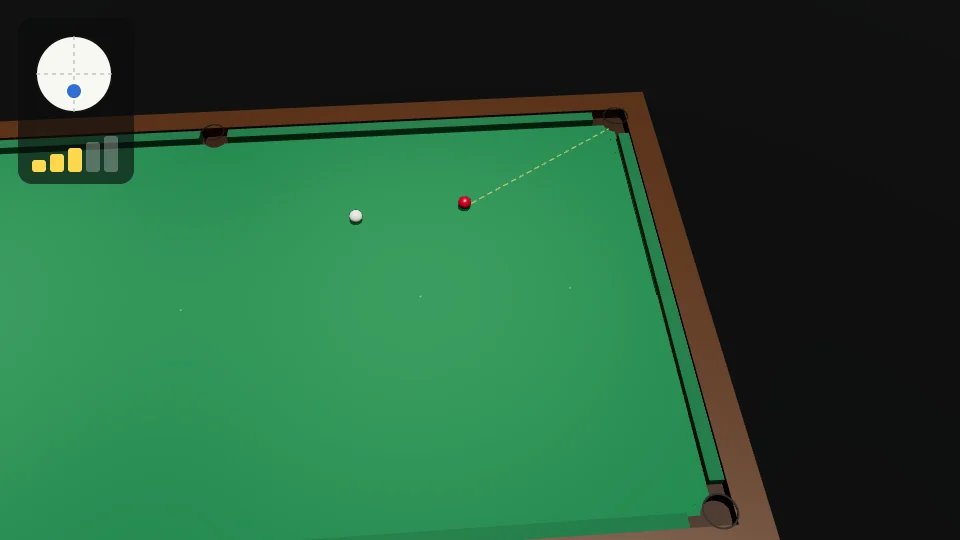
Low tip: the white leaves along the square line too, then the backspin pulls it back behind the line.
6 · Power decides where the bend starts
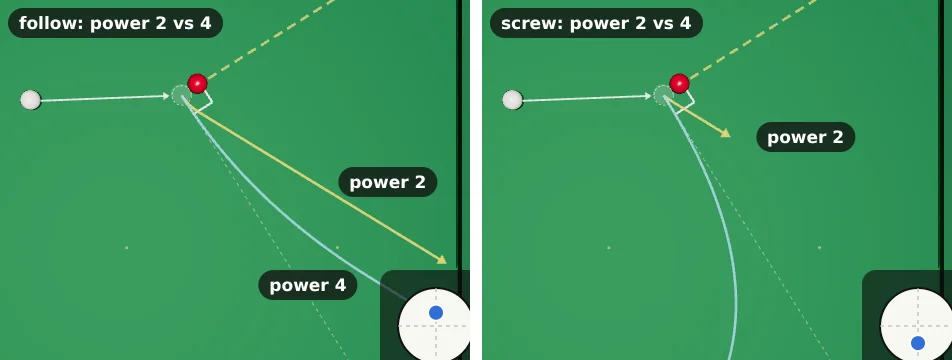
Every white leaves along the square line. The spin then takes time to grip. More pace = further along the square line before the bend (model, distance until the white has turned 15°):
| Power 2 | Power 4 | |
|---|---|---|
| follow | 4 cm | 39 cm |
| screw | 1 cm | 36 cm |
So the same tip spot gives very different paths. A soft shot turns at once; a firm shot keeps the square line for a while, then swings in a wide curve.
Watch out: a firm screw on a cut does not come straight back. It runs along the square line first. Check that part of the path too.
7 · The cut decides how much screw comes back
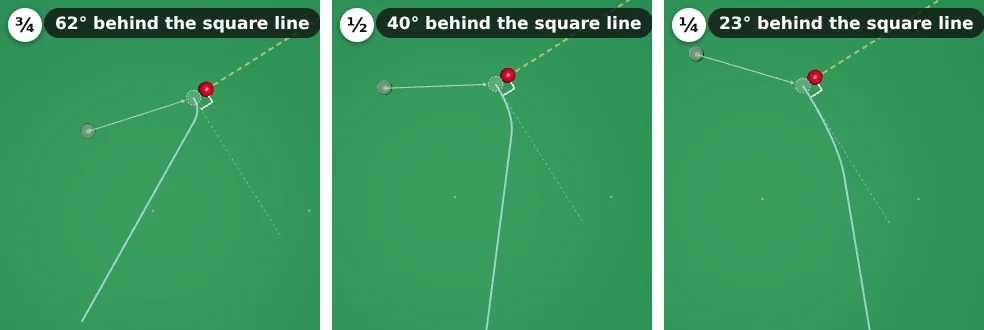
The same screw (tip 0.45 R below centre, power 3) on three cuts:
| Cut | The white ends behind the square line by |
|---|---|
| ¾ ball | 62° |
| ½ ball | 40° |
| ¼ ball | 23° |
The fuller the hit, the more the screw shows. On thin cuts the white keeps most of its forward speed (section 9), so screw only nudges it.
8 · Nearly full cuts
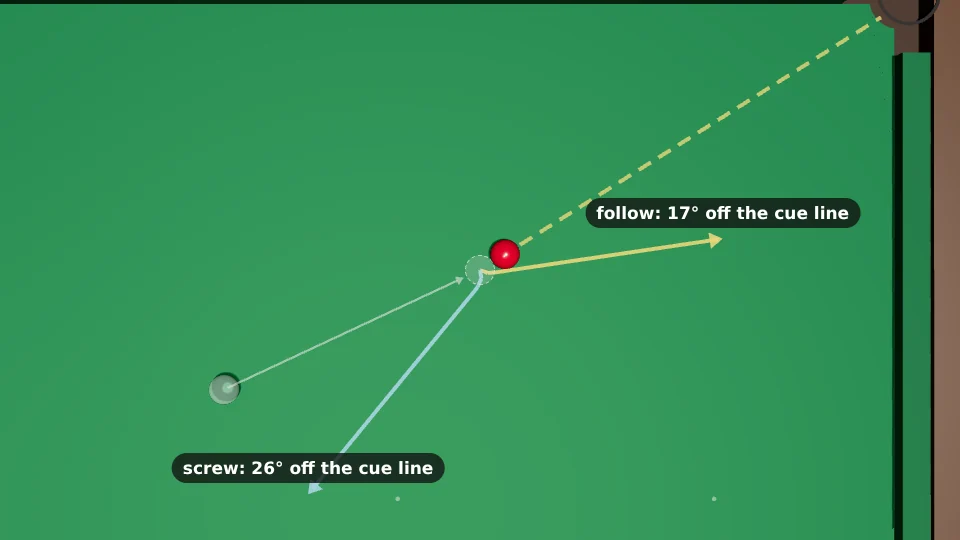
On a nearly straight pot (here ⅞ ball, a 7° cut), the white goes almost straight on with follow or almost straight back with screw. In the model, follow ended 17° off the cue line and screw 26° off it.
This is why nearly straight pots are hard for position: the white can only go forward or back along one line. Leave yourself a bit of angle when you can (post 12).
9 · How much speed the white keeps
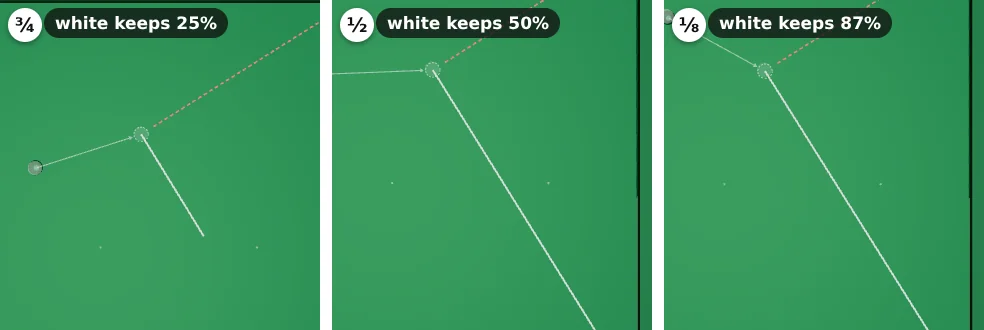
On a stun, the speed is split between the two balls:
| Cut | The white keeps | The red gets |
|---|---|---|
| ¾ ball | 25% | 97% |
| ½ ball | 50% | 87% |
| ⅛ ball | 87% | 48% |
(The two shares are the sine and cosine of the cut angle; they add up in speed squared, not in plain numbers.)
So on a thin cut, the white travels a long way and the red only a little: play thin cuts firmer to reach the pocket, and expect the white to run on. On a full hit, the white goes only a short way.
Chapter 3 — Check the white's path
10 · Avoid the in-off
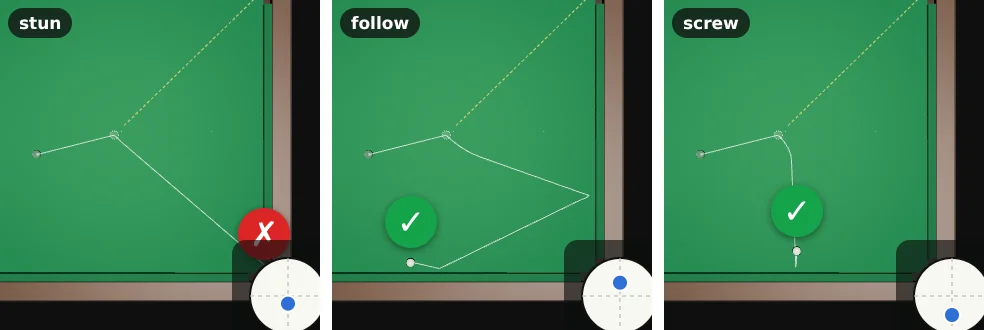
Here the square line points straight at a pocket. A stun sends the white in after the red: an in-off, a foul ✗. Follow or screw move the white off the line ✓.
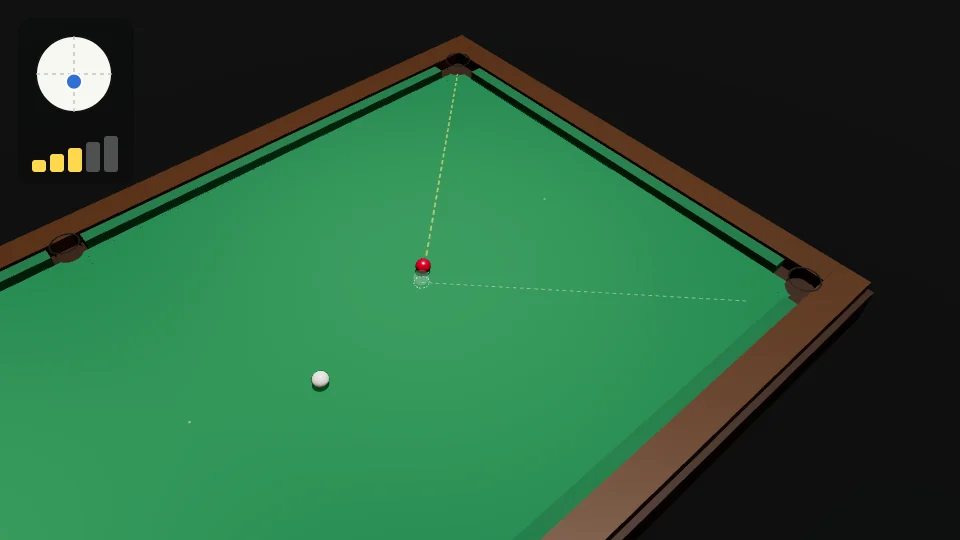
Trick: before every cut, look along the square line. If it hits a pocket, choose follow or screw, or change the pace so the white stops short.
11 · Check for kisses
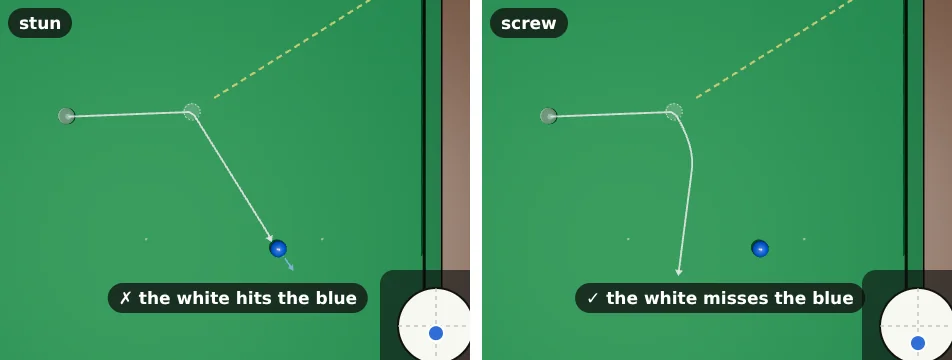
A ball on the white's path changes everything: the white stops, the other ball moves, and your next shot is gone. Here a blue sits 52 cm along the square line. The stun hits it ✗; screw takes the white behind it ✓.
The check is the same as for in-offs: picture the path for your tip and pace, and look along all of it.
Try it at the table
| Drill | Set-up | Look for |
|---|---|---|
| Square line | a half-ball pot; lay a cue on the table along the square line | stun: the white runs along the cue |
| Four paths | the same pot with screw, stun, stun run-through, follow | four different landing spots; mark each with a coin |
| 30° check | top spin on ¾, ½ and ¼ ball cuts | the white turns about the same each time |
| Power and the bend | follow at power 2, then at power 4 | the firm one runs along the square line first |
| In-off spotter | a pot whose square line points at a pocket | play it with follow, then with screw, and stay out both times |
Cheat-sheet
| Stun | along the square line, at a right angle to the red's path |
| Stun run-through | just below centre: a little forward of the square line (about 15° on half ball) |
| Follow | forwards; ends about 30° off the line you sent the white on |
| Screw | behind the square line; more on fuller cuts (¾: 62°, ½: 40°, ¼: 23°) |
| Power | firmer = runs along the square line longer before bending |
| Nearly full | only straight on or straight back |
| Speed kept | ¾: 25% · ½: 50% · ⅛: 87% |
| Before every shot | look along the white's path: pockets, balls |
What's next
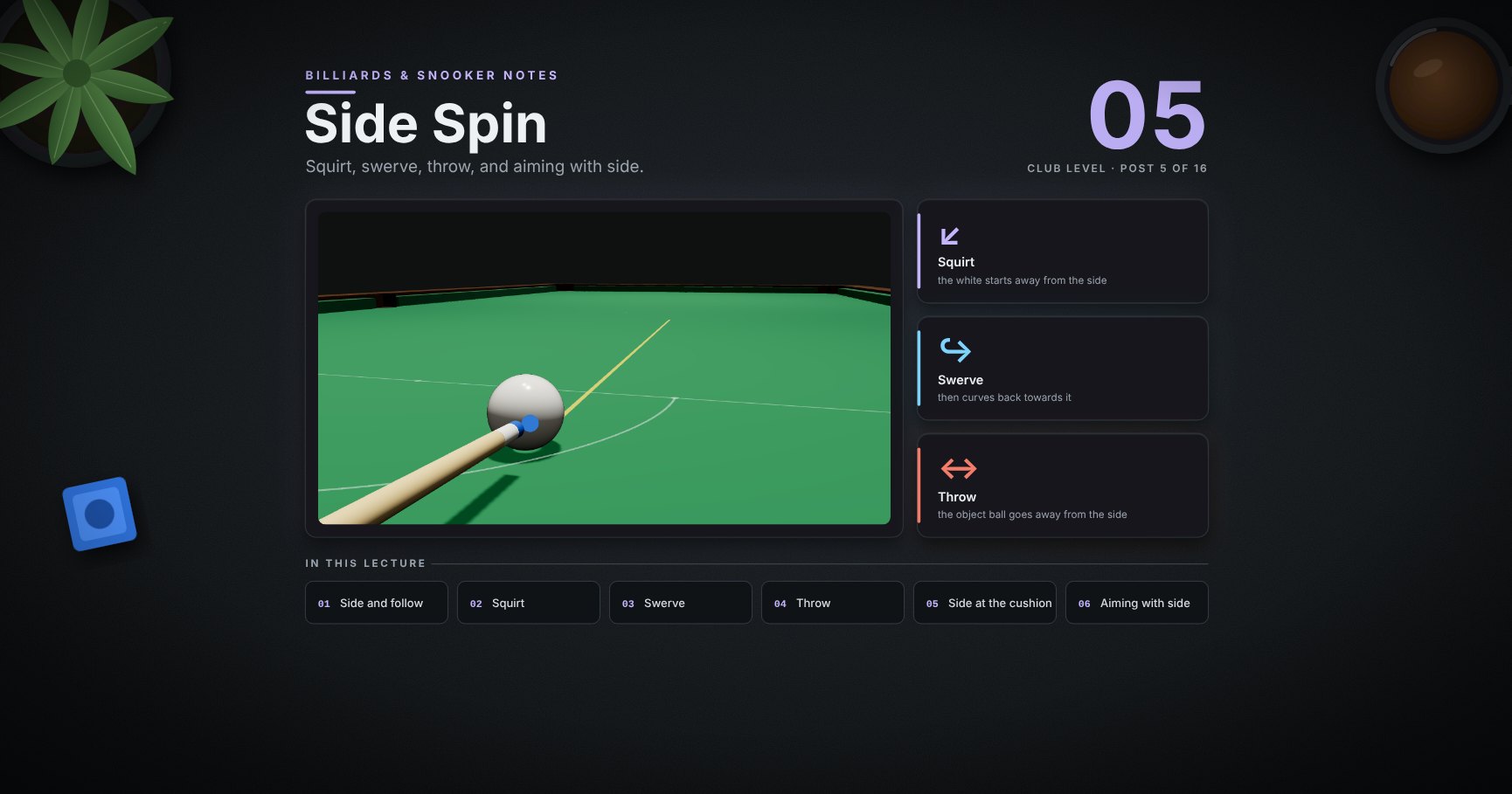
05 · Side spin. What side really does: squirt, swerve, throw, and side off a cushion, and how to aim with it.
References
- Dr. Dave Alciatore, the 90° rule and the 30° rule (articles, videos and technical proofs). https://billiards.colostate.edu/
- WPBSA, Official Rules (2022): in-off is a foul. https://wpbsa.com/rules/
- The speed split on a stun is exact for smooth balls (sine and cosine of the cut angle). The angles, distances and tip heights come from the physics model of the balls at snooker sizes; real tables vary a little, the patterns hold.
Note: this post is in progress. Planned additions: the same paths into a middle pocket, and where the white goes after the first cushion.