Billiards & Snooker — 13 · Break-building
A break is a run of pots in one visit. This lesson puts everything together: what each ball is worth and the maximum, how many points are left on the table, the black-ball game round the black spot, staying close with an angle, using the other colours, opening the reds, dealing with problem reds early, the colours in order and how they are spotted, and when to stop and play safe.
Series map. ★ Basics: 01 Cue action and elevation → 02 Aiming and potting → 03 Tip and power → 04 Where the white goes · ★★ Club: 05 Side spin → 06 Cut and side into pockets → 07 Cushions → 08 Doubles · ★★★ Advanced: 09 Escaping snookers → 10 Multi-ball shots → 11 Safety → 12 Position play · ★★★★ Hard: 13 Break-building (this post) → 14 Special shots · Reference: 15 Rules, tactics and practice · ★★★★★ Pro: 16 Cue-ball control.
Learning Outcome
- Know the ball values, the order of play and the maximum break.
- Count the points left, and know when you need snookers.
- Build a break round the black with short, angled positional shots.
- Plan when to open the reds and when to clear problem reds.
- Clear the colours in order, and know where a colour is spotted.
- Know when to stop and play safe.
Chapter 1 — The score
1 · What each ball is worth
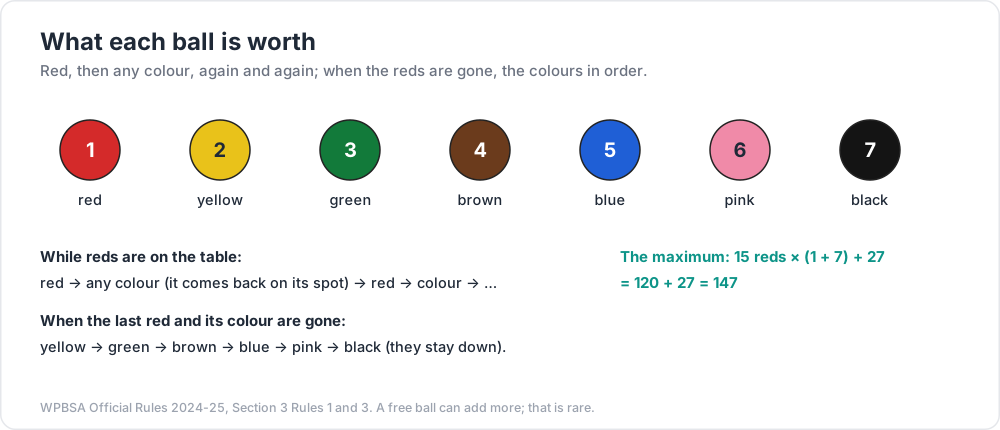
- While reds are on the table: a red, then any colour. The colour comes back on its spot.
- After the last red and its colour: the colours in order, yellow to black, and they stay down.
The maximum is 15 reds each with the black, then all the colours: 15 × 8 + 27 = 147.
2 · Points left on the table
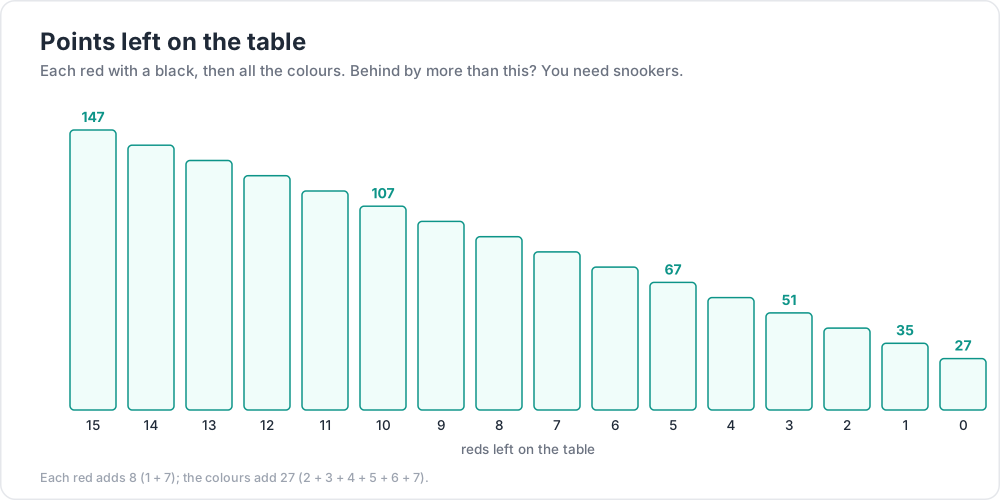
The most points left = reds left × 8 + 27.
| Reds left | Points left |
|---|---|
| 15 | 147 |
| 10 | 107 |
| 5 | 67 |
| 3 | 51 |
| 1 | 35 |
| 0 | 27 |
If you are behind by more than this, potting alone cannot win: you need your opponent to give away fouls (you "need snookers"). Count it before you take on a risky pot late in a frame.
Chapter 2 — Building
3 · The black-ball game
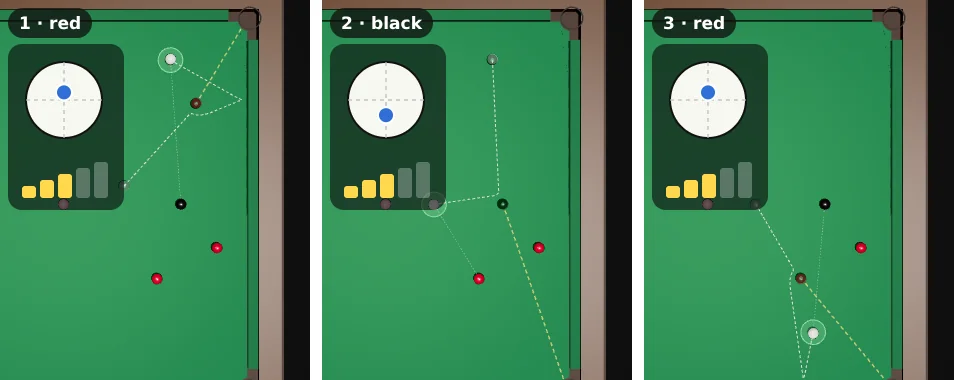
Most big breaks are built round the black spot: reds near it, the black after each red. Three shots from the model:
| Shot | Ball and pocket | Tip, power | The white ends… | Next ball |
|---|---|---|---|---|
| 1 | red, top right | a little above centre, power 3 | above the black | black at a 16° cut |
| 2 | black, bottom right | screw, power 3 | to the left of the spot | red at a 9° cut |
| 3 | red, bottom right | a little above centre, power 3 | below the black | black at a 15° cut |
After each black, the black goes back on its spot, so you can plan round a fixed point.
4 · Stay close
In those three shots the white moved only 65, 76 and 68 cm (start to finish in a straight line). Short moves mean:
- small pace errors (post 12);
- short next pots, with lots of room (post 02);
- fewer balls in the way.
Trick: when the reds are near the black, think "small circles round the black spot" rather than big trips round the table.
5 · An angle on every ball
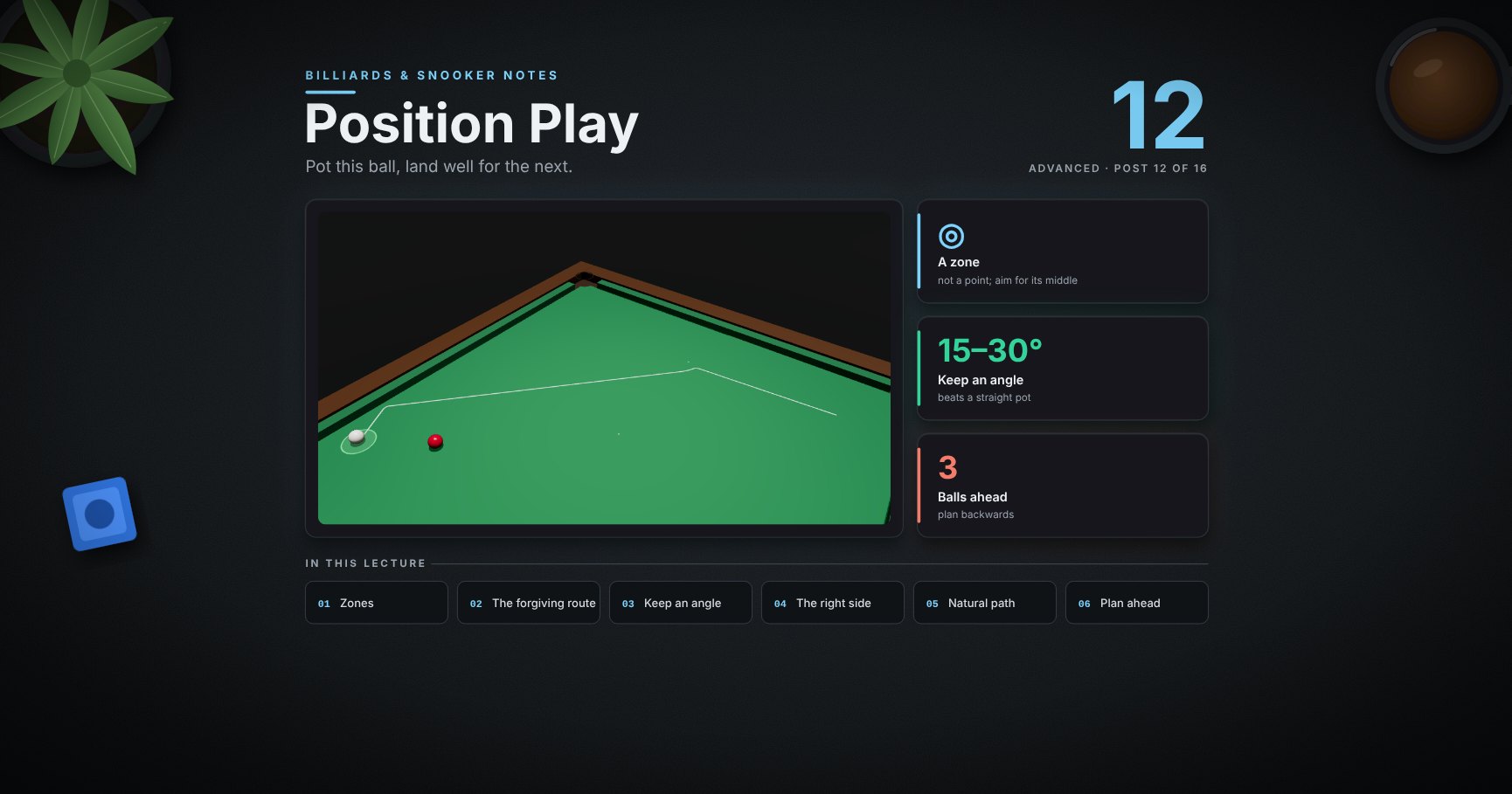
Every next pot in the sequence had a cut between 9° and 16°: never dead straight, never thin. That is the angle from post 12, kept shot after shot. If one shot leaves you straight, the next is often a stun or screw just to keep going, with no choice of where the white goes.
6 · Use the pink and the blue too
The black is worth most, but it is not always the best colour:
- the black's pot may be blocked, or its angle may send the white the wrong way;
- the pink and blue sit nearer the middle of the table, close to reds that have spread;
- a safe blue that keeps the break going beats a risky black that ends it.
Coaching advice: choose the colour by where it sends the white, not by its value alone.
7 · Open the reds early
Reds in a tight pack cannot be potted. Open them while you are still in, and while the colours around them are on their spots:
- pot a red or a colour and let the white run into the side of the pack (post 10);
- choose the pace: one step softer leaves a few reds out, one step firmer spreads them (post 10);
- do it from a shot where the pot itself is easy.
8 · Problem reds first
Some reds can only be potted one way: on a cushion, near the baulk end, or touching another ball. Coaching advice: take them early, while there are other reds for the white to go to afterwards. Leave them to the end and they finish the break.
Chapter 3 — The colours
9 · Clearing the colours
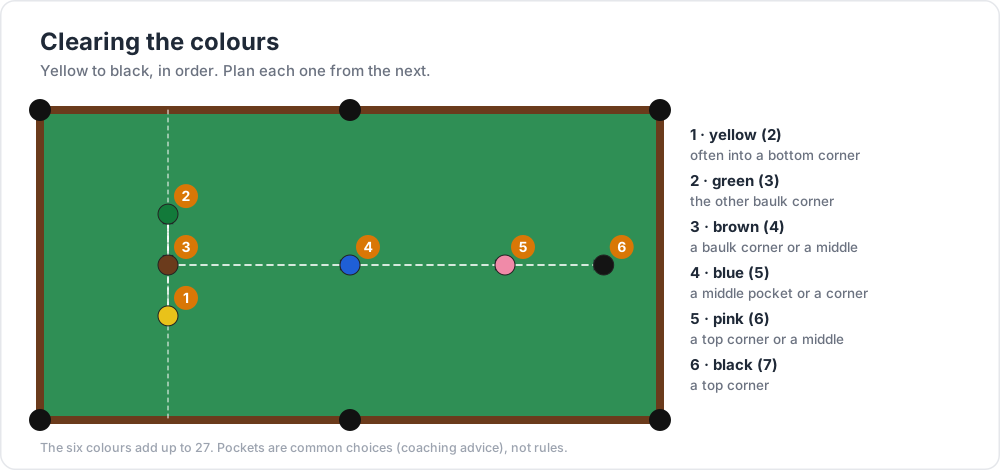
After the last red, the colours go in order: yellow, green, brown, blue, pink, black, together worth 27. Plan each one for the next, exactly as in post 12. The pockets in the picture are common choices (coaching advice), not rules.
10 · Where a colour is spotted
While reds remain, a potted colour goes back on its own spot. If that spot is taken by another ball (WPBSA rules, simplified):
- it goes on the highest-value spot that is free;
- if several colours need spotting, the highest-value one goes first;
- if every spot is taken, it goes as near its own spot as possible, between the spot and the top cushion (the short cushion at the black end).
So a red sitting on the black spot can send the black somewhere else. Check before you plan the next shot.
11 · When to stop and play safe
Keep going while the next pot is one you make most of the time. Stop when:
- the only pot left is long, thin, or a plant, and a miss leaves your opponent in (post 11);
- the white has run out of position and the next pot is a gamble;
- you are well ahead and a safety keeps it that way.
A break of 30 and a good safety usually beats a break of 30 and a missed long pot.
Try it at the table
| Drill | Set-up | Look for |
|---|---|---|
| Black-ball circle | five reds round the black spot | red, black, red, … without leaving the top end |
| Short moves | the same; mark where the white stops | each move under about 1 m |
| Angle check | the same | no dead-straight black |
| Blue and pink | reds spread near the middle | use the blue or pink when the black sends the white wrong |
| Line-up | 15 reds in a line across the table, colours on spots | pot them all with colours |
| Clearance | only the colours on their spots | yellow to black in order |
Cheat-sheet
| Values | red 1, yellow 2, green 3, brown 4, blue 5, pink 6, black 7 |
| Order | red, colour, red, …; then yellow → black |
| Maximum | 15 × 8 + 27 = 147 |
| Points left | reds × 8 + 27 |
| Black-ball game | small circles round the black spot |
| Every shot | short moves, a 10–30° angle on the next ball |
| Colours | choose by where the white goes, not only by value |
| Reds | open the pack early; problem reds first |
| Spot taken | the highest free spot |
| Stop | when the next pot is a gamble |
What's next
14 · Special shots. Swerve and massé, the jump shot (and why it is a foul), a touching ball, a ball in the jaws, and other awkward spots.
References
- WPBSA, Official Rules (2024-25): ball values, order of play (Section 3 Rules 1 and 3), spotting colours (Section 3 Rule 7). https://www.wpbsa.com/rules/
- Dr. Dave Alciatore, cue ball control and pattern play. https://billiards.colostate.edu/
- The three-shot sequence comes from the physics model; the pockets for the colours, the pink and blue choices and when to stop are coaching advice.
Note: this post is in progress. Planned additions: a full line-up drill drawn shot by shot, and breaking up the pack from the blue.