Billiards & Snooker — 02 · Aiming and Potting
How do you send a red into the pocket when the white is somewhere else? You plan it backwards, from the pocket. This lesson covers the whole of aiming: the ghost ball, the classic miss, ball fractions and the angles they give, thin cuts, why long and thin pots are hard, how much room each pocket gives, and the small "drag" on slow cuts.
Series map. ★ Basics: 01 Cue action and elevation → 02 Aiming and potting (this post) → 03 Tip and power → 04 Where the white goes · ★★ Club: 05 Side spin → 06 Cut and side into pockets → 07 Cushions → 08 Doubles · ★★★ Advanced: 09 Escaping snookers → 10 Multi-ball shots → 11 Safety → 12 Position play · ★★★★ Hard: 13 Break-building → 14 Special shots · Reference: 15 Rules, tactics and practice · ★★★★★ Pro: 16 Cue-ball control.
Learning Outcome
- Find the red dot on any ball for any pocket, and aim the white at the ghost ball.
- Read a cut as a ball fraction (full, ¾, ½, ¼, ⅛) and know the angle each one gives.
- Aim thin cuts two ways, and know how thin "very thin" really is.
- See why long pots and thin cuts are hard, with numbers.
- Know how much room the corner and middle pockets give from different angles.
- Allow for throw on slow cuts.
Colour key, used in every picture:
| Mark | Means |
|---|---|
| yellow dashed line | the way to the pocket |
| red dot | where the two balls must touch |
| see-through ball | the ghost ball: where the white must be at the moment it touches |
| white arrow | where you send the white |
| green wedge or band | room: how much the aim or the ball may be off and still pot |
| ✓ / ✗ | pot / miss |
Chapter 1 — Finding the aim
1 · Three steps, from the pocket back
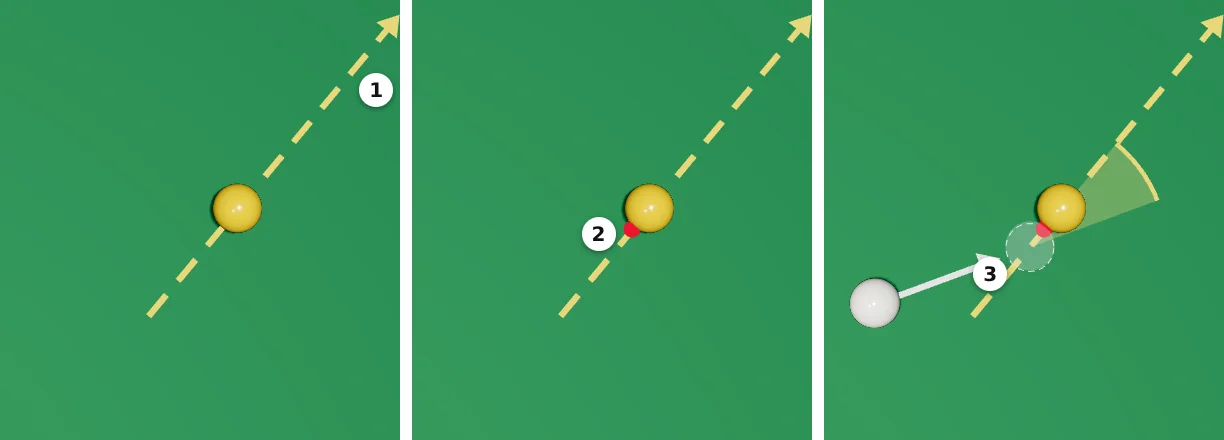
- Line from the pocket through the middle of the ball.
- Where that line comes out of the back: the red dot.
- A ball touching the red dot: the ghost ball. Send the white's centre to the ghost's centre.
The red dot never moves when the white moves. Only the cut changes.
2 · What you see down the cue
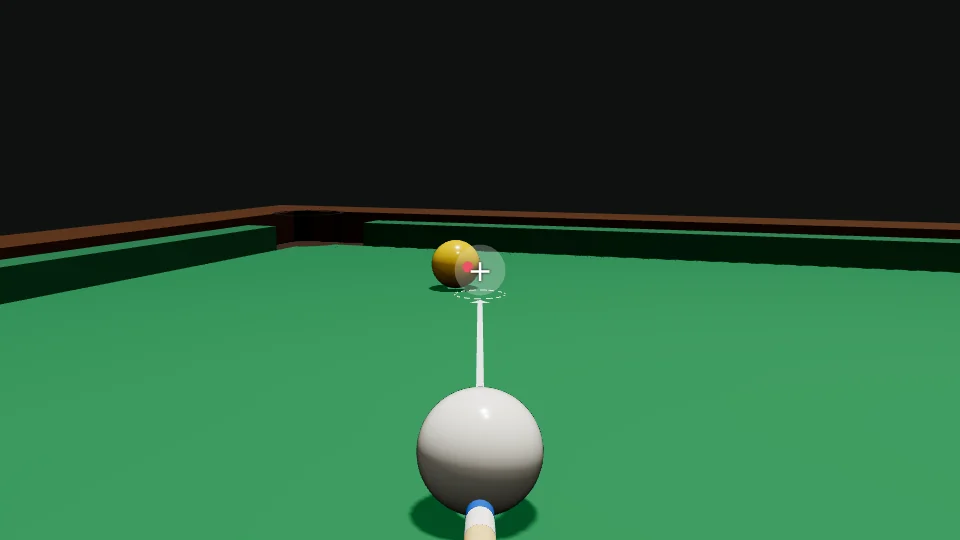
Aim at the +, the ghost's centre. It sits on empty cloth, half a ball beyond the red dot. Pick a speck on the cloth there and aim at it.
Trick: walk in behind the ball first, looking at the pocket. Find the red dot from there, then walk round to the white.
3 · Watch it: a stun pot
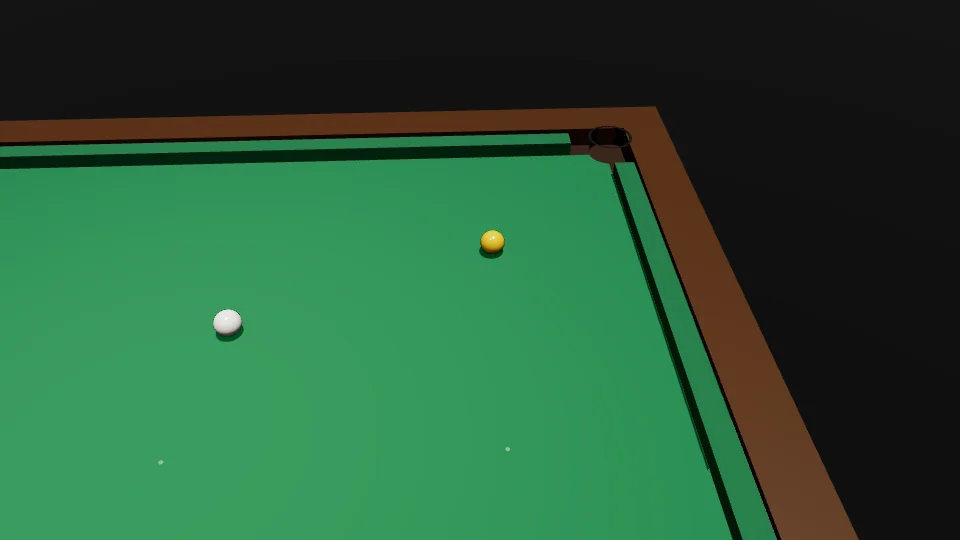
The yellow follows the dashed line into the pocket ✓. Hit a little below the middle (a stun) and the white leaves at a right angle (the square). Post 04 shows where it goes with other spins.
4 · The classic miss: aiming at the red dot
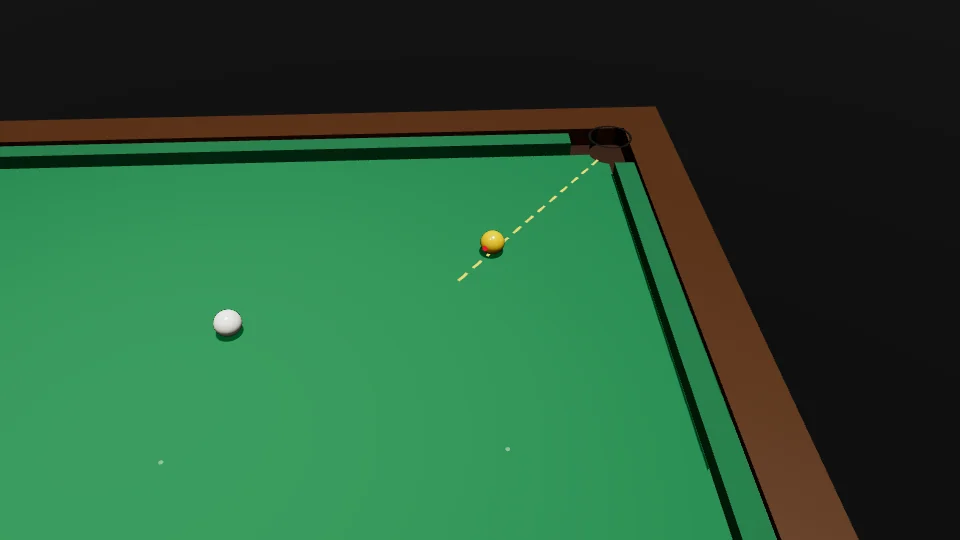
The red dot is easy to see, so it is tempting to send the white straight at it. But the white is a ball, not a point: it touches early, the hit is too full, the yellow does not turn enough, and it misses ✗.
Common pitfall: "I keep missing thick." Move the aim out to the ghost's centre: one ball-radius beyond the red dot.
Chapter 2 — Ball fractions and thin cuts
5 · Ball fractions and the angles they give
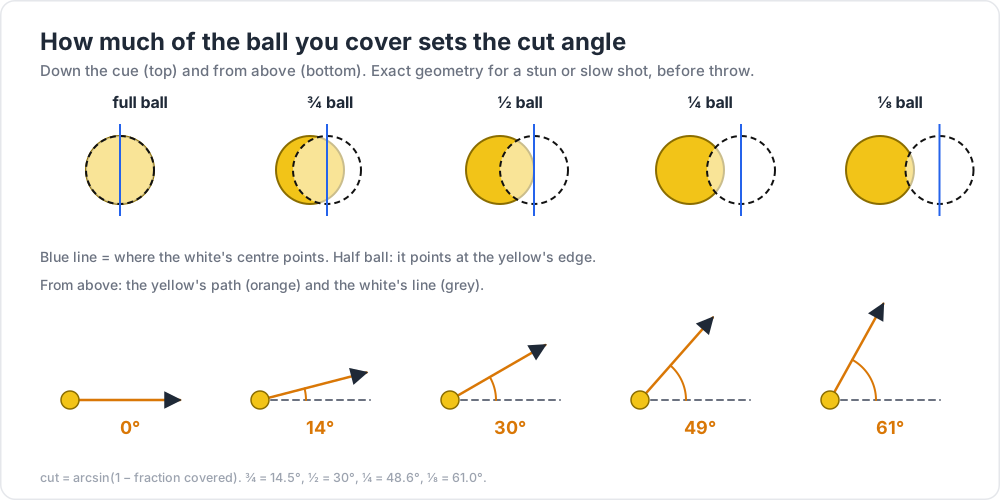
Down the cue, look at how much of the object ball the white covers. That fraction sets the angle the ball leaves at:
| Cover | Where the white's centre points | The ball leaves at |
|---|---|---|
| full | the ball's centre | 0° (straight on) |
| ¾ | halfway between centre and edge | about 14° |
| ½ | the ball's edge | 30° |
| ¼ | half a radius outside the edge | about 49° |
| ⅛ | three-quarters of a radius outside the edge | about 61° |
The half ball is the one to learn first: the white's centre points at the ball's edge, and the ball goes off at 30°. The others are "a bit fuller" or "a bit thinner" than that picture.
Trick: the angles are not evenly spaced. Moving the aim half a radius, from full to ¾, turns the ball 14°. Moving it only a quarter of a radius, from ¼ to ⅛, turns it another 12°. That is why thin cuts feel fussy.
6 · How thin is very thin?
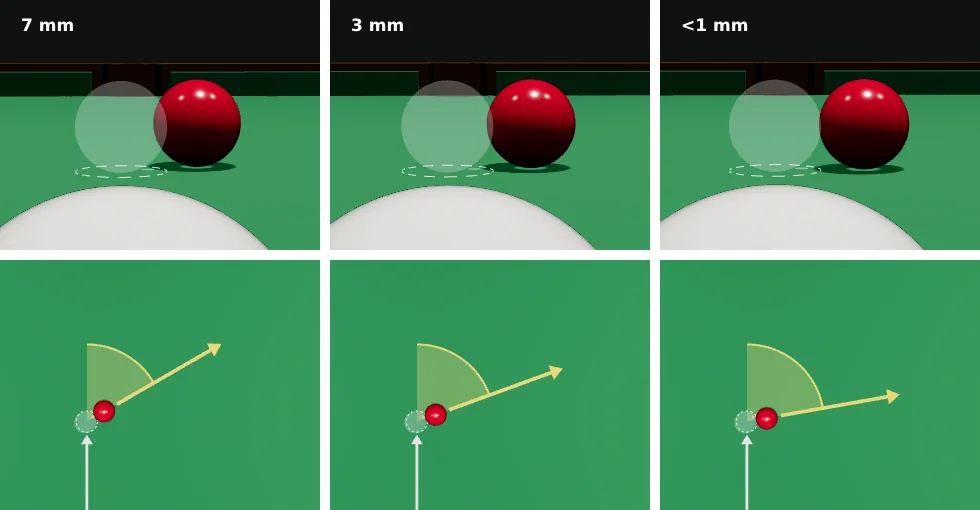
Past ⅛, the overlap is measured in millimetres:
| The ball turns… | The white overlaps it by… |
|---|---|
| 60° | about 7 mm (≈ ⅛ ball) |
| 70° | about 3 mm |
| 80° | less than 1 mm |
So an 80° cut is a "nearly miss". Leave yourself fuller pots when you can.
7 · Two ways to aim a thin cut
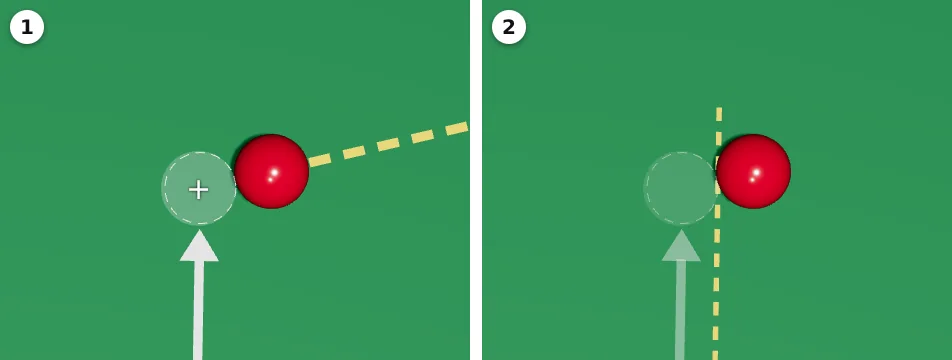
Use whichever your eye likes; many players check one with the other.
- Ghost ball. Put the ghost against the far side of the red and aim the white's centre at the ghost's centre. On thin cuts the ghost sits almost a whole ball out to the side.
- Edge to edge. Send the white's edge to pass just inside the red's edge. For a near right angle, "just inside" means less than 1 mm.
Trick: on very thin cuts, stand up and look from the side first. Decide how far out the ghost is, then get down and keep that picture.
8 · Watch it: almost sideways
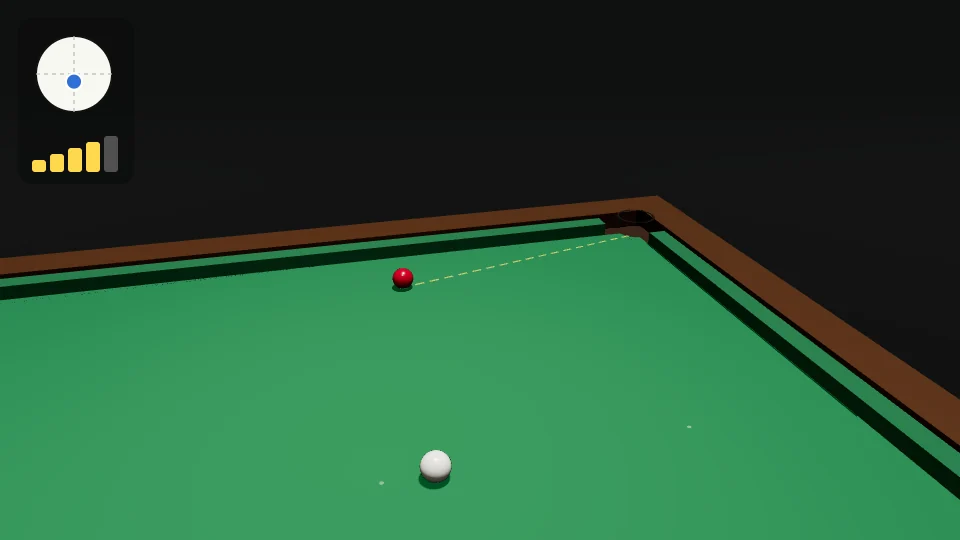
The white only grazes the red. The red goes off about 76° from the white's line and runs into the corner ✓. The white hardly notices and carries on.
Watch out: the red gets only a small part of the white's speed (here about a quarter). This pot needs power 4. At power 2 or 3 the red stops short.
Chapter 3 — What makes a pot hard
9 · Thin cuts spread your error
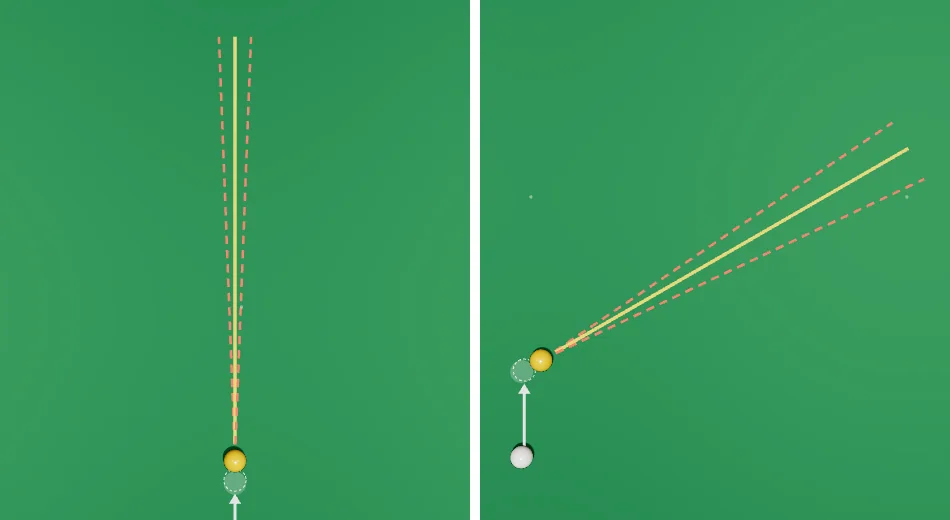
The same tiny mistake on both (the white 2 mm to one side). Straight pot: the ball's paths stay together. Thin cut: they fan out wide. The thinner the cut, the more an error grows.
10 · Distance shrinks the room
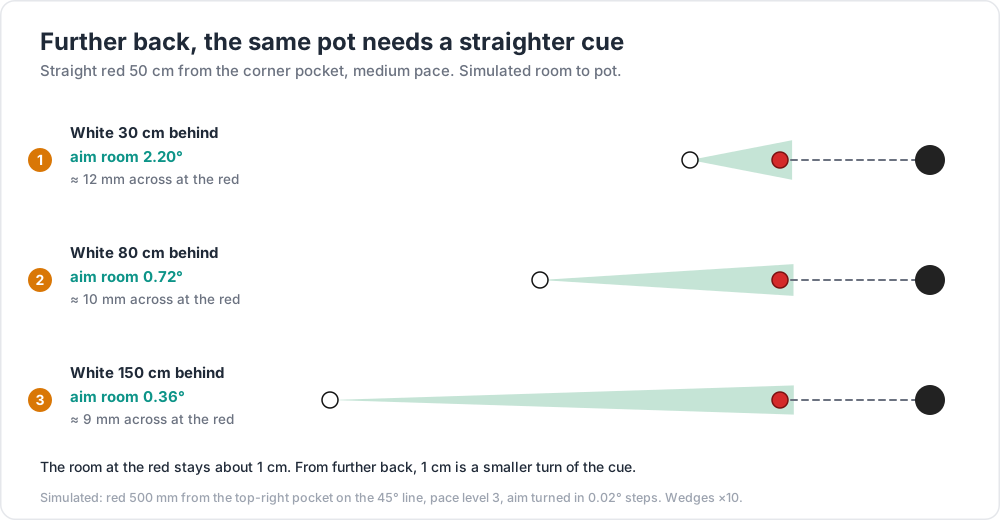
The same straight red, 50 cm from the corner. Move the white back and the room to pot shrinks (model, medium pace):
| White behind the red | Aim may turn by (total) | Room at the red |
|---|---|---|
| 30 cm | 2.2° | about 12 mm |
| 80 cm | 0.72° | about 10 mm |
| 150 cm | 0.36° | about 9 mm |
The room at the red stays about 1 cm. But from further back, 1 cm is a smaller turn of the cue. Twice as far back, about half the room.
11 · Watch it: a long pot
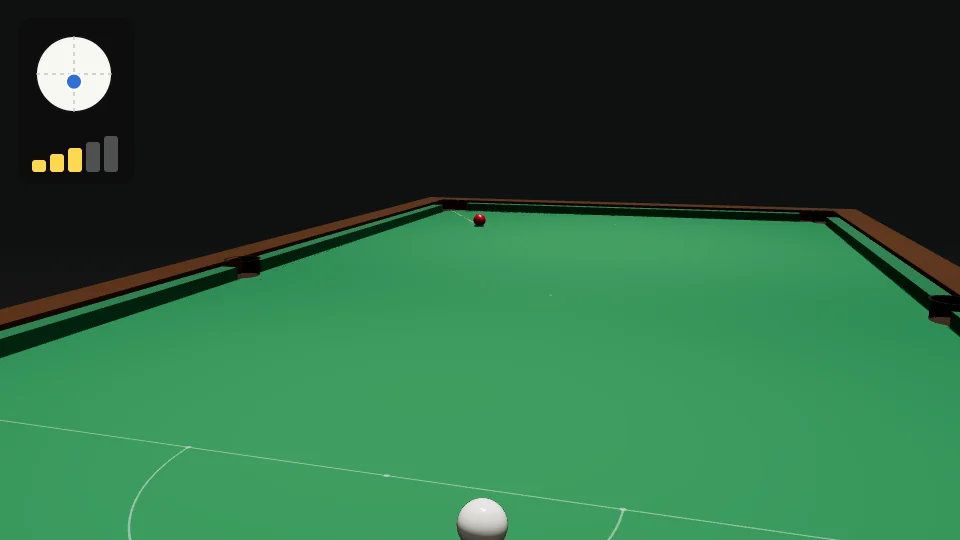
The white is 2.5 m from the red, and the red is 0.6 m from the pocket. The model gives only 0.12° of room: about 5 mm at the red. That is why the long pot is the big test of a straight cue.
What coaches usually advise for long pots (coaching advice, not a rule):
- Centre ball or a touch below, no side. Side bends the white's path (post 05).
- Medium pace. Firm enough to reach the pocket at a good speed, not a slam.
- Hold still until the red is in. Moving early moves the cue.
Trick: practise long pots with the white and red in the same places each time. The same picture, ten times, trains the eye faster than ten different pots.
Chapter 4 — How much room the pocket gives
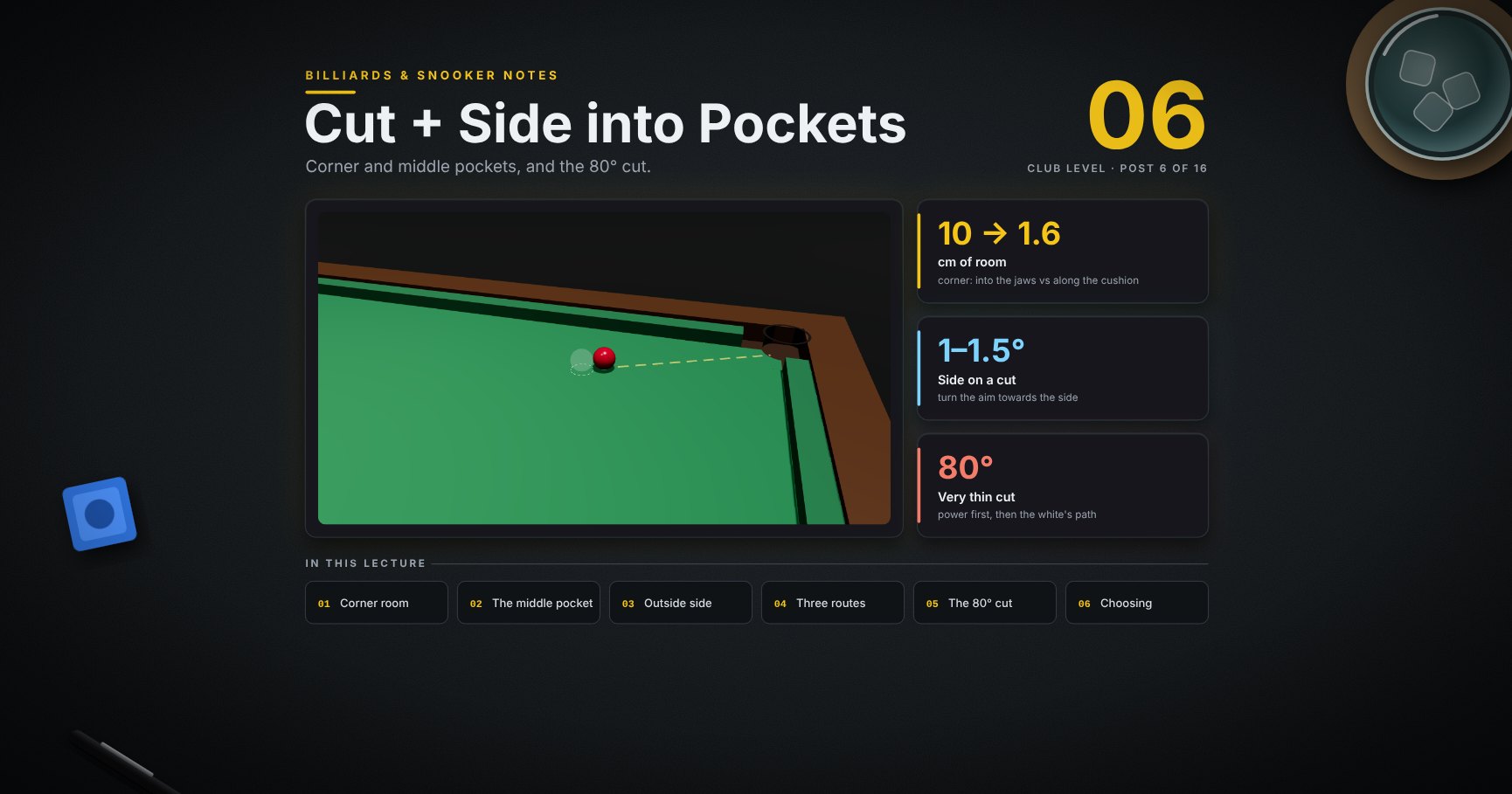
12 · The corner pocket: into the jaws vs along the cushion
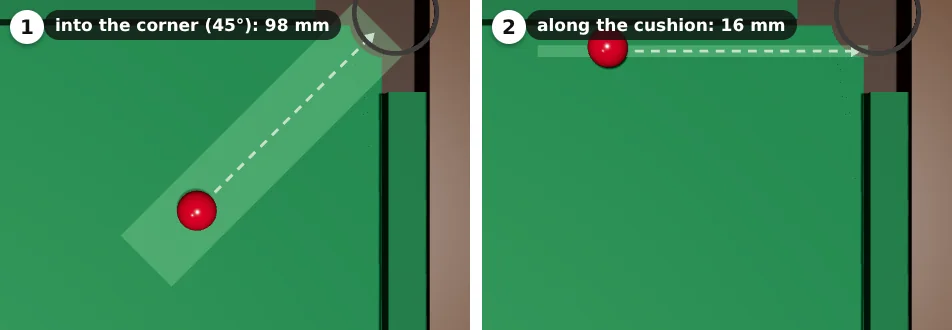
| The ball rolls in… | Room for the ball's centre (model) |
|---|---|
| straight into the jaws (45°) | about 10 cm |
| along the cushion | about 1.6 cm: the ball must stay within about 1.6 cm of the cushion |
A ball sent into the jaws has lots of room. A ball along the cushion has to stay tight to it; drift 2 cm off it and the ball misses. Post 07 covers balls on the cushion.
13 · The middle pocket closes as the angle gets flatter
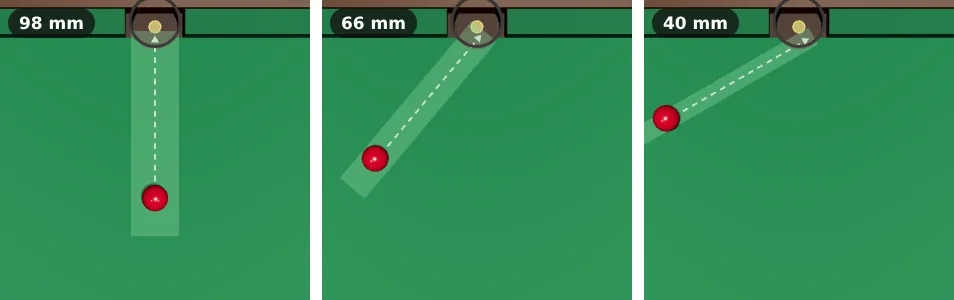
The middle pocket is cut into a straight cushion, so a ball coming in at a slant meets the far knuckle:
| Coming in… | Room for the ball's centre (model) |
|---|---|
| straight | about 10 cm |
| 40° off straight | about 6–7 cm |
| 60° off straight | about 4 cm |
Trick: on a slant, aim the ball at the middle of the hole itself (the yellow dot, behind the cushion line), not at the middle of the gap between the knuckles. That keeps it away from the far knuckle.
Chapter 5 — A small correction
14 · Slow cuts get dragged a little (throw)
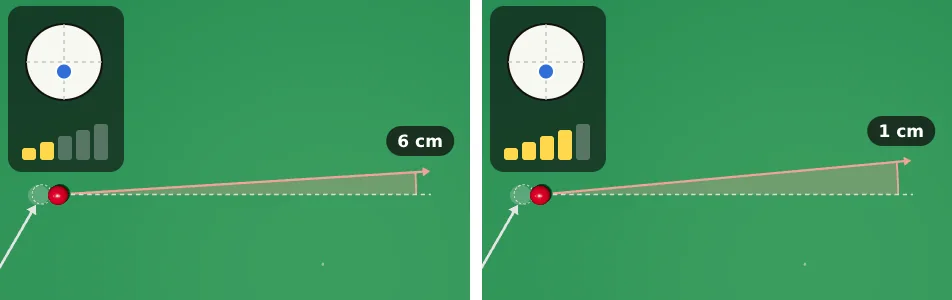
At contact the white rubs on the red and drags it a little the way the white is moving. This is throw. The red goes a touch fuller (less cut) than the ghost-ball line, more on slow shots.
If your slow cuts keep missing on the thick side:
| Fix | How |
|---|---|
| Overcut a hair | aim a fraction thinner than the ghost ball |
| Add pace | a firmer hit drags less (power 4: about 1.5 cm off at 1 m instead of 6 cm) |
| Side | a touch of side the right way cancels it (post 05) |
Try it at the table
| Drill | Set-up | Look for |
|---|---|---|
| Straight pots | white, red and pocket in a line, 30 cm then 80 cm apart | the white stops dead (stun, full ball) |
| Fraction ladder | the same red; play it full, ¾, ½, ¼ by moving the white | say the fraction before each shot; the ball goes where you said |
| Ghost check | put a coin where the ghost ball sits, look from behind the white, take the coin away, play | your eye learns where the ghost is |
| Thin cuts | a red 30 cm from a corner, near the cushion; the white from the middle | pot it at power 4 |
| Long pots | the white in baulk, a red near a top corner | ten in a row from the same spot |
| Middle slant | the blue on its spot, the white at three angles | aim at the hole's centre; how many drop? |
Cheat-sheet
| Plan | pocket → line → red dot → ghost → aim |
| Aim | white's centre to the ghost's centre, never at the red dot |
| Fractions | full 0° · ¾ 14° · ½ 30° · ¼ 49° · ⅛ 61° |
| Very thin | 60° ≈ 7 mm overlap · 70° ≈ 3 mm · 80° < 1 mm |
| Thin cuts | errors fan out; play firmer, the ball gets little speed |
| Distance | twice as far back ≈ half the room |
| Pockets | corner: into the jaws ≈ 10 cm, along the cushion ≈ 1.6 cm · middle: straight ≈ 10 cm, 60° ≈ 4 cm |
| Throw | slow cuts go a touch fat; overcut a hair or add pace |
What's next
03 · Tip and power. Where the tip meets the white, the five power levels, and stop, follow, screw, stun run-through and the drag shot.
References
- WPBSA, Official Rules of the Games of Snooker and English Billiards (2022): ball 52.5 mm, table 3569 × 1778 mm. https://wpbsa.com/rules/
- Dr. Dave Alciatore, "Aiming at the ghost ball, not the contact point", Billiards Digest, Oct 2008. https://billiards.colostate.edu/bd_articles/2008/oct08.pdf
- Dr. Dave Alciatore, technical proofs and FAQ: the 90° rule for stun shots, cut-induced throw and the ball-ball friction fit used here. https://billiards.colostate.edu/
- Ball fractions and overlaps are exact geometry: cut angle = arcsin(1 − fraction covered). The room to pot, the long pot, the pocket bands and the throw numbers come from the physics model of the balls and cushions at snooker sizes; real tables differ with cloth, cushions and pocket cut.
- Long-pot advice (centre ball, medium pace, hold still) is common coaching advice.
Note: this post is in progress. Planned additions: the same pots seen down the cue for each fraction, and contact-induced throw with side in more detail.