Billiards & Snooker — 06 · Cut and Side into Pockets
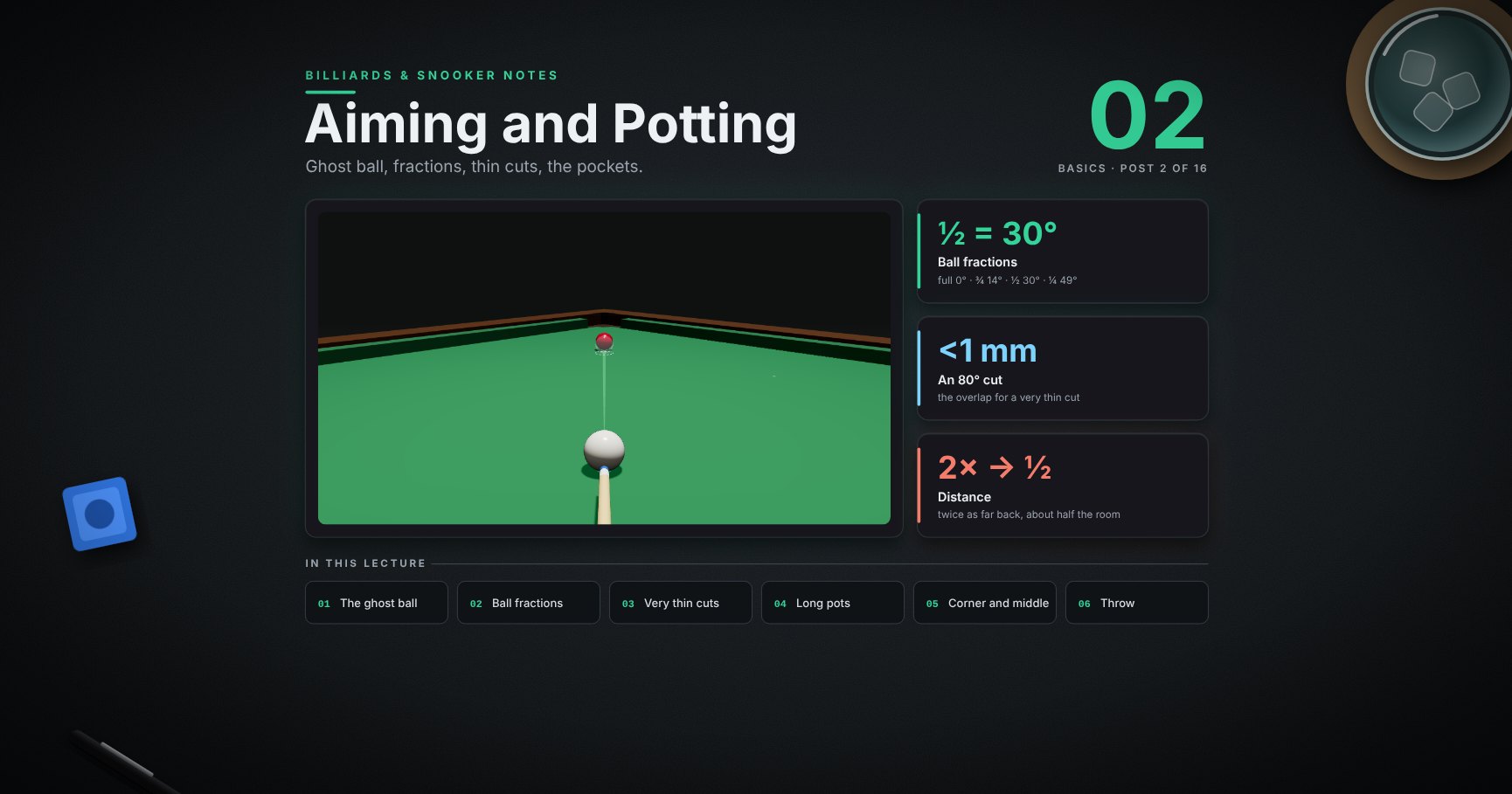
This is where aiming (post 02), the white's path (post 04) and side (post 05) meet. How much room the corner pocket gives from each angle, cutting into the middle, how much to turn the aim for side, inside and outside side, three routes off one black, and then the very thin cuts: an 80° cut along the cushion with three ways to play it, and a thin cut into the middle pocket.
Series map. ★ Basics: 01 Cue action and elevation → 02 Aiming and potting → 03 Tip and power → 04 Where the white goes · ★★ Club: 05 Side spin → 06 Cut and side into pockets (this post) → 07 Cushions → 08 Doubles · ★★★ Advanced: 09 Escaping snookers → 10 Multi-ball shots → 11 Safety → 12 Position play · ★★★★ Hard: 13 Break-building → 14 Special shots · Reference: 15 Rules, tactics and practice · ★★★★★ Pro: 16 Cue-ball control.
Learning Outcome
- Know how the corner pocket's room shrinks as the ball comes in flatter.
- Cut into the middle pocket by aiming at the hole itself.
- Turn the aim the right amount when you use side on a cut.
- Use inside and outside side, and know which one cancels throw.
- Choose between check side, no side and running side for position.
- Play an 80° thin cut: enough power, the right aim, and the side that keeps the white safe.
- Play a thin cut into the middle pocket.
Chapter 1 — Pockets from an angle
1 · The corner pocket: room by angle
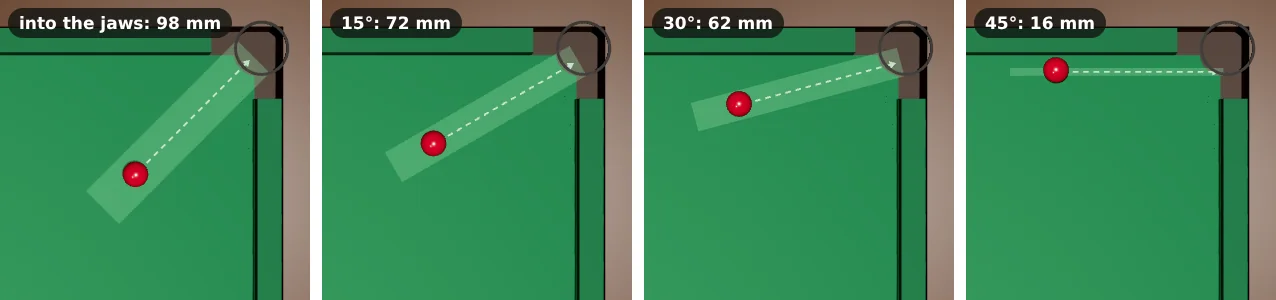
The angle is measured from the pocket's centre line (the 45° line into the jaws). Room for the ball's centre (model):
| Coming in… | Room |
|---|---|
| straight into the jaws | 98 mm |
| 15° off | 72 mm |
| 30° off | 62 mm |
| along the cushion (45° off) | 16 mm |
The corner is forgiving until the ball comes in nearly along the cushion. Then it must hug the cushion. The middle pocket closes faster (post 02).
2 · Cutting into the middle: aim at the hole
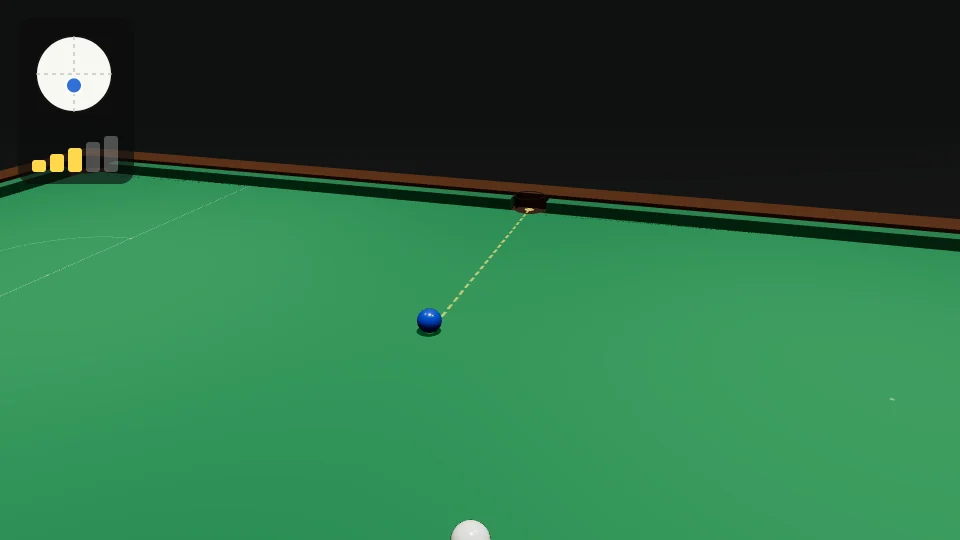
- Find the hole's centre (yellow dot), behind the cushion line.
- Line from it through the blue; the ghost ball sits on that line.
- White's centre to the ghost's centre, power 3, a little below centre.
Aiming at the hole, not at the gap between the knuckles, keeps the ball off the far knuckle.
Chapter 2 — Side on a cut
3 · Turn the aim towards the side
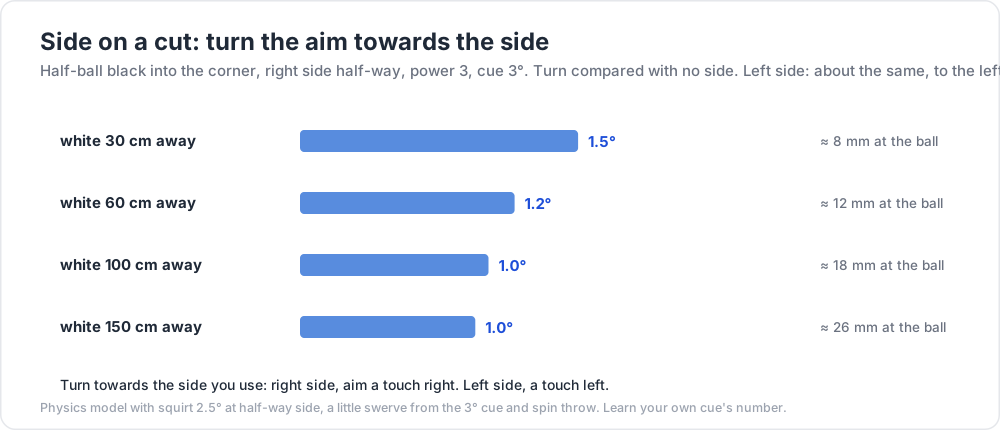
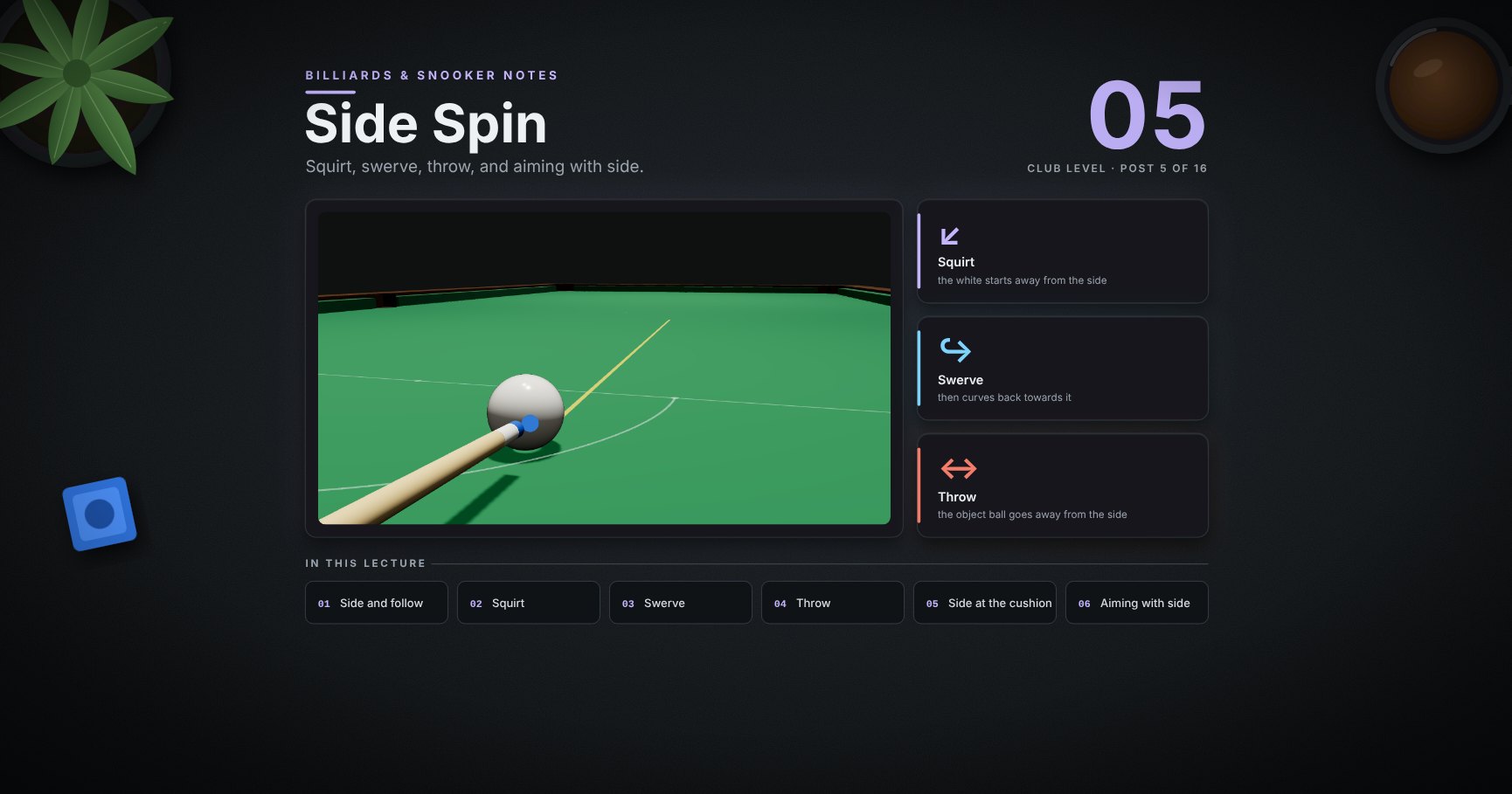
Side makes the white squirt away from it (post 05), so turn the aim a touch towards the side. A half-ball black, half-way side, power 3 (model):
| White from the black | Turn the aim | At the ball that is about |
|---|---|---|
| 30 cm | 1.5° | 8 mm |
| 60 cm | 1.2° | 12 mm |
| 1 m | 1.0° | 18 mm |
| 1.5 m | 1.0° | 26 mm |
The turn in degrees is a little bigger on short shots (swerve has not had time to pull back). In millimetres at the ball, the long shot needs more.
Watch out: these are the model cue's numbers. Learn your own with the drills; the pattern is what matters.
4 · Inside and outside side
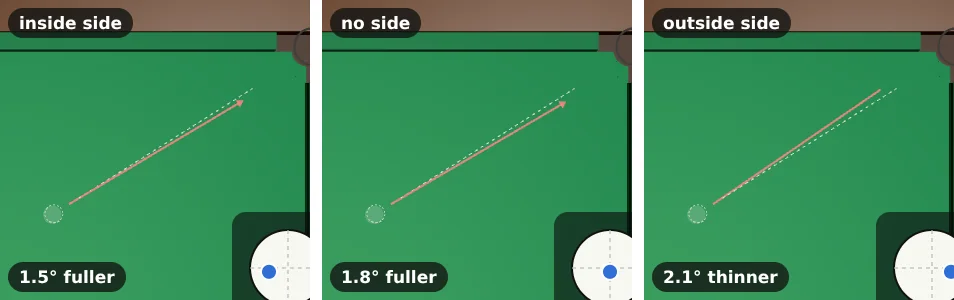
On a cut, the side away from the direction of the cut is outside side; the other is inside side. On a slow half-ball cut, aimed at the ghost ball (model, squirt switched off so the contact is the same):
| Tip | The red goes… |
|---|---|
| no side | 1.8° fuller (cut throw) |
| inside side, half-way | 1.5° fuller |
| outside side, half-way | 2.1° thinner |
| a little outside side (0.17 R) | on the ghost-ball line: throw cancelled |
So a little outside side cancels throw on slow cuts; more outside side over-cuts. Inside side keeps the throw.
Trick: a slow cut that keeps going in fat? A touch of outside side, and remember to turn the aim for squirt (section 3).
5 · One black, three routes
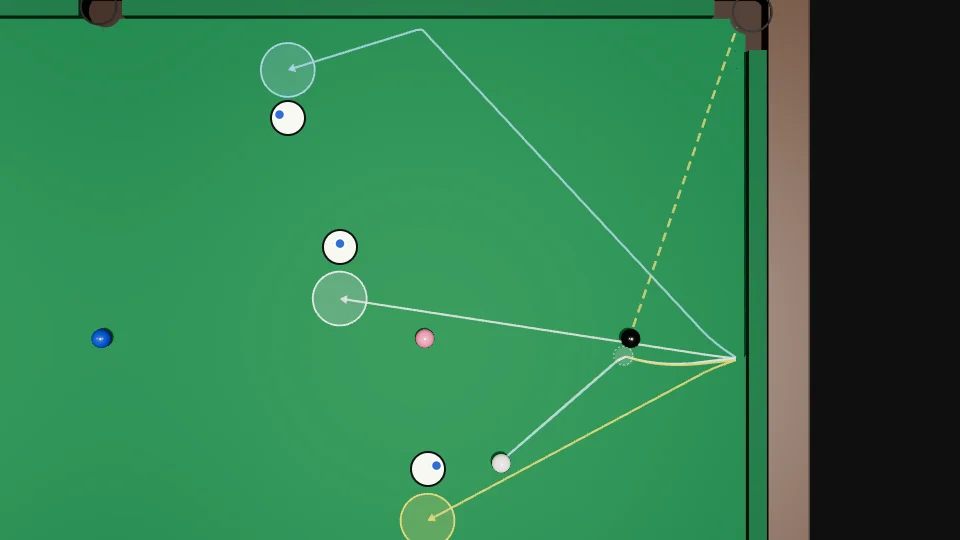
The same black, the same pocket, three tip spots. The white comes off the top cushion at three different angles:
| Tip | Name | The white comes off… | Good for a red… |
|---|---|---|---|
| ◀ left of centre | check side | narrower, back up towards the far side cushion | near that side cushion |
| centre (a touch of top) | plain | straight back to the middle | near the pink |
| right of centre ▶ | running side | wider, down the table | towards the near side |
Each side shot needed its own small aim turn (section 3).
6 · Watch it: running side off the black
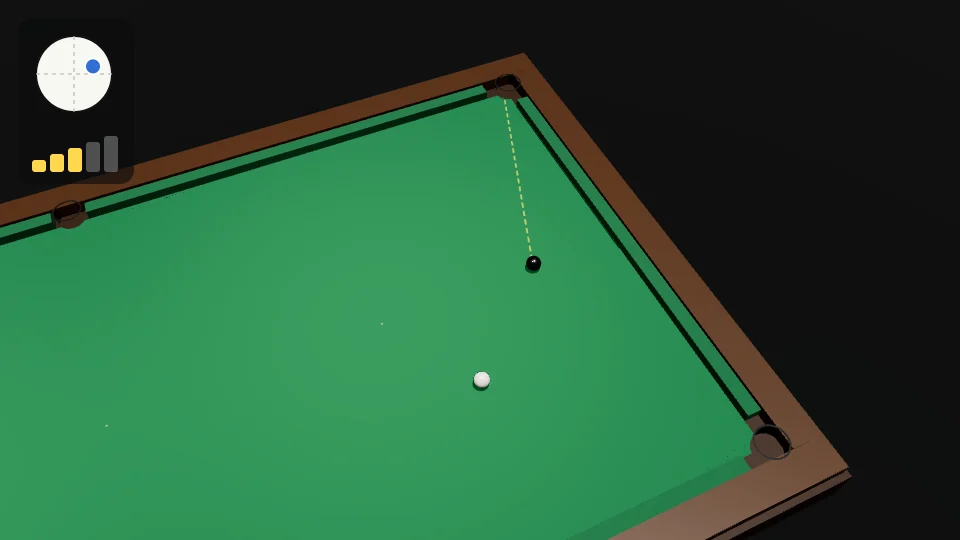
Right-hand running side, power 3: the black goes in ✓, and the white comes off the top cushion wide and down the table.
Chapter 3 — Very thin cuts
7 · An 80° cut needs power
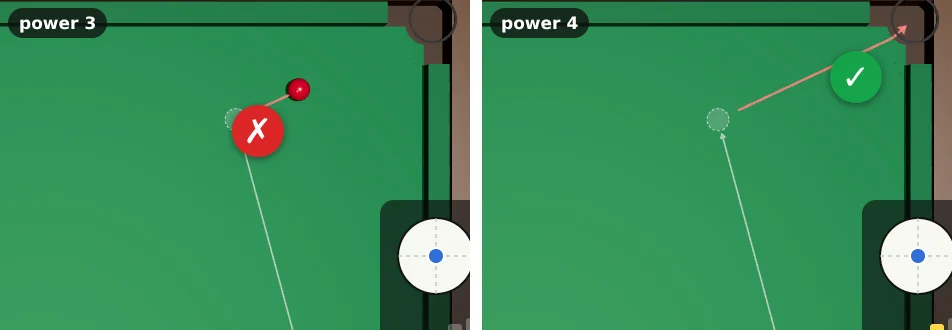
A red near the top cushion, cut along it into the corner. The white comes in at 80°: an overlap of under 1 mm (post 02). The red gets only about a sixth of the white's speed.
| Power | Result (model) |
|---|---|
| 3 | the red stops short ✗ |
| 4 | the red reaches the pocket ✓ |
Thin cuts are a power decision first. Pick the pace that gets the red to the pocket, then think about the white.
8 · The same 80° cut, three ways
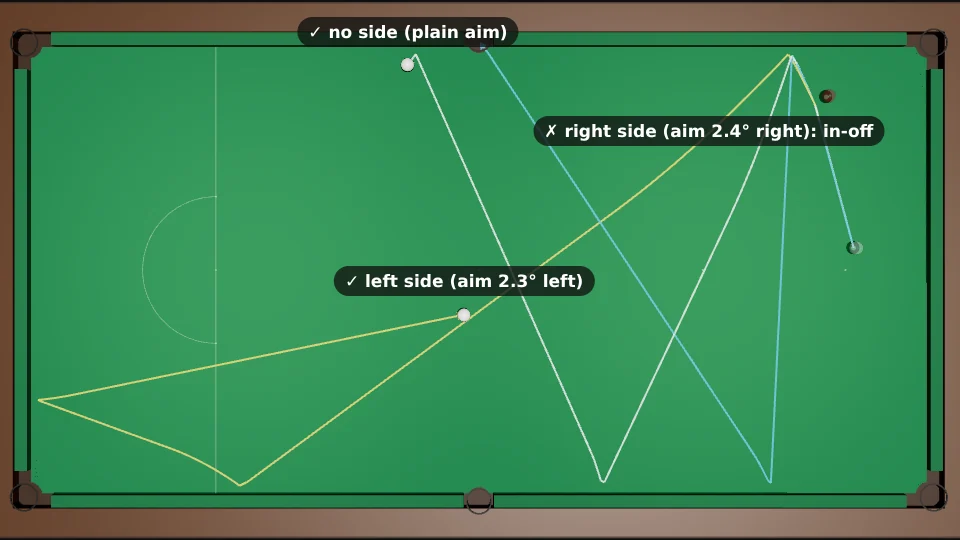
The white keeps almost all its speed and travels a long way. Side changes where, and each side needs its own aim (model, power 4):
| Tip | Aim turned | The white… |
|---|---|---|
| no side | plain aim | runs up and down, ends near the top cushion ✓ |
| left side (running side here) | 2.3° left | comes off wider, ends in the middle of the table ✓ |
| right side (check side here) | 2.4° right | comes off narrower and goes into the top middle pocket ✗ in-off |
Two good solutions, one trap. With a red near the middle of the table, the left side route is best; with a red near the top cushion, no side is simpler and more accurate.
Common pitfall: using side on a thin cut "for position" without checking the white's whole path. Here the check-side route finds a pocket.
9 · Watch it: the 80° cut with running side
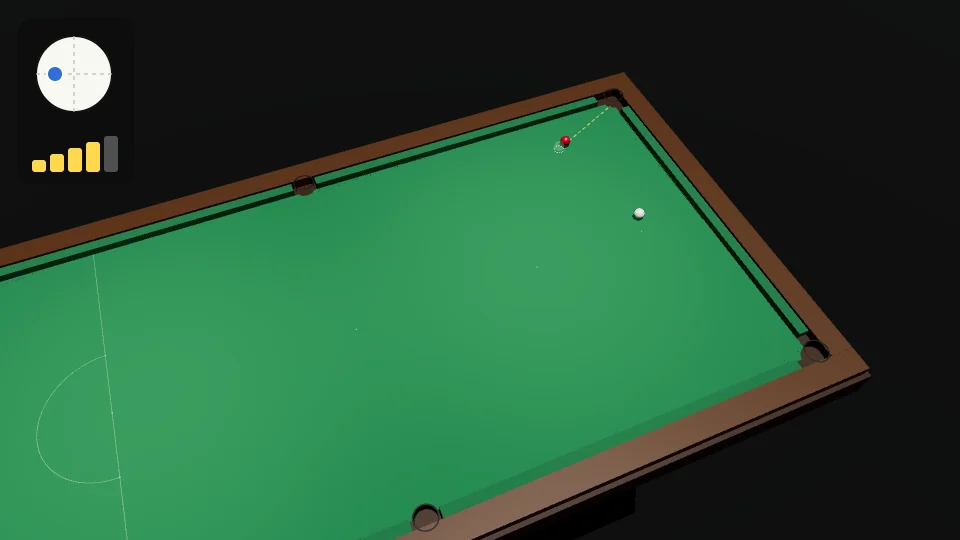
Left side, aim turned 2.3° left, power 4. The red creeps along the cushion and drops ✓; the white travels round the table to the middle.
10 · A thin cut into the middle pocket
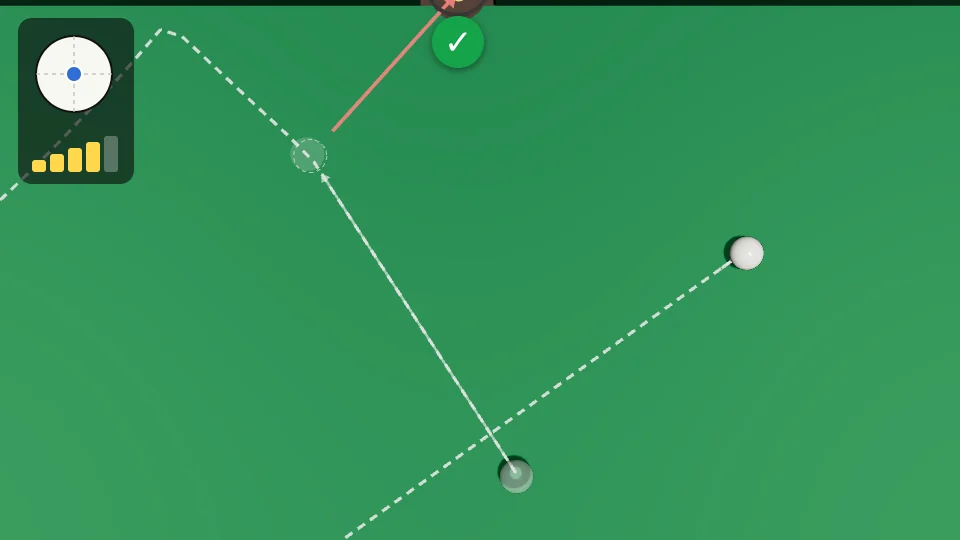
The red is 20 cm left of the middle pocket and 20 cm out. It goes in at 42° to straight, where the middle pocket has about 6 cm of room (post 02). The white cuts it at 75°, power 4 ✓.
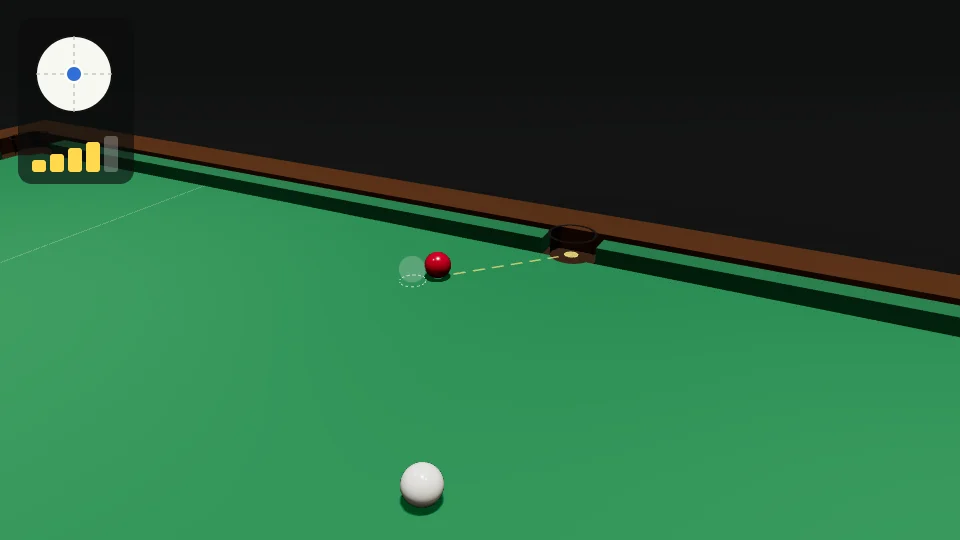
Trick: on a thin cut into the middle, aim the red at the back of the hole (yellow dot), like section 2. The slant already uses up half the room.
11 · Choosing a route
When more than one route works, choose the one that:
- Keeps the white away from pockets and other balls on the way (section 8's trap).
- Lands in the biggest area that leaves a pot on the next ball (post 12).
- Needs the least side. No side is the most accurate pot.
So if the plain route is good enough, play it. Use side when it opens a clearly better landing spot.
Try it at the table
| Drill | Set-up | Look for |
|---|---|---|
| Corner angles | a red 30 cm from a corner, sent in on the 45° line, then flatter, then along the cushion | how tight it gets |
| Middle-pocket angles | the blue on its spot; the white straight, then at an angle, then flatter | aim at the hole's centre |
| Side correction | the same black with side, 30 cm then 1 m away | how much you turn the aim at each distance |
| Outside side | a slow half-ball cut; no side, then a touch of outside side | the touch of outside side stops it going in fat |
| Three routes | the black on its spot, the white as in picture 5 | land check, plain and running each in a different third |
| 80° cut | a red 20 cm off the top cushion, 40 cm from the corner; the white from the side | power 4; then add side and watch the white |
Cheat-sheet
| Corner room | into the jaws ≈ 10 cm · 15° ≈ 7 cm · 30° ≈ 6 cm · along the cushion ≈ 1.6 cm |
| Middle | aim at the hole's centre, not the gap |
| Side on a cut | turn the aim towards the side: about 1–1.5° (model cue) |
| Outside side | a little cancels throw; more over-cuts |
| Inside side | keeps the throw |
| Running side | the white comes off wider, keeps its run · check side: narrower |
| Very thin cut | power first (the red gets little speed), then the white's path |
| Choose | safe path → biggest landing area → least side |
What's next
07 · Cushions. The angle in and the angle out, how pace and spin change it, pots off the cushion, and the white tight on the cushion.
References
- WPBSA, Official Rules (2022) and table specification: pocket positions. https://wpbsa.com/rules/
- Dr. Dave Alciatore, "effective target size" of pockets at different angles; inside and outside English, gearing English and throw. https://billiards.colostate.edu/
- The pocket room, aim turns, throw angles and routes come from the physics model (squirt 2.5° at half-way side, ball-ball friction fit after Alciatore, model pockets). Real pockets, cues and cloth differ; the patterns hold.
Note: this post is in progress. Planned additions: an 80° cut into the middle pocket, and the same thin cuts with screw.