Billiards & Snooker — 14 · Special Shots
Some spots need an unusual shot. This lesson covers cue elevation and how much it curves the white, swerve and massé, cueing over a ball, the two fouls to know (the jump shot and the push stroke), a touching ball, a ball in the jaws, and how to choose when a spot has several answers.
Series map. ★ Basics: 01 Cue action and elevation → 02 Aiming and potting → 03 Tip and power → 04 Where the white goes · ★★ Club: 05 Side spin → 06 Cut and side into pockets → 07 Cushions → 08 Doubles · ★★★ Advanced: 09 Escaping snookers → 10 Multi-ball shots → 11 Safety → 12 Position play · ★★★★ Hard: 13 Break-building → 14 Special shots (this post) · Reference: 15 Rules, tactics and practice · ★★★★★ Pro: 16 Cue-ball control.
Learning Outcome
- Know what "the cue raised" means, and how much each angle curves the white.
- Play a swerve and know what a massé is.
- Cue over a ball at the right angle.
- Avoid the jump shot and the push stroke.
- Play from a touching ball and pot a ball in the jaws.
- List every answer to an awkward spot before you choose.
Chapter 1 — A raised cue
1 · How high is the cue?
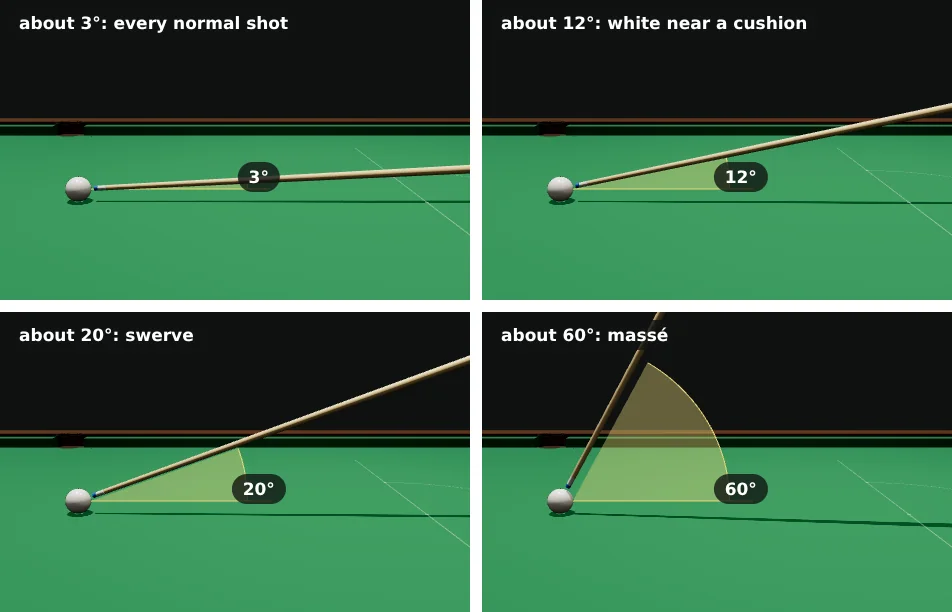
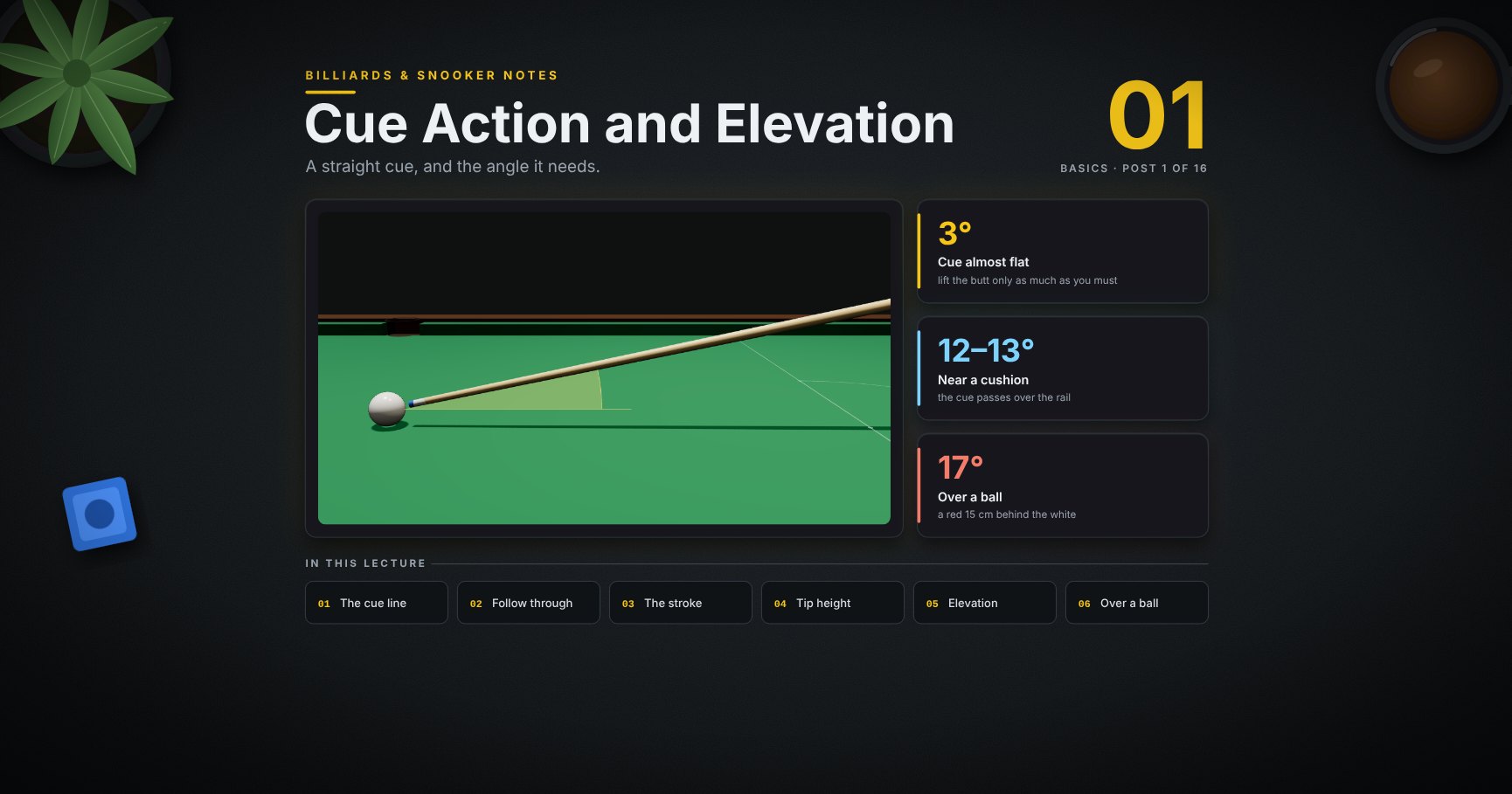
"Raising the cue" means lifting the butt (the back end), so the cue comes down at the white. The yellow wedge is the angle to the cloth.
| About | Used for |
|---|---|
| 3° | every normal shot (as low as the rail lets you) |
| 12° | the white near a cushion (post 07) |
| 20° | swerve |
| 60° | massé |
2 · More elevation, more curve
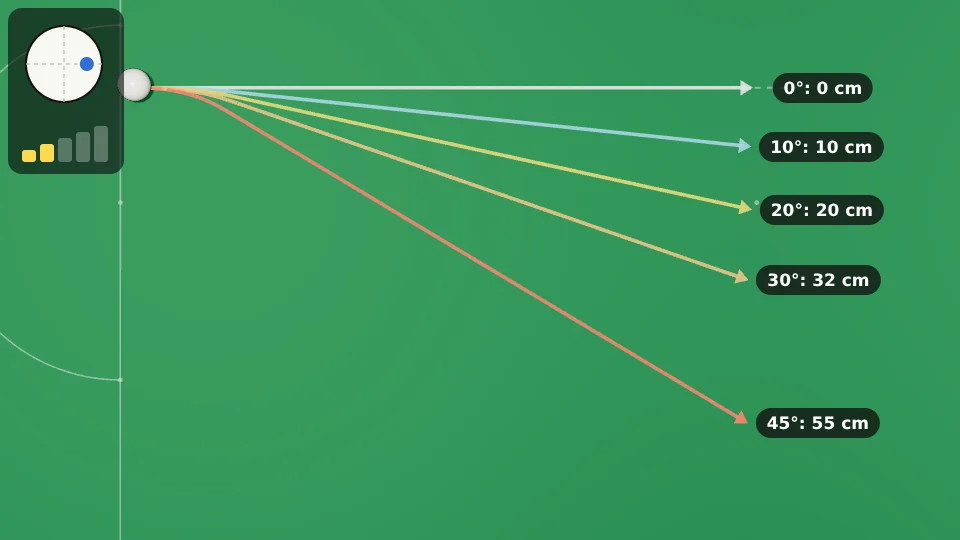
The same aim and side (right-hand, 0.6 R), power 2, only the cue raised more each time (model, squirt switched off to show the curve alone):
| Cue raised | Off the aiming line after 1 m |
|---|---|
| level | 0 |
| 10° | 10 cm |
| 20° | 20 cm |
| 30° | 32 cm |
| 45° | 55 cm |
The white curves towards the side you use, and most of the bend happens early, while it is still sliding. More pace means it slides further before it bends (post 05).
Watch out: a raised cue makes a clean hit harder and the tip more likely to slip. Raise it only as much as the shot needs.
3 · Swerve round a ball
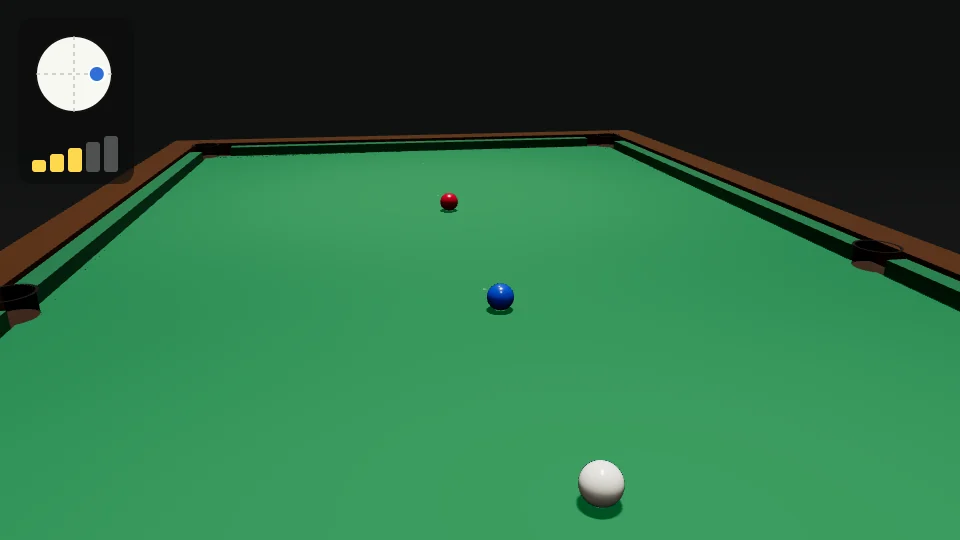
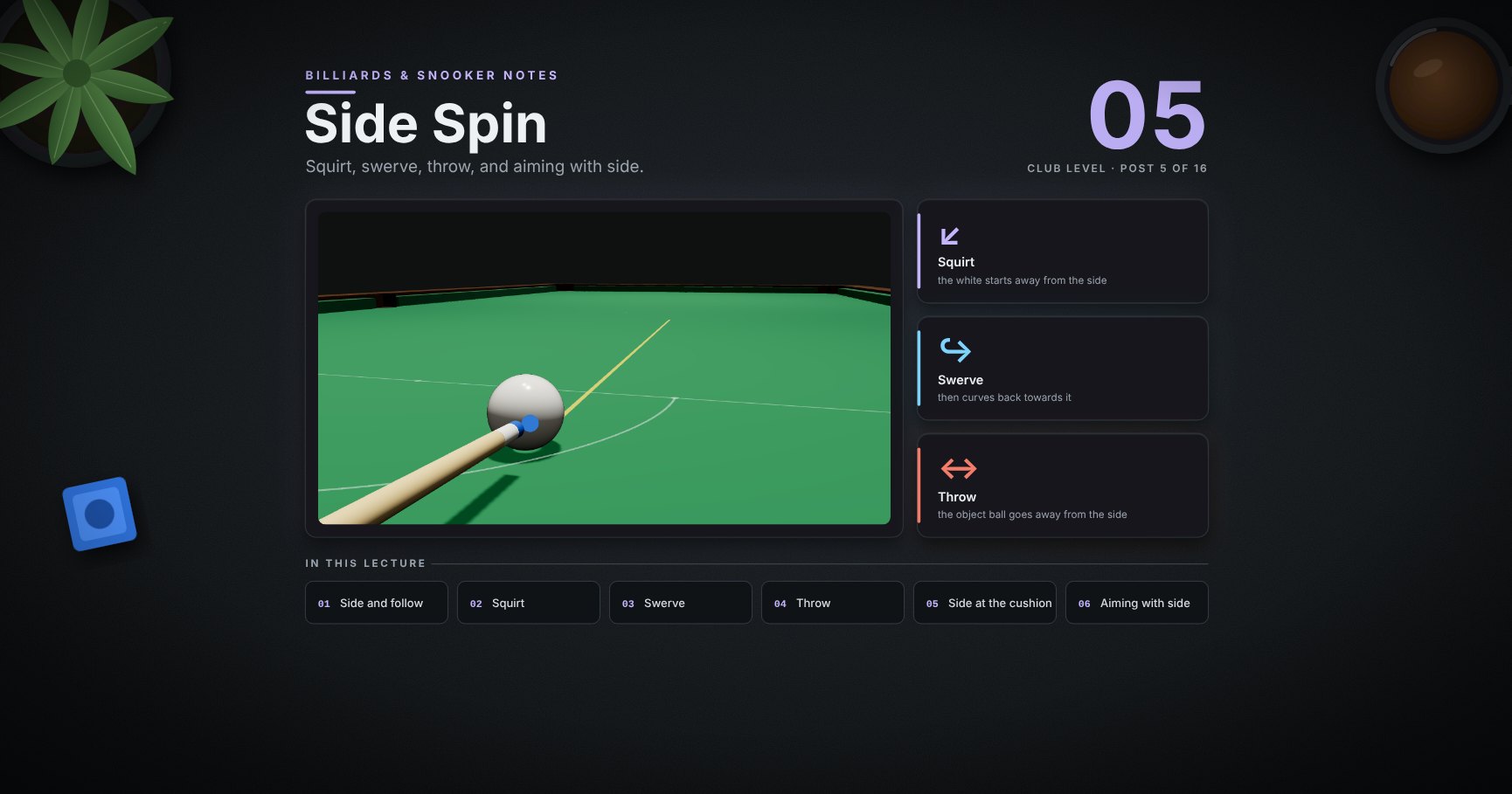
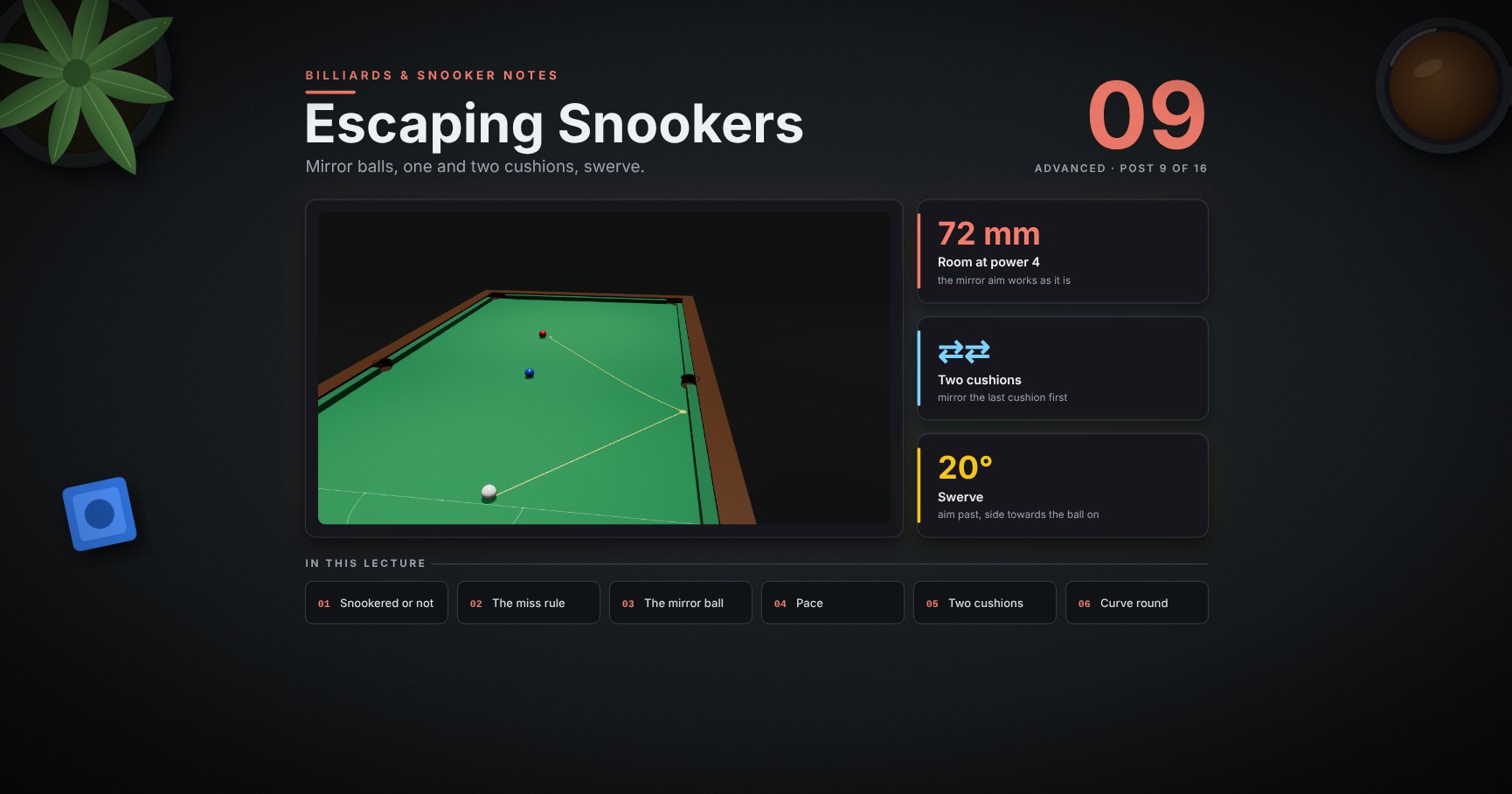
Post 09 showed the swerve escape: aim past the blocking ball, side towards the ball you want, butt raised about 20°, power 3. Only about 1° of aims made it round (model), so use it when the cushions are shut.
4 · Massé: a big curve from close range
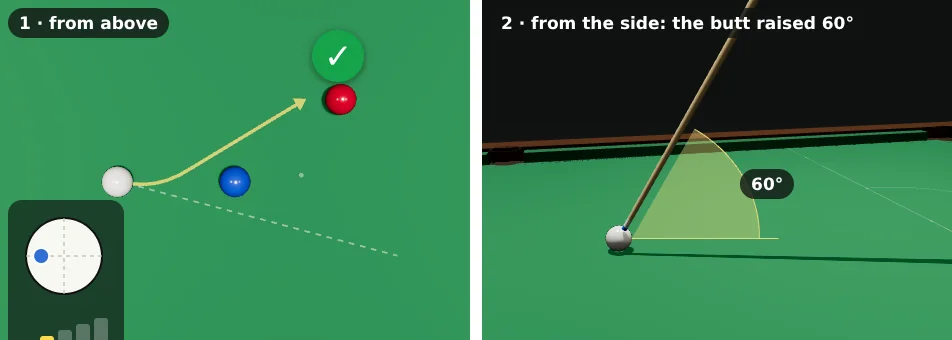
When the blocking ball is too close for a swerve, a massé curves the white much more. Here the blue is only 20 cm in front (model):
| Cue | The same aim (13–17° to the right of the blue's centre) |
|---|---|
| level | hits the blue ✗ |
| raised 60°, left-hand side, power 2 | curves round the blue into the red ✓ |
About 5° of aim worked. Massé is hard to control and hard on the cloth; many clubs do not like it. Learn it on a practice table, and prefer any cushion route that is open.
Watch out: at 60° the tip must hit the white down and to the side, not into the cloth. A miscue can mark the cloth.
5 · Cueing over a ball
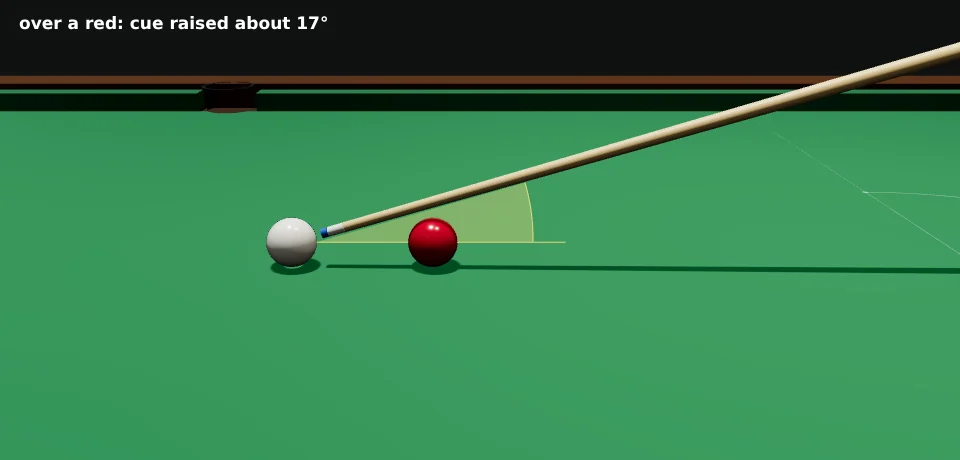
When a ball sits just behind the white, the cue has to go over it. With a red 15 cm behind, the cue rises about 17°, so the tip meets the white from above: expect a little swerve if you use side, and less screw. Out of reach, the spider or swan holds the cue over the balls at a similar angle (post 01).
Chapter 2 — Two fouls to know
6 · The jump shot is a foul
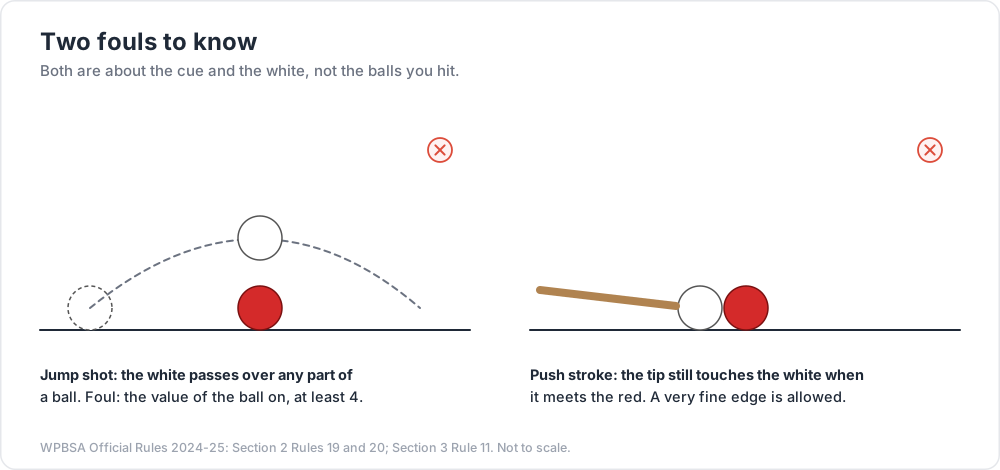
A jump shot is the white passing over any part of a ball (WPBSA, simplified; it is allowed only when the white first hits another ball and then jumps). The penalty is the value of the ball on, at least 4.
Unlike pool, snooker has no legal jump shot over a ball in the way. The answers are a cushion, a swerve or a massé.
7 · The push stroke and the fine edge
A push stroke is the tip still touching the white after it starts moving, or when the white meets the ball (picture above, right). The penalty is the value of the ball on or the ball hit, at least 4.
When the white is almost touching a ball, a normal stroke is a push. The rule allows one way out: a very fine edge, so thin that the tip has gone before the contact. Otherwise, play a different ball, or away.
8 · A touching ball
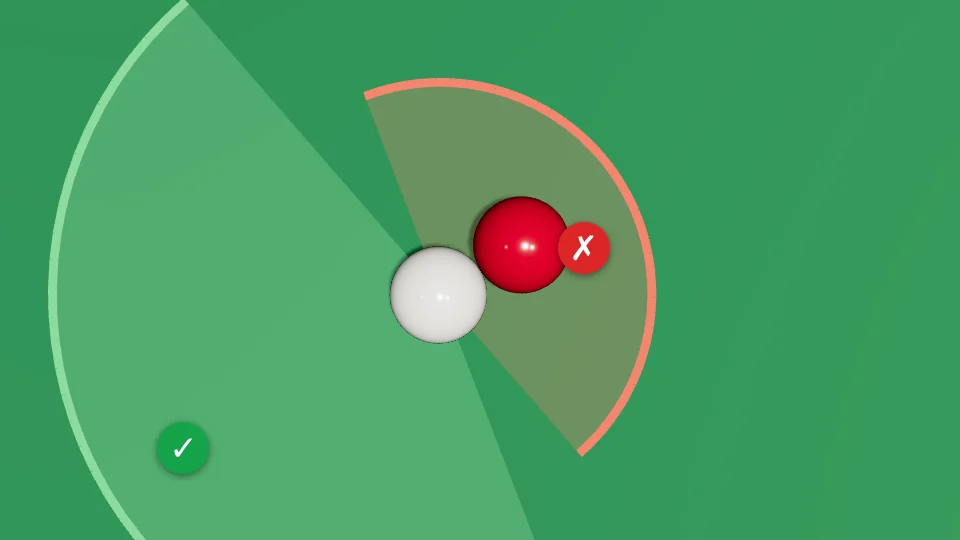
If the white stops touching a ball on (or one that could be on), the referee calls "touching ball":
- play the white away from it (green) without moving it; moving it is a push stroke;
- if that ball is on, you do not need to hit any ball at all;
- if it could be on (a colour after a red), declare it, then the same applies.
So a touching ball is often a gift: play away to a safe place with nothing to hit.
9 · A ball in the jaws
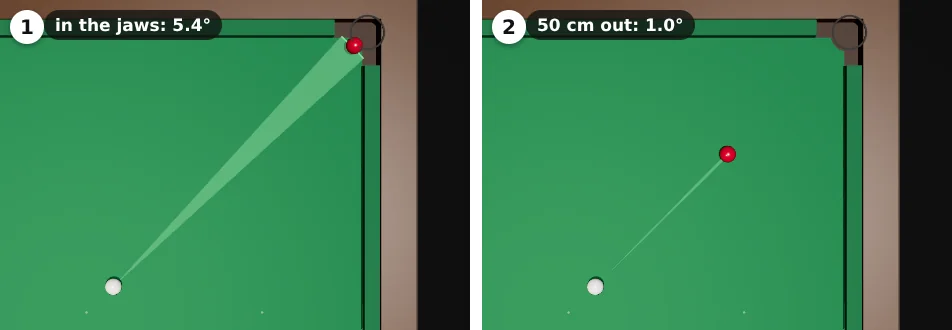
| Red | Room in the aim (model) |
|---|---|
| in the jaws (power 1) | 5.4°: almost any contact pots it |
| 50 cm out (power 2) | 1.0° |
Common pitfall: the white follows it in. At power 1 no aim went in-off; at power 2 the fullest hits did. Play it soft, or a little thin, so the white goes away from the pocket.
Chapter 3 — Choosing
10 · Many answers: how to choose
| Spot | Answers | Choose by… |
|---|---|---|
| a ball blocks the red | one cushion, two or three cushions (09), swerve, massé | the most room; curve only when cushions are shut |
| a ball right behind the white | cue over it (or the spider) | the lowest cue that clears it |
| white almost touching a ball | a very fine edge, or play another ball | no push stroke |
| touching a ball on | play away to safety, or pot another red | what is safest for you afterwards |
| red in the jaws | pot it soft or thin; use it for a plant (10) | the white's path after |
| red near a cushion | cut it, double it (08), or play safe (11) | the double kiss risk (08) |
Trick: say the options out loud before you get down. Players who see only one answer often miss a better one.
Try it at the table
| Drill | Set-up | Look for |
|---|---|---|
| Elevation ladder | the white, a coin 1 m away; right side, cue level then 10°, 20°, 30° | how far right of the coin it ends |
| Swerve | a colour 60 cm in front, a red 80 cm beyond | curve round, then hit the red |
| Massé (practice table) | a colour 20 cm in front, a red behind and to the side | a soft, controlled curve |
| Over a ball | a red 15 cm behind the white | a clean centre-ball hit with the cue raised |
| Fine edge | the white 2 mm from a red | a thin hit with no push |
| Jaws | a red over the corner pocket, the white 1 m away | ten pots without an in-off |
Cheat-sheet
| Raised cue | the butt lifted: 3° normal, 12° cushion, 20° swerve, 60° massé |
| Curve | grows with elevation: 10 / 20 / 32 / 55 cm after 1 m at 10 / 20 / 30 / 45° (model) |
| Swerve | aim past, side towards the target, about 20° |
| Massé | blocking ball close; about 60°; practise first |
| Over a ball | the cue raised about 17° with a red 15 cm behind |
| Jump shot | always a foul in snooker |
| Push stroke | foul; a very fine edge is allowed |
| Touching ball | play away without moving it; no need to hit a ball if it is on |
| Jaws | soft or thin to stay out |
What's next
15 · Rules, tactics and practice. The rules you meet most, frame tactics, and practice routines to build all of this into your game.
References
- WPBSA, Official Rules (2024-25): push stroke and jump shot (Section 2 Rules 19, 20), touching ball (Section 3 Rule 8), penalty values (Section 3 Rule 11). https://www.wpbsa.com/rules/
- Dr. Dave Alciatore, swerve, massé and cue elevation; pocketing balls in the jaws. https://billiards.colostate.edu/
- Curves, the massé and the jaws come from the physics model (raised-cue swerve, ball-cloth friction). Real curve depends a lot on the cloth and your cue; learn yours with the drills. The views on massé in clubs are coaching advice.
Note: this post is in progress. Planned additions: a ball in the jaws of the middle pocket, and the swerve with screw.