Billiards & Snooker — 09 · Escaping Snookers (對射角)
You are snookered: a ball you may not hit sits between the white and every ball you may hit. This lesson covers what counts as a snooker, what the rules say about fouls and misses, the mirror aim off one cushion (對射角), choosing a route by its room, how pace moves the aim, where the balls end afterwards, escapes off two and three cushions, and swerving round the blocking ball.
Series map. ★ Basics: 01 Cue action and elevation → 02 Aiming and potting → 03 Tip and power → 04 Where the white goes · ★★ Club: 05 Side spin → 06 Cut and side into pockets → 07 Cushions → 08 Doubles · ★★★ Advanced: 09 Escaping snookers (this post) → 10 Multi-ball shots → 11 Safety → 12 Position play · ★★★★ Hard: 13 Break-building → 14 Special shots · Reference: 15 Rules, tactics and practice · ★★★★★ Pro: 16 Cue-ball control.
Learning Outcome
- Tell whether you are snookered, and know the foul, miss and free-ball rules.
- Aim a one-cushion escape at the mirror ball.
- Choose a route by its room, and adjust the aim for pace.
- Think about where the white and the red end.
- Aim a two-cushion escape with the double mirror.
- Know when a swerve is the way out, and how the cue is raised for it.
Chapter 1 — Snookered
1 · The view down the cue
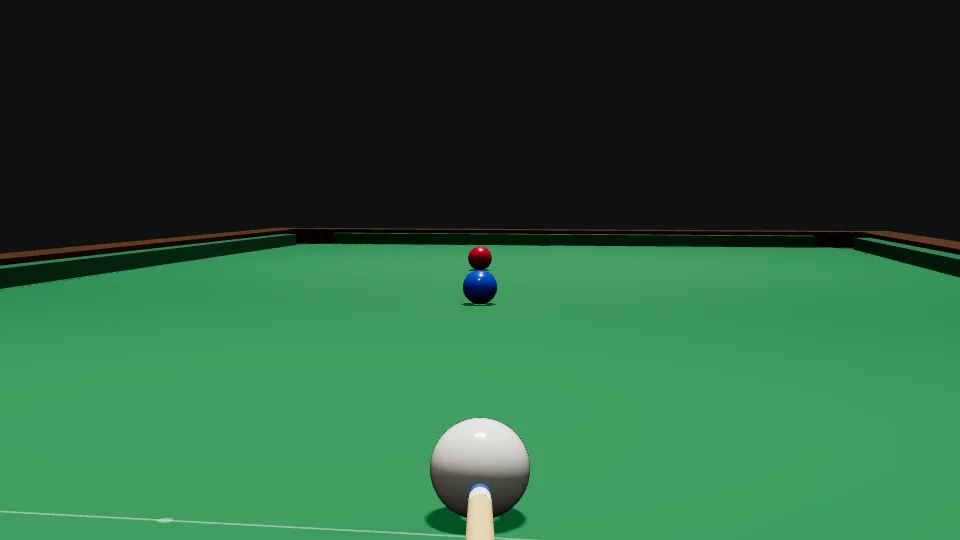
Red is the ball on, and it is straight behind the blue. Hitting the blue first is a foul. You need a way round.
2 · Snookered or not? Look at both edges
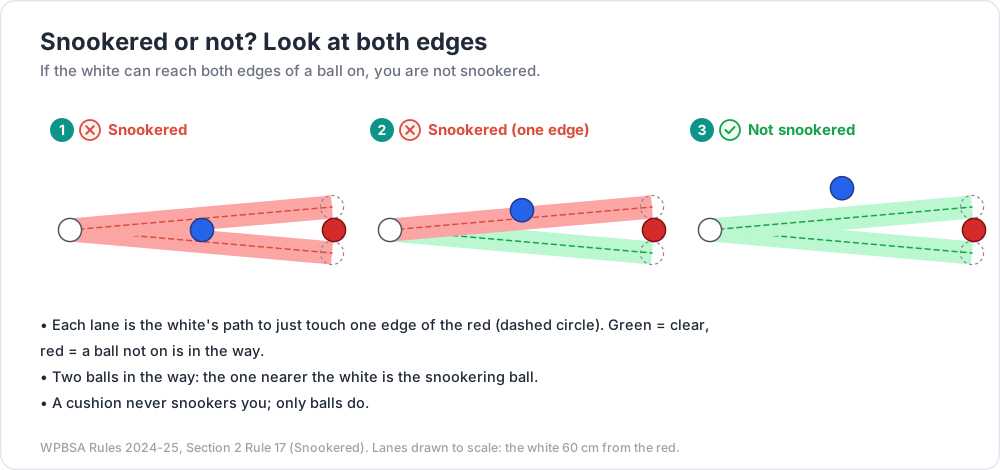
The rule: you are not snookered if the white can travel straight to both edges of at least one ball on.
| Left edge | Right edge | ||
|---|---|---|---|
| 1 | blocked | blocked | snookered |
| 2 | clear | blocked | still snookered |
| 3 | clear | clear | not snookered |
When two balls are in the way, the one nearer the white is the snookering ball. A cushion never snookers you.
3 · Fouls, the miss and the free ball
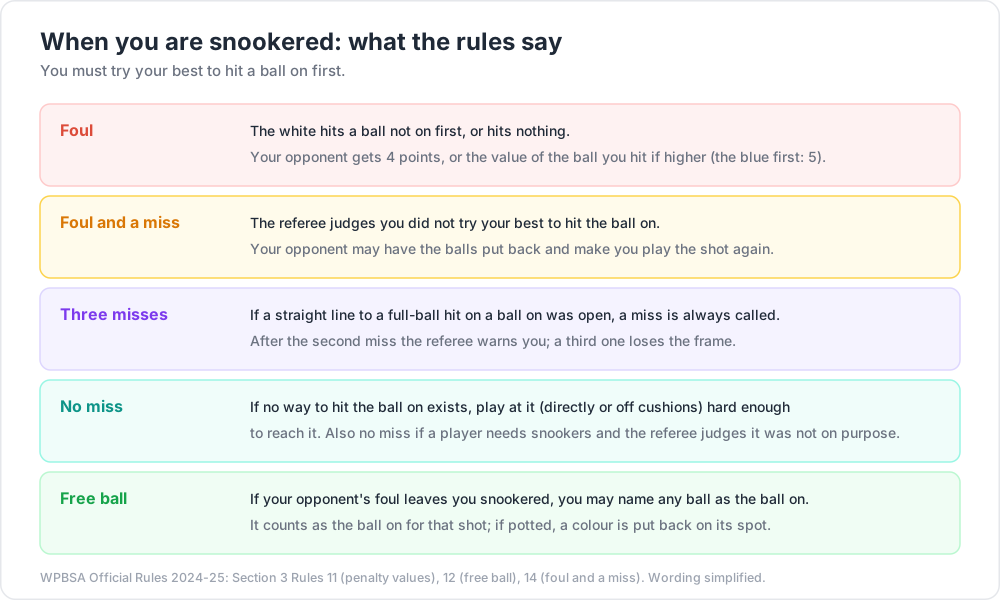
The rules (WPBSA, simplified):
- Foul: the white hits a ball not on first, or nothing. Your opponent gets 4 points, or the value of the ball you hit if that is higher. Hitting the blue first here costs 5.
- Foul and a miss: if the referee judges you did not try your best, your opponent may have the balls put back and make you play again.
- Three misses: when a straight line to a full-ball hit on a ball on was open, a miss is always called. After the second the referee warns you; a third loses the frame.
- No miss when hitting the ball on is impossible, if you play at it hard enough to reach it.
- Free ball: if your opponent's foul leaves you snookered, you may name any ball as the ball on for that shot.
So in a real snooker, an honest attempt with enough pace matters as much as the aim.
Chapter 2 — One cushion
4 · Aim at the mirror ball
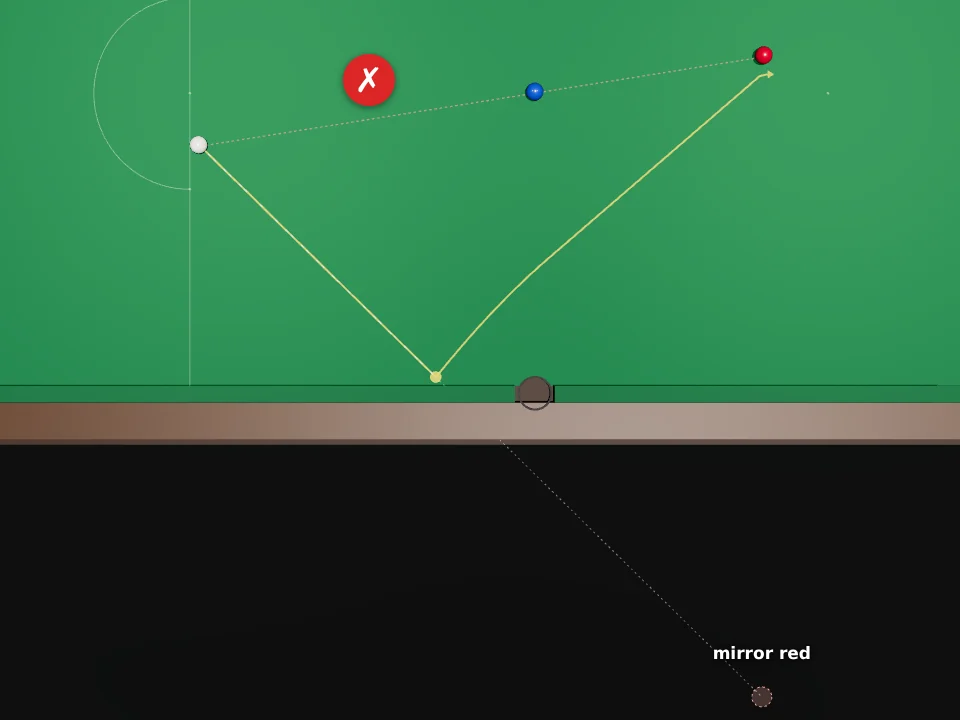
- Picture the red reflected behind the cushion you will use (the mirror red).
- Aim the white's centre at the mirror red's centre.
- The yellow point where that line meets the cushion is your target. Look at it, not at the red.
Trick: reflect from where the white's centre touches the cushion, half a ball out from the rubber (post 07). Pick a mark on the rail level with your cushion point.
5 · Two routes, two windows
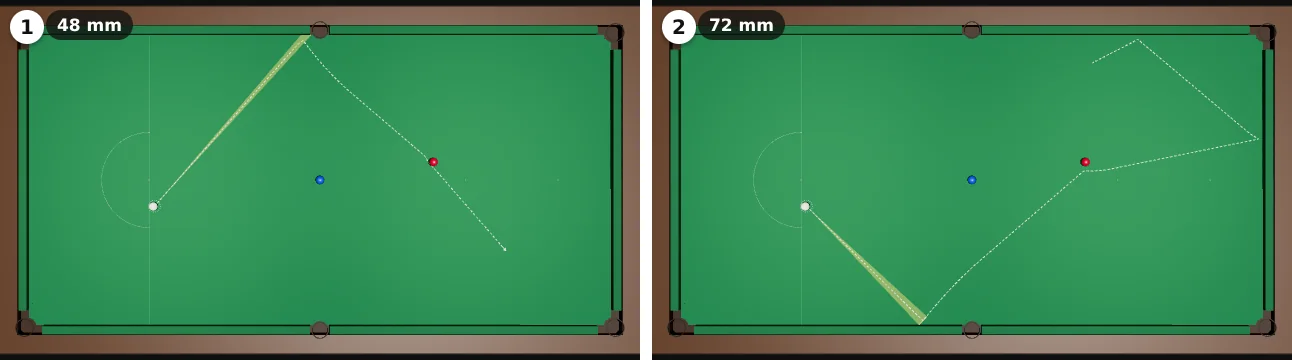
Any contact on the red escapes, so each route has a window: all the aims that touch the red first.
| Route (power 4) | White to the cushion | Room at the cushion | Mirror aim as it is |
|---|---|---|---|
| 1 · top side cushion | 1.4 m | about 5 cm | misses ✗ |
| 2 · bottom side cushion | 1.0 m | about 7 cm | hits ✓, right in the middle |
Take route 2: more room, and the plain mirror works.
Watch out: check the whole path for other balls first. A route that clips a third ball is no route.
6 · Pace moves the aim
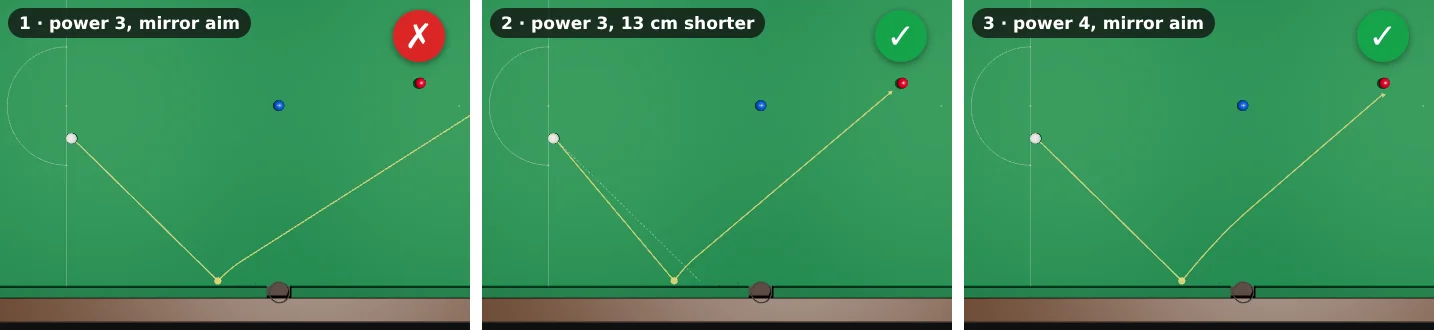
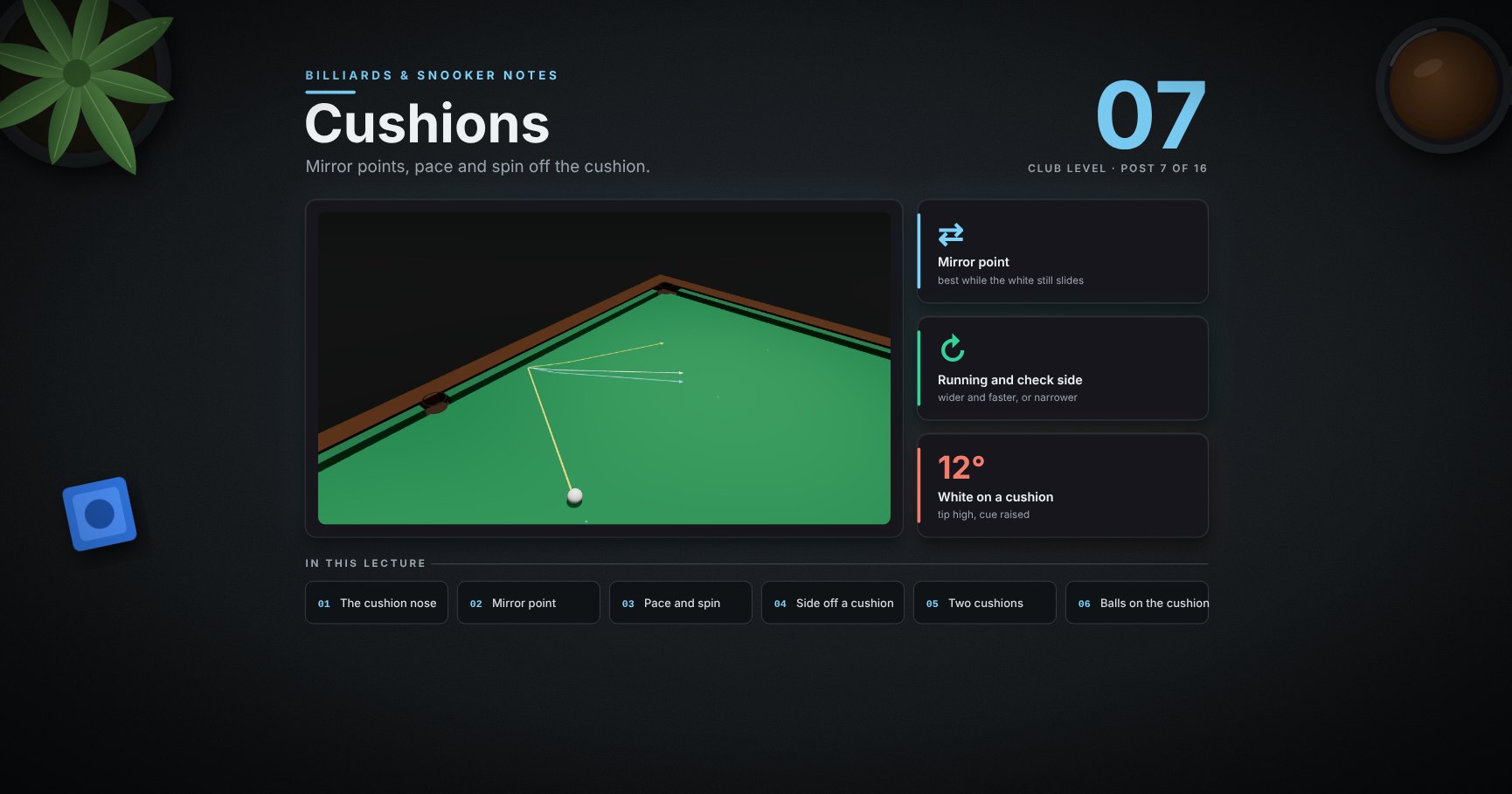
The mirror works when the white is still sliding at the cushion. At power 3 it is already rolling, so it comes off flatter (post 07). Route 2 (model):
| Aim | Room at the cushion | Result | |
|---|---|---|---|
| 1 | power 3, mirror | misses ✗ | |
| 2 | power 3, cushion point 13 cm shorter | about 4 cm | ✓ |
| 3 | power 4, mirror | about 7 cm | ✓ |
Two good ways: firmer and trust the mirror, or softer and aim shorter. Firmer has more room.
7 · Watch it: the escape
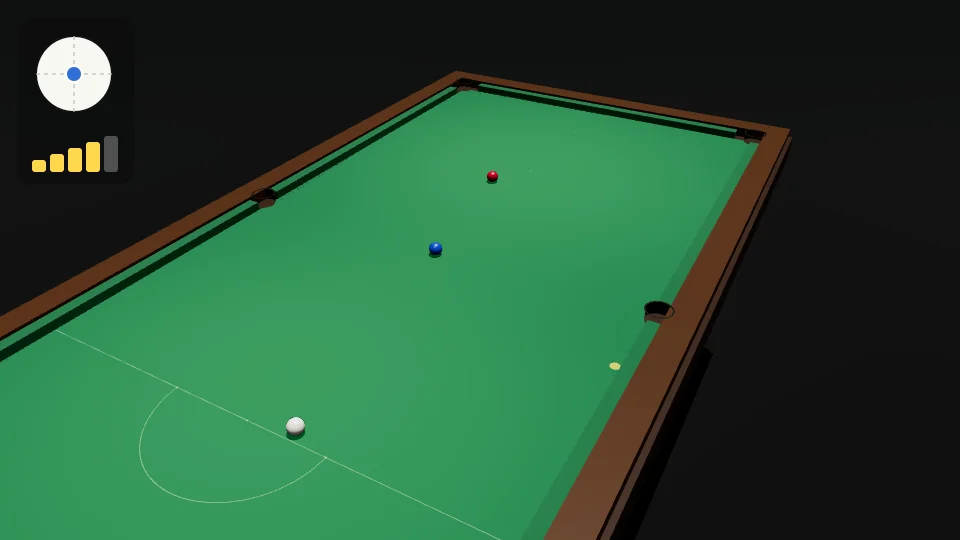
Power 4, centre ball, aimed at the mirror red ✓.
8 · Where do the balls end?
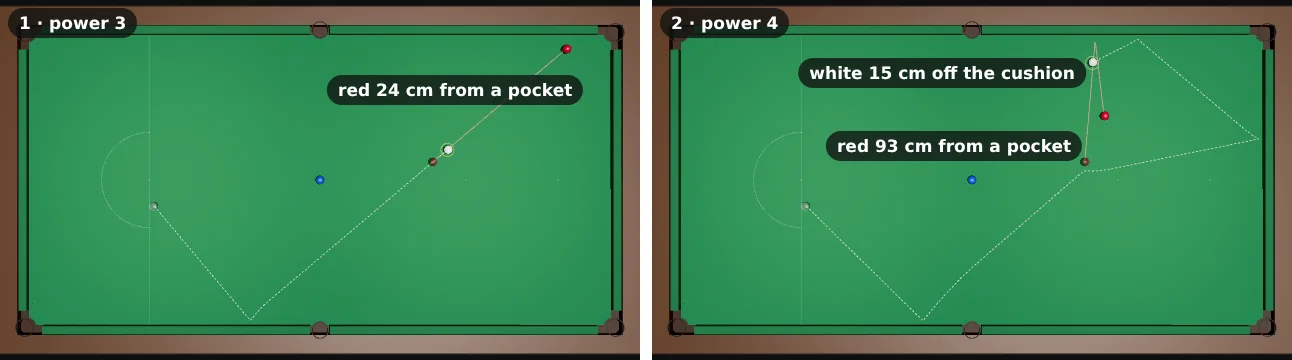
Both escapes hit the red. What they leave is very different (model):
| The red ends | The white ends | |
|---|---|---|
| 1 · power 3 | 24 cm from the top-right pocket | in the open, mid-table |
| 2 · power 4 | 93 cm from any pocket | 15 cm off the top cushion |
The soft one gives your opponent an easy red. Here the firmer route is better twice: more room and a safer leave. Before you play, picture both balls after the contact.
Chapter 3 — Round the angles
9 · Nothing simple is on

Check in this order: direct, one cushion each side, then two or more. Here the blue blocks the direct line, the pink blocks the top side cushion route, and the black blocks the bottom side cushion route.
10 · The double mirror
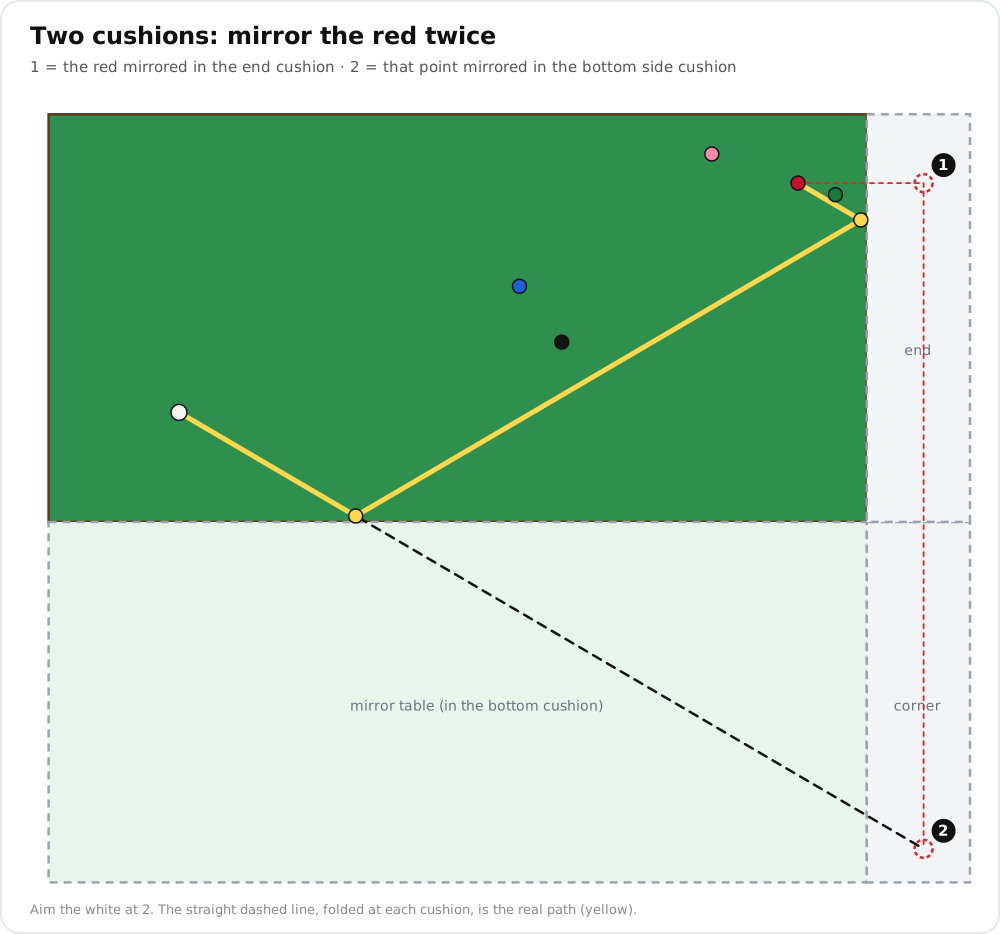
- Mirror the red in the last cushion the white will touch: point 1.
- Mirror point 1 in the first cushion: point 2.
- Aim at point 2. Where the line meets the first cushion is your target.
For two cushions that meet at a corner, point 2 is the red reflected through the corner.
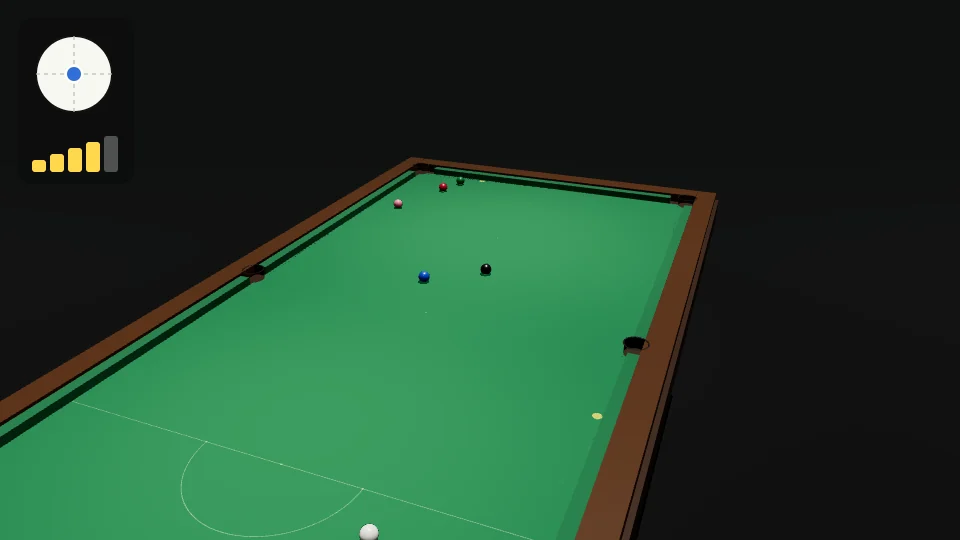
Watch out: a rolling white comes off each cushion a little flatter, and two cushions add up. Here the first cushion point needed to be about 5 cm shorter than the double-mirror line (a turn of about 1.7°).
11 · More than one way out

| Route | Cushions | Room (power 4) |
|---|---|---|
| 1 | top side → end | 1.3° |
| 2 | bottom side → end | 1.1° |
| 3 | bottom side → top side → end | 1.1° |
On an open table, the one-cushion route off the top side cushion had 2.7°. Escapes round the angles have about half the room, which is why you check the simple lines first.
Chapter 4 — Swerve
12 · Curve round the ball
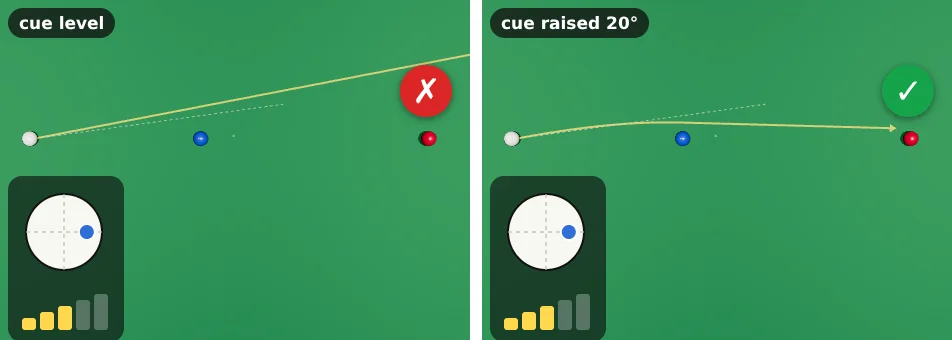
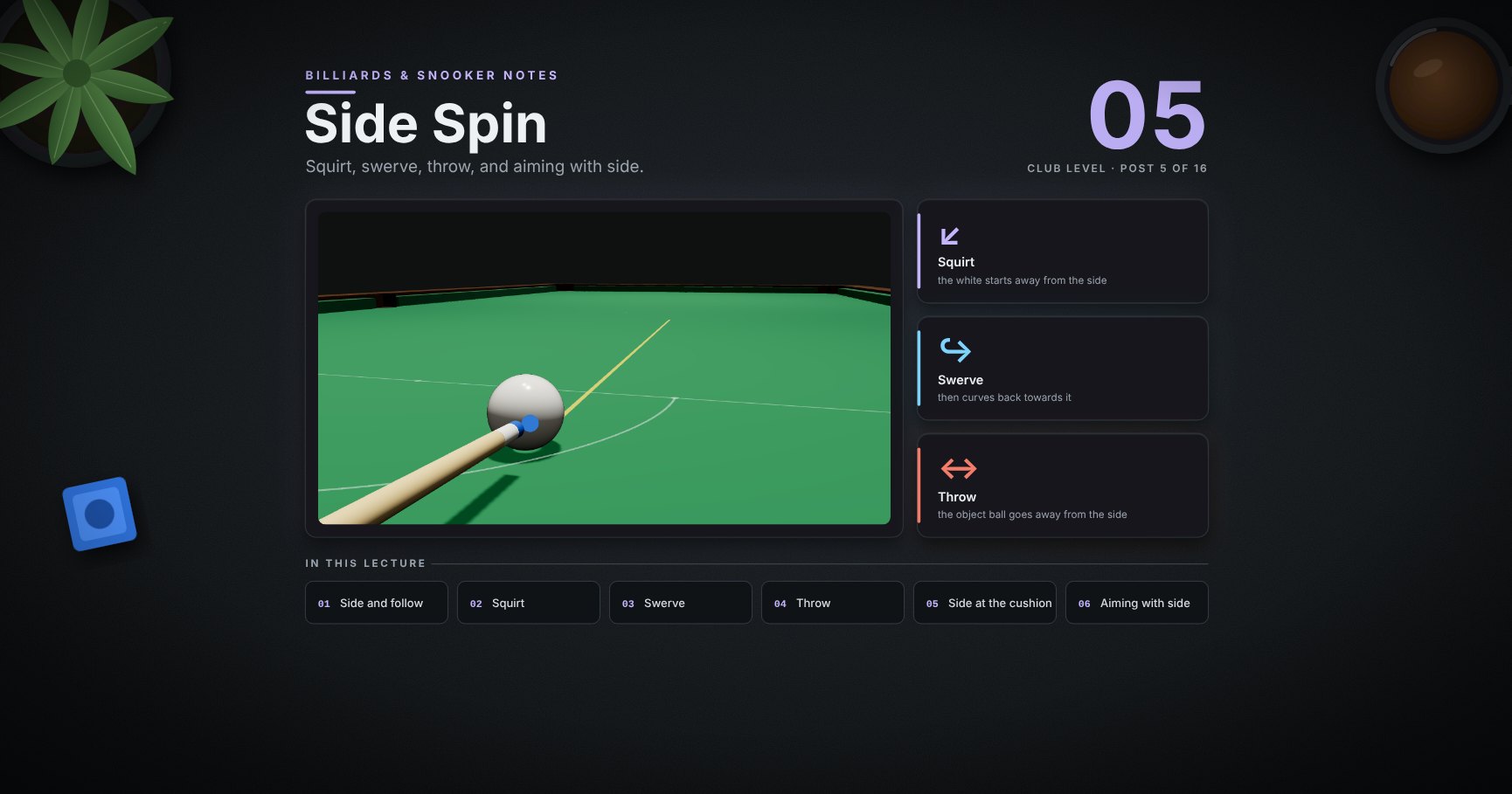
When the cushions are shut, side with a raised cue curves the white (post 05):
- Aim past the blocking ball, on the side away from the curve (here left).
- Side towards the red (here right-hand side, half-way out).
- Raise the butt about 20°, power 3.
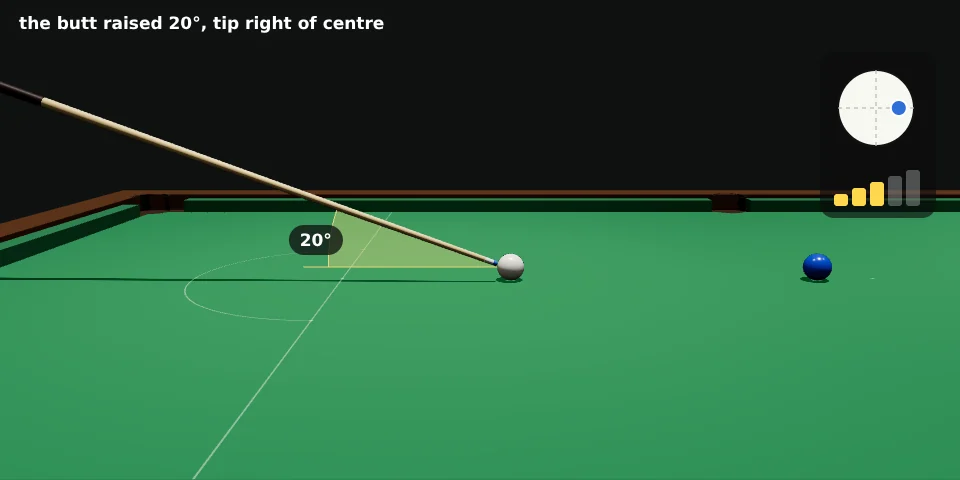
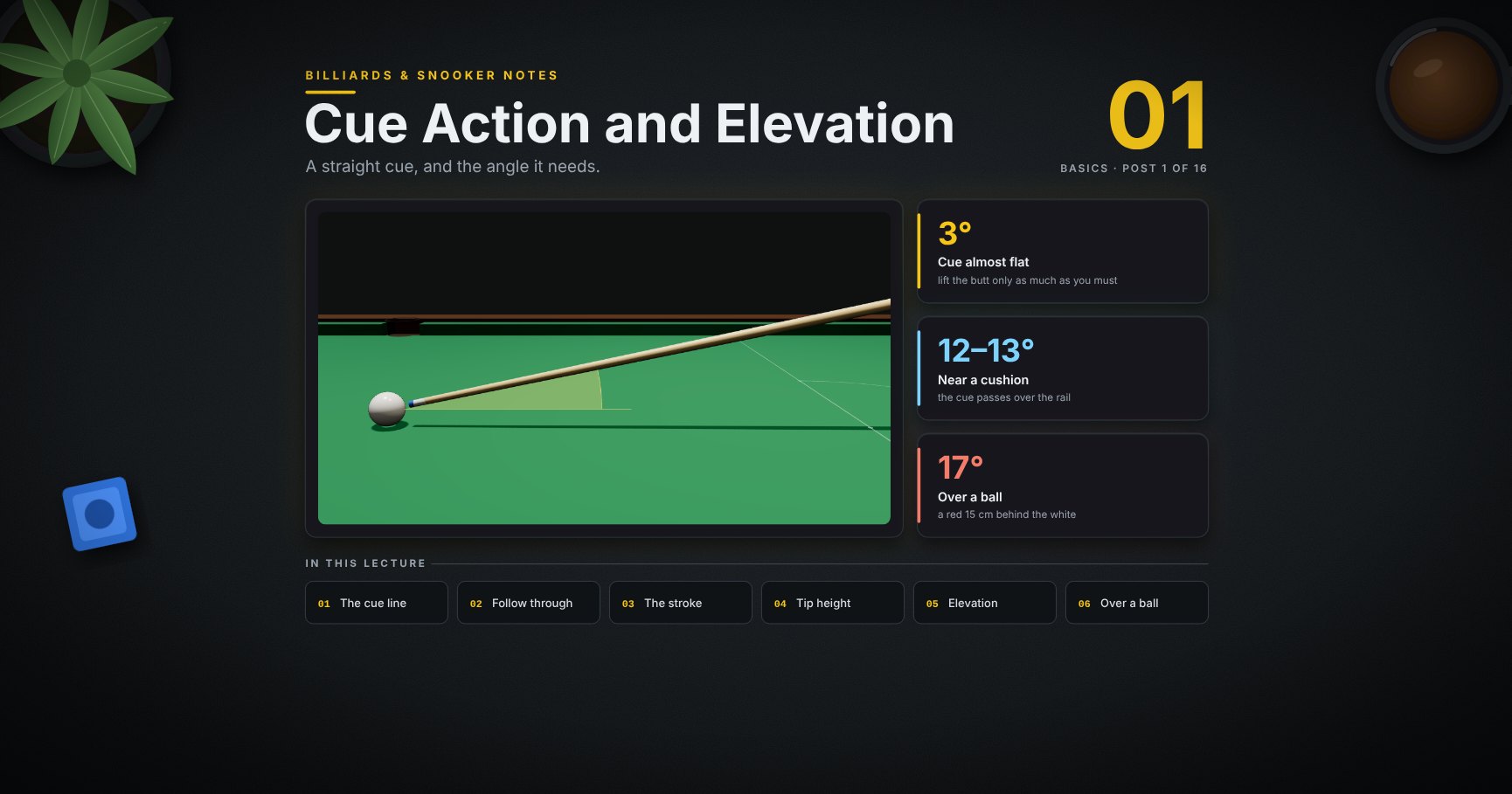
That is what "raised 20°" means at the table: the back of the cue lifted, so the cue comes down at the white (post 01).
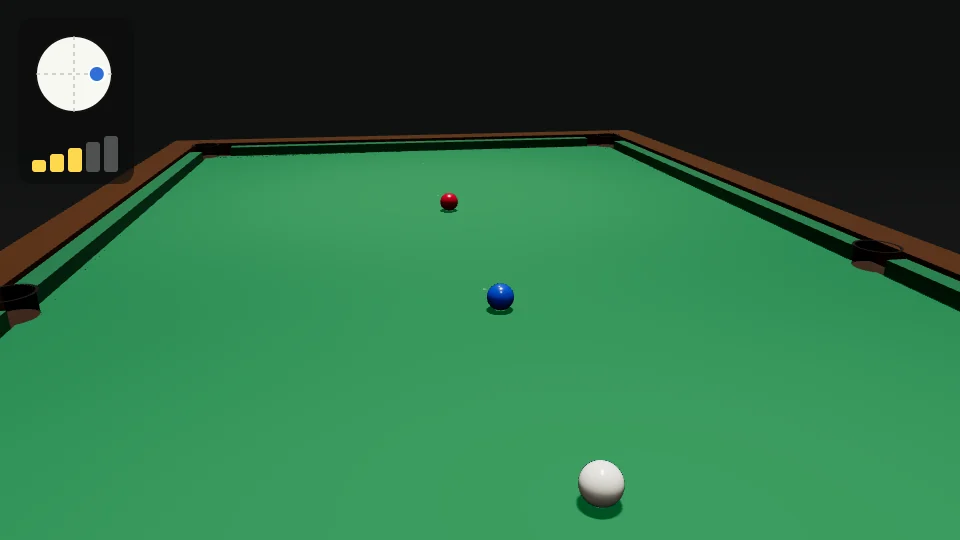
| Cue | The same aim and side |
|---|---|
| level | goes straight, misses the red ✗ |
| raised 20° | curves round the blue into the red ✓ |
The room is small: only about 1° of aims made it round (model). Prefer a cushion when one is open.
13 · Choosing the way out
| Ask | Why |
|---|---|
| Is a direct edge free? | then you are not snookered at all |
| Which one-cushion route has the most room? | the plain mirror at power 4 is the easiest shot |
| Is any third ball on the path? | a clipped ball is a foul |
| Where will the red and the white end? | a safe leave is worth a little room |
| Cushions all shut? | two cushions (half the room), then swerve |
| Is there a full-ball line open? | then a miss is always called: take the escape you hit most often |
Try it at the table
| Drill | Set-up | Look for |
|---|---|---|
| Edges | the white, a colour and a red in a line; move the colour sideways | when both edges are clear |
| Mirror ball | the white in the D, a red near the pink spot, a colour in between | find the cushion point before you get down |
| Window | the same, aim 2 cm left and right of your point | which aims still hit |
| Two paces | the same route at power 3 and power 4 | how much shorter the soft one needs |
| Leave | the same escape; mark where the red and the white stop | which pace leaves the red far from pockets |
| Corner | a red near a corner, the white in baulk | reflect through the corner; hit the red |
| Swerve | a ball 60 cm in front of the white, a red 80 cm behind it | curve round with the butt raised |
Cheat-sheet
| Snookered | no ball on with both edges clear |
| Foul | 4 points, or the value of the ball hit if higher |
| Miss | not your best try: balls back, play again; a full-ball line open: three misses lose the frame |
| Free ball | snookered after a foul: name any ball as the ball on |
| One cushion | the white's centre at the mirror ball |
| Choose | most room, no third ball, safe leave |
| Power 4 | the mirror works as it is; softer: aim shorter |
| Two cushions | mirror in the last cushion, then the first; hit a little shorter |
| Swerve | aim past, side towards the ball on, butt raised about 20° |
What's next
10 · Multi-ball shots. Plants, sets, cannons and kisses: using one ball to move another.
References
- WPBSA, Official Rules of the Games of Snooker and English Billiards (2024-25): Section 2 Rule 17 (snookered), Section 3 Rules 11 (penalty values), 12 (free ball) and 14 (foul and a miss). https://www.wpbsa.com/rules/
- Dr. Dave Alciatore, kick-shot (escape) aiming with the mirror (ghost table) method; swerve and cue elevation. https://billiards.colostate.edu/
- Windows, pace corrections, where the balls stop and the swerve come from the physics model. They change with the table, the cloth and your pace; the drills show your own.
Note: this post is in progress. Planned additions: an escape off the baulk cushion, and escapes using side off the cushion.