Billiards & Snooker — 08 · Doubles (反彈)
A double sends the object ball off a cushion and into a pocket. It uses the cushion ideas from post 07 for the ball you hit. This lesson covers the mirror pocket, a quick way to find the cushion point, the pace a double needs and how pace moves the line, the cross double and the cut-back, the double kiss and how to avoid it, a double into the corner, and when a double is worth playing.
Series map. ★ Basics: 01 Cue action and elevation → 02 Aiming and potting → 03 Tip and power → 04 Where the white goes · ★★ Club: 05 Side spin → 06 Cut and side into pockets → 07 Cushions → 08 Doubles (this post) · ★★★ Advanced: 09 Escaping snookers → 10 Multi-ball shots → 11 Safety → 12 Position play · ★★★★ Hard: 13 Break-building → 14 Special shots · Reference: 15 Rules, tactics and practice · ★★★★★ Pro: 16 Cue-ball control.
Learning Outcome
- Find the double's line by mirroring the pocket, and check it by proportion.
- Give a double enough pace, and allow for the line moving at high pace.
- Tell a cross double from a cut-back double, and know the risk in each.
- Spot and avoid the double kiss.
- Play a double into a corner pocket.
- Decide when a double is the right shot.
Chapter 1 — The line
1 · Mirror the pocket
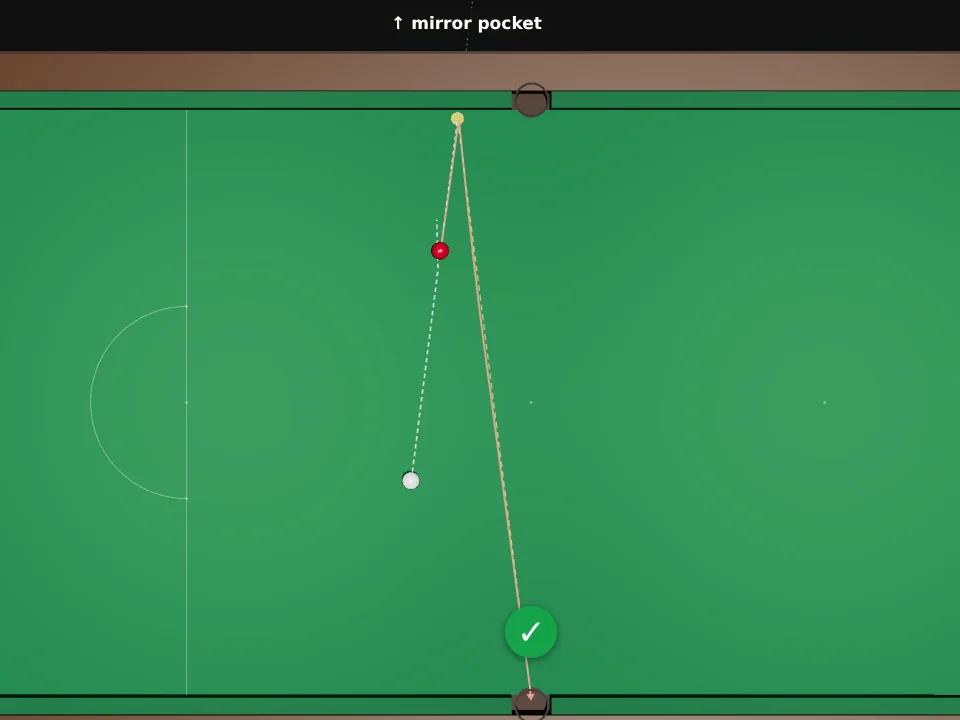
- Picture the pocket reflected behind the cushion, the same distance on the other side (the mirror pocket).
- The red must go at the mirror pocket. Where that line meets the cushion is the point the red must hit.
- Now it is a normal pot at the mirror pocket: find the ghost ball and aim (post 02).
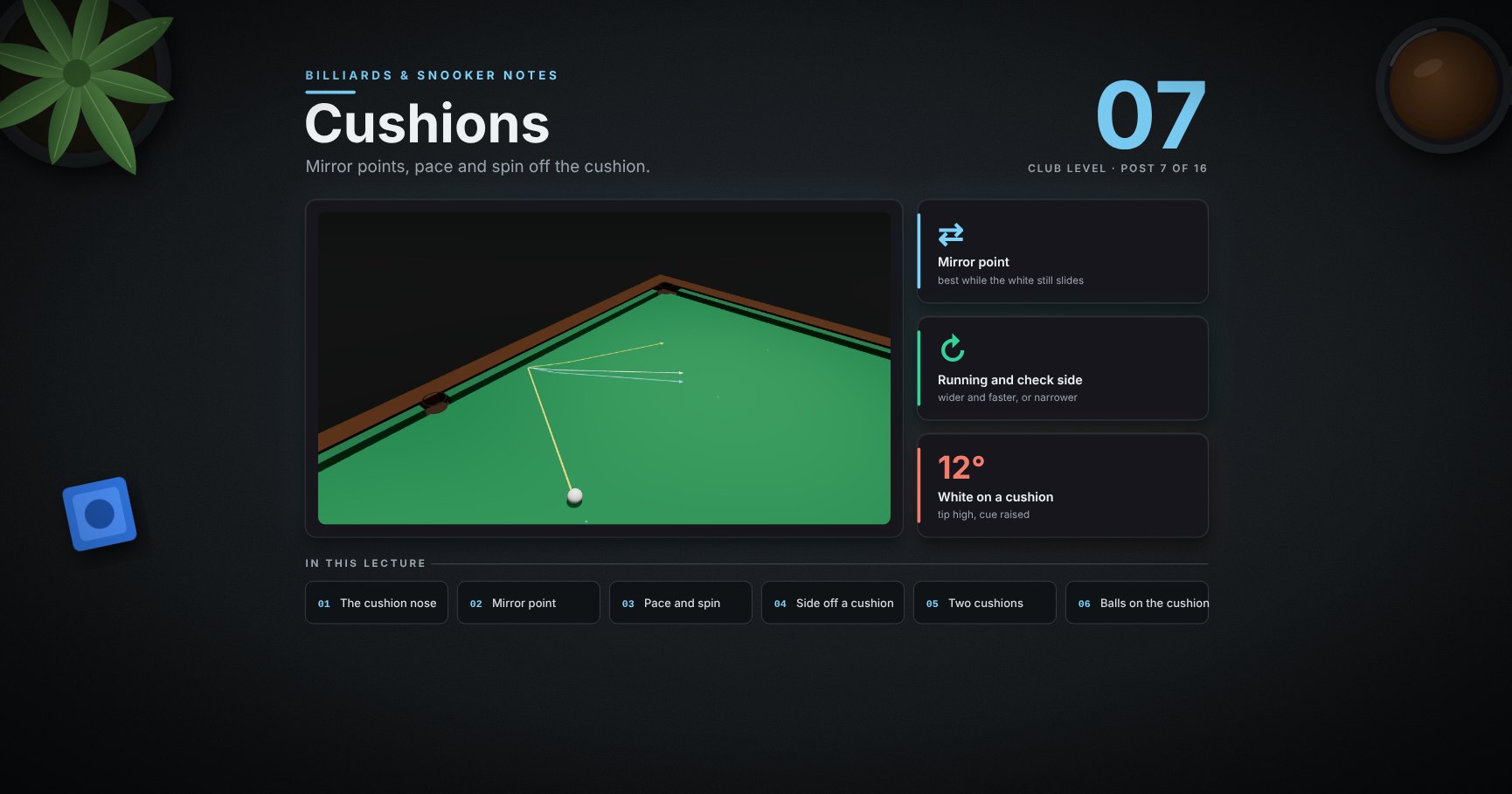
A red that has just been hit is sliding, and a sliding ball comes off a cushion close to the mirror line (post 07).
Trick: check the line from the other end. Stand behind the pocket and look at the cushion point: the red should sit on the reflected line.
2 · Find the cushion point by proportion
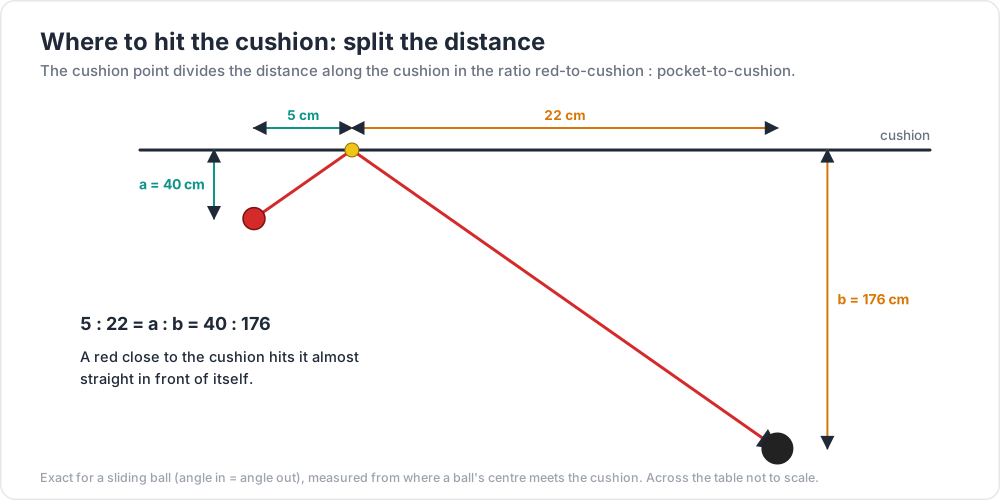
The mirror rule gives a quick check. The cushion point splits the distance along the cushion in the same ratio as the distances from the cushion:
| From the cushion | Along the cushion | |
|---|---|---|
| red | a = 40 cm | 5 cm to the cushion point |
| b = 176 cm | 22 cm from the cushion point |
40 : 176 is the same as 5 : 22. So a red close to the cushion hits it almost straight in front of itself; a red half-way across hits it half-way to the pocket.
3 · Pace: a double is a long pot
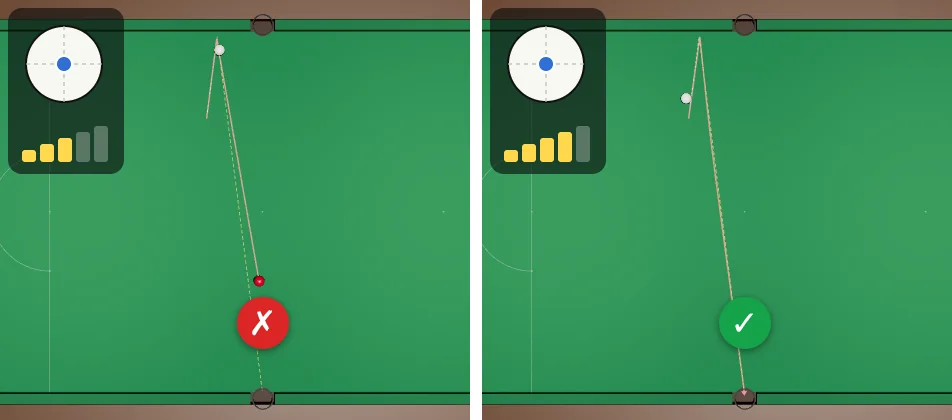
This red travels about 2.2 m: up to the cushion, then all the way across. The cushion also takes pace off it.
| White | Power 3 | Power 4 | Power 5 |
|---|---|---|---|
| straight behind the red (full ball) | stops short ✗ | ✓ | ✓ |
| from the left (cut about 35°) | short, and the white went in-off ✗ | ✓ | ✓ |
| from the right (cut about 50°) | short ✗ | ✓ | ✓ |
(Each ✓ is with the aim fine-tuned; section 4 shows why power 5 needs it.) Power 4 was enough every time; power 3 never was. The thinner you hit the red, the less pace it gets (post 04), so on a cut double lean towards the firmer side.
4 · Firm doubles come off a little short
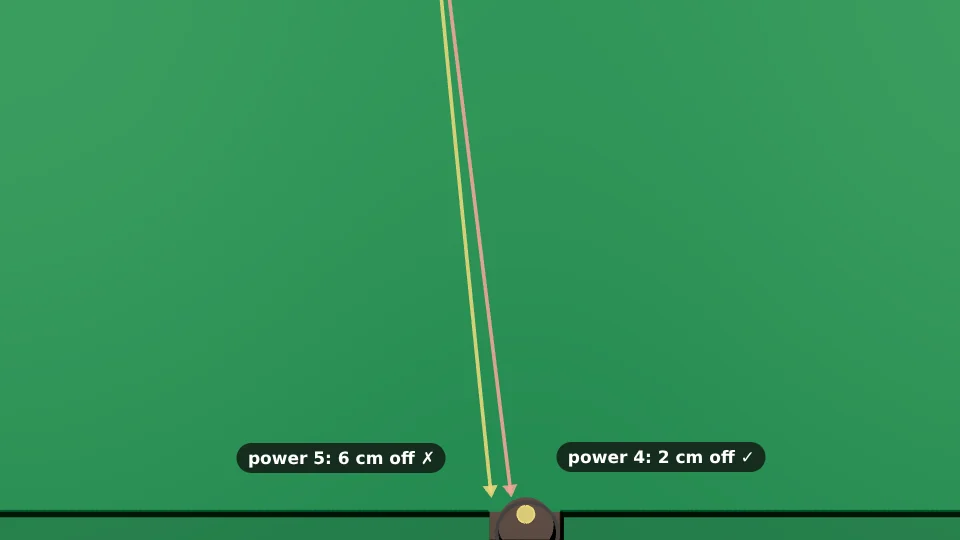
The same mirror aim at two paces (model):
| Power | Reaches the far cushion | Result |
|---|---|---|
| 4 | 2 cm from the pocket's centre | ✓ |
| 5 | 6 cm short of it | ✗ |
At high pace the red comes off the cushion a little short (squarer). At power 5 the aim needed turning about 0.2° to make up for it. So: play doubles at the lowest pace that gets there, and if you must hit hard, aim a touch longer.
Chapter 2 — Cross, cut-back and the kiss
5 · Two ways to play it
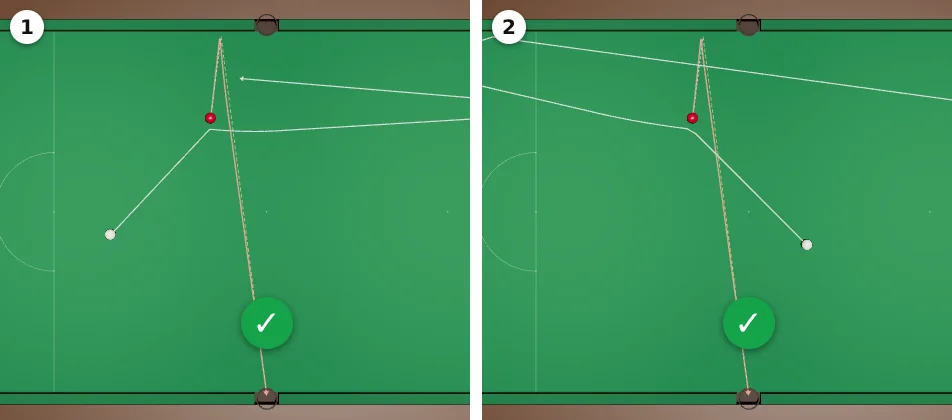
| Cross double (1) | Cut-back double (2) | |
|---|---|---|
| White comes from | the same side the red comes back to | the other side |
| After contact the white | runs across the red's path back | goes away from it |
| Main risk | a kiss: the red hits the white on its way back | a thinner hit, so less pace and a harder line |
Neither is "the" right way; it depends on where the white is.
6 · Watch it: a cross double
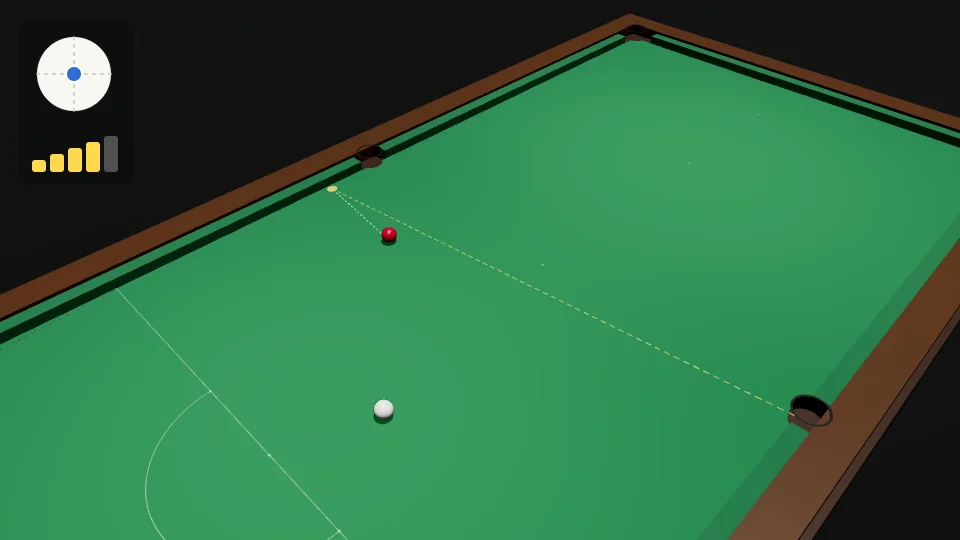
Power 4, centre ball. The white runs across the red's path but has already gone past before the red comes back.
7 · The double kiss
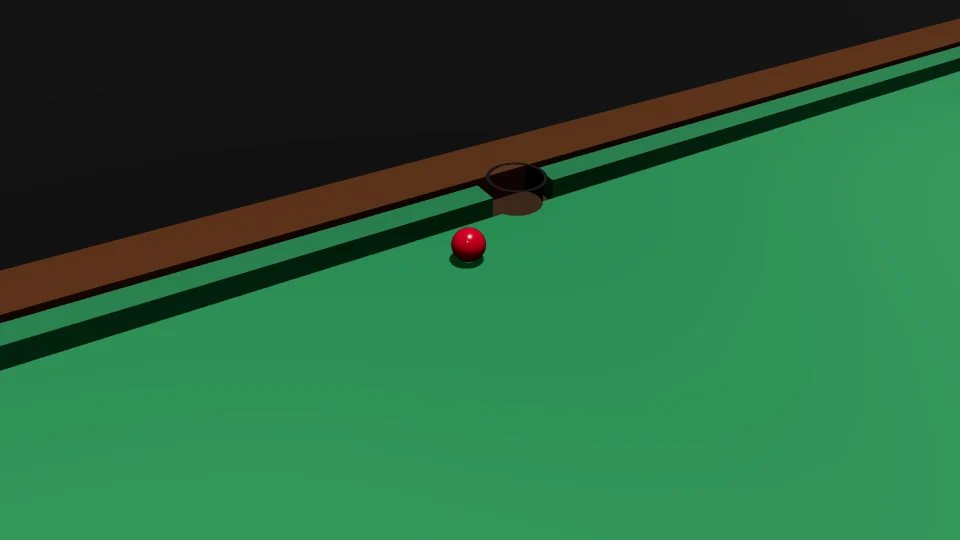
A red 6 cm off the cushion, hit full: the red reaches the cushion, bounces straight back, and meets the white again before the white has gone anywhere. That second contact is a double kiss: the red goes off line.
Watch out: pace does not fix it. At power 3, 4 and 5 the white met the red twice every time. The white is simply too close.
8 · Change the angle to avoid the kiss
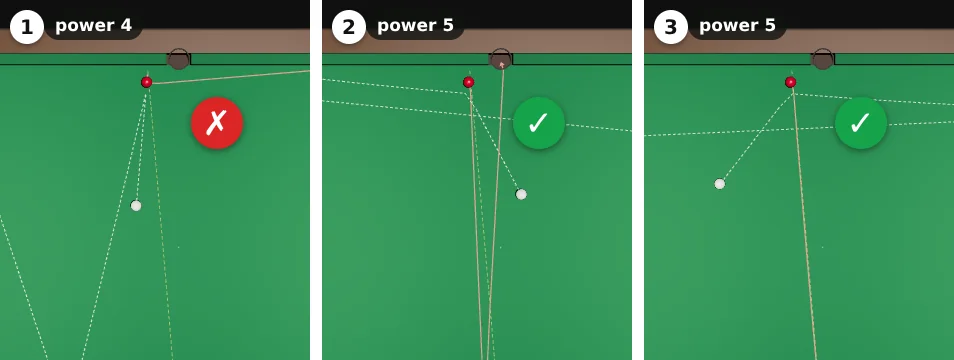
Change the angle, so the white moves out of the red's way after the first contact:
| White comes in | Contacts | Result | |
|---|---|---|---|
| 1 | straight (full ball) | 2 | ✗ double kiss |
| 2 | 30° from the right (cut-back double) | 1 | ✓ |
| 3 | 30° from the left (cross double) | 1 | ✓ |
A cut needs more pace; here power 5. Before any shot into a nearby cushion, ask: "after the first contact, does the white get out of the way?"
Chapter 3 — More doubles
9 · A double into the corner
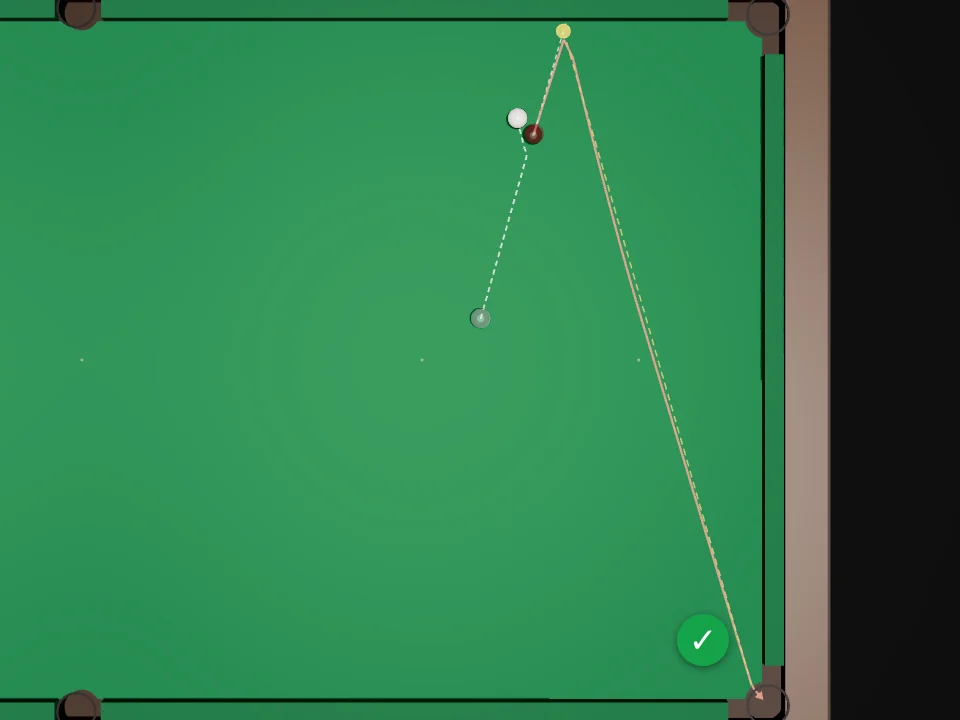
The same mirror idea works for a corner: reflect the corner pocket behind the cushion and send the red at it. Here a red near the top cushion, power 4, aim turned 0.2° from the mirror line (model).
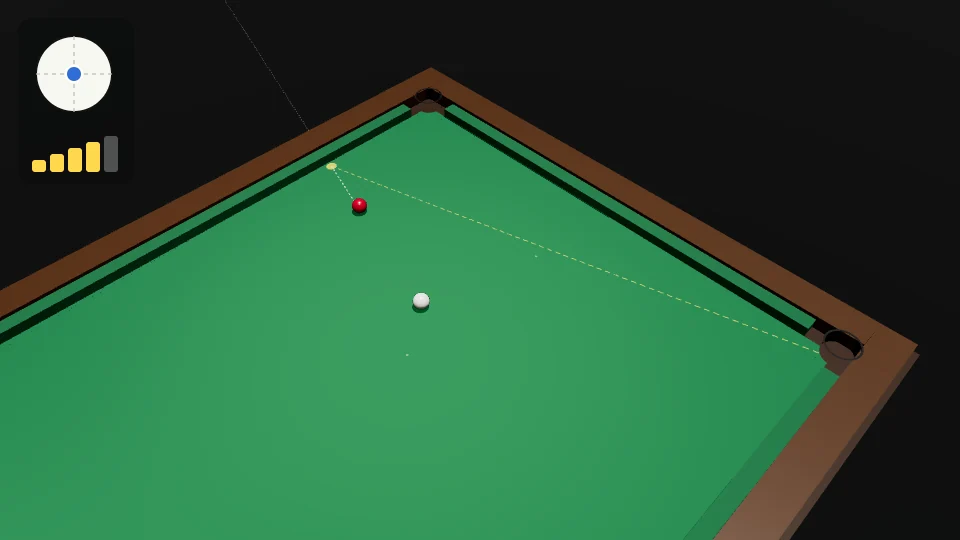
Trick: a corner double comes into the pocket at a slant, so give it the jaws, not the cushion. If the line runs close along the end cushion, it has only about 2 cm of room (post 06).
10 · When to play a double
- When the direct pot is blocked or impossible.
- When the double is close to straight (the white more or less behind the red, as in picture 1): those are the easiest.
- As a "shot to nothing": a miss sends the red back across the table, often to a place that is awkward for your opponent. Check where it goes before you play.
Before you play it, check the white: where does it go at this pace, and is there a pocket or a kiss on its path?
Try it at the table
| Drill | Set-up | Look for |
|---|---|---|
| Straight double | a red 40 cm off a side cushion, level with the middle pocket; the white behind it | power 4 reaches the opposite middle pocket |
| Proportion check | the same, the red moved 30 cm towards baulk | find the cushion point by a : b before you get down |
| Pace ladder | the same double at power 4, then power 5 | the firm one comes off a little short |
| Cross vs cut-back | the white 50 cm left, then 50 cm right of the line | a clean pot both ways, no kiss |
| Kiss test | a red 6 cm off the cushion, full ball, then from 30° | the full one kisses, the angled one does not |
| Corner double | a red 30 cm off the top cushion, 60 cm from the end | it drops into the far corner |
Cheat-sheet
| Line | send the red at the mirror pocket |
| Check | cushion point splits the distance along in the ratio a : b |
| Pace | long trip: power 4; firmer comes off a little short |
| Cross double | the white crosses the red's way back: watch the kiss |
| Cut-back double | thinner hit, so lean firmer |
| Double kiss | red close to the cushion, hit full: change the angle |
| Corner double | mirror the corner pocket; aim for the jaws |
| Best doubles | close to straight, from close range |
What's next
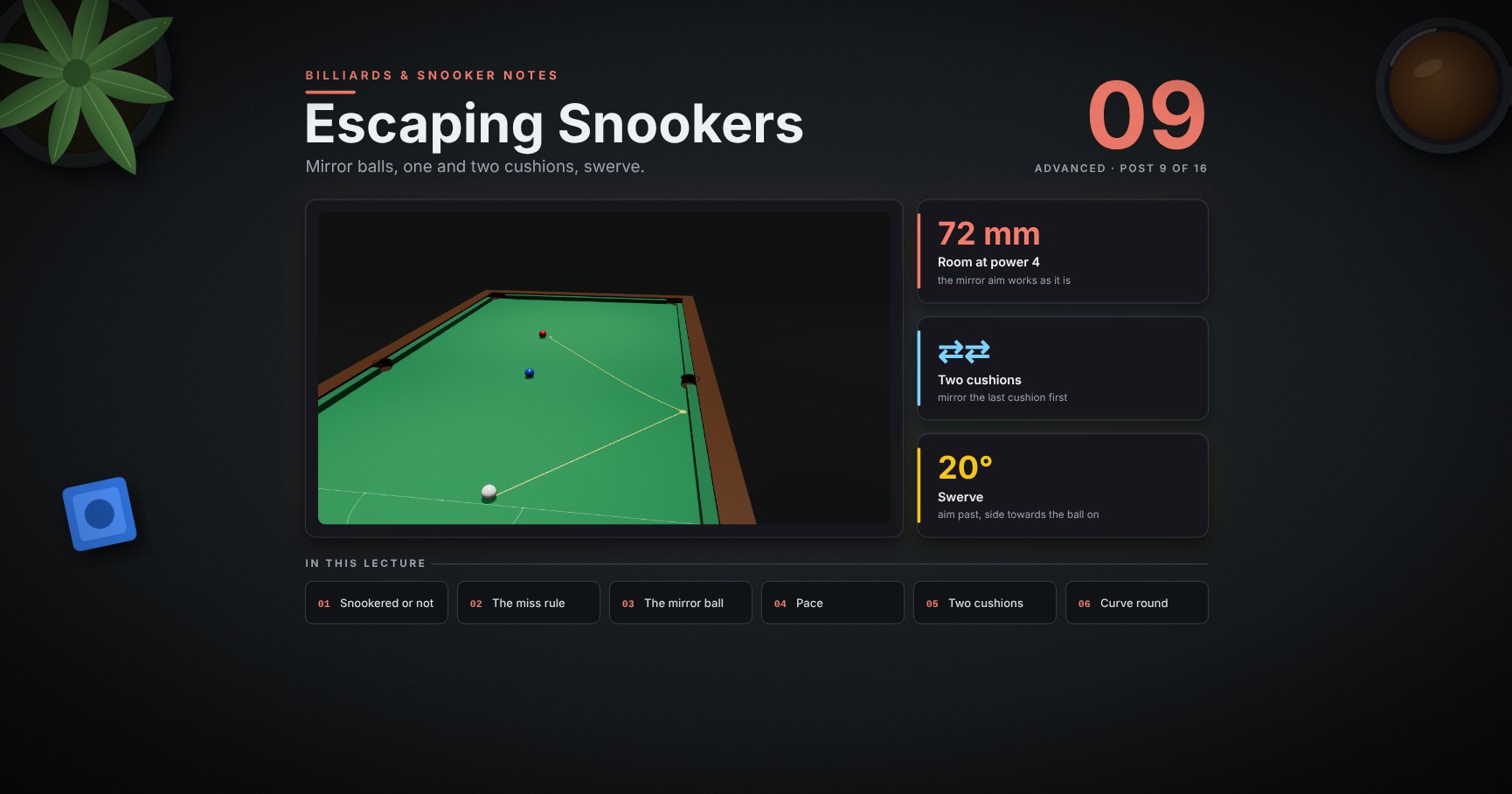
09 · Escaping snookers (對射角). The same mirror, used for the white: hit a ball you cannot see directly, off one, two or three cushions, or with a swerve.
References
- WPBSA, Official Rules (2022): table and pocket positions. https://wpbsa.com/rules/
- Dr. Dave Alciatore, bank-shot (double) aiming systems and cushion rebound. https://billiards.colostate.edu/
- The proportion rule is exact geometry for angle in = angle out. Paces, lines and the kiss come from the physics model used in every post (cushion restitution 0.8, the cushion meeting the ball above its centre). Real cushions differ table to table; check your table with the drills.
Note: this post is in progress. Planned additions: the cocked-hat double (three cushions into a middle pocket), and doubles off the top cushion.