Billiards & Snooker — 15 · Rules, Tactics and Practice
The last lesson is the one to keep open on your phone at the club. It covers the table and its spots, how a frame starts, playing from the D, the fouls you meet most and what happens after them, the miss and the free ball, how a frame ends (and the re-spotted black), counting the points left, tactics when you are ahead or behind, the line-up drill, a practice session, and table manners.
Series map. ★ Basics: 01 Cue action and elevation → 02 Aiming and potting → 03 Tip and power → 04 Where the white goes · ★★ Club: 05 Side spin → 06 Cut and side into pockets → 07 Cushions → 08 Doubles · ★★★ Advanced: 09 Escaping snookers → 10 Multi-ball shots → 11 Safety → 12 Position play · ★★★★ Hard: 13 Break-building → 14 Special shots · Reference: 15 Rules, tactics and practice (this post) · ★★★★★ Pro: 16 Cue-ball control.
Learning Outcome
- Know the table, its lines and where each colour sits.
- Start a frame and play correctly from the D.
- Know the common fouls, their penalties and your choices after one.
- Know how a frame ends, and when you need snookers.
- Choose a plan from the score: attack, play normally, or lay snookers.
- Practise with a plan, and behave well at the table.
Chapter 1 — The table and the start
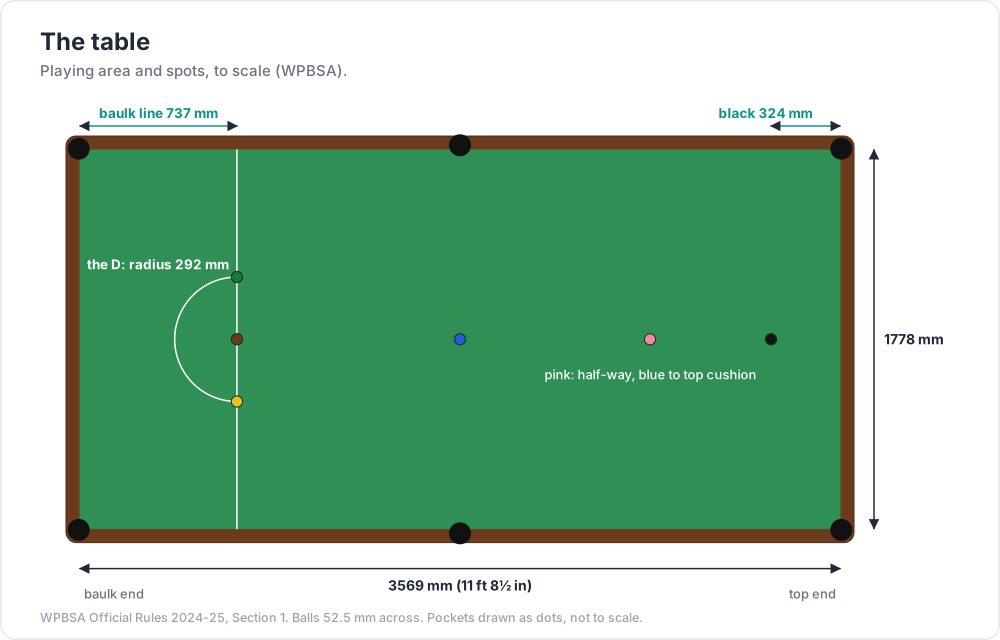
1 · The table
| Part | Where |
|---|---|
| Playing area | 3569 × 1778 mm (a full-size table) |
| Baulk line | 737 mm from the baulk cushion |
| The D | a half-circle on the baulk line, radius 292 mm |
| Yellow, brown, green | on the baulk line: yellow and green at the ends of the D, brown in the middle |
| Blue | the centre of the table |
| Pink | half-way between the blue and the top cushion |
| Black | 324 mm from the top cushion |
Seen from the baulk end, the yellow is on the right of the D and the green on the left. Club tables are often smaller; the spots keep the same pattern.
2 · Starting a frame
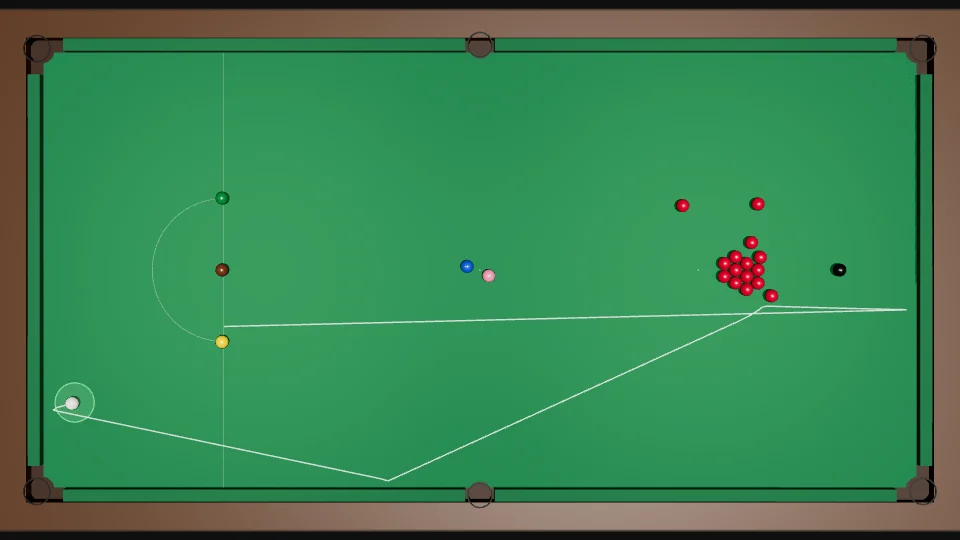
- The 15 reds go in a tight triangle, the front red as close to the pink as it can be without touching it, the back row parallel to the top cushion.
- The colours go on their spots.
- Toss a coin (or agree) for who breaks. After that, the players take turns to break, frame by frame.
- The first shot is from in-hand (the white placed in the D), and the ball on is a red.
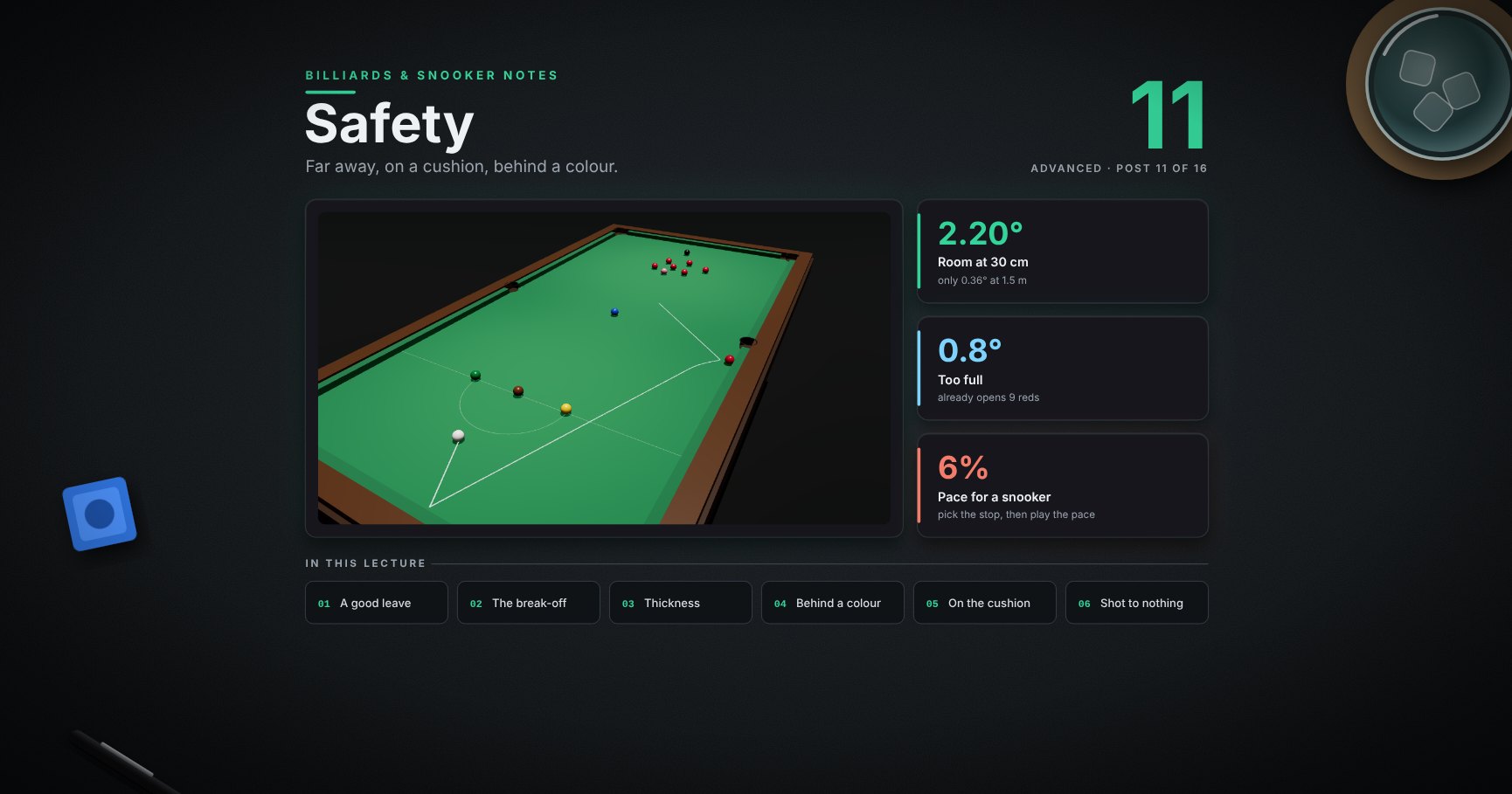
The usual break-off is the safety from post 11: a thin touch on the end red, and back to baulk.
3 · Playing from the D
The white is in-hand at the start of a frame, after it goes in a pocket or off the table, and for a re-spotted black. Then:
- place it on or inside the lines of the D (on the line counts);
- you may then play in any direction, even back towards the baulk cushion;
- if the tip touches the white while you are only placing it, it does not count as a shot.
Trick: move the white along the D before you settle. A few centimetres often turns a thin cut into an easy one, or opens a safety line.
Chapter 2 — Fouls
4 · The fouls you meet most
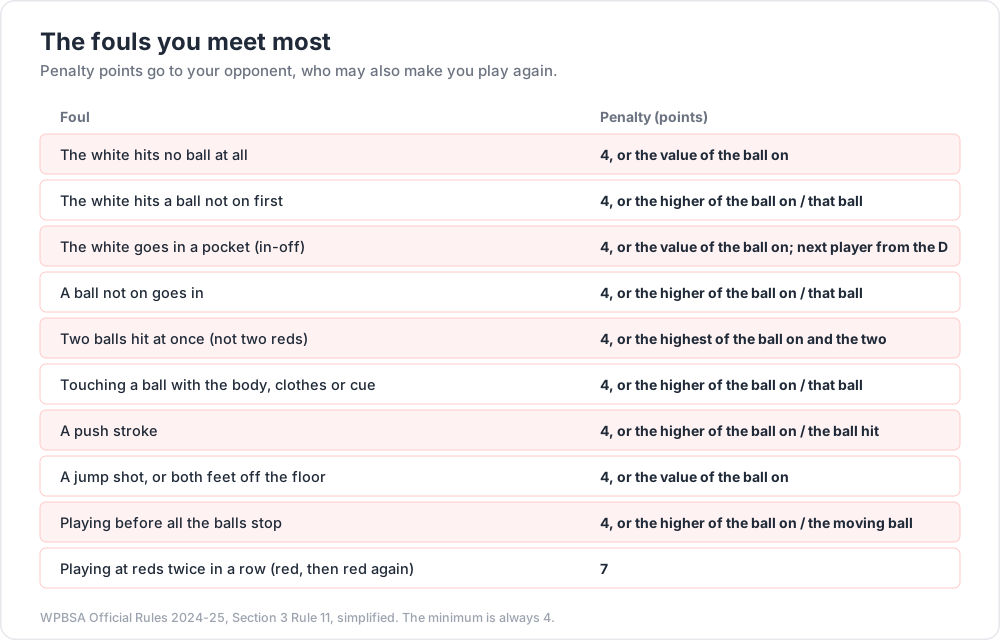
Every penalty is at least 4, and more if a higher-value ball is involved (blue 5, pink 6, black 7). The points go to your opponent; you lose nothing from your own score. If two fouls happen in one shot, only the higher penalty counts.
Common pitfall: a foul on the black ball costs 7, even if the ball on was a red. Brushing the black with your sleeve is the classic one.
5 · After a foul: two choices
After your opponent fouls, you choose:
- play the next shot yourself from where the balls are; or
- make your opponent play again from there.
Choose 2 when the position is bad for whoever plays next: a hard snooker, or a ball on a cushion. Choose 1 when there is a pot or an easy safety. (A foul and a miss adds a third choice, below.)
6 · The miss and the free ball
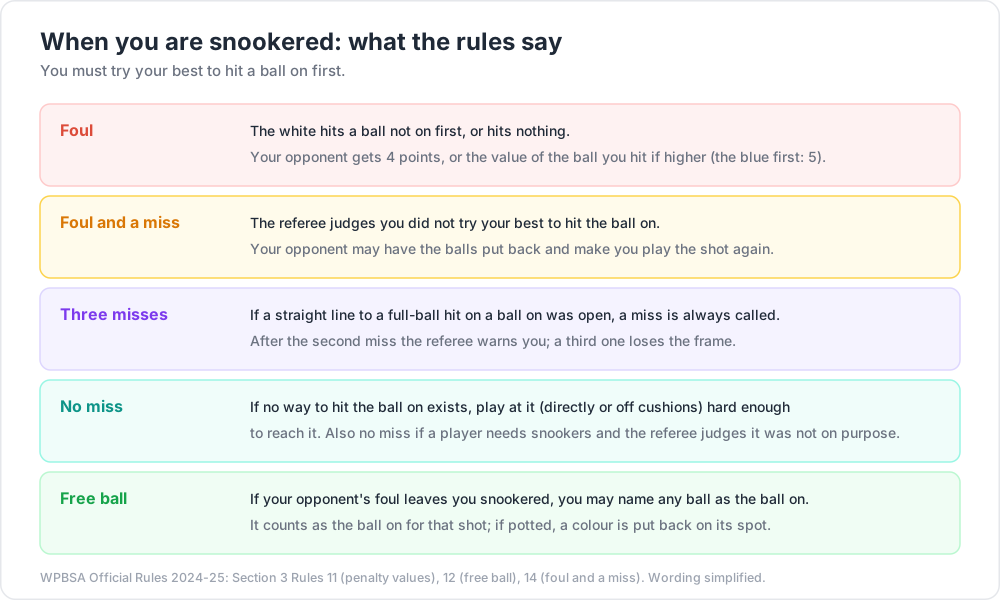
Post 09 has the full story. In short:
- Foul and a miss: the referee thinks you did not try your best to hit the ball on. Your opponent may also have the balls put back and make you play the same shot again.
- If you had a clear, straight path to the full ball and missed, the next miss from the same spot gets a warning, and a third can lose the frame.
- Free ball: if a foul leaves you snookered, you may name any ball as the ball on for one shot. It scores as the ball on (1 if reds are on).
Club games often play without the miss rule; agree before the frame.
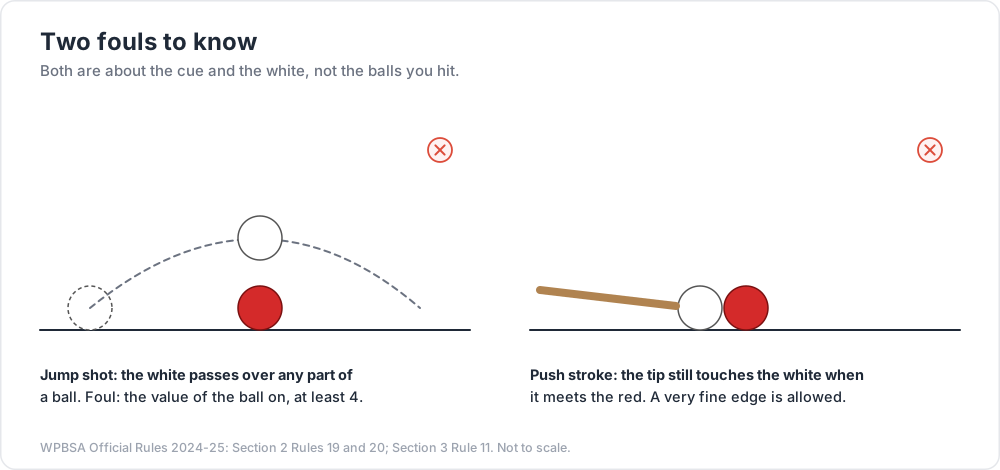
7 · Touching ball, push and jump
| Spot | The rule (post 14) |
|---|---|
| The white touching a ball | play away from it; if that ball is on, you need not hit any ball |
| The white almost touching | a normal stroke is a push; a very fine edge is allowed |
| A ball in the way | jumping over it is always a foul; go round it |
Chapter 3 — The end of a frame
8 · How a frame ends
- When only the black is left, the first pot or foul ends the frame.
- If the scores are then equal, the black is re-spotted: toss a coin for who plays first, that player plays from in-hand, and again the first pot or foul wins.
So a foul on the last black gives your opponent 7 points and ends the frame: if that puts them ahead, they win. On a re-spotted black, a safe first shot (thin, white back to baulk) is usually better than a long pot.
9 · Points left, and needing snookers
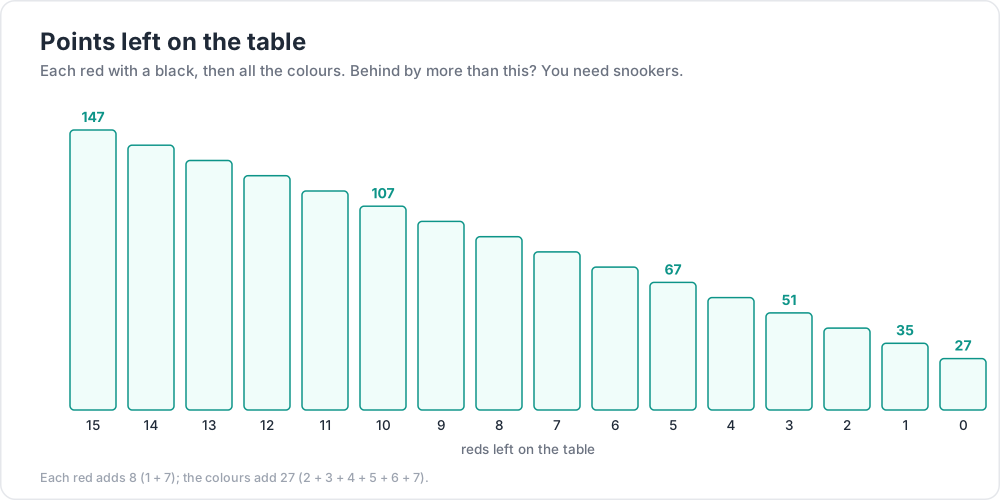
Points left = reds × 8 + 27 (post 13). When only colours are left, add up the colours still on the table:
| Colour on | Points left |
|---|---|
| yellow | 27 |
| green | 25 |
| brown | 22 |
| blue | 18 |
| pink | 13 |
| black | 7 |
If you are behind by more than the points left, you "need snookers": potting alone cannot catch up.
Conceding. You may offer to give up the frame, and your opponent may say no and play on. In WPBSA play you may not concede while you still have a chance (until somebody needs snookers); club manners are the same.
10 · Tactics: ahead or behind?
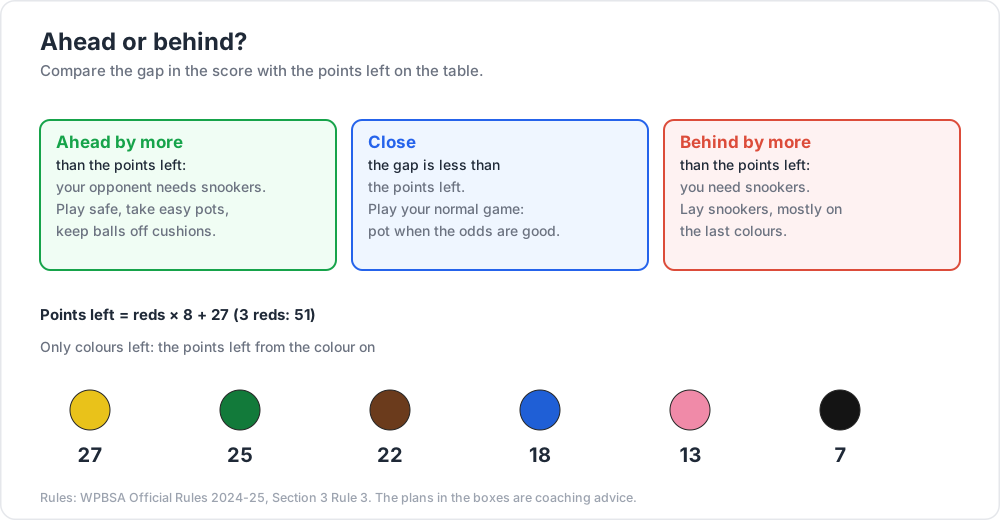
| Score | Plan (coaching advice) |
|---|---|
| Ahead by more than the points left | take only easy pots; play safe; clear balls off cushions so snookers are hard to lay |
| Close | your normal game; pot when the odds are good, safety when they are not (post 11) |
| Behind by more than the points left | play for snookers, best behind the last colours, where few balls are left to escape to (post 09) |
Trick: when you need snookers, pot what you can first. Each pot lowers the points you need from fouls.
Chapter 4 — Practice
11 · The line-up
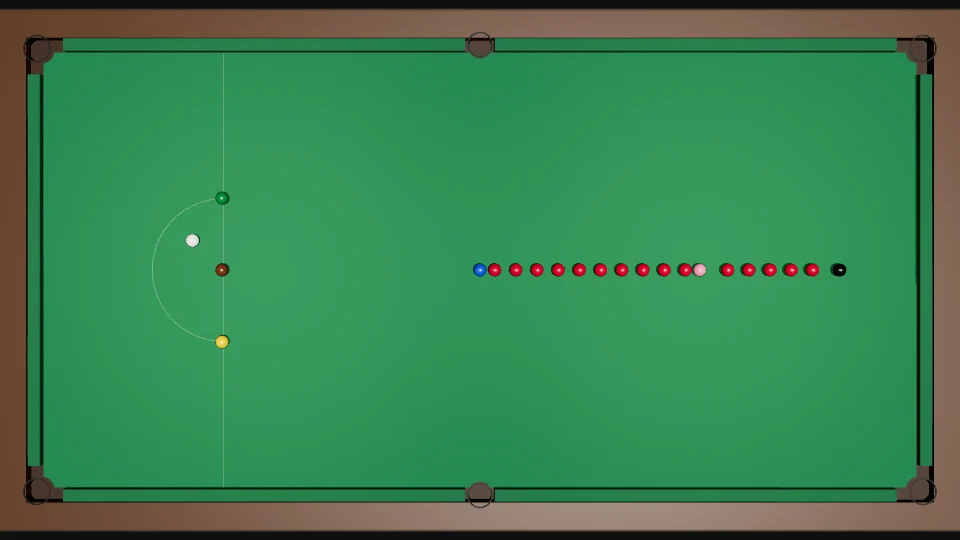
The best single drill in snooker. Put the 15 reds in a line on the long middle line, between the blue and the black, colours on their spots. Then play red, colour, red, colour… as in a match:
- Level 1: any colour after each red.
- Level 2: only the black, pink or blue.
- Level 3: only the black, and do not let the white touch another red.
Write down your best break. Every lesson in this series (pots, stun, angles, position, opening reds) is in it.
12 · A practice session
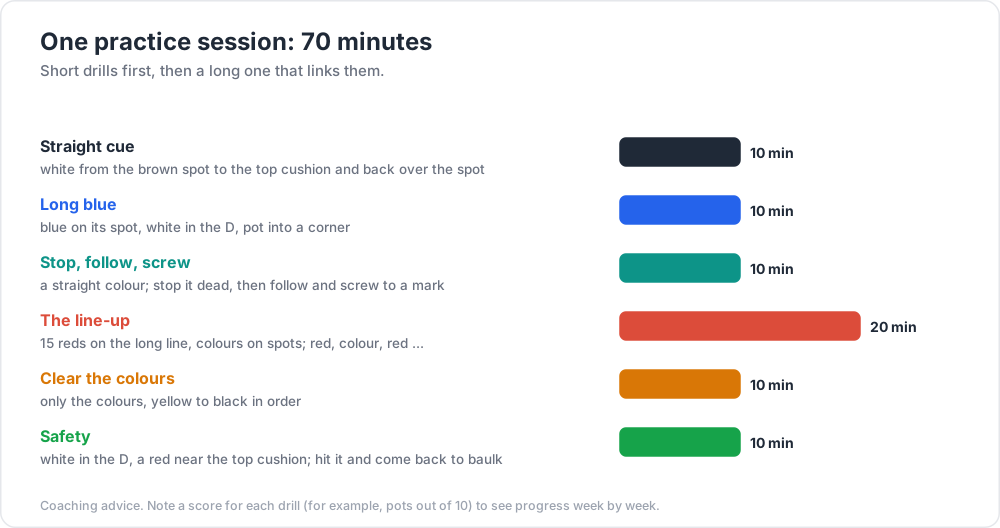
Coaching advice: short drills first (cue action, a long pot, the three strokes), then a long drill that uses them all, then safety. Score every drill, for example pots out of 10, and keep the numbers. Two or three sessions a week beat one long one.
Watch out: practise the shots you miss, not only the ones you like. Pick one weak drill from posts 02–14 each week.
13 · Table manners
Custom more than rules, but expected in every club:
- shake hands before and after the frame;
- when your opponent plays, sit or stand still, away from their line of sight, and stay quiet;
- call your own fouls in a friendly game, even if nobody saw;
- a raised hand for a lucky pot (a fluke) is polite;
- do not concede while the frame can still be won (section 9);
- leave the table tidy: balls back, chalk off the cushions.
Try it at the table
| Drill | Set-up | Look for |
|---|---|---|
| Know the spots | an empty table | place all six colours on their spots from memory |
| The D | white anywhere in the D, a red near a middle pocket | find the spot in the D that gives the easiest angle |
| After a foul | your friend lays a snooker on a red | decide: play it, or make them play again |
| Count | stop a frame at random | say the points left, and who needs snookers |
| Re-spotted black | the black on its spot, white in-hand | play a safe first shot back to baulk |
| Line-up | post section 11 | beat your best break |
Cheat-sheet
| Table | 3569 × 1778 mm; baulk line 737 mm; D radius 292 mm; black 324 mm from the top |
| Start | reds in a triangle by the pink; white in-hand; ball on a red; players take turns to break |
| In-hand | anywhere on or inside the D, any direction |
| Penalty | at least 4; the higher-value ball if one is involved; 7 for reds twice in a row |
| After a foul | play, or make them play again (and, after a miss, put the balls back) |
| Free ball | snookered after a foul: name any ball as the ball on |
| End | the last black: first pot or foul; equal scores: re-spotted black |
| Points left | reds × 8 + 27; colours: 27, 25, 22, 18, 13, 7 |
| Behind by more | you need snookers |
| Practice | the line-up, and score every drill |
What's next
16 · Cue-ball control: pro patterns. Position the professional way: a position map for one pot, breaking the pack from the blue, the key ball, and the colours cleared shot by shot.
References
- WPBSA, Official Rules of the Games of Snooker and English Billiards (2024-25): the table (Section 1 Rule 1), in-hand (Section 2 Rule 9), the start and order of play (Section 3 Rules 2 and 3), the end of the frame (Section 3 Rule 4), playing from in-hand (Section 3 Rule 5), fouls and penalties (Section 3 Rules 10 and 11), free ball (Rule 12), foul and a miss (Rule 14), conceding (Section 4 Rule 2). https://www.wpbsa.com/rules/
- The frame tactics, practice session and table manners are coaching advice and club custom, not rules.
Note: this post is in progress. Planned additions: a picture of each spot on the D, and a printable practice score sheet.