Billiards & Snooker — 12 · Position Play
A break is a chain: each pot must leave the white where the next pot is easy. That is position play. This lesson covers aiming the white at a zone, choosing the route that forgives pace errors, keeping an angle, the right side of the ball, the natural path, planning three balls ahead, and a checklist for every shot.
Series map. ★ Basics: 01 Cue action and elevation → 02 Aiming and potting → 03 Tip and power → 04 Where the white goes · ★★ Club: 05 Side spin → 06 Cut and side into pockets → 07 Cushions → 08 Doubles · ★★★ Advanced: 09 Escaping snookers → 10 Multi-ball shots → 11 Safety → 12 Position play (this post) · ★★★★ Hard: 13 Break-building → 14 Special shots · Reference: 15 Rules, tactics and practice · ★★★★★ Pro: 16 Cue-ball control.
Learning Outcome
- Aim the white at a zone, not a spot.
- Pick the route whose path runs along the zone.
- Keep a small angle on the next ball, on the right side.
- Use the natural path and control only the pace.
- Plan three balls ahead.
Chapter 1 — Where to send the white
1 · A zone, not a point
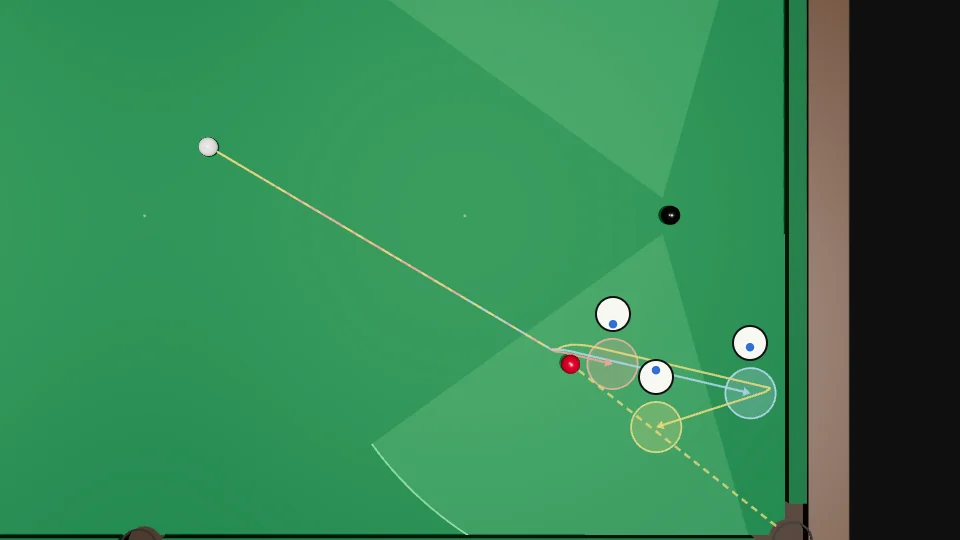
After this red you want the black. The green wedges are every place where the black is comfortable: a cut of 35° or less, from 25 cm to 1 m away, into either top corner.
| Route (power 3) | White ends | Next black |
|---|---|---|
| stun (a little below centre) | by the end cushion | no comfortable pot ✗ |
| follow (above centre) | off the end cushion, in the green | a 17° cut ✓ |
| screw (well below centre) | just past the red, in the green | a 2° cut, almost straight |
Two routes reach the zone. Which is better? The next two sections answer it.
2 · The route that forgives pace
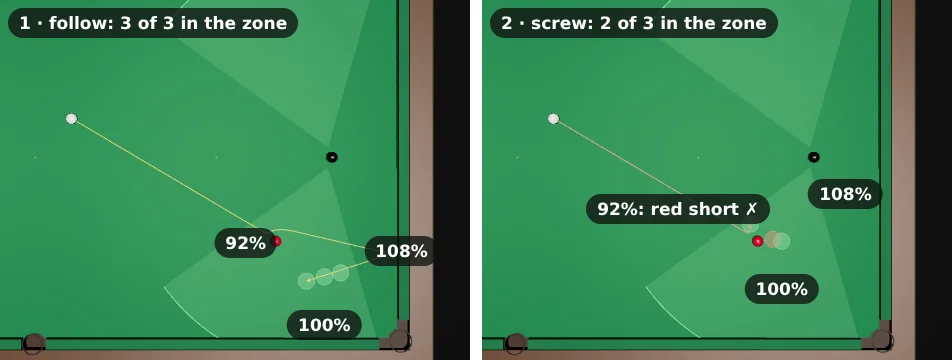
Nobody hits the exact pace. The same two routes at 8% softer and 8% firmer (model):
| Pace | Follow: next black | Screw: next black |
|---|---|---|
| 92% | a 26° cut ✓ | the red stops short ✗ |
| 100% | a 17° cut ✓ | a 2° cut ✓ |
| 108% | an 8° cut ✓ | a 27° cut ✓ |
The follow path runs along the zone, so a pace error only slides the white along it. The screw shot also drags pace off the white before it reaches the red (post 03), so the soft one does not even pot.
Trick: draw the white's path through the zone. The longer the stretch of path inside the zone, the more pace error you can afford.
3 · Keep an angle
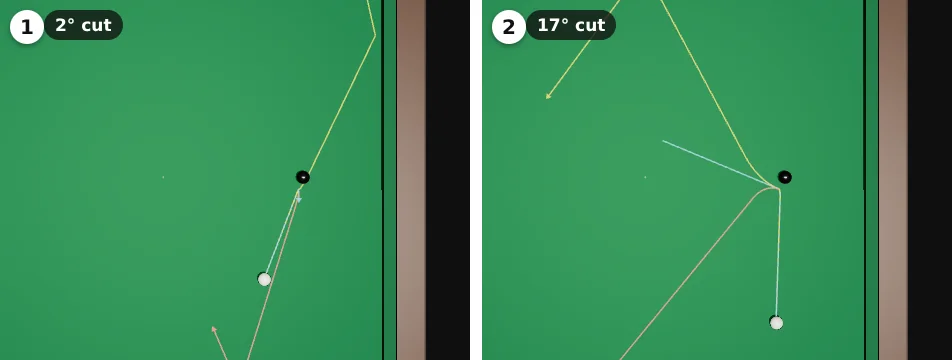
From each landing spot, pot the black three ways (screw, stun, follow):
| Black from… | The three routes reach… |
|---|---|
| almost straight (2° cut) | only 13 cm off one line |
| a 17° angle | up to 99 cm to the side |
Dead straight is easy to pot, but the white can only go forward or back along one line. A small angle lets it go across the table.
Trick: many coaches aim for about 15–30° on the next ball: enough to move the white, not so much that the pot gets hard.
4 · Watch it: follow into the zone
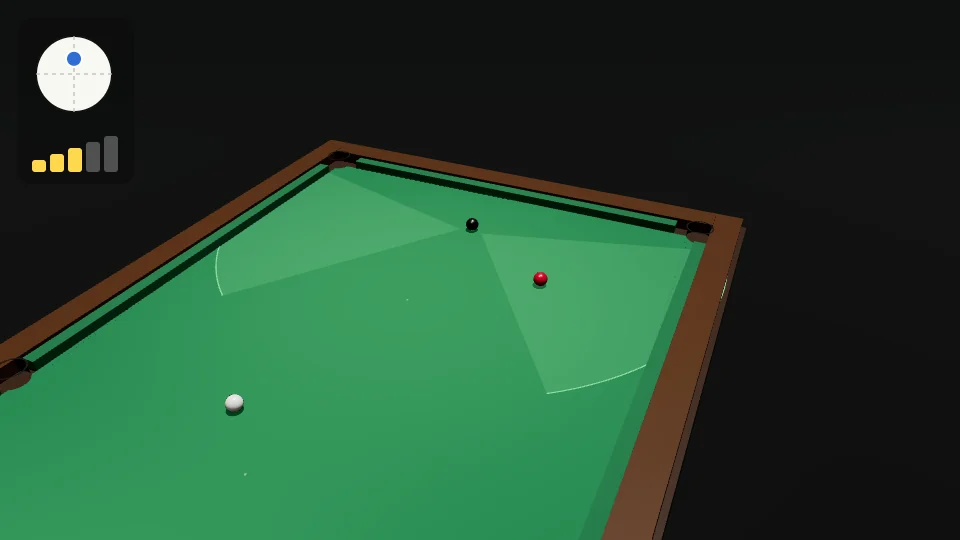
Above centre, power 3: the red drops, the white comes off the end cushion and lands in the green ✓.
5 · The right side of the ball
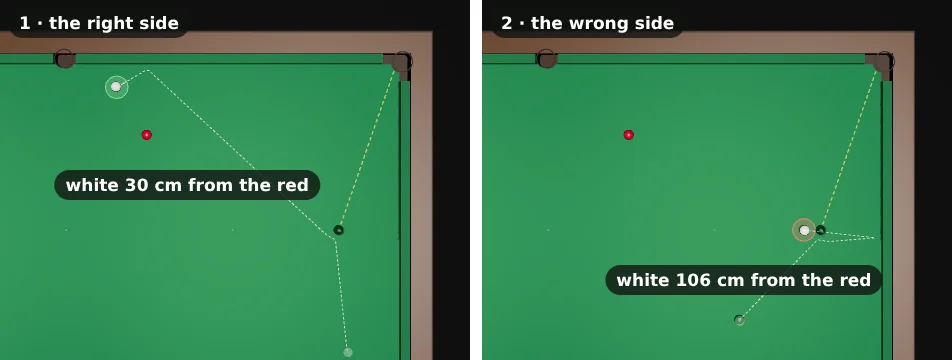
The same 25° cut on the black, from the two sides of the black's line to the pocket (model, power 3, a touch below centre):
| White on… | After the black it… | Next red |
|---|---|---|
| the right side (1) | runs off the end cushion up the table | 30 cm away ✓ |
| the wrong side (2) | comes back to the black's spot | 106 cm away ✗ |
The angle is the same; only the side of the line changes, and the white goes the opposite way. So the zone for position is half of the green: the half that sends the white towards the next ball.
6 · The natural path: change only the pace
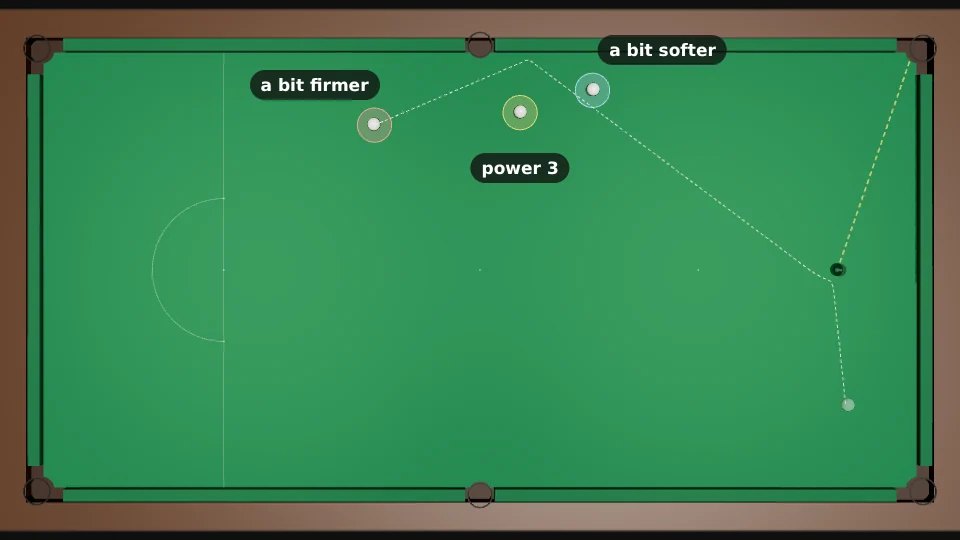
The white's natural path is where it goes with a plain centre-ball hit. Here, three paces of the same shot (model):
| Pace | Where the white stops |
|---|---|
| a bit softer (85%) | by the top side cushion, between the pink and the blue |
| power 3 | about 30 cm further on |
| a bit firmer (120%) | about 60 cm further again |
If the next ball is on the natural path, don't add spin: just choose the pace. It is the most accurate way to get position.
Chapter 2 — Planning
7 · Plan three balls ahead
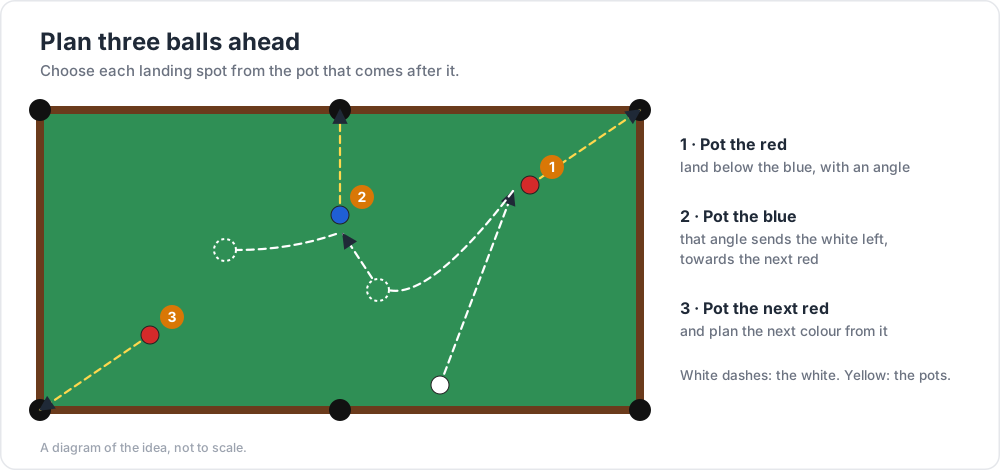
Work backwards:
- Where must the white be for pot 3 (the next red)?
- So which angle on pot 2 (the colour) sends it there?
- So where must pot 1 (this red) leave the white?
In snooker you choose the colour after each red. Choose the one whose angle sends the white towards the next red.
8 · Stay below the ball you need
Coaching advice: when you want to come back towards the next ball, land a little below it (on the side away from where you will go). Then the white comes back towards it with a natural angle. If you land level with it or past it, you have to screw back or go round the table.
This is the same idea as section 5: choose the side of the ball before you choose the spot.
9 · Choose the simplest shot
When two routes reach the zone, prefer:
- the natural path with pace only (section 6);
- then plain follow, stun or screw;
- side only when it opens a clearly better route (post 06).
Each extra thing (side, a very low tip, a long route round the table) adds a chance of missing the pot itself. The pot comes first: position is no use if this ball stays out.
10 · The checklist
Before every shot in a break:
| Ask | Why |
|---|---|
| Which ball next, and the one after? | three balls ahead (section 7) |
| Where is the zone, and which half? | the side that sends the white on (section 5) |
| Which route runs along the zone? | forgives pace (section 2) |
| Is there an angle left? | straight kills the next move (section 3) |
| Is the path clear? | kisses, pockets, the pack (post 10) |
| Can I pot this ball with that route? | the pot comes first (section 9) |
Try it at the table
| Drill | Set-up | Look for |
|---|---|---|
| Three routes | a red near a corner, the black on its spot | land in the zone with follow, then with screw |
| Pace ladder | the same follow route, softer and firmer | does it stay in the zone? |
| Angle ladder | the black from straight, 10°, 20°, 30° | how far you can send the white after it |
| Right side | the black at 25° from each side, a red up the table | which side brings the white to the red |
| Natural path | a 25° black, centre ball | three paces, three stopping spots |
| Line-up | three reds across the table, then the black | pot all four without losing the angle |
Cheat-sheet
| Zone | every place with a comfortable next pot; aim for its middle |
| Route | the one whose path runs along the zone |
| Angle | about 15–30° beats straight |
| Side of the ball | the half of the zone that sends the white on |
| Natural path | centre ball; choose the pace only |
| Plan | three balls ahead, backwards |
| Simplest | the pot comes first; side only when needed |
What's next
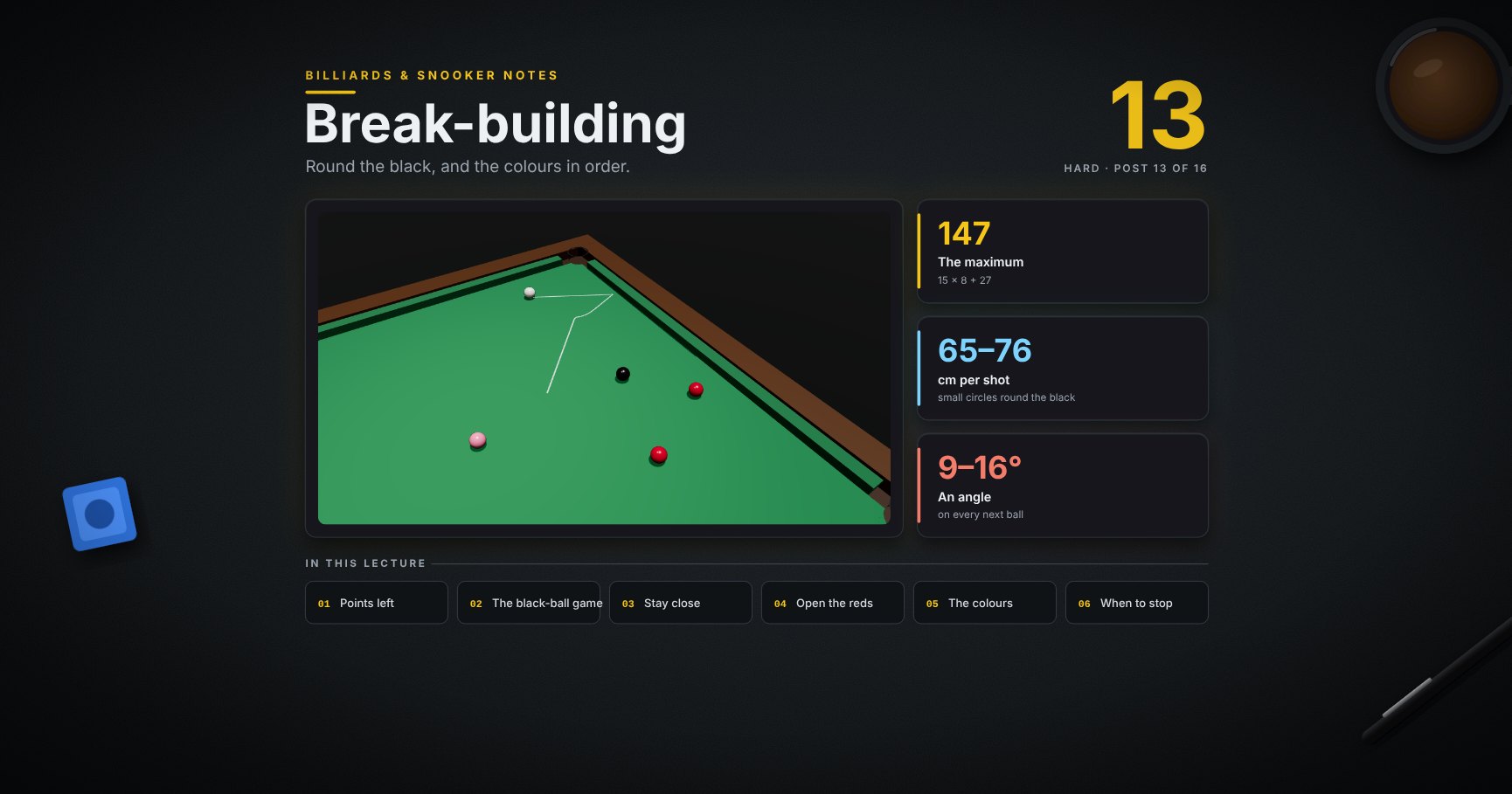
13 · Break-building. The whole frame: opening the reds, the black-ball game, clearing the colours, and scoring with a plan.
References
- Dr. Dave Alciatore, "position zones", natural angles and cue ball control. https://billiards.colostate.edu/
- Landing spots, pace errors and angles come from the physics model; your pace will vary, which is exactly why a zone beats a point. The 15–30° angle is coaching advice.
Note: this post is in progress. Planned additions: position off the cushion with side, and position into the middle pockets.