Billiards & Snooker — 11 · Safety
When there is no good pot, the best shot leaves your opponent nothing. This lesson covers what a good safety leaves, the break-off and why thickness is everything, a thin safety back behind a baulk colour, how exact the pace must be, why distance and cushions defend, the shot to nothing, soft safeties, and how to choose.
Series map. ★ Basics: 01 Cue action and elevation → 02 Aiming and potting → 03 Tip and power → 04 Where the white goes · ★★ Club: 05 Side spin → 06 Cut and side into pockets → 07 Cushions → 08 Doubles · ★★★ Advanced: 09 Escaping snookers → 10 Multi-ball shots → 11 Safety (this post) → 12 Position play · ★★★★ Hard: 13 Break-building → 14 Special shots · Reference: 15 Rules, tactics and practice · ★★★★★ Pro: 16 Cue-ball control.
Learning Outcome
- Know what a good safety leaves: the white far away, on a cushion, or behind a colour.
- Play a break-off, and miss on the thin side.
- Play a thin safety back to baulk, and judge its pace.
- Use distance and cushions as defence.
- Pick between safety options by what your opponent has next.
Chapter 1 — The idea
1 · What a good safety leaves
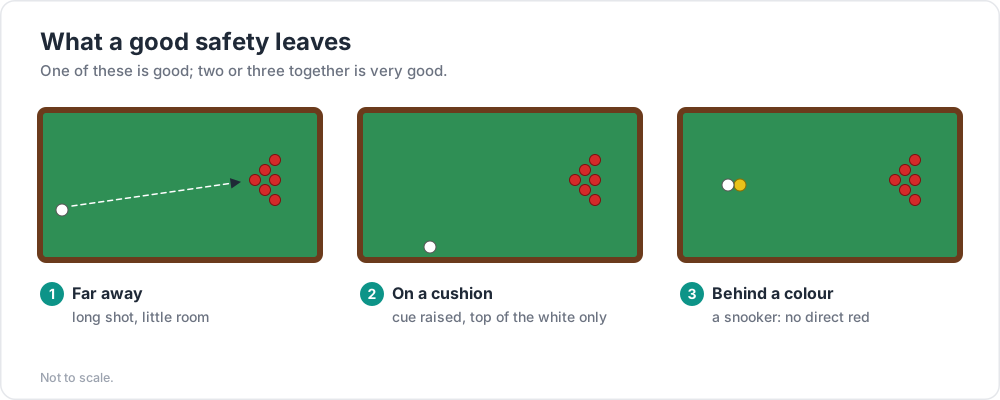
After a good safety your opponent has no easy pot, and the white is:
- far from the reds (a long shot has little room), or
- on a cushion (they must raise the cue and hit the top of the white), or
- behind a colour (a snooker: they cannot hit a red directly).
One of these is good. Two or three together is very good. You do not need a perfect snooker every time.
2 · Distance is defence
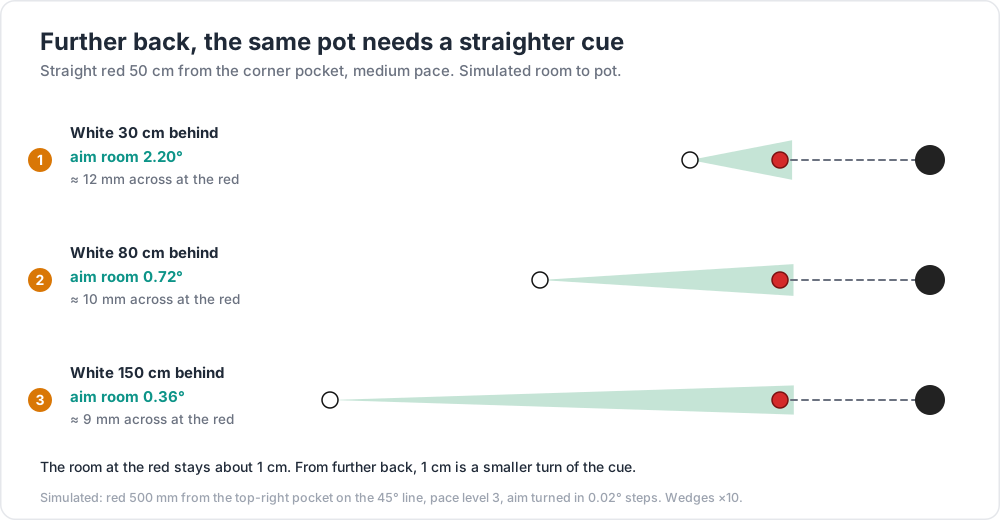
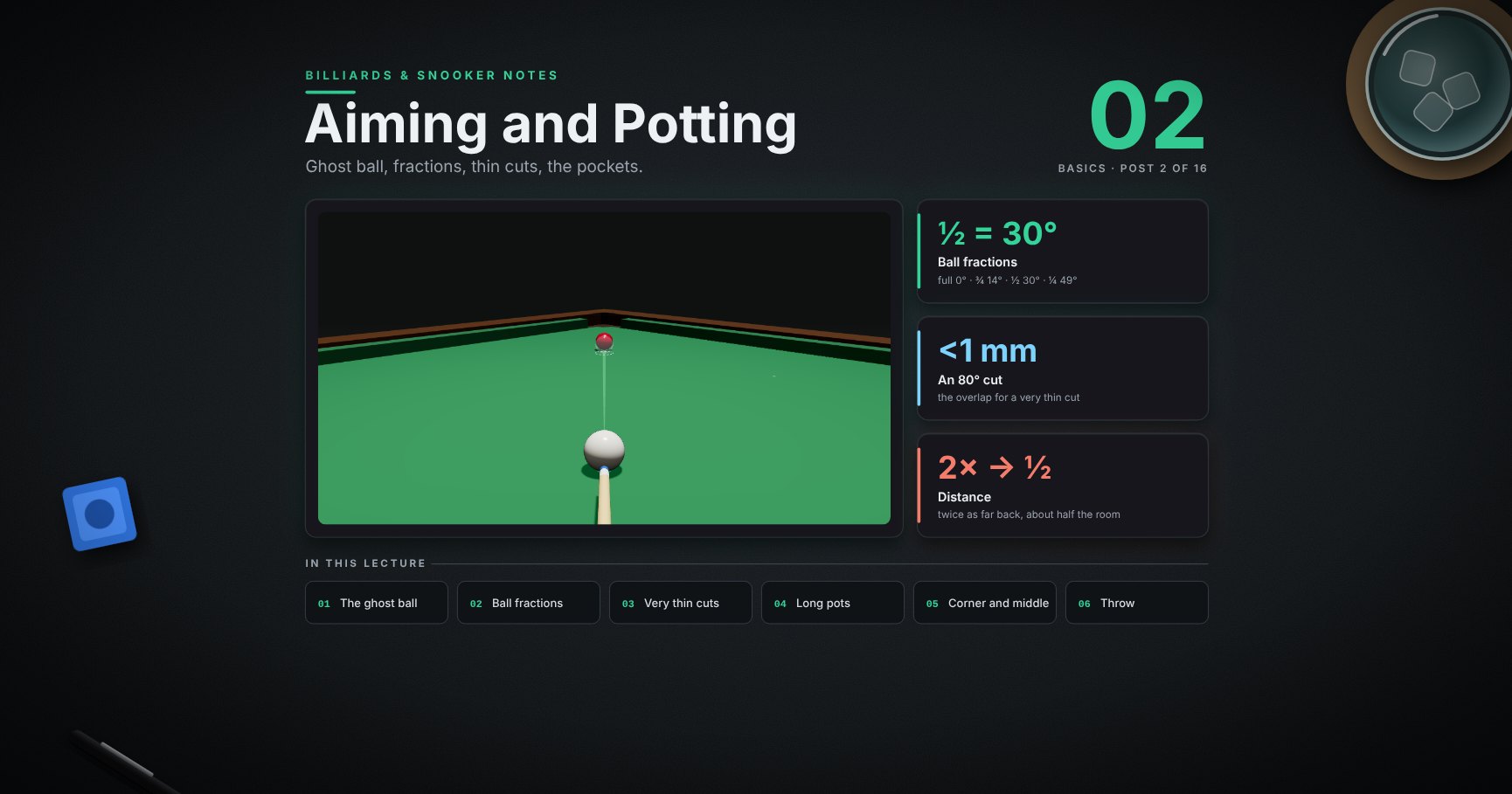
From post 02: the same pot from 30 cm has 2.20° of room, from 1.5 m only 0.36°. Every metre you put between the white and the reds makes your opponent's next shot much harder.
Chapter 2 — The break-off
3 · The break-off
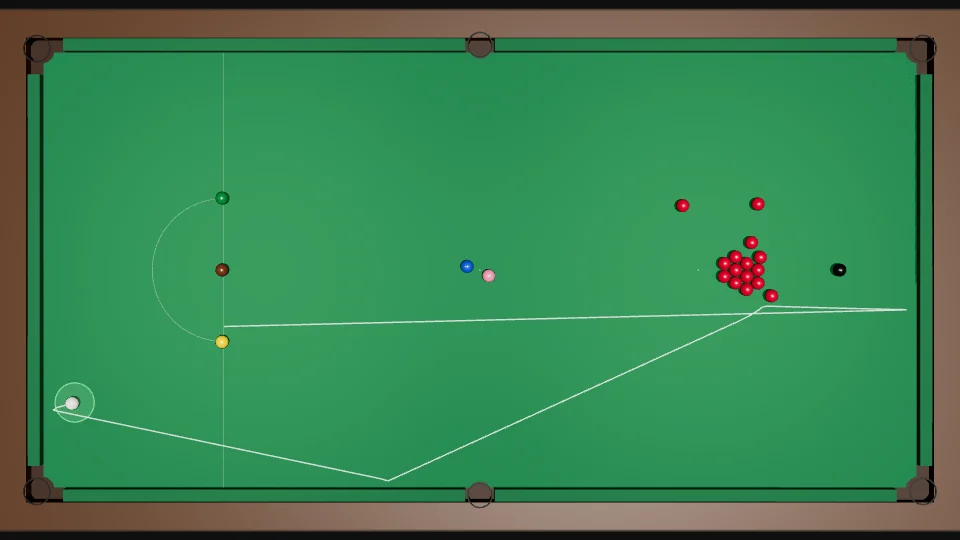
- White in the D, between the brown and the yellow.
- Aim to just clip the end red of the back row, on the outside.
- Power 4, a touch above centre.
- The white goes top cushion, side cushion, and back to the baulk end.
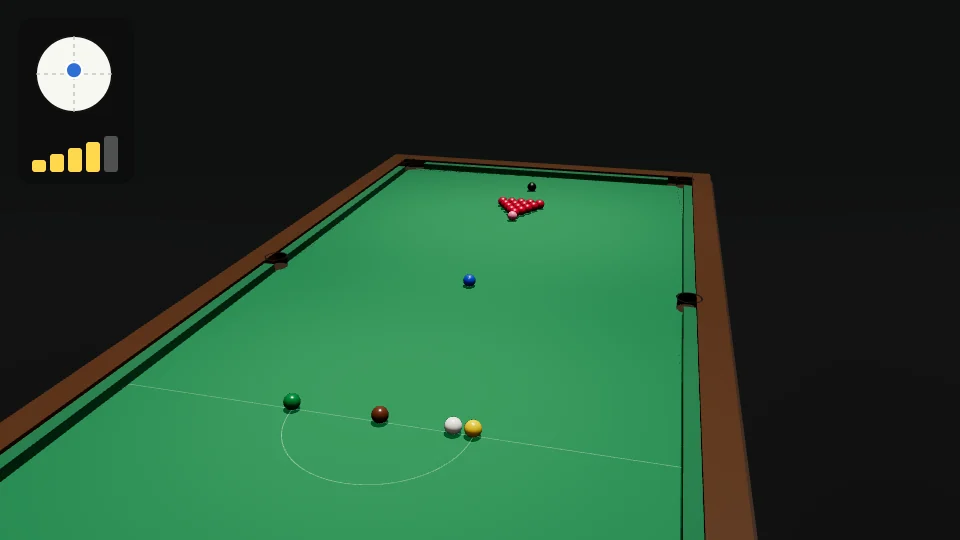
Only 3 reds move more than 4 cm, and the white stops in baulk near the cushion ✓ (model).
Trick: pick a mark on the top cushion where the white should land, and watch that mark, not the red, as you play.
4 · Thickness is everything
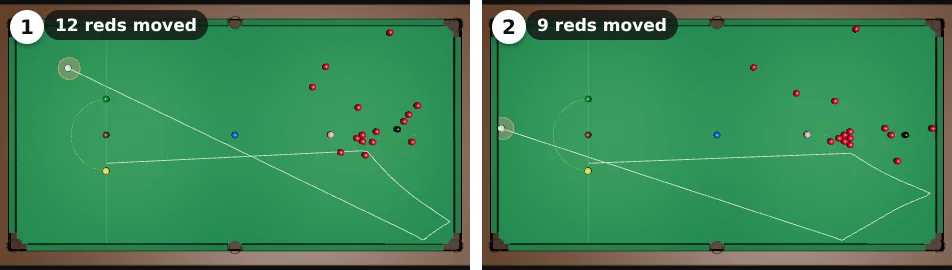
| Hit | White touches | Reds moved | White ends |
|---|---|---|---|
| just right | the end red | 3 | baulk end, near the cushion ✓ |
| a bit thick (2) | the end red | 9 | baulk cushion, but reds everywhere ✗ |
| too thick (1) | two reds | 12 | loose in baulk ✗ |
"Just right" and "a bit thick" are only 0.8° apart at the white. Miss on the thin side: a fraction too thin may miss the red (a foul, 4 points), but too thick opens the reds for your opponent.
Chapter 3 — Safety in the frame
5 · Thin off a red, back behind a colour
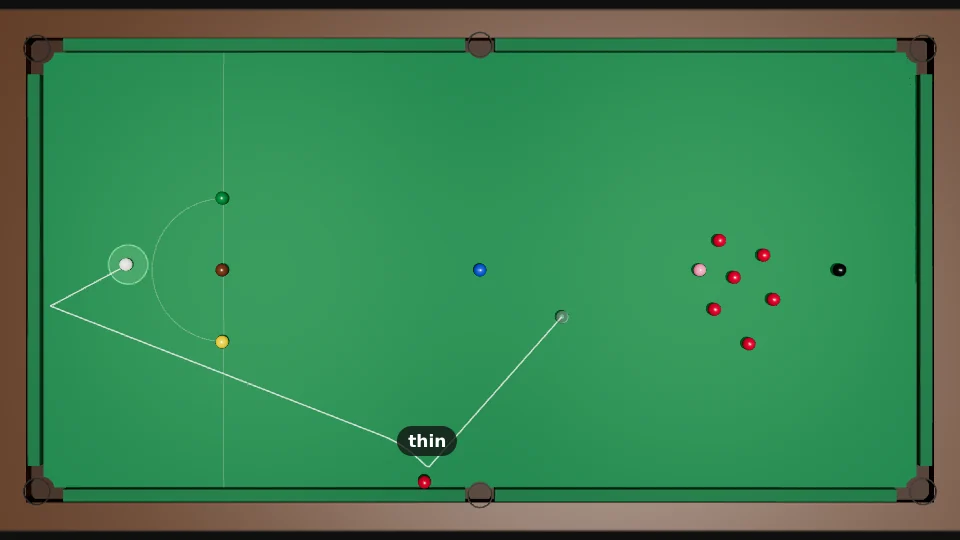
The same idea as the break-off, later in the frame. The reds are up the table; one red sits on the side cushion.
- Clip that red thin: it moves only 1 cm and stays on the cushion.
- The white comes off the cushion, runs to the baulk cushion and back.
- It stops about 35 cm behind the brown.
From there no red can be hit at both edges (post 09): the colours are in the way. A full snooker.
6 · Pace makes the snooker
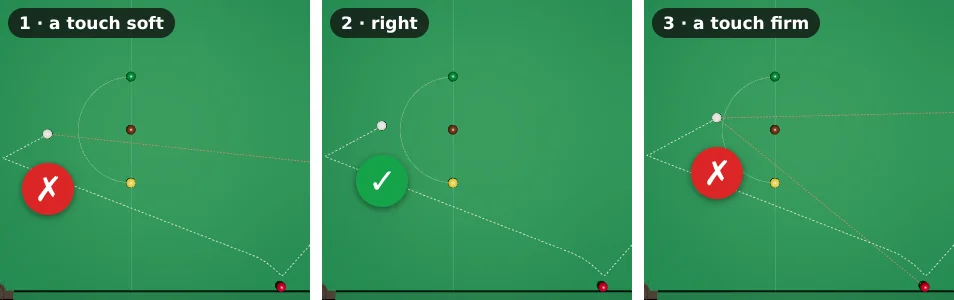
The same aim at different paces (model):
| Pace | The white ends | Reds it can hit |
|---|---|---|
| a touch soft | nearer the baulk cushion, off the line behind the brown | 1 ✗ |
| right | behind the brown | none ✓ |
| a touch firm | closer to the brown, but off to the side | 2 ✗ |
The snooker works over about 6% of the pace, somewhere between power 2 and power 3. Even when it misses by a little, the white is still in baulk, far from the reds: a good safety, just not a snooker.
Trick: pick the stopping spot first ("a ball behind the brown"), then play the pace for that spot. The aim is the easy part.
7 · Leave the white on a cushion
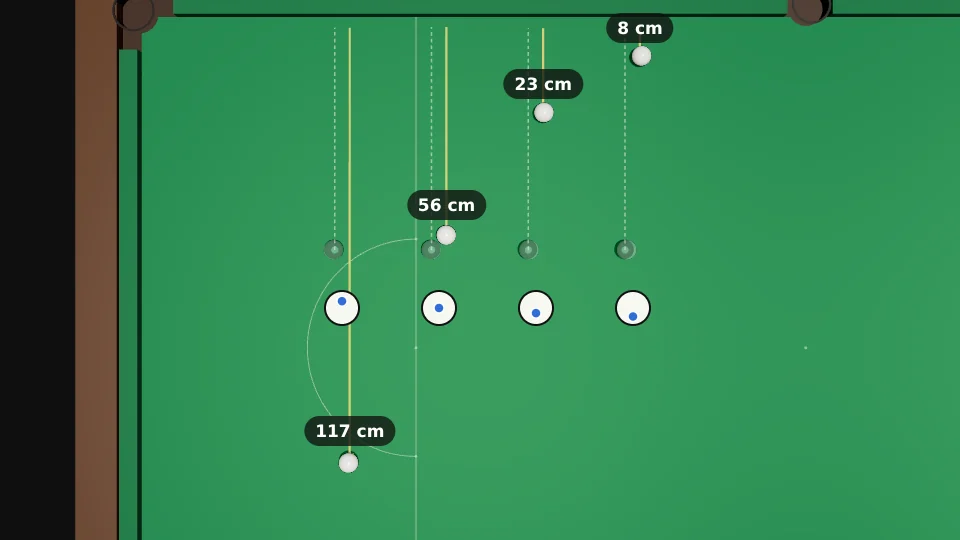
A white that dies on a cushion is hard to play from. Straight in with a low tip and soft pace, it comes back only 8 cm (post 07).
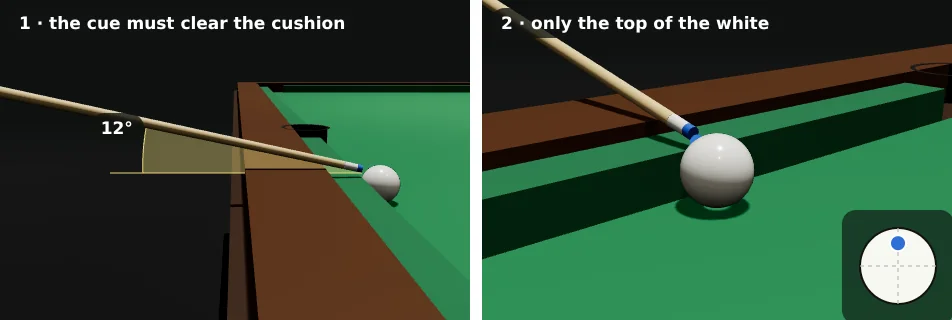
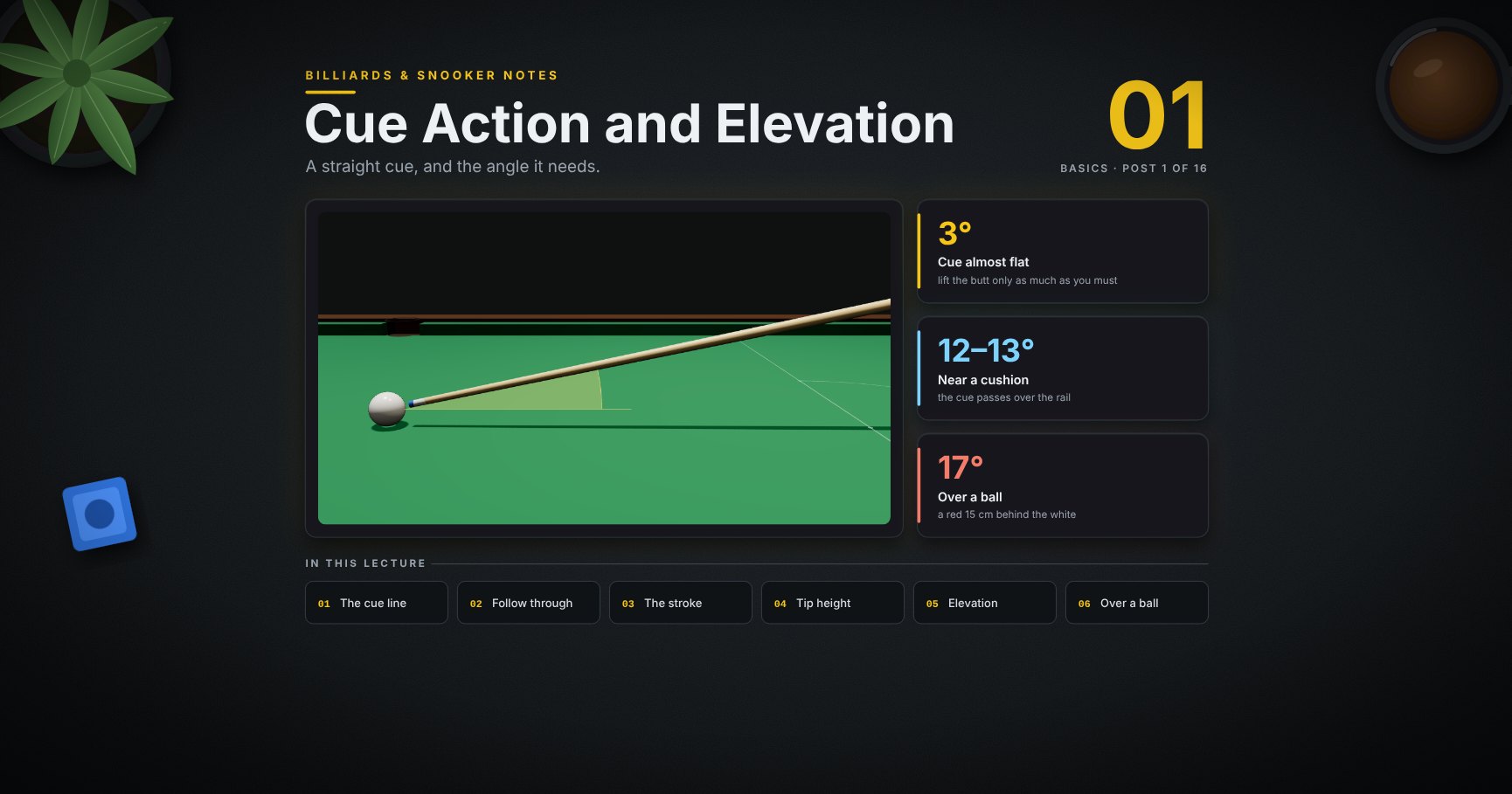
Your opponent then has to raise the cue about 12°, and hit the top of the white: no screw, no stun (post 07).
8 · A soft touch is a shot too
Snooker has no cushion rule: after the white hits a ball on, nothing has to reach a cushion (unlike pool). So a soft safety is legal:
- roll the white up to a red so it stops just behind it, or behind a colour next to it;
- nudge a red a few centimetres off a pocket;
- just touch a red in the pack and stay there.
A soft touch moves the fewest balls, so you know exactly what you leave.
Watch out: stopping touching a red is a special case (post 14). Your opponent may play away from it without hitting anything, which can be easy for them.
9 · The shot to nothing
A shot to nothing is a pot where the white goes somewhere safe whether it goes in or not (coaching advice):
- you play the pot at a pace that also sends the white back to baulk;
- if it goes in, you have a chance to build a break;
- if it misses, your opponent still faces a long shot.
Before a long pot, ask: "if this misses, where are the red and the white?" In the model, a long red into a top corner missed by 0.6° ran all the way back to baulk, so check where the red ends, not just the white.
10 · Choosing a safety
| Option | When | The idea |
|---|---|---|
| thin off a red, white to baulk | the reds are up the table | like the break-off: thin contact, the white runs back off the cushions |
| behind a colour | a colour is near the line back | a snooker (section 5) |
| white on a cushion | a straight line into a cushion is open | low tip, soft pace |
| put the red safe | a loose red is near a pocket | send it to a cushion away from the pockets, the white the other way |
| soft touch | the reds are tight | move as little as possible |
For each option ask: "what does my opponent have next?" Choose the one that leaves the least, and the one you can play.
Try it at the table
| Drill | Set-up | Look for |
|---|---|---|
| Break-off | a full rack; the white between the brown and yellow | back in baulk, three or fewer reds out |
| Thickness ladder | the same, a hair fuller each time | at which thickness the pack opens |
| Behind the brown | a red on the side cushion near the middle pocket, the white mid-table | the white stops behind the brown |
| Pace ladder | the same, ten shots | how many end in a full snooker |
| Dead on the cushion | straight into a cushion from 60 cm, low tip, power 2 | the white within 10 cm of the cushion |
| Soft touch | the white 50 cm from a red | stop within 5 cm, not touching |
Cheat-sheet
| Good safety | far away · on a cushion · behind a colour |
| Distance | 30 cm 2.20° of room, 1.5 m only 0.36° |
| Break-off | thin on the end red, power 4, top → side → baulk |
| Thickness | 0.8° fuller already opens 9 reds; miss thin |
| Snooker | pick the stopping spot, then play the pace (about 6% of room) |
| Cushion | low tip, soft: dies near the cushion |
| Soft touch | legal; no cushion rule in snooker |
| Shot to nothing | the white safe whether it goes in or not |
| Choose | what does my opponent have next? |
What's next
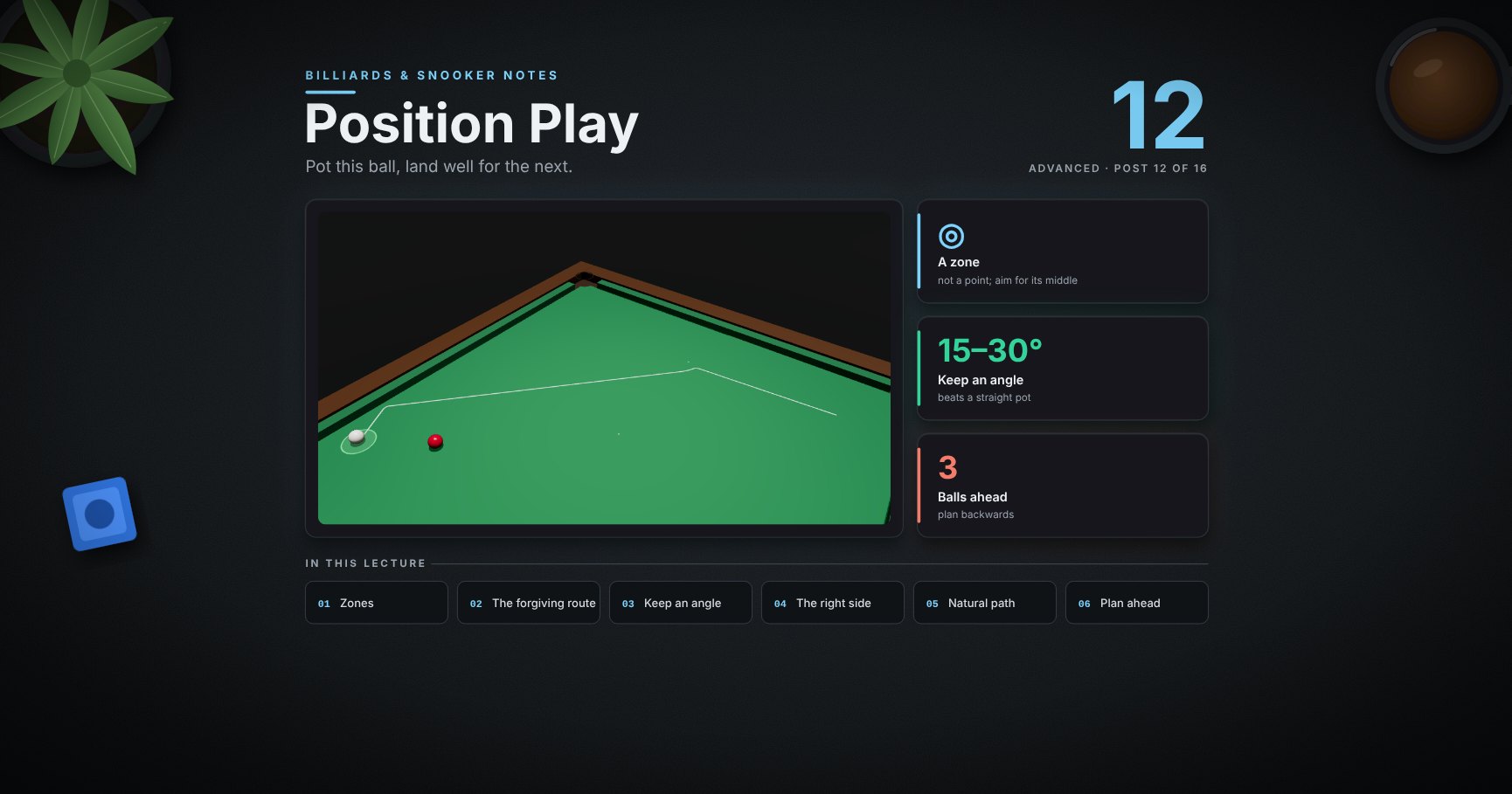
12 · Position play. Pot this ball and land the white in the right place for the next one.
References
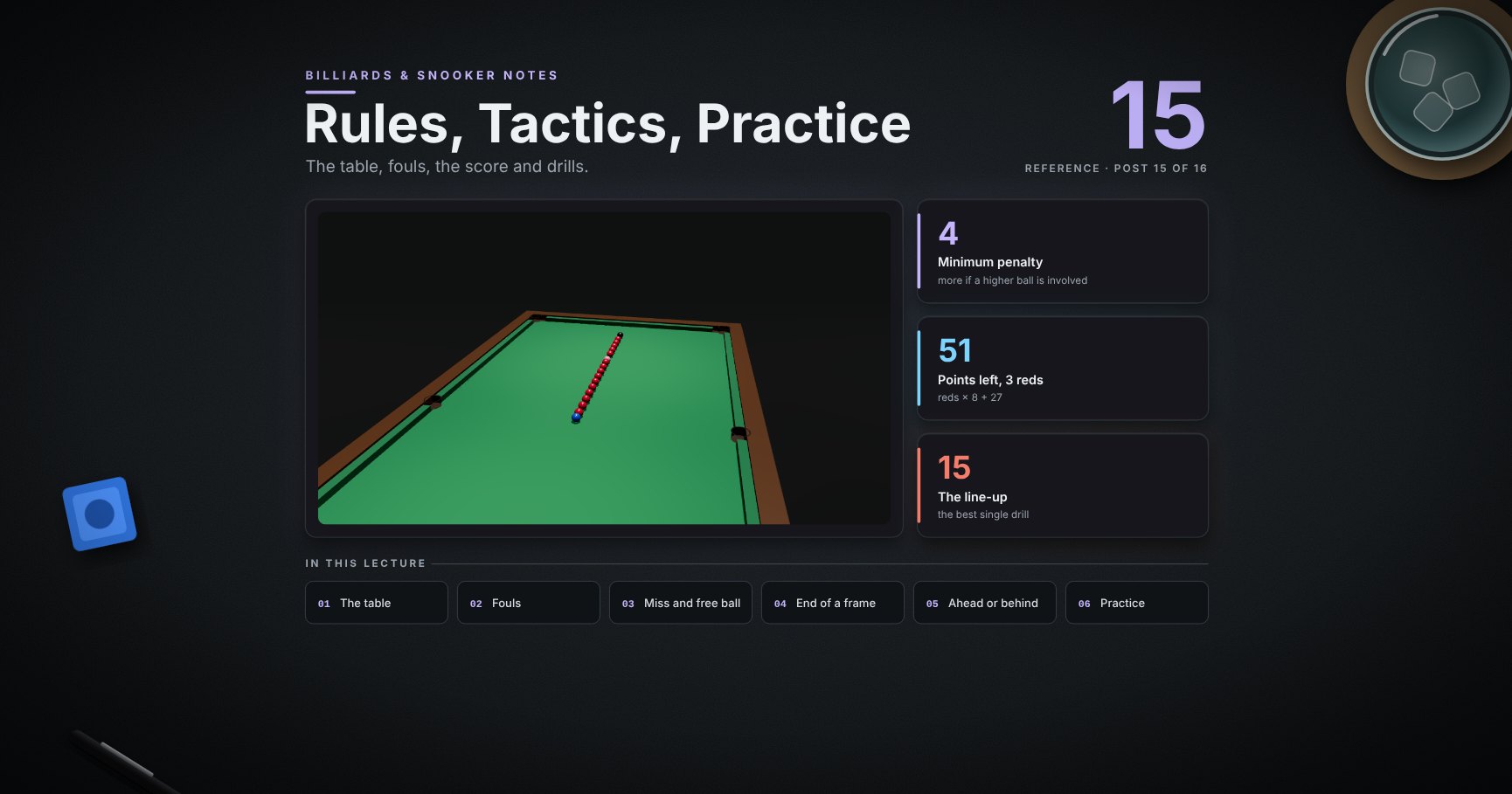
- WPBSA, Official Rules (2024-25): the opening stroke, snookered (Section 2 Rule 17), fouls and penalties. https://www.wpbsa.com/rules/
- Dr. Dave Alciatore, safety play and the effect of hit thickness on cue ball direction. https://billiards.colostate.edu/
- The break-off, the thin safety and its pace window come from the physics model with a tightly racked pack. How far reds move in a real break depends on the rack, and your pace window depends on your cloth; the trends are the same.
Note: this post is in progress. Planned additions: a roll-up snooker behind a colour, and putting a red safe on the top cushion.