Billiards & Snooker — 10 · Multi-ball Shots
Real frames have many balls, and the ball you hit is not always the one that goes in. This lesson covers two touching balls (the set and the tangent kiss), plants with two ghost balls and why they are hard, how the gap changes a plant, using a cannon to stop the white, and the white meeting the pack: potting and splitting, and how pace decides how far the reds spread.
Series map. ★ Basics: 01 Cue action and elevation → 02 Aiming and potting → 03 Tip and power → 04 Where the white goes · ★★ Club: 05 Side spin → 06 Cut and side into pockets → 07 Cushions → 08 Doubles · ★★★ Advanced: 09 Escaping snookers → 10 Multi-ball shots (this post) → 11 Safety → 12 Position play · ★★★★ Hard: 13 Break-building → 14 Special shots · Reference: 15 Rules, tactics and practice · ★★★★★ Pro: 16 Cue-ball control.
Learning Outcome
- Know where two touching balls go: the line of centres and the tangent.
- Spot a set and a tangent kiss, and allow for throw on long ones.
- Aim a plant with two ghost balls, and judge how hard it is.
- Use a cannon to stop the white.
- Pot a red and open the pack, with the right pace.
Chapter 1 — Two touching balls
1 · Where each ball goes
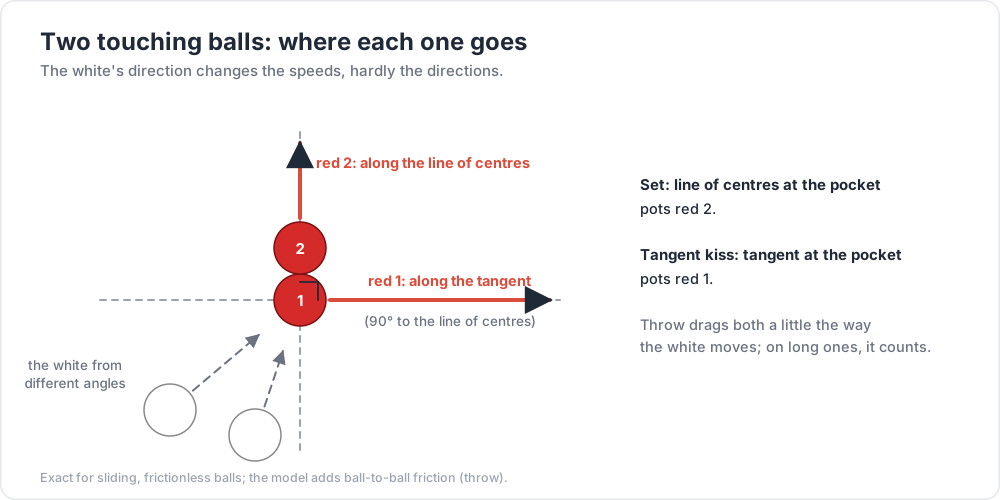
When the white hits red 1 and red 1 is touching red 2:
- Red 2 leaves along the line of centres (through both centres).
- Red 1 leaves along the tangent, at 90° to that line.
Where the white comes from changes how fast each one goes, and hardly where. That gives two pots from one pair.
2 · The set: line of centres at the pocket
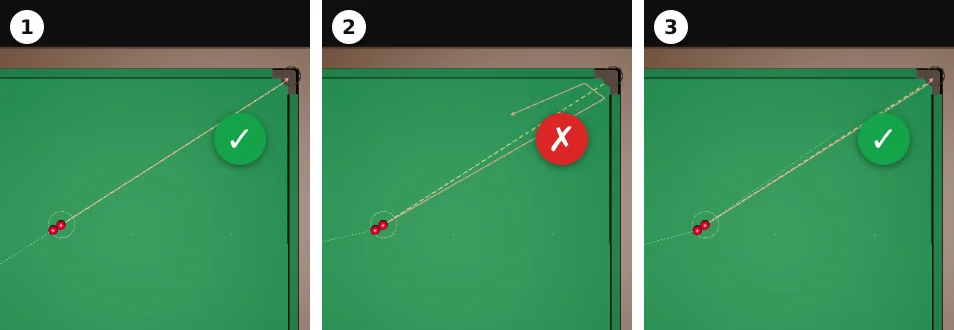
A set is "on" when the line of centres points at the pocket. "Hardly" is not "never": red 1 rubs red 2 and drags it a little the way red 1 is moving (throw, post 04). Over 1.5 m (model):
| White comes in… | Red 2 dragged by | Result |
|---|---|---|
| along the line (1) | 0° | ✓ |
| 10° to the side | 1.4° | ✓ |
| 20° to the side (2) | 2.9° | ✗ |
| 30° to the side | 3.0° | ✗ |
Trick: the drag can help. A set that points 2.5° wide (picture 3) goes in when played from the side that drags it back, here anywhere from 10° to 40°. Straight on, it misses.
3 · The tangent kiss: tangent at the pocket
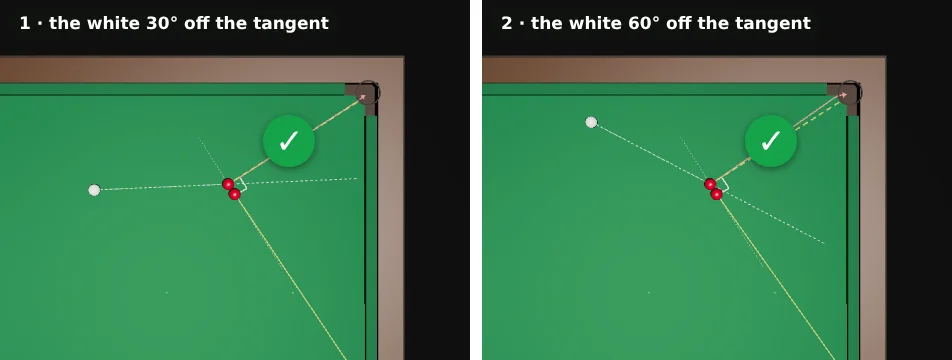
Here the line of centres does not point at the pocket, so red 2 is no set. But red 1's tangent does. Hit red 1 into red 2 and red 1 runs off along the tangent (model, power 3, 70 cm from the pocket):
| White comes in, off the tangent | Red 1 leaves, off the tangent | Result |
|---|---|---|
| 15° | 1.1° | ✓ |
| 30° (1) | 0.2° | ✓ |
| 45° | 0.6° | ✓ |
| 60° (2) | 1.7° | ✓ |
| 75° | 4.6° | ✗ |
A huge window: almost any full hit pots it. Only when the white comes in nearly along the line of centres does the throw pull red 1 off.
Watch out: red 2 goes somewhere too. Check its path for pockets and for balls you need later.
Chapter 2 — Plants
4 · A plant: two ghost balls
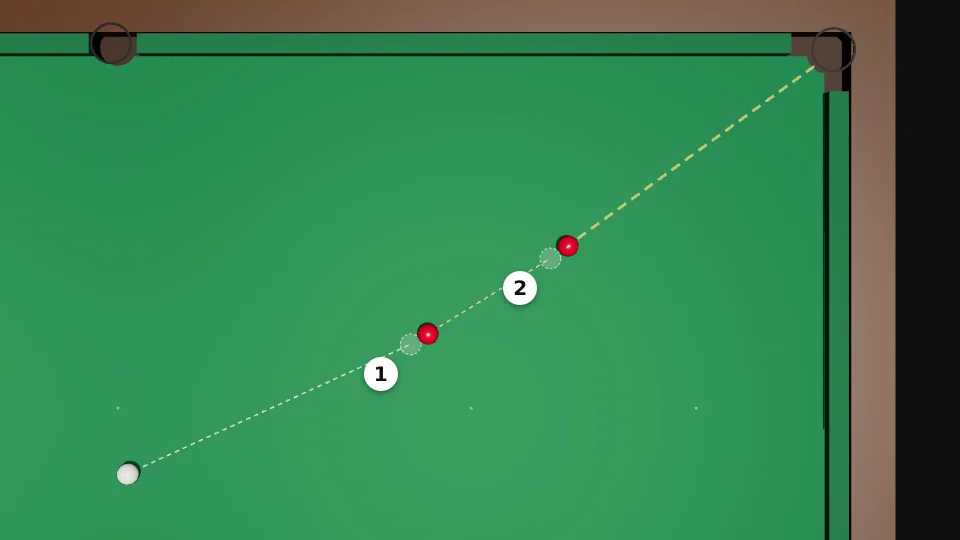
When the two reds are apart, it is a plant. Work backwards from the pocket:
- Ghost ball 2: where red 1 must be when it touches red 2.
- Ghost ball 1: where the white must be when it touches red 1.
- Aim the white at ghost ball 1, like any pot.
Watch out: throw happens twice. Here the plain ghost-ball aim needed a turn of 0.08°. Small, but this plant has no room to spare.
5 · Small errors grow
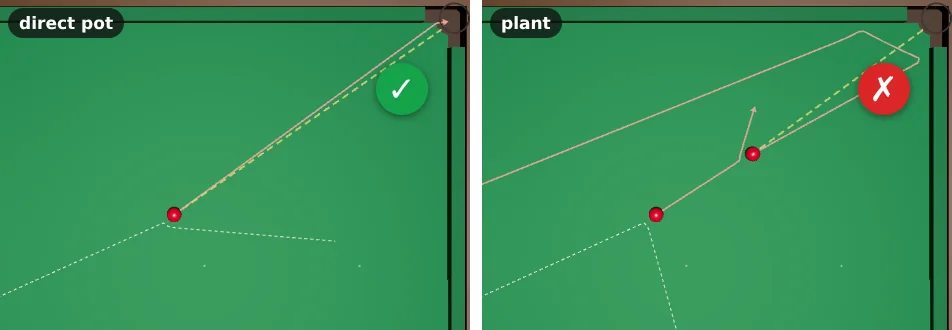
From the same white (model):
| Room in the aim | |
|---|---|
| direct pot of red 1 into the corner | 0.24° |
| the plant | 0.08°, 3 times less |
Aim 0.1° off (1.4 mm sideways at red 1): the direct pot still drops, the plant misses. Every ball in the chain passes the error on and makes it bigger.
6 · The gap matters
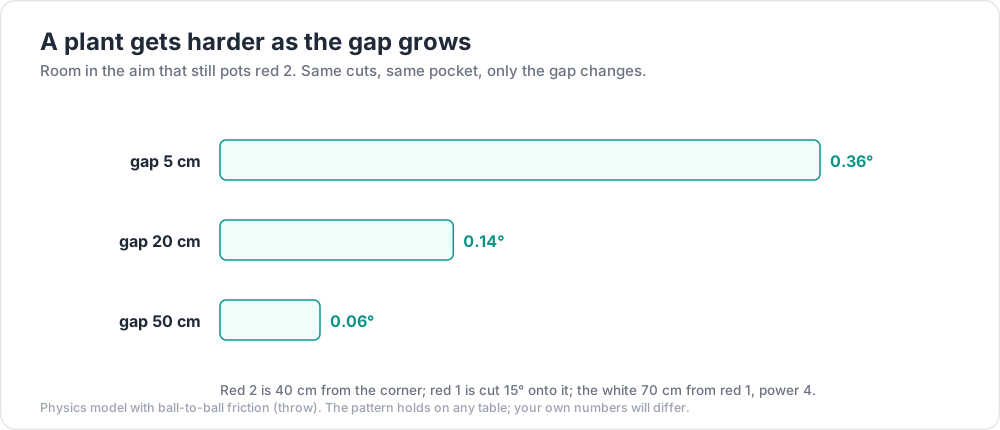
The same plant with only the gap between the reds changed (model: red 2 40 cm from the corner, both cuts 15°, power 4):
| Gap | Room |
|---|---|
| 5 cm | 0.36° |
| 20 cm | 0.14° |
| 50 cm | 0.06° |
Ten times the gap, about six times less room. Plants are best when the reds are close together, red 2 is close to the pocket, and red 1 is hit nearly full.
7 · Watch it: the plant
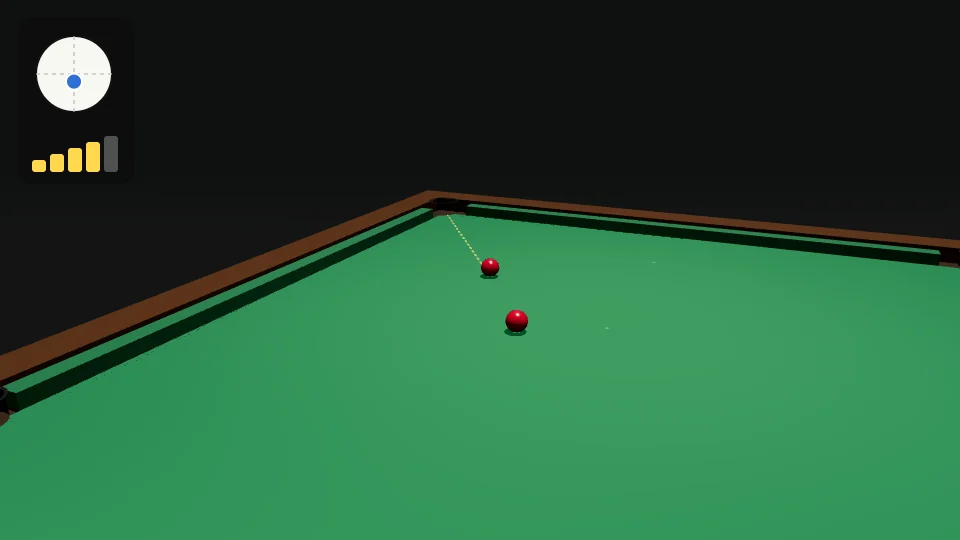
Power 4, a little below centre. Pocket, ghost 2, ghost 1, then aim ✓.
Chapter 3 — Cannons and the pack
8 · A cannon to stop the white
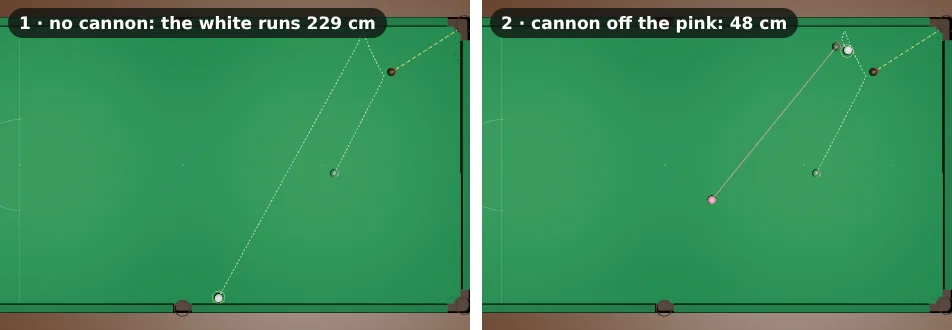
A cannon is the white hitting a second ball after the first. It is legal as long as the first ball was a ball on and nothing else goes in.
| The white travels after the red (model, power 4, centre ball) | |
|---|---|
| 1 · no cannon | 229 cm, to near the bottom middle pocket |
| 2 · cannon on the pink (about ¾ ball) | 48 cm; the pink moves 127 cm |
A fuller cannon takes more pace off the white. Use it to stop the white near the reds, or to knock a colour into a better spot.
Watch out: if the cannoned ball goes in, it is a foul (the pink: 6 points). Check its path too.
9 · Pot a red and open the pack
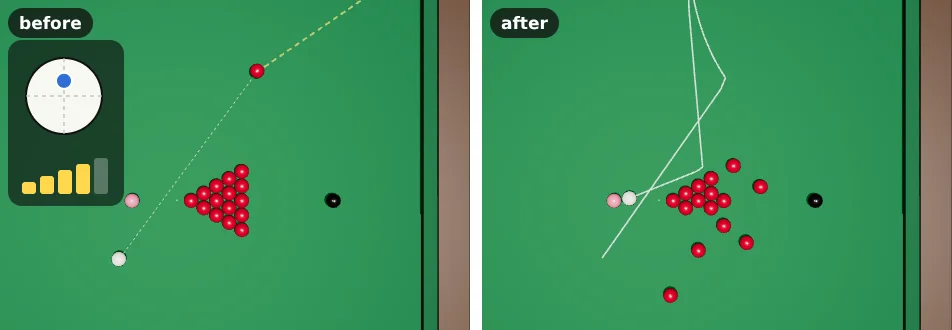
Early in a frame the reds sit in a pack. You need them open, but not all over the table. One shot can do both: pot a loose red and let the white run on into the pack.
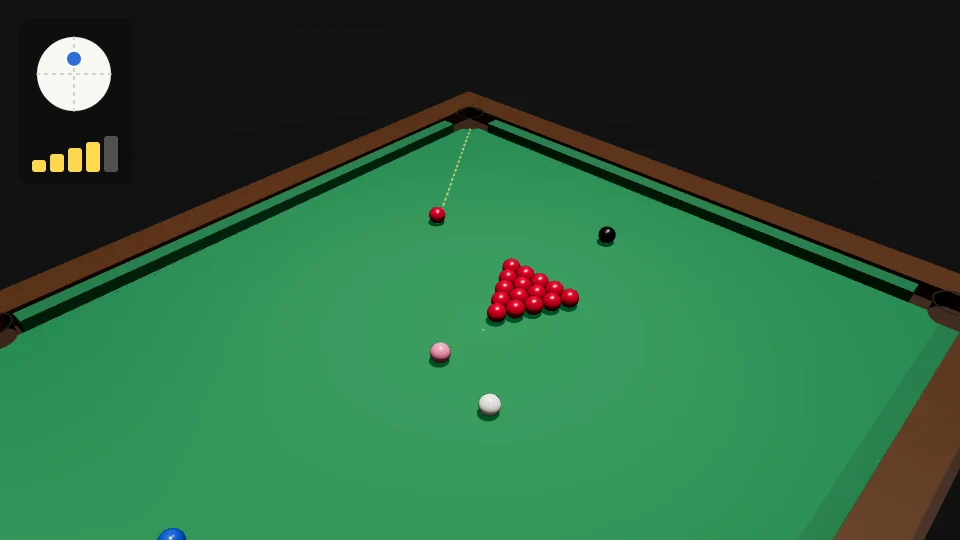
A cut of about 20°, top spin, power 4. The red goes in ✓, the white comes off the side cushion into the pack, and four reds come out by more than 6 cm. The pack also stops the white: it ends near the pink.
10 · Pace decides how far the pack opens
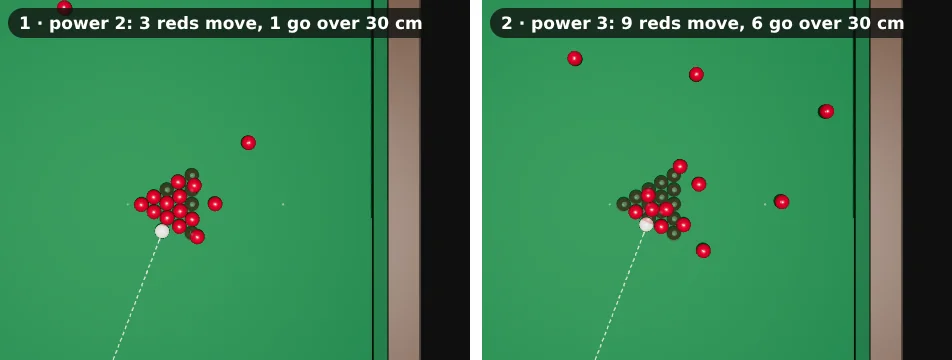
The same white into the side of the pack, 70 cm away, full on the middle red of that side (model):
| Power | Reds moved (over 6 cm) | Went over 30 cm |
|---|---|---|
| 2 | 3 | 1 |
| 3 | 9 | 6 |
One step of pace is the difference between "a few reds out" and "reds everywhere". Spread reds are good when you are in and building a break (post 13), and bad when you might miss and leave them to your opponent.
Trick: pick the pace first, then the spot on the pack the white should meet. Where the white stops matters as much as how many reds come out.
11 · Check the white's whole path, and choose
Before any multi-ball shot, trace every ball:
| Question | Why |
|---|---|
| Does the white pass close to another ball? | a kiss or cannon changes its path, or sends a ball into a pocket |
| Where does the second ball go? | a set or kiss sends the other ball somewhere too |
| Does the white end touching a ball? | awkward next shot (post 14) |
| Is the plant short and close together? | if long and wide, look for a direct pot or a safety (post 11) |
A missed plant often leaves two reds near a pocket for your opponent. Play it when it is short, or when nothing else is on.
Try it at the table
| Drill | Set-up | Look for |
|---|---|---|
| Set check | two touching reds 1 m from a corner, pointing at it | from straight behind, then 10°, 20° and 30° to the side |
| Use the drag | the same set turned a little wide | find the side and angle that pot it |
| Tangent kiss | two touching reds, the tangent of one at a corner | pot it from three different angles |
| Short plant | two reds 5 cm apart, 40 cm from a pocket | five in a row |
| Gap ladder | the same, gap 20 cm, then 50 cm | how fast it gets harder |
| Cannon | a red near a corner; a colour on the white's path | stop the white near the colour |
| Pack pace | the white into the side of the pack, power 2 then 3 | how many reds come out |
Cheat-sheet
| Touching balls | second ball: line of centres · first ball: tangent |
| Set | line of centres at the pocket; long sets drag the way the first ball moves |
| Tangent kiss | tangent at the pocket; a big window |
| Plant | ghost 2, then ghost 1, then aim; errors grow through the chain |
| Gap | 5 → 50 cm: about six times less room |
| Cannon | legal after a ball on; a fuller cannon stops the white more |
| Pack | one step of pace = a few reds or reds everywhere |
| Always | trace every ball's path |
What's next
11 · Safety. When there is no pot: leave the white far away and the reds tight.
References
- Dr. Dave Alciatore, the 90° rule, frozen-ball combination throw, combination (plant) aiming, and cue ball control into a cluster. https://billiards.colostate.edu/
- WPBSA, Official Rules (2024-25): penalty for potting a ball not on (Section 3 Rule 11). https://www.wpbsa.com/rules/
- Throw angles, rooms, the cannon and the pack come from the physics model with Alciatore's ball-to-ball friction fit. Clean, polished balls throw less; how a real pack opens depends on how tight it was racked.
Note: this post is in progress. Planned additions: plants with the white on a cushion, and sets inside the pack.