Billiards & Snooker — 05 · Side Spin
Side is the tip left or right of centre. It is powerful and easy to misuse. This lesson takes it apart: where side goes on the white, how it mixes with follow and screw, squirt and swerve one at a time and together, how pace changes them, throw on the object ball, what side does at the cushion, two ways to aim with side, and when to leave it alone.
Series map. ★ Basics: 01 Cue action and elevation → 02 Aiming and potting → 03 Tip and power → 04 Where the white goes · ★★ Club: 05 Side spin (this post) → 06 Cut and side into pockets → 07 Cushions → 08 Doubles · ★★★ Advanced: 09 Escaping snookers → 10 Multi-ball shots → 11 Safety → 12 Position play · ★★★★ Hard: 13 Break-building → 14 Special shots · Reference: 15 Rules, tactics and practice · ★★★★★ Pro: 16 Cue-ball control.
Learning Outcome
- Put side on the white, alone or with follow or screw, inside the safe zone.
- See squirt and swerve separately, and know when they cancel.
- Know how pace and a raised cue change where the white arrives.
- Know that side throws the object ball the other way.
- See that side does its main work at the cushion: running side and check side.
- Aim with side two ways, and use it only when you need it.
Chapter 1 — What side is
1 · Side: the tip left or right of centre
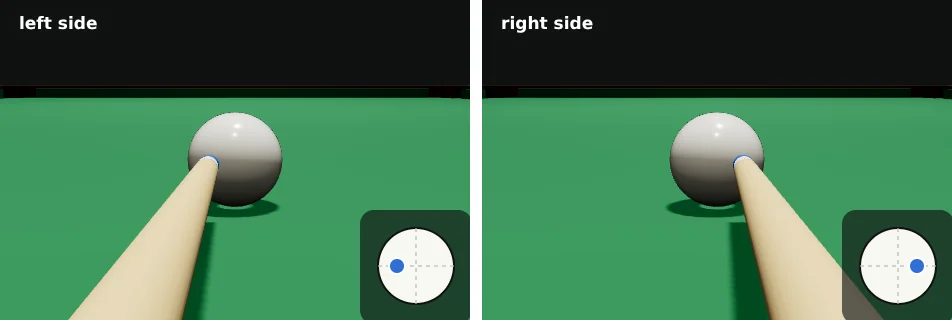
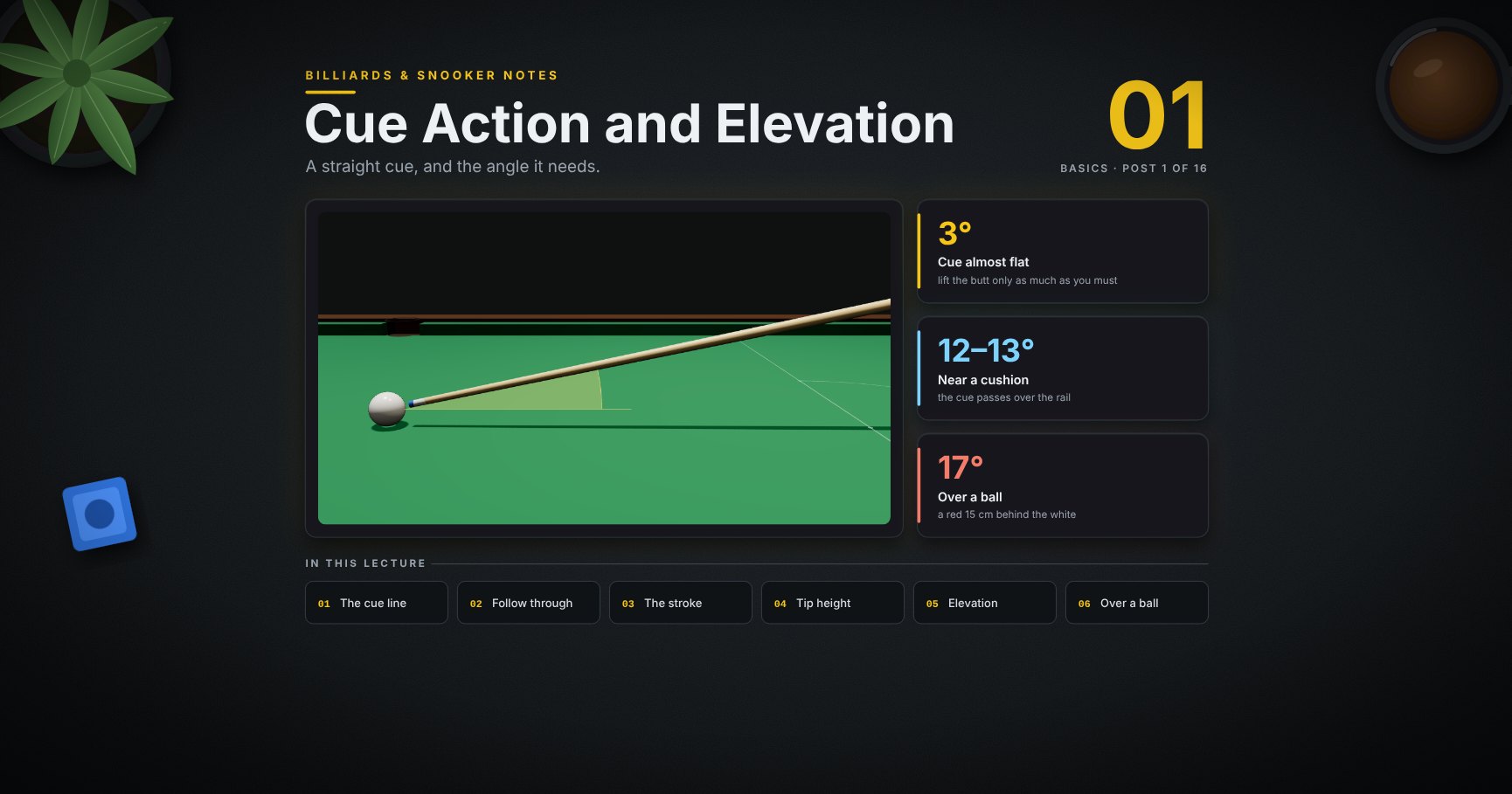
Move the whole cue sideways, parallel to your line, and strike left or right of centre. Keep the tip within about half-way to the edge (the safe zone, post 03). The pictures in this post use half-way side.
Watch out: don't just turn the butt to reach the side. That points the cue off the line (see section 9 for when this is done on purpose).
2 · Side mixes with follow and screw
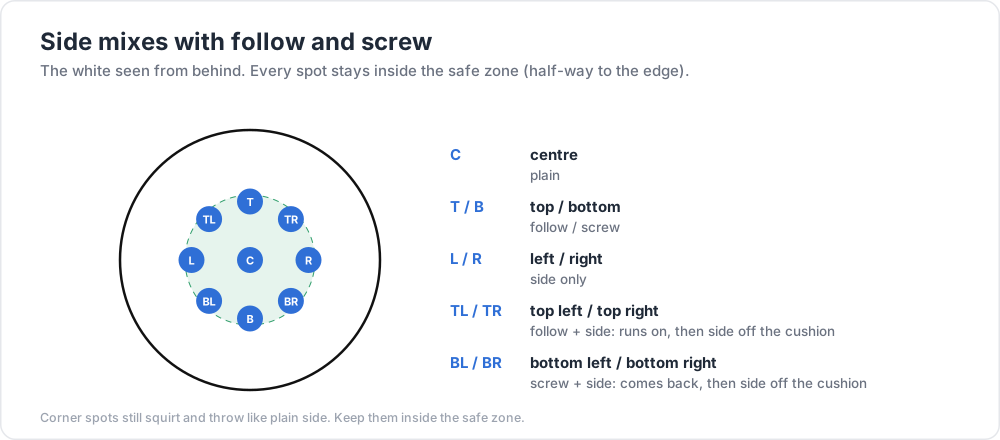
The tip can go anywhere in the safe zone. The corners mix two effects:
- Top right / top left: follow, then side off the cushion.
- Bottom right / bottom left: screw, then side off the cushion.
Everything below about squirt, swerve and throw applies to the corner spots too.
Chapter 2 — What side does to the white
3 · Squirt: the white starts away from the side
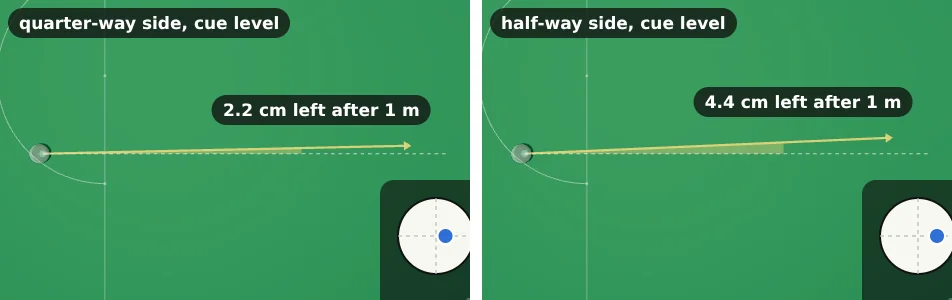
Hit right of centre and the white leaves a little to the left: away from the side. In the model (a typical snooker cue):
| Side | Squirt angle | Off line after 1 m |
|---|---|---|
| quarter-way | 1.25° | 2.2 cm |
| half-way | 2.5° | 4.4 cm |
Squirt depends on the cue (a stiffer, heavier tip end squirts more). Yours may be more or less; the test is in the drills.
4 · Swerve: then it curves towards the side
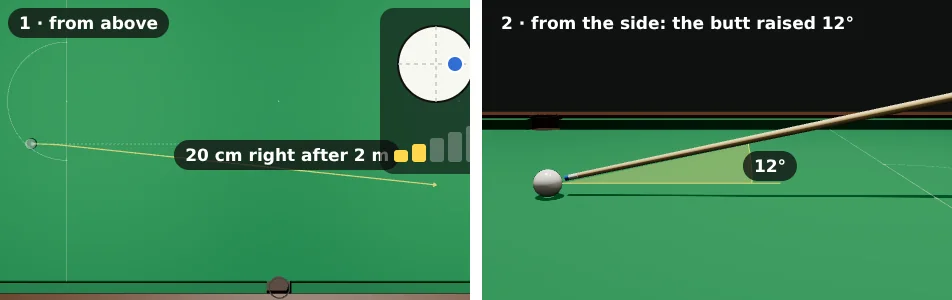
While the white slides, side spin and the cloth curve it back towards the side. The more the butt is raised, the more it curves. In the model, with squirt switched off so you see swerve alone (right side, power 2):
| Cue raised | Off line after 2 m (to the right) |
|---|---|
| 5° (nearly level) | 8 cm |
| 12° | 20 cm |
The curve happens while the white slides. Once it rolls, it runs straight on in its new direction.
5 · Squirt and swerve together
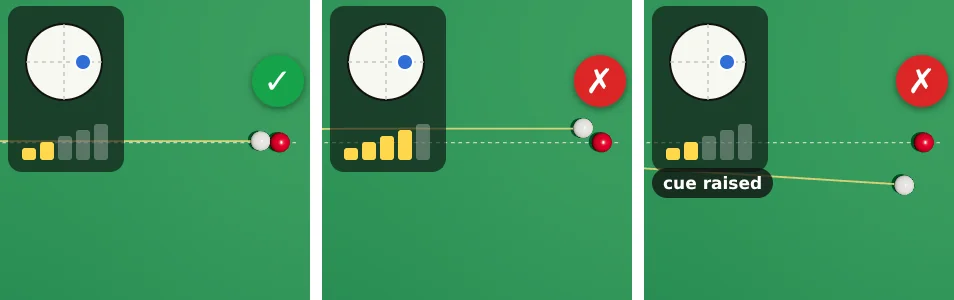
Real shots have both: squirt first (left), then swerve (right). Aimed straight at a red 2 m away with right side:
| Shot | What wins | Where the white arrives |
|---|---|---|
| power 2, cue nearly level | they almost cancel | on the line ✓ |
| power 4, cue nearly level | squirt | too far left ✗ |
| power 2, cue raised | swerve | far right ✗ |
6 · Pace changes it
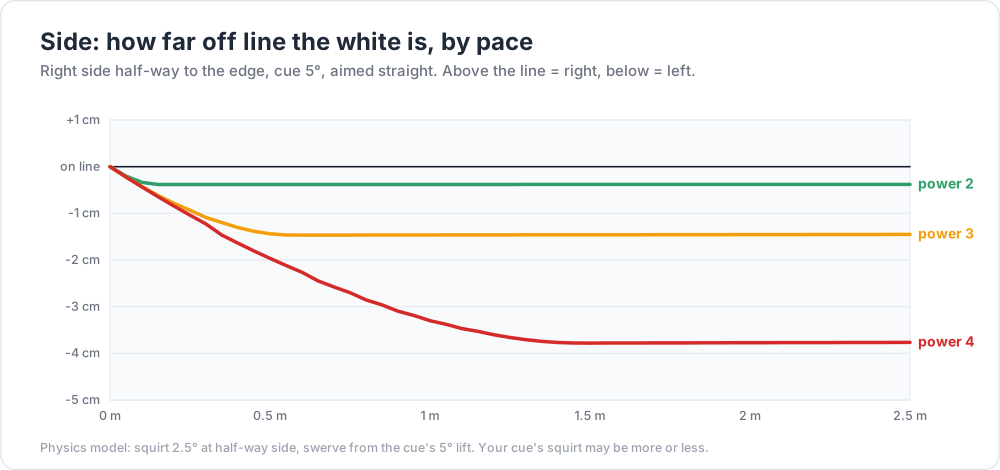
The same right side, the same nearly level cue (5°), three paces (model):
| Power | Off line after 2.5 m |
|---|---|
| 2 | 0.4 cm left: nearly cancelled |
| 3 | 1.5 cm left |
| 4 | 3.8 cm left |
A soft shot slides only a short way, so swerve has time to undo the squirt early. A firm shot slides further; squirt wins, and the gap stays once the white rolls. So: the harder you hit with side, the more you must allow for squirt.
Chapter 3 — What side does to the ball and the cushion
7 · Throw: side pushes the object ball the other way
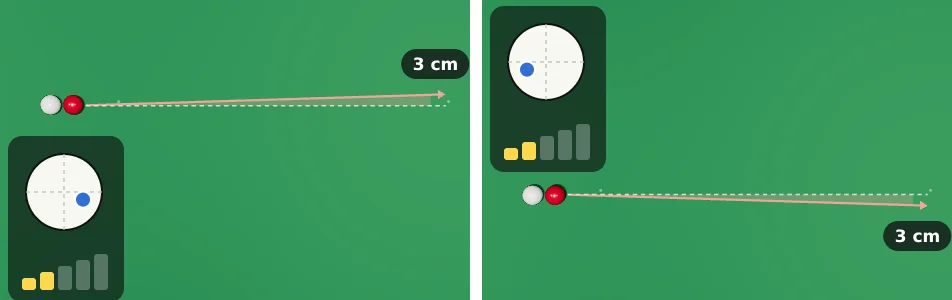
At contact, the spinning white rubs the red. Right side throws the red left; left side throws it right, here about 3 cm over a metre on a slow full-ball hit.
Trick: this is how good players fix a slow cut that keeps going in fat (post 02): a little side that throws the ball towards the pocket.
8 · Side waits for the cushion
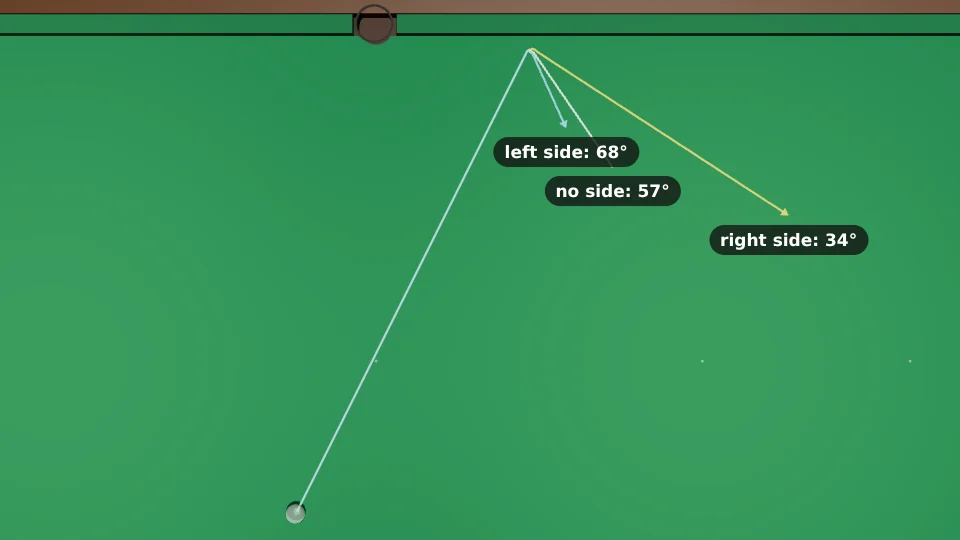
Before the cushion, side changes little (once you allow for squirt; in this picture squirt is switched off so all three take the same path in). At the cushion, the spin grips and changes the angle. Coming in at 63° to the cushion, power 2 (model):
| Tip | Comes off at (to the cushion) | Name here |
|---|---|---|
| no side | 57° | |
| right side | 34°: flatter, runs on along the cushion | running side |
| left side | 68°: steeper, "held" back | check side |
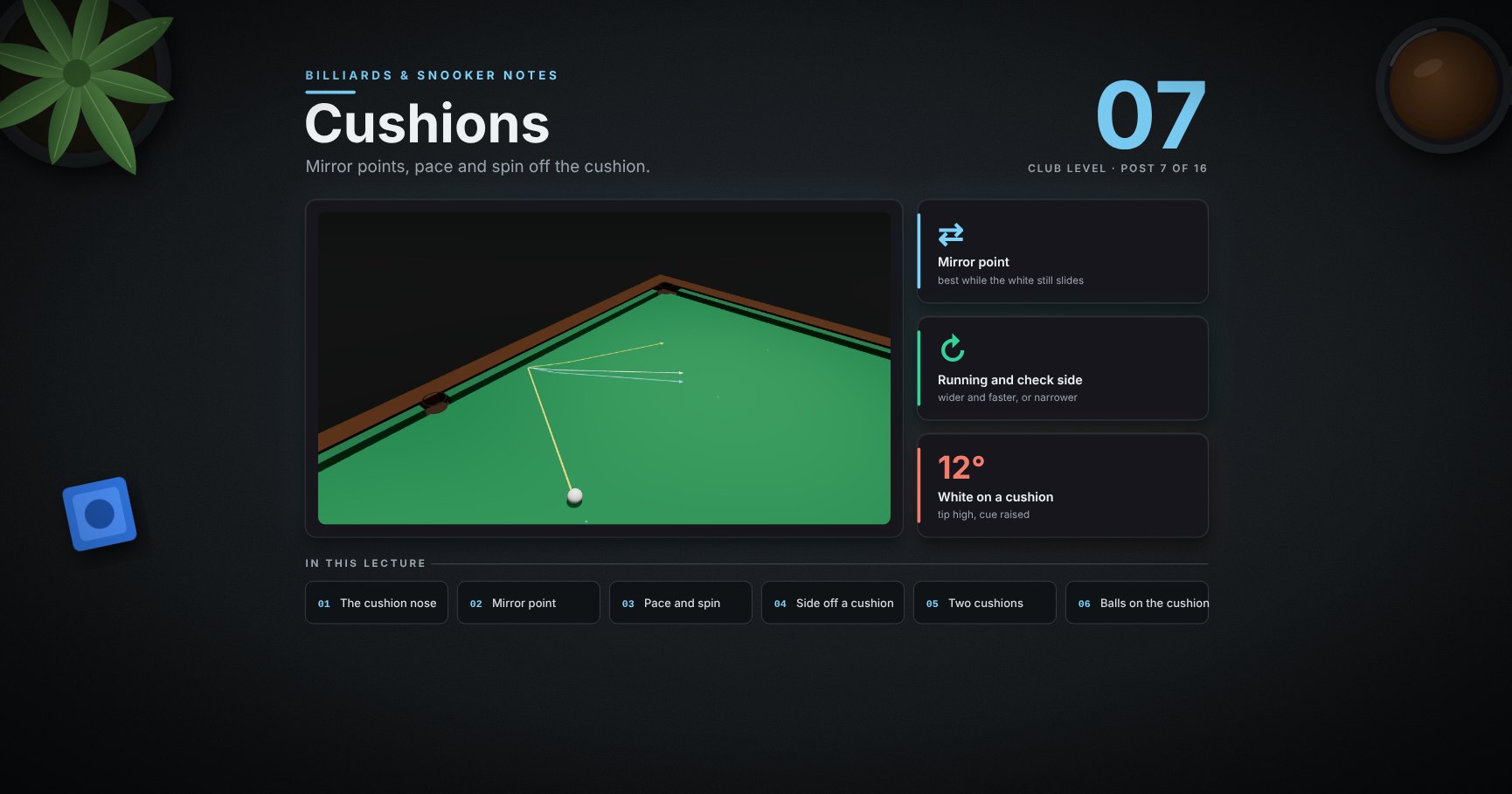
Running side is the side that keeps the white going the way it was travelling along the cushion. Check side is the other one. Which is left or right depends on the shot. Post 07 uses this a lot.
Chapter 4 — Aiming with side
9 · Two ways to aim with side
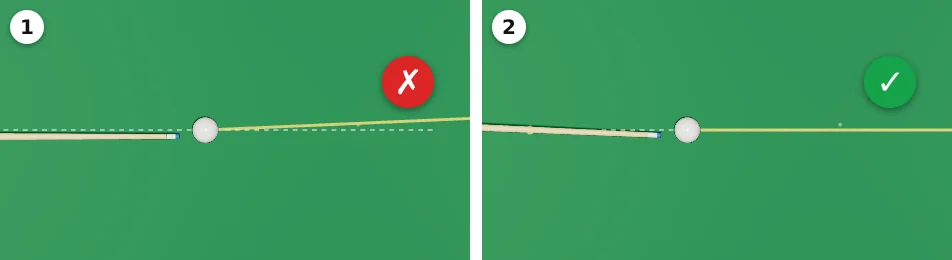
- Aim, then adjust. Line up as normal, move the cue sideways for side, then turn your aim a touch towards the side you use. How much depends on your cue and the pace; learn it by practice.
- Pivot the cue. Line up centre-ball, then turn only the back of the cue about a point on the cue behind the white. The cue now points slightly towards the side, and squirt brings the white back onto the line. It cancels squirt exactly when that point is at your cue's pivot length behind the tip (about 30 cm for the model cue here).
Neither is "right". Method 1 is easier to learn; method 2 is easier to repeat once you know your cue.
10 · Watch it: a long pot with side
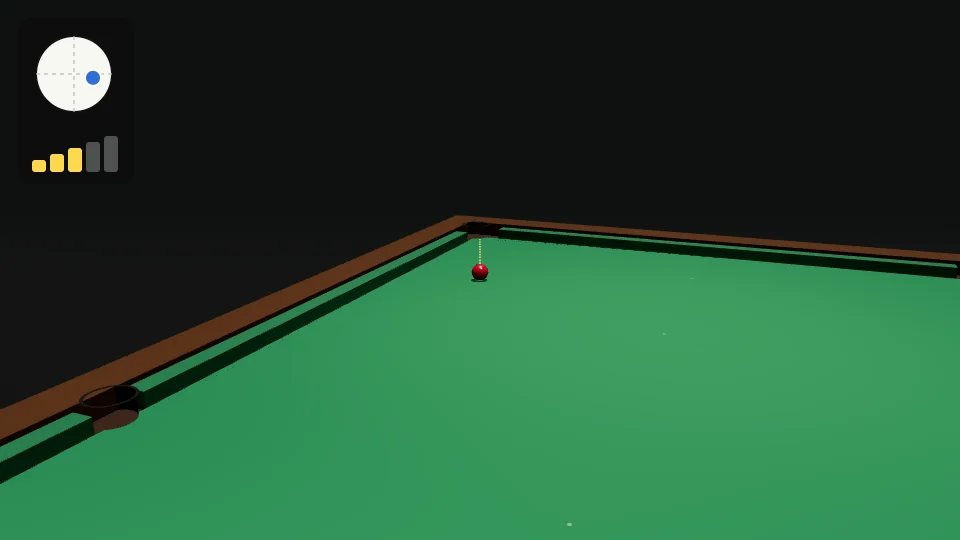
Right side, power 3, aimed as if there were no side: the white arrives a little off, and over a long pot that is enough to miss ✗.
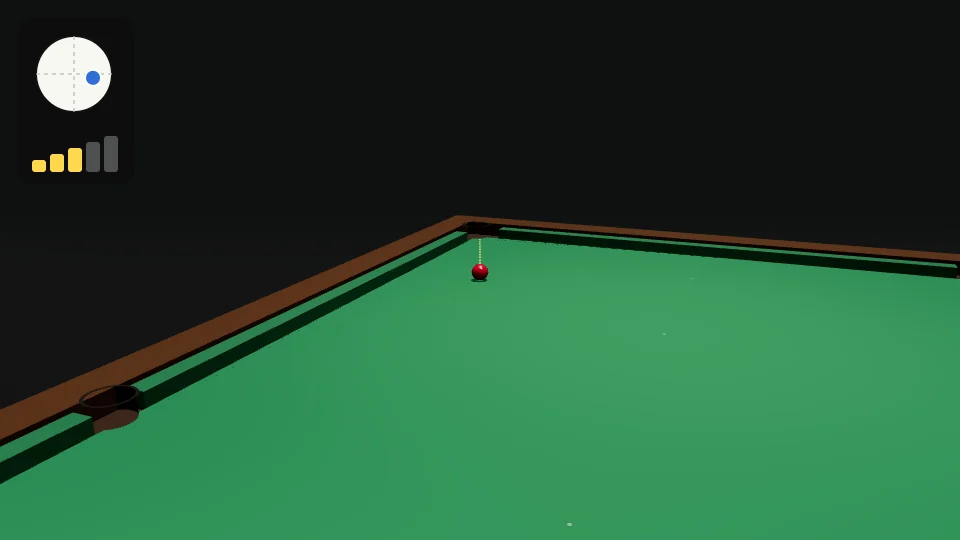
The same shot with the aim turned a touch to the right (less than a degree): it goes in ✓.
Common pitfall: "I put side on to get position and missed the pot." Most misses with side are long pots. Use it on long pots only when you must.
11 · When to use side
| Use side to… | Post |
|---|---|
| change the angle off a cushion (wider or narrower) | 07 |
| hold the white or send it further for position | 06, 12 |
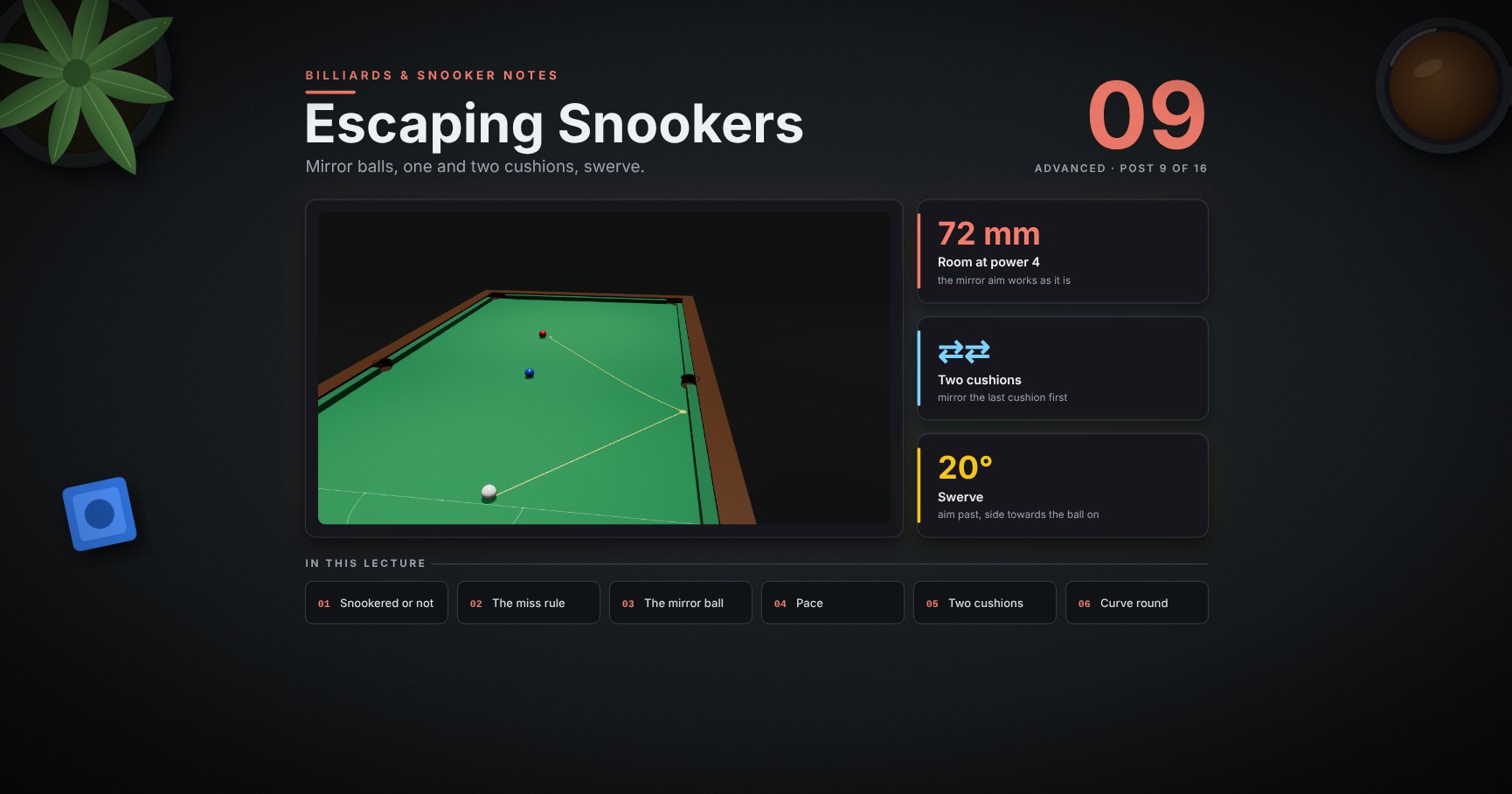
| reach a ball when snookered | 09 |
| cancel throw on a slow cut | 02 |
| curve round a ball (with a raised cue) | 14 |
If none of these applies, play without side. A centre-ball hit is easier and more accurate.
Try it at the table
| Drill | Set-up | Look for |
|---|---|---|
| Squirt test | white on the baulk line, play it up over the spots with right side, power 2 then 4 | how far off the spots it runs at each pace |
| Swerve test | the same at power 2, butt raised a little more each time | where the curve starts to win |
| Pivot length | the pivot method; move the pivot point closer or further | the pivot length where the white stays on the spots |
| Throw test | full-ball hit on a red 30 cm away, left side, then right side | the red goes a little the other way |
| Cushion test | the same angle into a cushion: no side, running, check | three different angles off |
Cheat-sheet
| Where | move the whole cue sideways; inside the safe zone |
| Squirt | the white starts away from the side; more with power |
| Swerve | then curves back towards it, only while sliding; more with a raised cue |
| Pace | soft: they cancel early · firm: squirt wins |
| Throw | the object ball goes away from the side |
| Cushion | running side: flatter, on along the cushion · check side: steeper |
| Aim | turn a touch towards the side, or pivot the cue |
| Default | no side unless you need it |
What's next
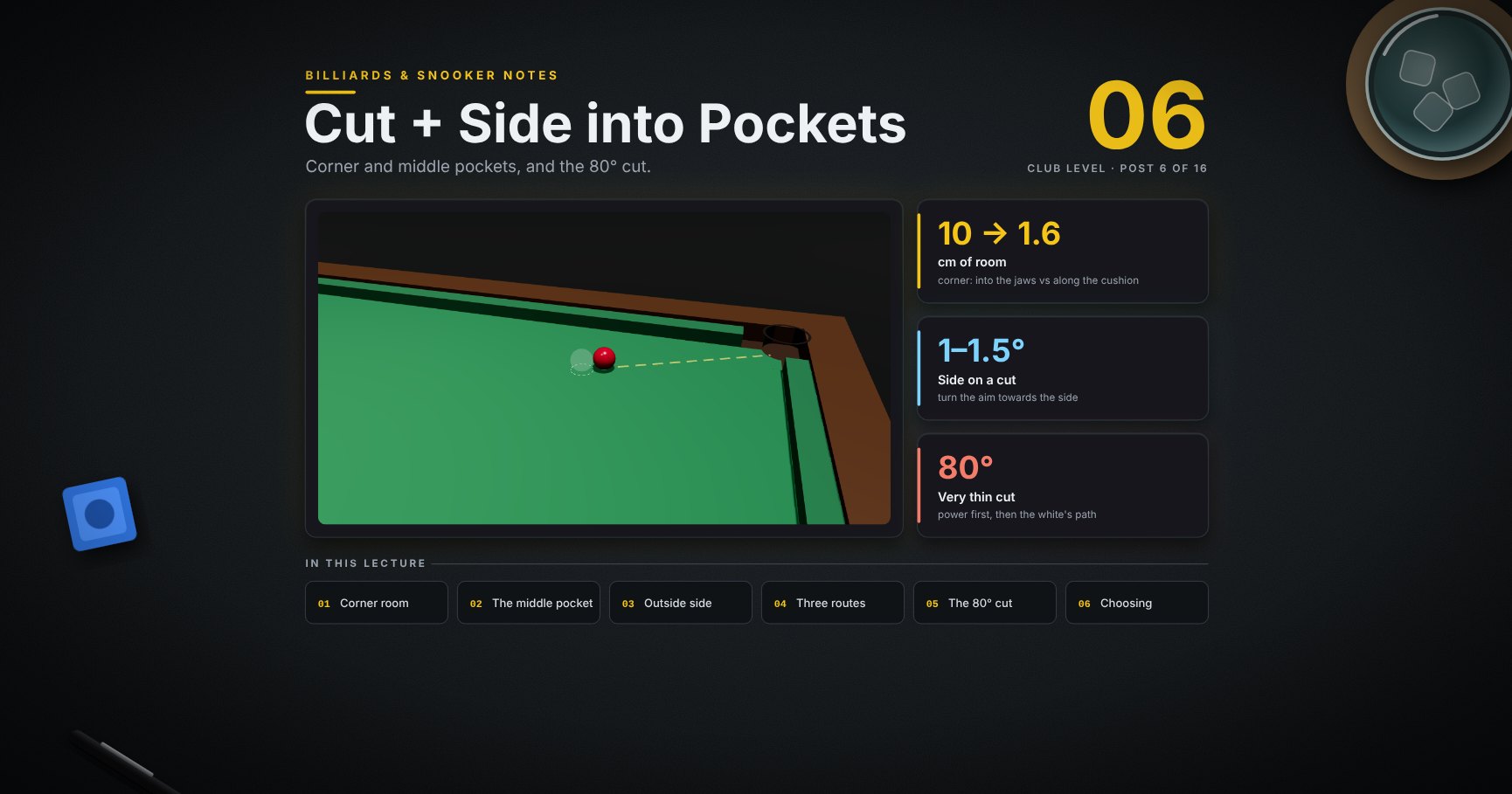
06 · Cut and side into pockets. Pots with side into the corner and the middle, very thin cuts, and choosing the side for the next ball.
References
- Dr. Dave Alciatore, squirt, swerve and throw: technical proofs, the pivot-length method and the effect of cue elevation. https://billiards.colostate.edu/
- Dr. Dave Alciatore, "What effects does cue elevation have on a shot". https://drdavepoolinfo.com/?p=1979
- The numbers come from the physics model of the balls at snooker sizes, with squirt set to 2.5° at half-way side (a typical value; real cues differ). The cushion angles use the model cushion (nose above the ball's centre, friction 0.2). The patterns hold; your exact numbers depend on your cue, cloth and cushions.
Note: this post is in progress. Planned additions: squirt for different cues, and side with screw off a cushion.