Violin Notes — 08 · Grade 8 Virtuoso Bowing, All Double Stops, Performance Polish
Grade 8 ABRSM violin is the diploma threshold. All major and minor scales in three or four octaves, double stops in 3rds / 6ths / 8ves / 10ths, the full vocabulary of bow techniques (martelé, ricochet, sautillé, flying staccato, col legno, jeté), and concerto / sonata repertoire approaching professional standard. Past Grade 8 lies DipABRSM and onward.
Series map: 00 Beginner → 01 Grade 1 → … → 07 Grade 7 → 08 Grade 8 (this post — final in this series).
Learning Outcome
- Play all major and minor three-octave scales + arpeggios fluently.
- Play scales in 3rds, 6ths, octaves, and 10ths in all common keys.
- Use every bow technique in repertoire.
- Apply expressive vibrato (variable speed + width) for musical effect.
- Perform a complete concerto movement of significant length (8–15 minutes) from memory.
- Read and interpret 20th-century notation (extended techniques, irregular metres).
- Demonstrate stylistic understanding: Baroque, Classical, Romantic, Modern.
Chapter 1 — The full scale + double-stop arsenal
Three-octave scales: every key
By Grade 8 you must own all 12 major and all 12 minor (× 2 = harmonic + melodic) scales — three octaves each.
Practice rotation (4-week cycle)
| Week | Major keys | Minor keys |
|---|---|---|
| 1 | C, G, D, A, E | A, E, B, F♯, C♯ |
| 2 | B, F♯, C♯, D♭, A♭ | G♯, D♯, A♯, B♭, F |
| 3 | E♭, B♭, F | C, G, D |
| 4 | Review weakest 4 keys | Review weakest 4 keys |
15 minutes scales per day, rotating focus across the cycle.
Double stops at Grade 8
| Interval | Difficulty | Key example |
|---|---|---|
| 3rds | Moderate (Grade 6+) | G, D, A major |
| 6ths | Moderate | G, D, A major |
| Octaves | Hard | G, D major |
| 10ths | Very hard | Selected keys, single octave |
| Fingered octaves | Very hard | Heifetz scale system |
10ths require an enormous left-hand stretch (1st + 4th finger on adjacent strings, an octave and a third apart). Most adult learners take 1–2 years to play 10ths reliably.
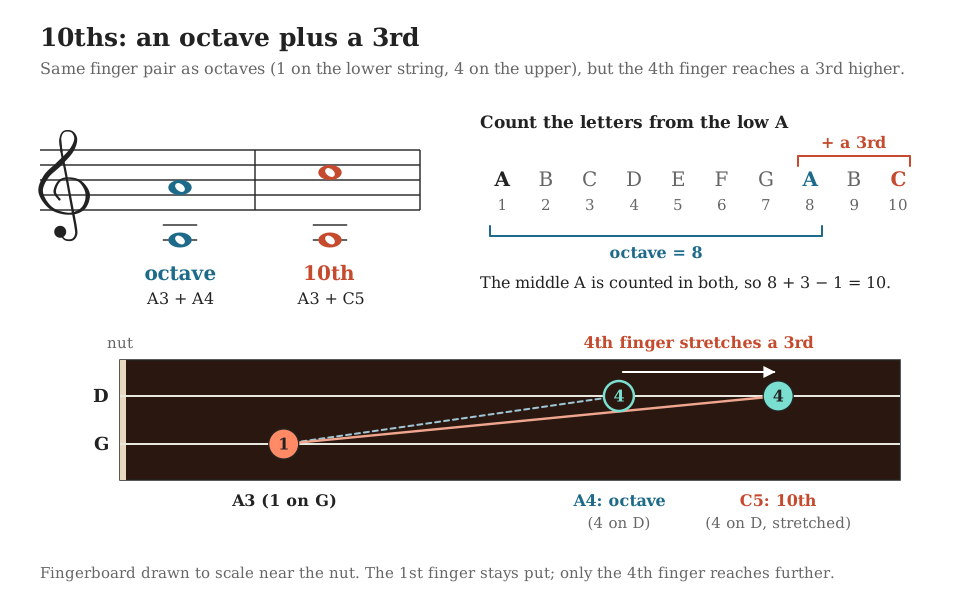
Trick: don't force 10ths into pieces if they're not in the syllabus. Practise as a stretch exercise (open-palm yoga for the violin hand). When the syllabus demands them, you'll already have the reach.
Chapter 2 — Virtuoso bowing toolkit
By Grade 8 every technique is in active use. Quick reference:
| Bowing | Description | Typical use |
|---|---|---|
| Détaché | Smooth separate strokes | Most Classical/Romantic passages |
| Legato / slur | Connected, one bow | Lyrical lines |
| Staccato | Sharp short, on string | Articulated passages |
| Slurred staccato | Multiple stops, one direction | Long lines with articulation |
| Spiccato | Bow lifts between notes | Light, dancing passages |
| Sautillé | Very fast spiccato | Fast 16th-note passages |
| Ricochet | Multiple bounces per drop | Showpieces, cadenzas |
| Martelé | Hammered, percussive | Accents, dramatic openings |
| Flying staccato | Lifts each note, one direction | Showpieces |
| Col legno battuto | Tap with the bow stick | Modern repertoire, Mars (Holst) |
| Col legno tratto | Draw with the wood | Eerie effects, rare |
| Sul ponticello | Near the bridge | Glassy colour |
| Sul tasto | Over the fingerboard | Soft, dreamy colour |
| Pizzicato | Plucked | Common; Bartók pizz snaps string against fingerboard |
| Jeté | "Thrown" — multiple notes from a single bounce-then-draw | Showpieces |
| Tremolo | Rapid bow oscillation on one note | Suspense, orchestral effect |
A piece using nearly all of them
Sarasate Zigeunerweisen uses détaché, legato, spiccato, sautillé, ricochet, harmonics, pizzicato, and flying staccato in one 9-minute work. Reference repertoire for technique synthesis.
Chapter 3 — Vibrato as expression
By Grade 8, vibrato is not "on" or "off" — it's a continuous parameter.
The four vibrato variables
- Width — narrow (subtle warmth) vs wide (passionate Romantic).
- Speed — slow (sustained nobility) vs fast (intense, virtuoso fire).
- Continuous vs delayed — start the vibrato instantly, or let the note begin straight then add vibrato.
- Pulse — strict steady vibrato vs phrased vibrato (slows and speeds with the phrase).
Vibrato style per period
| Period | Vibrato preference |
|---|---|
| Baroque | Sparse, narrow, often as ornament (varies by historical performance practice) |
| Classical | Selective; on long notes mostly |
| Romantic | Continuous, wide, warm |
| 20th-c / Modern | Variable; sometimes deliberately senza vibrato |
| Folk / world | Narrow, fast, intermittent |
Trick: listen to one violinist play the same piece from different periods (e.g., Hilary Hahn plays both Bach and Tchaikovsky). Notice how her vibrato choice changes. Internalise the period-appropriate sound by daily listening.
Chapter 4 — 20th-century notation
Grade 8 introduces:
Irregular metres
5/4, 7/8, 11/16. Count subdivisions:
1
2
3
4
5/4 = 3+2 or 2+3
7/8 = 2+2+3 or 3+2+2
11/16 = many possible groupings
Listen: Holst Mars (5/4), Stravinsky Rite of Spring (constantly shifting metres).
Extended techniques (notation symbols)
| Symbol | Technique |
|---|---|
| Diamond note | Natural or artificial harmonic |
| Open circle above note | Natural harmonic |
| "+" above note | Left-hand pizzicato (pluck with left finger) |
| "Bartók pizz" symbol | Snap pluck (string against fingerboard) |
| Wavy line above note | Trill |
| ↑ ↓ arrows | Glissando direction |
| Box around staff | Aleatoric (player chooses) |
Atonal pitch language
Some Grade 8 repertoire abandons traditional key signatures. Read by intervals, not by key. Practise by sight-reading short atonal exercises (Bartók Mikrokosmos arranged for violin, etc.).
Chapter 5 — Suggested Performance Repertoire
Concerto choices (Grade 8 level — pick one to focus 6 months)
| Concerto | Composer | Style |
|---|---|---|
| Mozart Concerto No. 3, 4, or 5 | Mozart | Classical balance |
| Bruch Concerto No. 1 in G minor | Bruch | Romantic favourite |
| Saint-Saëns Concerto No. 3 in B minor | Saint-Saëns | French Romantic |
| Mendelssohn Concerto in E minor | Mendelssohn | The "standard" Romantic |
| Lalo Symphonie Espagnole | Lalo | Spanish-flavoured concerto |
Sonata choices
| Sonata | Composer | Style |
|---|---|---|
| Bach Sonatas Nos. 1–3 (unaccompanied) | Bach | Baroque solo |
| Beethoven Spring Sonata Op. 24 | Beethoven | Classical/early Romantic |
| Brahms Sonatas 1, 2, 3 | Brahms | German Romantic |
| Franck Sonata in A | Franck | Late Romantic French |
Showpieces (encore-level virtuoso)
| Piece | Composer | What it tests |
|---|---|---|
| Zigeunerweisen | Sarasate | Every bowing technique |
| Tzigane | Ravel | Harmonics, modal language |
| Praeludium and Allegro | Kreisler | Pseudo-Baroque style |
| Caprices (selected) | Paganini | Each caprice = one virtuoso problem |
| Méditation from Thaïs | Massenet | Lyrical depth + vibrato |
Études at Grade 8
- Rode 24 Caprices.
- Dont Op. 35 — major reference.
- Paganini 24 Caprices — start Nos. 5, 9, 13.
- Wieniawski L'École Moderne Op. 10.
Chapter 6 — Performance polish
Grade 8 exams test interpretation, not just technique.
Programme planning (typical Grade 8 recital)
| Slot | Choice | Length |
|---|---|---|
| 1 | Baroque (Bach, Handel) | 5–8 min |
| 2 | Classical / early Romantic (Mozart, Beethoven) | 8–12 min |
| 3 | Late Romantic / Modern (Brahms, Ravel, Bartók) | 5–10 min |
| 4 | Virtuoso showpiece | 4–8 min |
Variety across periods is graded.
Stage presentation
- Tuning ritual: walk onstage, tune visibly, take a breath, begin.
- Eye contact with pianist (if accompanied) before nodding to start.
- Bow direction visible to audience.
- Recovery: if you make a mistake, don't react. Continue. Audience usually misses small errors.
Stage anxiety management
- Daily mock performance for 30 days before exam. Play full programme top-to-bottom every day.
- Performance-day routine: same warm-up, same meal timing, same clothing dress rehearsal.
- Breathing: 4 seconds in, 6 seconds out, before walking onstage. Lowers heart rate.
- Visualisation: mentally walk through the recital from arrival to bow, daily for 2 weeks before exam.
Where I got stuck: I prepared technically but didn't rehearse the experience of performing. First exam: hands shook on the bow. Fix: 4 weeks of daily mock recitals — in front of family, friends, even an empty room with a recording running. By exam day, the room was less intimidating because I'd "performed" 30 times already.
Chapter 7 — Stylistic understanding
Grade 8 exams ask: Why is this Baroque ornament played this way? You should know:
Baroque (1600–1750)
- Trills start on upper note, on the beat.
- Less vibrato; vibrato as occasional ornament.
- Strong terraced dynamics (sudden f to p, not gradual).
- Rubato sparingly; mostly steady tempo.
- Détaché with subtle weight changes for phrase shape.
Classical (1750–1820)
- Balanced phrases, clear structure.
- Vibrato on long notes only.
- Dynamic gradients (cresc, dim) more frequent.
- Détaché with elegance; spiccato light.
Romantic (1820–1900)
- Vibrato continuous.
- Wide dynamic range; rubato substantial.
- Long lyrical lines.
- Full use of register; expressive shifts welcomed.
Modern (1900+)
- Technique-heavy.
- May use extended techniques.
- Senza vibrato on certain passages.
- Irregular metres + atonal pitch language possible.
How to internalise style
Listen to one piece per period weekly, with score in hand. Mark performance choices (vibrato, rubato, bowing). Compare across recordings. Over a year, style sensitivity becomes second nature.
Chapter 8 — Aural / Listening Skills
Grade 8 aural is extensive:
- Sing/play 8-bar phrases with modulations and chromatic notes after 1–2 hearings.
- Identify period + style at sight/sound.
- Identify formal structure (sonata-allegro, rondo, theme + variations).
- Identify modulations to distant + enharmonic keys.
- Identify orchestral textures (homophonic, polyphonic, monophonic).
- Sight-sing complex 8-bar phrases with modulation + chromaticism.
Daily preparation
15 minutes ear training daily for 3 months before exam. Use Tonal Energy, Functional Ear Trainer, or Teoria.com drills. Mix:
- Intervals (target: 1 sec recognition)
- Chord qualities (target: 2 sec recognition)
- Modulation type (target: 5 sec recognition)
- Period style (target: 10 sec from short clip)
Chapter 9 — Beyond Grade 8: the diploma path
After Grade 8, the ABRSM diploma path:
| Diploma | Level | Requirements |
|---|---|---|
| ARSM | Performance diploma | 30-min recital, professional standard |
| DipABRSM | Performance / Teaching | 35-min recital + viva / pedagogy paper |
| LRSM | Licentiate | 50-min recital + extensive theory |
| FRSM | Fellowship | Concert-artist level |
Most adult learners stop at Grade 8 or ARSM. The leap to DipABRSM and beyond is substantial — concerto level reaches Tchaikovsky / Brahms / Sibelius standards, with full memorisation and stylistic mastery.
Useful Shortcut
Cheat-sheet
| What | How |
|---|---|
| All scales | 3-octave + arpeggio + dom 7 + dim 7 |
| Double stops | 3rds + 6ths + 8ves + 10ths |
| Full bow vocabulary | Every technique in active use |
| Vibrato | Variable: width × speed × delay × pulse |
| Memorisation | Section + mental + random-start drill |
| Period style | Listen weekly; mark interpretive choices |
| Performance | 30-day mock recital before exam |
| Beyond Grade 8 | ARSM → DipABRSM → LRSM → FRSM |
Daily routine (150 min)
| Block | Time | Content |
|---|---|---|
| Tune | 3 min | Tuner + 5ths |
| Bow warm-up | 12 min | Full vocabulary cycle (8 bowings) |
| Vibrato | 5 min | Variable width/speed on slow scale |
| Scales (single notes) | 15 min | Rotating 3-octave + arpeggios + dom 7 |
| Scales (double stops) | 20 min | 3rds + 6ths + 8ves + (10ths) |
| Étude | 20 min | Rode / Dont / Paganini |
| Sight-read | 10 min | 32-bar passage, atonal or modal mix |
| Repertoire 1 | 30 min | Main concerto movement |
| Repertoire 2 | 20 min | Sonata movement or showpiece |
| Memory + mental | 10 min | Mental walkthrough + random-start |
| Cool-down | 5 min | Slow scale, listen, release tension |
Suggested listening (context)
Listen across periods. Each weekly listening:
| Period | Reference recording |
|---|---|
| Baroque | Hilary Hahn — Bach Sonatas & Partitas |
| Classical | Anne-Sophie Mutter — Mozart Violin Concertos |
| Romantic | Itzhak Perlman — Tchaikovsky / Brahms / Mendelssohn Concertos |
| 20th-c | Maxim Vengerov — Shostakovich Concerto No. 1 |
| Virtuoso | Salvatore Accardo — Paganini 24 Caprices |
| Modern | Patricia Kopatchinskaja — Bartók / Ligeti |
Trick: every great violinist has a different sound. By Grade 8 you should start to hear "this is Hahn vs this is Mutter vs this is Perlman" within 5 seconds of a clip. That auditory sensitivity is what informs your own interpretive choices.
Closing — the journey from Grade 1
Looking back across this series:
- Grades 1–2: getting the hands to work at all.
- Grades 3–4: first shift, first concerto, first real expression.
- Grade 5: the bottleneck (vibrato + theory paper).
- Grades 6–7: double stops, advanced bowings, full repertoire.
- Grade 8: synthesis — every technique in service of musical interpretation.
Grade 8 isn't an endpoint; it's a license to start the real study — the chamber music, the recital tours, the deeper Bach partitas, the modern works. Many adult learners find Grade 8 is where the violin finally feels like a voice rather than a project.
Final trick: keep listening. Daily, lifelong. Every great violinist I admire spends more time listening than playing. Hearing shapes the hand. Hearing shapes the bow. Hearing makes you a musician — not just a violinist.
References
- ABRSM (current). Violin Exam Pieces — Grade 8.
- Carl Flesch, Scale System for Violin (complete).
- Heifetz, Heifetz Scale Book.
- Galamian, Contemporary Violin Technique.
- Simon Fischer, The Violin Lesson, Practice, Tone.
- Paganini, 24 Caprices Op. 1.
- Rode, 24 Caprices.
- Dont, Op. 35.
- IMSLP — Bach Sonatas & Partitas, Mozart concertos, Mendelssohn, Bruch, Lalo, Saint-Saëns, Brahms, Franck.
Note: this post — and this series — is in progress. Planned additions: full diploma-path post; concerto comparison post (Mendelssohn vs Bruch vs Mozart 3); 10ths practice diagram; period-style listening playlist.