Violin Notes — 05 · Grade 5 Vibrato, Shifting Across Positions, Three-Octave Scales
Grade 5 ABRSM violin is the milestone exam. Pass it, and you've earned the right to attempt Grades 6–8 (which require Grade 5 theory as a prerequisite — read your local rules). Technically, Grade 5 demands vibrato, shifts to 4th and 5th position, the first three-octave scales for some keys, and a far wider repertoire including full sonata movements.
Series map: 00 Beginner → 01 Grade 1 → … → 04 Grade 4 → 05 Grade 5 (this post) → 06 Grade 6 → 07 Grade 7 → 08 Grade 8.
Learning Outcome
- Apply continuous vibrato to sustained notes.
- Shift fluently between 1st, 2nd, 3rd, 4th, and 5th positions.
- Play three-octave G and A major scales (some syllabi).
- Play two-octave scales in all major keys + most minor keys (harmonic + melodic).
- Use sul G (play on G string only) and sul ponticello / sul tasto colour techniques.
- Identify all triads (major, minor, diminished, augmented) at sight.
- Play a complete Baroque sonata movement + one concerto movement.
Chapter 1 — Vibrato: the expression
Vibrato is the small, rapid pitch oscillation that adds warmth and life to sustained notes. Without it, classical violin tone sounds naked.
Three vibrato types
| Type | Source | Speed | When |
|---|---|---|---|
| Wrist vibrato | Wrist rocks back and forth | Medium | Most repertoire |
| Arm vibrato | Whole forearm rocks | Slow + wide | Romantic, big tone |
| Finger vibrato | Finger joint flexes | Fast + narrow | Rare; modern works |
Wrist is the standard first vibrato taught at Grade 5.
Learning wrist vibrato — step by step
- Air vibrato — without violin. Hold left arm up as if holding violin. Wave hand at the wrist, palm-up to palm-down motion, for 30 sec. This is the motion.
- Vibrato on knee. Sit. Place finger on knee. Rock wrist gently, finger stays in contact, pad rolls. Build motor pattern.
- Vibrato on violin neck (no string). Finger on the neck, not string. Rock wrist.
- Vibrato on string with finger anchored. 3rd finger on A (= D5). Bow a long D on the A string. Rock wrist; finger should roll (not slide). Pitch should wobble below the pitch and back to it.
- Slow metronome vibrato. 4 wobbles per beat at 60 bpm = 4 Hz. Build to 6 Hz over 6 months.
- Apply to scales. Vibrate every sustained note in a slow scale.
Where I got stuck: my wrist locked. Vibrato felt impossible for 3 months. Fix: spend 5 minutes per day on the "knee drill" — no violin, no string, just the wrist motion. The brain learns motion separately from instrument. Once the wrist could rock freely, transferring to the violin took one week.
Pitch direction
Vibrato should wobble below the in-tune pitch back up to it. Never above. The brain hears the upper limit of the oscillation as "the note".
Where to start using it
Don't vibrate every note. Start with:
- Long notes (half-notes, whole-notes).
- Phrase peak notes.
- Final note of a phrase.
By Grade 6, you'll vibrate almost every note that's longer than a quaver. At Grade 5, just the obvious ones.
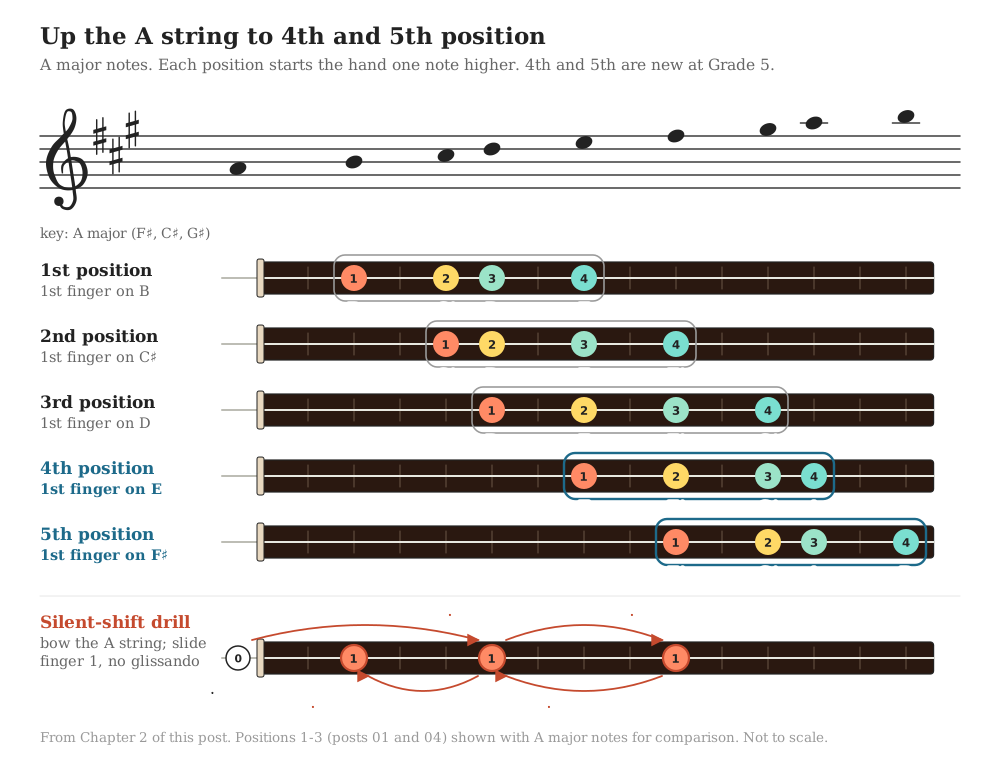
Chapter 2 — Shifting to 4th and 5th positions
4th position
On the A string: 1=E5, 2=F♯5, 3=G♯5, 4=A5.
Note: 1 in 4th position = E5 = the same note as the open E next door. Useful for staying on one string.
5th position
1=F♯5, 2=G♯5, 3=A5, 4=B5.
5th position is where the violin's neck meets the body. The thumb position changes — you'll start using the "shoulder" of the violin as a reference.
The shift map (3-octave G major)
To play G major across 3 octaves, you traverse:
- G string: 1st position G-A-B-C
- D string: 1st pos D-E-F♯-G
- A string: 1st pos A-B-C-D
- E string: 1st pos E-F♯-G
- Shift to 3rd pos on E: A-B-C
- Shift to 5th pos on E: D-E-F♯ (fingers 2-3-4)
- Shift to 7th pos on E for the top G (3rd finger) — or go to 6th position for D-E-F♯-G (1-2-3-4); depends on edition
Trick: learn the shift route as a fixed sequence. Mark "III" or "V" above the music. Practise just the route (no rhythm) until the shifts are automatic; then add timing.
Silent shift drill (essential at Grade 5+)
- Bow open A.
- Slide 1st finger up to D5 (3rd pos).
- Continue sliding to F♯5 (5th pos).
- Back down to D5, then to 1st position B.
- Repeat 10×, very slowly. No glissando audible.
Daily. The shifts smoothen over weeks.
Chapter 3 — Three-octave scales
The standard 3-octave scale layout (G major shown):
1
2
3
4
5
6
G string: G A B C (1st position, fingers 0-1-2-3)
D string: D E F♯ G (1st position, fingers 0-1-2-3)
A string: A B C D (1st position, fingers 0-1-2-3)
E string: E F♯ G A (1st pos: 0-1-2-3)
E string: B C D E F♯ G (shift to 4th pos: 1-2-3-4, then shift again for F♯-G)
Exact fingering varies by teacher. Pick one fingering and stick to it for 6 months minimum. Switching fingerings mid-learning resets your muscle memory.
Recommended fingering source
- Carl Flesch, Scale System — the bible of violin scales. Used by every conservatory student.
- Galamian Contemporary Violin Technique — slightly different fingerings.
- Whichever your teacher prefers.
Chapter 4 — Triads: all four qualities
Grade 5 theory requires identification of:
| Triad | Intervals (from root) | Sound |
|---|---|---|
| Major | Maj 3rd + Min 3rd | Bright |
| Minor | Min 3rd + Maj 3rd | Sad |
| Diminished | Min 3rd + Min 3rd | Tense, unstable |
| Augmented | Maj 3rd + Maj 3rd | Suspenseful, dreamy |
Building each from C
- C major: C–E–G (M3 + m3)
- C minor: C–E♭–G (m3 + M3)
- C diminished: C–E♭–G♭ (m3 + m3)
- C augmented: C–E–G♯ (M3 + M3)
Inversions
A triad has 3 notes; any of them can be in the bass:
| Position | Bass note | Example (C major) |
|---|---|---|
| Root | Root | C–E–G |
| First inversion | 3rd | E–G–C |
| Second inversion | 5th | G–C–E |
Notation: figured bass uses ⁶ (1st inv) and ⁶⁄₄ (2nd inv). At Grade 5 you must identify these from a score.
Chapter 5 — Tone colours
Grade 5 introduces colour markings in scores. Common ones:
| Marking | Italian | Effect |
|---|---|---|
| sul G | "on the G string" | Forces phrase onto G string for rich, dark tone |
| sul D / A / E | "on the D/A/E string" | Same idea, different colour |
| sul ponticello | "near the bridge" | Glassy, eerie, metallic |
| sul tasto | "over the fingerboard" | Soft, flute-like, dreamy |
| pizzicato | "plucked" | Plucked string |
| col legno | "with the wood" | Tap with the bow stick |
Practise: D major scale sul ponticello, then sul tasto. The difference is dramatic. Composers exploit this.
Chapter 6 — Suggested Practice Pieces
Suzuki Vol. 5 staples
| Piece | Composer | Why |
|---|---|---|
| Concerto in G minor | Vivaldi | Substantial concerto, multiple movements |
| Gavotte | J.B. Lully | Baroque dance suite entry |
| Country Dance | C.M. von Weber | Folk feel, dotted rhythms |
| Concerto No. 5 in D, 1st mvt | Vivaldi | First major D-major concerto |
ABRSM Grade 5 alternatives
| Piece | Composer | Why |
|---|---|---|
| Concerto in A minor, 1st mvt | Accolay | Standard student-concerto favourite |
| Sonata in E minor | Telemann | Full Baroque sonata movement |
| Romance | Beethoven (excerpt) | Lyrical, vibrato showcase |
| Hungarian Dance | Brahms (arr.) | Rubato + folk fire |
| Méditation from Thaïs | Massenet (excerpt) | The dream piece; finally playable |
Étude staples
- Wohlfahrt Op. 45 Book 2 — continued.
- Mazas Op. 36 Book 1 — étude graduation.
- Kreutzer 42 Études — start the first 5 by Grade 5.
Chapter 7 — Aural / Listening Skills
Grade 5 aural is a separate exam paper in some syllabi or a section of the practical. It includes:
- Sing or play back a 4–8 bar phrase after one hearing.
- Identify modulations to dominant or relative minor.
- Identify cadences in context.
- Identify chord progressions (basic I-IV-V-I).
- Sight-sing a longer phrase with leaps.
Trick: daily aural drill. 5 minutes, every day. Apps: Tonal Energy, Functional Ear Trainer, Teoria. Random intervals → cadences → progressions → modulations. Build the ear like a muscle.
Chapter 8 — The Grade 5 Theory prerequisite
In the ABRSM system, you cannot enter the Grade 6, 7, or 8 practical exam without first passing Grade 5 Theory. This is the bottleneck.
Grade 5 theory paper covers
- All intervals (size + quality, simple + compound).
- All triads (4 qualities + inversions).
- All cadences.
- Time signatures including 5/4, 7/8 (irregular).
- Transposition (writing music in a new key).
- Score reading (alto + tenor clefs introduction; full score interpretation).
- Composition: 8-bar melody using given opening.
- Ornament identification (trill, mordent, turn, appoggiatura, acciaccatura).
Preparation strategy
- Buy ABRSM Music Theory in Practice — Grade 5 workbook.
- Work through 1 chapter per week.
- Take 2 past papers per month for the last 3 months.
- Aim for 90% on practice papers before booking the exam.
Average study time: 6 months alongside violin practice.
Chapter 9 — Common Grade 5 Pitfalls
| Pitfall | Fix |
|---|---|
| Vibrato sounds forced | Slower metronome, focus on relaxation |
| Shift to 5th pos misses by a semitone | Slow silent shifts; visualise the position landmarks |
| 3-octave scale fingers tangle | Stick to ONE fingering; don't switch mid-week |
| Triad confusion (major vs minor) | Sing them; bottom 3rd = the giveaway |
| Theory paper rushed | Take past papers under timed conditions early |
| Vibrato applied too aggressively to fast notes | Apply only to long notes at first; speed will follow |
| sul G phrase scratches at low end | Bow weight + slow speed; G string demands patience |
Useful Shortcut
Cheat-sheet
| What | How |
|---|---|
| Vibrato motion | Wrist rocks; finger rolls below pitch back to it |
| Vibrato start | Knee drill → no-string → string anchored → bowed |
| 4th position 1st finger | E (A string) |
| 5th position 1st finger | F♯ (A string) |
| 3-octave G major shifts | Around E string upper octave |
| Triad qualities | Maj=M3+m3, Min=m3+M3, Dim=m3+m3, Aug=M3+M3 |
| sul G | Stay on G string for tone |
| Grade 5 theory needed | Required for Grade 6+ practical entry |
Daily routine (75 min)
| Block | Time | Content |
|---|---|---|
| Tune | 2 min | Tuner + 5ths |
| Bow warm-up | 8 min | Long bows + spiccato + colour drills |
| Vibrato drill | 5 min | Slow on long notes |
| Scales | 15 min | 1 three-octave + 2 two-octave (major + minor) |
| Shifting drill | 5 min | Silent shifts up to 5th position |
| Étude | 10 min | Wohlfahrt / Mazas |
| Sight-read | 5 min | New piece |
| Repertoire | 20 min | Concerto + sonata movement |
| Cool-down | 5 min | Slow vibrato on open string-derived pitch |
Suggested listening (context)
| Piece | Performer | Why |
|---|---|---|
| Vivaldi Four Seasons | Itzhak Perlman | Standard violin repertoire; many Grade 5–7 segments |
| Mozart Violin Sonata K. 304 in E minor | Hahn | The "tragic" sonata; mature Mozart |
| Bach Partita No. 2 — Chaconne | Hilary Hahn | Pinnacle solo violin; aspirational |
| Brahms Violin Concerto | Anne-Sophie Mutter | Adult-career repertoire; listen for vibrato variety |
| Sibelius Violin Concerto | Hahn or Mutter | The "rich, dark" tone goal |
References
- ABRSM (current). Music Theory in Practice — Grade 5 (the bottleneck workbook).
- ABRSM (current). Violin Exam Pieces — Grade 5.
- Suzuki, S. Suzuki Violin School, Vol. 5.
- Carl Flesch, Scale System for Violin.
- Simon Fischer, Basics and The Violin Lesson.
- Wohlfahrt Op. 45, Mazas Op. 36, beginning Kreutzer.
- Galamian, Contemporary Violin Technique.
Note: this post is in progress. Planned additions: vibrato video reference; 3-octave fingering chart; position-shift map diagrams; Grade 5 theory past-paper walkthroughs.