Violin Notes — 02 · Grade 2 Two-Octave Scales & Slur Control
Grade 2 ABRSM violin doubles your reach: two-octave scales, the first minor key, dotted rhythms, and longer slurs that demand real bow planning. The hand shape from Grade 1 stays, but it now travels — string crossings within a scale become the central skill.
Series map: 00 Beginner → 01 Grade 1 → 02 Grade 2 (this post) → 03 Grade 3 → … → 08 Grade 8.
Learning Outcome
- Play two-octave scales of G and D major, one-octave C and F major.
- Play A natural minor (one octave) and recognise the relative-minor concept.
- Use dotted-quaver + semiquaver rhythms accurately.
- Slur 4–8 notes per bow with even tone.
- Read fluently up to B above the staff (B5: E string, 4th finger).
- Play 4–6 Grade 2 pieces with hands together, musically shaped.
Chapter 1 — Two-octave scales arrive
A one-octave scale spans two strings (that was Grade 1); a two-octave scale now traverses three or four strings — G major uses all four.
G major (two octaves)
1
2
3
4
5
G string: G 1=A 2=B 3=C
D string: D 1=E 2=F♯ 3=G
A string: A 1=B 2=C 3=D ← C natural: low 2, right next to 1
E string: E 1=F♯ 2=G (no 3 needed; top note is G5 in many syllabi, or continue to A5 with 3rd finger)
Grade 2 typically asks for the scale to reach G5 (2nd finger on E in 1st position). Some editions extend to A5 (3rd finger).
D major (two octaves)
1
2
3
4
D string: D 1=E 2=F♯ 3=G
A string: A 1=B 2=C♯ 3=D
E string: E 1=F♯ 2=G♯ 3=A
Top note here is A5 (3rd finger on E). The full two octaves end on D6, which needs a shift up the E string — so for now I stop at A5.
C major (one octave) — first piece with no sharps
1
2
3
4
G string: 3=C
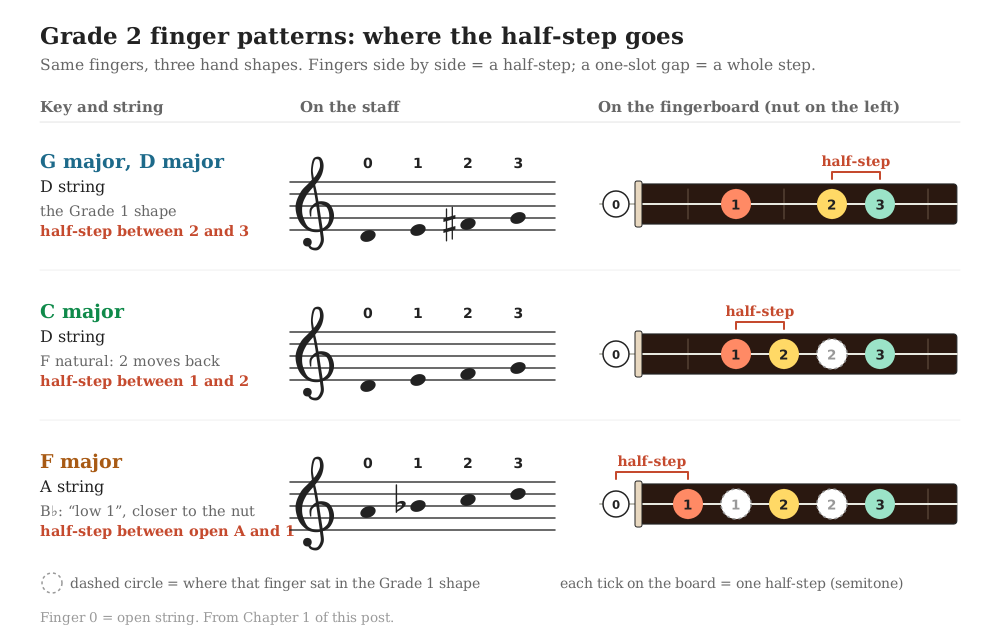
D string: D 1=E 2=F 3=G ← half-step between 1 and 2 here!
A string: A 1=B 2=C
Trick: C major is the shock key for violin beginners. Every other scale you've played has the half-step between 2 and 3. C major has it between 1 and 2 on the D string. Mark the music with an arrow over the F natural for the first 2 weeks.
F major (one octave)
1
2
3
4
D string: 2=F 3=G (F natural = low 2)
A string: A 1=B♭ 2=C 3=D
E string: E 1=F 2=G
Half-step lands between open A and finger 1 on the A string (A → B♭). The B♭ requires placing finger 1 low — closer to the nut than normal.
Where I got stuck: "low 1" felt unnatural for weeks. The finger wants to land where it always does. Fix: physically mark a tape line for "low 1" position on the A string for one practice session. Once your finger learns the distance, peel the tape off.
Chapter 2 — The first minor scale: A natural minor
A natural minor uses the same notes as C major but starts on A:
1
2
A B C D E F G A
Fingering (one octave starting from open A):
1
2
3
A string: A 1=B 2=C 3=D
E string: E 1=F 2=G 3=A (F = low 1, G = low 2)
Or starting on the G string for low-octave practice: 1=A3 (normal 1, not low) ... but Grade 2 starts on open A.
What "natural minor" means
Three forms of minor exist:
| Form | Pattern (intervals) | Where used |
|---|---|---|
| Natural | W-H-W-W-H-W-W | Grade 2 introduction |
| Harmonic | Raises 7th by half-step | Grade 3+ |
| Melodic | Raises 6th + 7th going up, naturals coming down | Grade 4+ |
Grade 2 only requires natural minor. Memorise it now; the others build on it.
Trick: A natural minor = the white notes from A to A. C major = the white notes from C to C. They share all notes — they're relative. Every major key has a relative minor a minor 3rd (3 semitones) below. Memorise this pairing now: it saves hours later.
Chapter 3 — Dotted rhythms
A dot after a note adds half its value:
1
2
3
♩. = ♩ + ♪ (dotted crotchet = crotchet + quaver = 1.5 beats)
♪. = ♪ + 𝅘𝅥𝅯 (dotted quaver = quaver + semiquaver = 0.75 beats)
The Grade 2 staple is the dotted-quaver + semiquaver pair:
1
2
♪. 𝅘𝅥𝅯 = 3/4 beat + 1/4 beat (one beat total)
Count subdivisions:
1
2
3
1-e-&-a (4 semiquavers = 1 beat)
[long ][s] (dotted-q on "1-e-&", semiq on "a")
Trick: I subdivided in semiquavers aloud for every dotted pair for 2 weeks: "ONE-e-and-AH, ONE-e-and-AH". Sounds ridiculous, locks the ratio in. Once it's automatic, drop the speaking.
Bow distribution for dotted rhythms
The long note gets more bow, the short note gets less. Roughly 3:1 ratio matching the duration:
1
2
3
dotted-quaver: 3 inches of bow
semiquaver: 1 inch of bow
If you give them equal bow, the short note sounds louder (more bow speed in less time). Wrong feel.
Chapter 4 — Longer slurs and bow planning
Grade 1 slurs were 2–4 notes. Grade 2 introduces 6, 8, even a full scale (8 notes) on one bow.
The bow-budget rule
Total bow length = ~25 inches (varies by player + bow).
For 8 notes in one bow: 25 ÷ 8 ≈ 3 inches per note.
You cannot play loud + slow + long-slurred. Pick two. Grade 2 long slurs are usually mezzo-piano and steady — the bow conserves itself.
Slur with string crossing
Example: slur "open A → 1st finger B → open E" in one bow. Two string changes inside one stroke. The right wrist + elbow tilt to roll between strings without breaking the sound.
Where I got stuck: every slur with a string crossing scratched on the crossing point. Fix: slow practice with the metronome at 40 bpm, paying attention to the angle of the bow hair at the crossing. The bow should tilt gradually, not snap. Drill: 5 minutes a day for 2 weeks → solved.
Practice progression
- 2-note slur, same string.
- 2-note slur, crossing strings.
- 4-note slur, same string.
- 4-note slur, crossing strings.
- 8-note slur = full scale.
Don't jump steps. Each stage takes about a week.
Chapter 5 — Intervals (Grade 2 theory)
Grade 2 theory paper introduces interval size within the major and natural minor keys:
| Size | Example (C major) | Notes spanned |
|---|---|---|
| 2nd | C–D | 2 |
| 3rd | C–E | 3 |
| 4th | C–F | 4 |
| 5th | C–G | 5 |
| 6th | C–A | 6 |
| 7th | C–B | 7 |
| 8ve | C–C (high) | 8 |
Trick: count letter names inclusive. C to E = C, D, E = 3 letters = a 3rd. Never count semitones for size at Grade 2 — that's Grade 3 (interval quality).
Practise: pick a key, name every interval from the tonic. Then play each on the violin. Linking name + sound + hand position triples retention.
Chapter 6 — Suggested Practice Pieces
Suzuki Vol. 2 staples
| Piece | Composer | Why |
|---|---|---|
| Chorus from Judas Maccabeus | Handel | First taste of "real" Baroque tone shaping |
| Musette | Bach (arr.) | Dance rhythm, slurred phrases |
| Hunters' Chorus | C. M. von Weber | Two-string passages; energetic |
| Long, Long Ago (Tempo di Minuetto) | Bayly | Two-octave reach |
| Waltz | Brahms | First waltz; bow distribution challenge |
| Bourrée | Handel | Compound dotted rhythms |
| Two Grenadiers | Schumann | Strong dotted-march rhythm |
| Theme from Witches' Dance | Paganini | Suzuki's "shock" piece; first time you feel virtuoso |
ABRSM Grade 2 alternatives
| Piece | Composer | Why |
|---|---|---|
| Minuet in D | Mozart (attr.) | Classical phrasing |
| Aria | Tchaikovsky | Lyrical line; bow control test |
| Polka | Czech traditional | Quick string crossings |
Listening assignment
Watch a recording of Itzhak Perlman or Hilary Hahn playing Bach Partita No. 2 — Allemande (don't try to play it; just listen). Notice how each note has identical bow weight despite enormous variety in speed. That's the Grade 2 goal: even tone across changes.
Chapter 7 — Intonation upgrade: cross-string checking
Grade 1 used drones on open strings. Grade 2 adds two-string checks at the same pitch:
| Pitch | Way 1 | Way 2 |
|---|---|---|
| A4 | Open A | 4th finger on D |
| E5 | Open E | 4th finger on A |
| D5 | 3rd finger on A | (also = open string interval check) |
If the two ways give the same pitch, you're in tune. If they fight, one finger is off.
Trick: end every scale with a check-note. Play G major scale up to G5, then hold the G5 and listen to the open G string. If the top note is true, the G string rings along by itself (two octaves below). If it stays quiet, adjust.
Tape removal
If you used tape on the fingerboard in Grade 1, remove it by Grade 2 exam. The eyes-on-fingerboard habit costs you sight-reading speed.
Chapter 8 — Aural / Listening Skills
ABRSM Grade 2 aural adds:
- Clap back rhythm in 6/8 (new at Grade 2).
- Sing back a 4-bar phrase.
- Identify if a melody is in major or minor.
- Identify the time signature (2/4, 3/4, 4/4, or 6/8).
Major vs minor identification
Major = "bright, happy". Minor = "sad, darker". The most reliable test: the third. Major 3rd (C–E) = 4 semitones. Minor 3rd (C–E♭) = 3 semitones.
Trick: sing "Happy Birthday" (major) immediately, then "Hey Jude" verse (also major) — internalise the colour. Then sing "Greensleeves" (Dorian, sounds minor) or "House of the Rising Sun" (minor) — feel the gloom. After a week of A/B comparisons, you'll identify them in 2 seconds.
Chapter 9 — Common Grade 2 Pitfalls
| Pitfall | Fix |
|---|---|
| Low 1 (B♭, F♮) lands at normal 1 position | Mark for first week; physical drill |
| Bow runs out before slur ends | Bow-budget rule; mark "mp" in pencil to save hair |
| Dotted rhythm becomes triplet (long-short-short instead of long-short) | Subdivide in semiquavers aloud |
| Scratching on slurred string crossing | Slow practice, watch the hair angle |
| C major fingering forgotten | Drill C major scale daily for 2 weeks |
| Eyes stuck on fingerboard | Cover with a small towel during scale practice |
Useful Shortcut
Cheat-sheet
| What | How |
|---|---|
| Two-octave G major | G string → D string → A string → E string (up to G5) |
| C major weirdness | Half-step between 1 and 2 on D string (not 2-3) |
| F major / B♭ | "Low 1" on A string |
| A natural minor | Same notes as C major, starts on A |
| Dotted-quaver + semiquaver | Long:short = 3:1 in duration AND bow |
| Long slur bow budget | Divide bow length by note count; save weight |
| Relative minor | 3 semitones below the major (C maj ↔ A min) |
| Cross-string intonation check | Same-name notes on two strings should match exactly |
Daily routine (35 min)
| Block | Time | Content |
|---|---|---|
| Tune + 5th check | 2 min | Tuner + double-stop |
| Bow warm-up | 5 min | Long open bows + 8-note slurs on each string |
| Scale | 8 min | Two-octave today's key + arpeggio + relative minor |
| Sight-read | 4 min | New 8-bar piece in the week's key |
| Repertoire | 14 min | Current piece, slow → tempo |
| Cool-down | 2 min | Air-shake bow arm, release tension |
Suggested listening (context)
| Piece | Performer | Why |
|---|---|---|
| Suzuki Vol. 2 | Hilary Hahn (Suzuki recordings) | Hear every piece pro-played |
| Concerto in A minor | Vivaldi / Anne-Sophie Mutter | Standard concerto study piece (Grade 4-5) — listen now for inspiration |
| Méditation from Thaïs | Massenet / Joshua Bell | Single long line, perfect for studying bow distribution |
| Liebesleid | Kreisler | Waltz, sentimental, shows dotted rhythm in expressive setting |
References
- ABRSM (current). Music Theory in Practice — Grade 2.
- ABRSM (current). Violin Exam Pieces — Grade 2.
- Suzuki, S. Suzuki Violin School, Vol. 2.
- Simon Fischer, Basics — Sections 1–3 (still relevant).
- IMSLP — Handel, Mozart, Bach (arrangement collections).
Note: this post is in progress. Planned additions: dotted-rhythm audio clips, C-major-specific fingering chart, slur visualisation.