Violin Notes — 03 · Grade 3 New Keys, Shifting Prep & Slurred Staccato
Grade 3 ABRSM violin is the gateway between "beginner who can play tunes" and "real student". Two new flat keys appear (B♭ and E♭), the three minor scales must be distinguished, a hint of position shifting is introduced, and bowings begin to diversify (slurred staccato, hooked bowing). The repertoire shifts toward Baroque dances and early Classical pieces.
Series map: 00 Beginner → 01 Grade 1 → 02 Grade 2 → 03 Grade 3 (this post) → 04 Grade 4 → … → 08 Grade 8.
Learning Outcome
- Play two-octave scales of G, D, A, B♭ majors and one-octave E♭ major.
- Play D, G, A natural and harmonic minors (one or two octaves as syllabus).
- Distinguish the three minor forms by ear and on paper.
- Use slurred staccato and hooked bowing.
- Prepare for 3rd position shifting (theoretical introduction).
- Identify interval quality (major, minor, perfect) at sight.
- Play 5–7 Grade 3 pieces with confident phrasing.
Chapter 1 — B♭ major (two octaves)
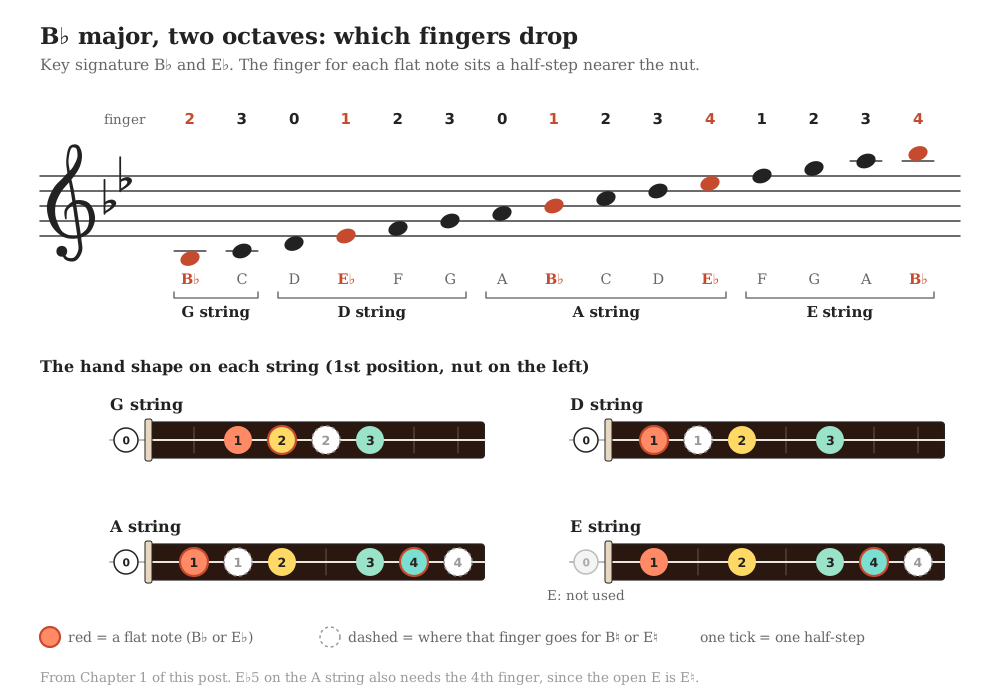
B♭ has two flats: B♭ and E♭. Translated to violin fingering:
1
2
3
4
5
G string: G 1=A 2=B♭(low 2!) 3=C
D string: D 1=E♭(low 1!) 2=F 3=G
A string: A 1=B♭(low 1!) 2=C 3=D 4=E♭(low 4!)
E string: (open E not used) 1=F 2=G 3=A 4=B♭(low 4!)
Wait — that's a lot of "low" fingers across the scale: every B♭ and E♭, plus F and G on the E string. The hand shape changes per string.
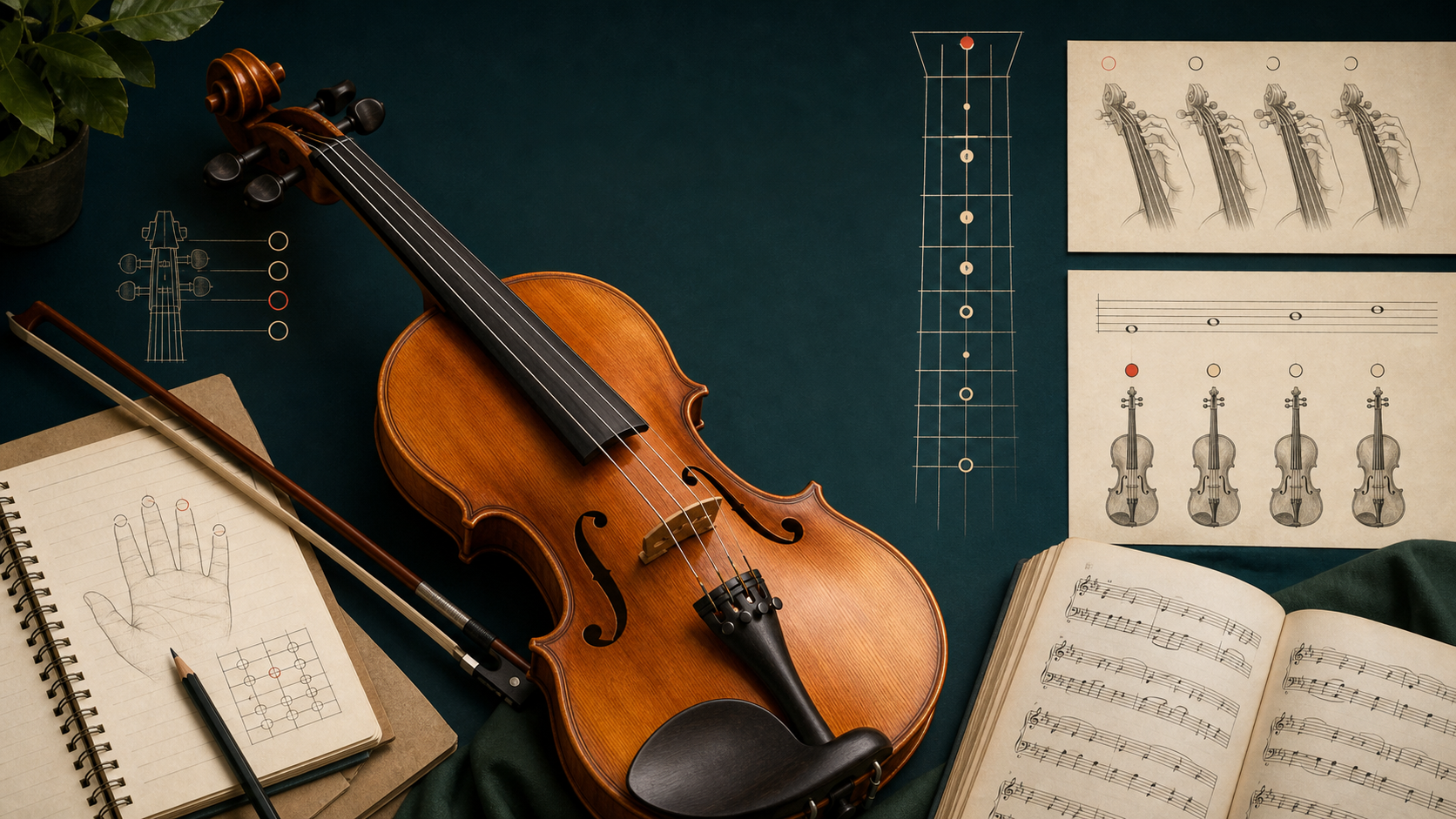
Trick: the rule for any key with flats: drop the finger that plays the flatted note half a finger-width toward the nut. For B♭ major, that's 2 on G string, 1 on D, 1 and 4 on A, 4 on E. Memorise the pattern of which finger is low, not the abstract scale.
Top note: B♭5 (4th finger on E in 1st position).
Why this key matters
B♭ is the first key violinists genuinely struggle with. The hand has to relearn its default spacing. Master B♭ by Grade 3, and every flat key after becomes intuitive.
Chapter 2 — E♭ major (one octave)
E♭ has three flats: B♭, E♭, A♭. One octave only at Grade 3.
1
2
3
4
D string: 1=E♭(low 1!) 2=F 3=G 4=A♭(low 4!)
A string: 1=B♭(low 1!) 2=C 3=D 4=E♭(low 4!)
E string: not needed — one octave stops at E♭5 (4th finger on A)
Fingerings vary a little between editions. The point: 3 flats means every B♭, E♭ and A♭ gets a "low" finger. Get the pattern of lowness right and your fingers will land.
Where I got stuck: I tried to memorise E♭ as "B♭, E♭, A♭" abstractly. Fix: I stopped naming the flats and just thought "low-low-low" in the right places. Faster, more reliable.
Chapter 3 — The three minor forms
Grade 2 introduced natural minor. Grade 3 adds harmonic and (sometimes) melodic.
Natural minor (review)
Same notes as the relative major. A natural minor:
1
2
A B C D E F G A
Harmonic minor — raises the 7th
The leading-tone effect that classical music expects:
1
2
A B C D E F G♯ A
That raised 7th creates an augmented 2nd between F and G♯ (3 semitones — a full step + half-step). This gives harmonic minor its Middle-Eastern or Spanish flavour.
Trick: harmonic minor sounds exotic compared to natural minor. Sing both ascending — natural feels "modal/folk", harmonic feels "classical/dramatic". After ten A/B comparisons, your ear locks the difference.
Melodic minor — raises 6th and 7th going up, naturals coming down
1
2
3
Ascending: A B C D E F♯ G♯ A
Descending: A G F E D C B A
Two different note sets in one scale. Composers chose this in the Baroque to handle melodic lines without the harmonic minor's augmented 2nd "bump".
Grade 3 typically requires melodic minor only on paper; full playing comes Grade 4.
D, G, A minor (Grade 3 syllabus)
| Major | Relative minor | Common form examined |
|---|---|---|
| F major | D natural & harmonic minor | Both |
| B♭ major | G natural & harmonic minor | Both |
| C major | A natural & harmonic minor | Both |
Practise: play the major scale, then immediately its relative minor (natural form). Then play harmonic minor of the same root. Six versions per session.
Chapter 4 — Slurred staccato
A new bowing. Notation: slur (curved line) + dot under each note within the slur.
1
2
3   .  .  .  .
♪‿♪‿♪‿♪    = play 4 notes in one bow, but each separated by a tiny pause
The bow stays on the string; the wrist makes a small stop-start motion for each note while moving in one direction.
Where I got stuck: I lifted the bow between notes — that's staccato volante (flying staccato), Grade 6 stuff. Fix: practise on open strings, bow stays on the string, only the wrist pulses. Picture a bow that "hesitates" 4 times in one stroke.
Hooked bowing
Two unequal notes (often dotted-quaver + semiquaver) on one bow with a tiny stop between them:
1
2
♪. 𝅘𝅥𝅯 <-- both on down-bow, stop between them
Used to keep the dotted figure on the same bow direction throughout a phrase. Saves bow-direction confusion.
Chapter 5 — Shifting: a theoretical preview
True shifting (moving the hand to 2nd/3rd/etc. positions) is Grade 4 territory, but Grade 3 introduces the concept and may use one shift in a piece or as a "step out" of 1st position.
Why shift?
- Reach higher notes the 1st position can't.
- Stay on one string for a phrase (changing tone colour).
- Make awkward fingerings easier.
What 3rd position feels like
In 3rd position, the 1st finger plays what the 3rd finger plays in 1st position. So on the A string:
- 1st position: 3rd finger = D5.
- 3rd position: 1st finger = D5.
The hand moves up the neck by about 1 inch.
First shift exercise
On the A string:
- Open A, then 3rd finger D (1st position).
- Slide the 1st finger up the string until it sounds D.
- Now you're in 3rd position. Play 2 (E) and 3 (F♯).
Don't lift; slide smoothly. The thumb travels with the hand.
Trick: the thumb moves at the same time as the fingers. If the thumb stays back, you get a stretched, painful hand. Practise the shift with eyes closed, only feeling the smooth slide. Listen for the slide pitch — at first it'll glissando, later it'll be silent.
Grade 3 may include one piece with a marked shift; Grade 4 requires the technique.
Chapter 6 — Interval quality
Grade 2 named interval size (2nd, 3rd, etc.). Grade 3 adds quality:
| Interval | Semitones | Example (from C) |
|---|---|---|
| Perfect 1st (unison) | 0 | C–C |
| Minor 2nd | 1 | C–D♭ |
| Major 2nd | 2 | C–D |
| Minor 3rd | 3 | C–E♭ |
| Major 3rd | 4 | C–E |
| Perfect 4th | 5 | C–F |
| Tritone (Aug 4 / dim 5) | 6 | C–F♯ |
| Perfect 5th | 7 | C–G |
| Minor 6th | 8 | C–A♭ |
| Major 6th | 9 | C–A |
| Minor 7th | 10 | C–B♭ |
| Major 7th | 11 | C–B |
| Perfect 8ve | 12 | C–C (high) |
The 4 "perfect" intervals + 4 major/minor pairs + tritone
- Perfect: 1st, 4th, 5th, 8ve. Stable, "pure" sound.
- Major / minor: 2nd, 3rd, 6th, 7th. Have two flavours.
- Tritone: unstable, called diabolus in musica historically.
Trick: the song hooks for intervals — sing the opening and find the interval in it:
- Major 2nd: "Happy Birthday" ("-py Birth-")
- Minor 3rd: "Greensleeves" ("A-las")
- Major 3rd: "When the Saints" ("Oh when")
- Perfect 4th: "Here Comes the Bride"
- Perfect 5th: "Twinkle, Twinkle" ("-kle, Twin-")
- Minor 6th: "The Entertainer" ("ta-ta")
- Major 6th: "My Bonnie"
- Octave: "Somewhere Over the Rainbow" ("Some-where")
Memorise one song per interval; identify intervals in 1 second.
Chapter 7 — Suggested Practice Pieces
Suzuki Vol. 3 staples
| Piece | Composer | Why |
|---|---|---|
| Gavotte from Mignon | A. Thomas | Classic Suzuki 3 entry; staccato + slur mix |
| Minuet in G | Beethoven | First Beethoven; clean Classical phrasing |
| Gavotte in G minor | Bach | Real Bach; first minor-mode piece |
| Humoresque | Dvořák | Famous melody; tests bow distribution + dotted rhythms |
| Gavotte | Becker | Dance feel + hooked bowing |
| Bourrée | Bach | Compound dance rhythm |
| Gavotte in D | Bach | The pairing of major + minor Bach gavottes is a Suzuki ritual |
ABRSM Grade 3 alternatives
| Piece | Composer | Why |
|---|---|---|
| Air | Purcell | Slow, sustained — bow control |
| Allegro | Vivaldi | Dance energy; arpeggio passages |
| Minuet in G | Boccherini | Famous tune; tests pizzicato + bowed mix |
| Largo from Xerxes | Handel | Long line, expressive |
Listening assignment
The Bach Gavottes (both G major and G minor in Suzuki 3) are based on dance forms. Listen to Janine Jansen or Hilary Hahn play any Bach Partita gavotte. Notice how the dance accent (beat 3 of 4/4) is felt rather than punched.
Chapter 8 — Aural / Listening Skills
Grade 3 aural expands to:
- Sing back a 4–5 note phrase (more contour).
- Identify major / minor / chromatic.
- Identify key features: same, different, or modified (transposition or change in dynamics).
- Clap rhythms with dotted figures.
Pitch matching pressure-test
The examiner plays a note on the piano in a key you haven't been told. You must identify it and play it on the violin. Practise daily for 30 seconds; by Grade 3 exam, you should pick the right string + finger 90% of the time within 5 seconds.
Chapter 9 — Common Grade 3 Pitfalls
| Pitfall | Fix |
|---|---|
| Low-finger pattern slips back to normal | Drill the low-finger shape on open string mute; visualise the hand position |
| Confusing harmonic minor (raised 7) with melodic (raised 6+7 up) | Always play them adjacent — A/B compare daily |
| Slurred staccato becomes lift-staccato | Watch bow hair: must stay on string |
| Shifting causes glissando in performance | Slow practice with silent shift (lighten thumb during slide) |
| Tritone identification wrong (called Perfect 4 or 5) | Memorise "Maria" (West Side Story) opening: it's a tritone |
| Ignoring dotted-rhythm bow distribution | Pencil-mark bow direction + amount for first read |
| Bow arm tension on B♭ scale | Stop, drop arm to side, shake, restart |
Useful Shortcut
Cheat-sheet
| What | How |
|---|---|
| B♭ major | Low 2 on G, low 1 on D, low 1 + low 4 on A, low 4 on E |
| E♭ major (1 oct) | Three "low" fingers in the pattern |
| Natural minor | Same notes as relative major |
| Harmonic minor | Raise 7th |
| Melodic minor | Raise 6+7 ascending; natural descending |
| Slurred staccato | Bow stays, wrist pulses |
| Hooked bowing | Two notes one direction with stop |
| 3rd position | 1st finger plays what 3rd finger played in 1st pos |
| Tritone | 6 semitones; "Maria" first two notes |
Daily routine (45 min)
| Block | Time | Content |
|---|---|---|
| Tune | 2 min | Tuner + 5ths + double-stop check |
| Bow warm-up | 5 min | Long bows, slurred staccato on open strings, hooked patterns |
| Scales | 12 min | 2 major + 2 relative minor (natural + harmonic) |
| Shift drill | 5 min | 1→3 position glissando on each string |
| Sight-read | 5 min | New 16-bar piece |
| Repertoire | 14 min | Current Suzuki/ABRSM piece |
| Cool-down | 2 min | Air-shake; favourite easy melody |
Suggested listening (context)
| Piece | Performer | Why |
|---|---|---|
| Bach Partita No. 3 in E — Gavotte en Rondeau | Hilary Hahn | The "Gavotte" form mastered |
| Vivaldi Concerto in A minor, RV 356 — Allegro | Anne-Sophie Mutter | Standard student concerto; play someday |
| Beethoven Romance in F | Itzhak Perlman | Single beautiful line; what bow control becomes |
| Sarasate — Romanza Andaluza | Sarah Chang | Spanish flavour = harmonic minor in action |
| Bartók — Romanian Folk Dances | Janine Jansen | Folk modes; advanced minor flavours |
References
- ABRSM (current). Music Theory in Practice — Grade 3.
- ABRSM (current). Violin Exam Pieces — Grade 3.
- Suzuki, S. Suzuki Violin School, Vol. 3.
- Simon Fischer, Basics — Sections on left-hand setup + first-position pattern.
- Simon Fischer, The Violin Lesson — chapter on first shifts.
- IMSLP — Bach gavottes, Vivaldi student concertos.
Note: this post is in progress. Planned additions: low-finger pattern diagram per key; shifting glissando audio examples; interval song-hook full set.