Violin Notes — 06 · Grade 6 Double Stops, Higher Positions, Chromatic Scales
Grade 6 ABRSM violin is where the instrument doubles itself. Double stops — two strings sounded together — become a syllabus requirement. The right hand learns flying staccato, the left hand uses all positions through 5th regularly, and chromatic scales add 12-note fluency. The repertoire is now full Baroque sonatas, mid-Romantic showpieces, and the first complete concerto movements expected at concert level.
Series map: 00 Beginner → 01 Grade 1 → … → 05 Grade 5 → 06 Grade 6 (this post) → 07 Grade 7 → 08 Grade 8.
Learning Outcome
- Play 3rds and 6ths double stops through one octave on selected keys.
- Play chromatic scale (one or two octaves) starting on G or A.
- Use 1st–5th positions fluently in a single piece.
- Play three-octave scales in G, A, B♭ major (and some minor).
- Use staccato volante ("flying staccato") in showpieces.
- Identify ornaments + execute trills, mordents, turns idiomatically.
- Perform a complete sonata movement + a Romantic showpiece.
Chapter 1 — Double stops: the violin singing in two voices
A double stop is two strings bowed simultaneously, each producing a different pitch. The bow must contact both strings at once.
Bow angle for double stops
The bow normally tilts to one side to contact one string. For double stops, the bow lies flat on both strings at the same angle. Bow arm height adjusts to suit.
Easy double stops: open string + stopped string
Examples:
- Open E + 1st finger B on A = B4 + E5 (a 4th)
- Open A + 1st finger F♯ on E = A4 + F♯5 (a 6th)
These are the entry-level double stops; you've been hearing them in pieces since Grade 3 (as the drone effect).
Stopped double stops: 3rds
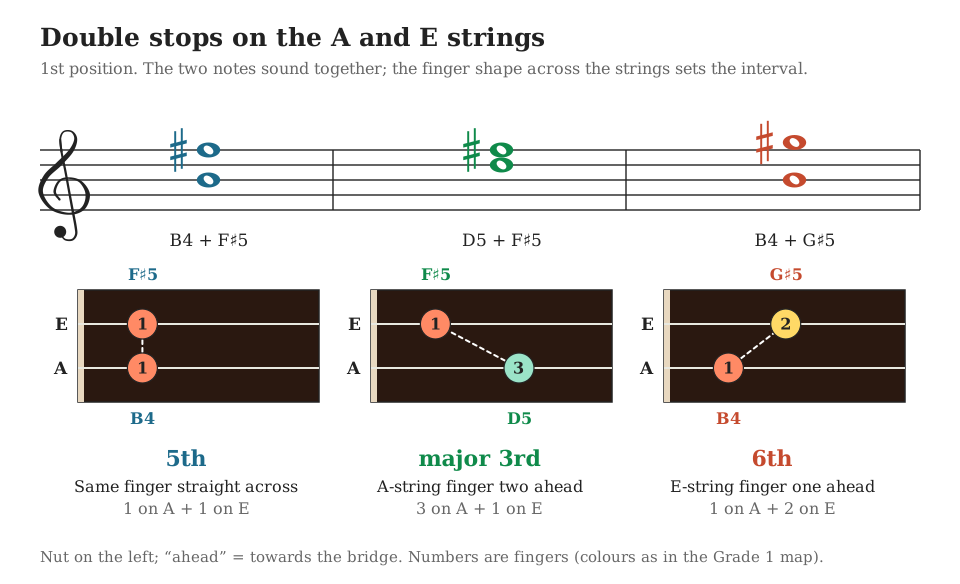
Two fingers on adjacent strings, both stopped. For a 3rd in 1st position:
1
2
3
4
A string: 1=B
E string: 1=F♯
sounding: B4 + F♯5 = a 5th... wait, that's a 5th
To get a 3rd, you need two fingers, one per string, giving notes 3 letters apart. In 1st position on A + E:
1
2
3
4
A string: 3=D
E string: 1=F♯
sounding: D5 + F♯5 = a major 3rd
The Grade 6 syllabus typically asks for a one-octave scale in 3rds in keys like G major.
6ths
1
2
3
4
A string: 1=B
E string: 2=G♯
sounding: B4 + G♯5 = a 6th
Two-finger spread; the two fingers are usually on different strings, one slightly behind the other.
Where I got stuck: my fingers couldn't independently stop adjacent strings at different positions. Fix: very slow practice with a tuner on each note separately, then together. 5 minutes per day, 6 weeks, before any scale in 3rds was reliable.
Chapter 2 — Chromatic scale
12 semitones in one octave, played either with traditional fingering or sliding-finger chromatic.
Traditional fingering (G chromatic ascending, one octave on G + D string)
1
2
Open G → 1=G♯ → 1=A → 2=A♯ → 2=B → 3=C → 4=C♯ → open D ...
The same finger plays two consecutive semitones by sliding (1 plays G♯ then A; 2 plays A♯ then B). The finger slides up about ½ a finger-width.
Galamian's chromatic fingering
Uses a different finger pattern that avoids slides. Faster but harder to learn.
Trick: the slide-finger chromatic is more idiomatic and what most pieces expect. Practise it very slowly with metronome. The "click" of the finger sliding between two semitones should be inaudible — the bow disguises it.
Chapter 3 — Flying staccato (staccato volante)
A series of bouncing staccato notes all on one bow direction, the bow lifting between each.
1
2
3   .  .  .  .  .  .
↓  ♪  ♪  ♪  ♪  ♪  ♪    = 6 staccato notes on a single down-bow
Distinct from slurred staccato (which stays on the string). Flying staccato lifts.
How to learn it
- Solid up-bow staccato first (easier direction). 4 notes per bow at slow tempo.
- Each note: bow stops and lifts a millimetre, then drops for the next note.
- Build to 8 notes per bow.
- Reverse to down-bow staccato.
Used famously in: Sarasate Zigeunerweisen, Wieniawski concertos, encore showpieces.
Trick: the wrist + fingers produce the "stop+lift" motion; the arm stays steady. If your arm is jerking, you're forcing it. Relax, slow down.
Chapter 4 — Higher positions: 6th, 7th, half position
Half position
The hand sits below 1st position — 1st finger plays just one semitone above the open string (B♭ on the A string). Used for low chromatic passages.
6th and 7th positions
6th pos on A: 1=G♯5.
7th pos on A: 1=A5 (an octave above open A).
In 7th position, the hand sits over the body of the violin. Thumb adjusts to a different position; left hand has limited mobility. Used mostly for very high passages in concertos and showpieces.
Where I got stuck: my left wrist collapsed in 7th position — the angle felt wrong. Fix: explicitly lift the left elbow forward (more underneath the violin) when shifting above 5th. The hand pivots more from underneath.
Chapter 5 — Ornaments executed idiomatically
Grade 6 demands playing, not just identifying, ornaments.
Trill (tr or ⟵⟶)
Rapid alternation between the written note and the note a step above. In Baroque: starts on the upper note. In Classical/Romantic: starts on the written note.
1
2
Trill on A4: A B A B A B A B ... (very fast)
The 2nd finger trills (lift-drop) while bow sustains. Trill speed: 6–10 oscillations per second. Practise slowly first, build speed.
Mordent (𝆚)
Quick three-note ornament: written note → step below (or above) → written note.
1
2
Lower mordent on A: A G A (very fast, takes maybe 1/8 of a beat)
Turn (∾)
Four-note ornament: above-note → written → below-note → written.
1
2
Turn on A: B A G A
Appoggiatura (small note before main note)
Takes half the value of the following note in Classical music.
Acciaccatura (small note with slash through stem)
A "crush" note — played as fast as possible, then immediately to the main note.
Chapter 6 — Suggested Practice Pieces
Suzuki Vol. 6 staples
| Piece | Composer | Why |
|---|---|---|
| La Folia | Corelli (arr. Suzuki) | Theme + variations; double stop practice |
| Sonata in F | Handel | Full Baroque sonata |
| Allegro | Fiocco | Bright Baroque showpiece |
| Gavotte | Rameau | Dance with ornaments |
ABRSM Grade 6 alternatives
| Piece | Composer | Why |
|---|---|---|
| Concerto in A minor, complete | Accolay | Standard student concerto |
| Romance in F | Beethoven | Romantic lyrical line |
| Méditation from Thaïs | Massenet | Full version of the dream piece |
| Hungarian Dance | Brahms (arr.) | Rubato + showpiece |
| Czardas (excerpt) | Monti | Aspirational virtuoso piece |
Étude staples (Grade 6)
- Kreutzer 42 Études — Nos. 2, 8, 9 standard.
- Mazas Op. 36 Book 2 — continued.
- Dont Op. 37 — etude introduction.
Chapter 7 — Aural / Listening Skills
Grade 6 aural expands:
- Sing/play back 4-bar phrases with modulations.
- Identify modulations to dominant, subdominant, relative minor.
- Identify chord progressions including II-V-I, secondary dominants.
- Identify formal sections (binary, ternary, rondo).
- Sight-sing 8-bar phrase with chromatic notes.
Modulation identification
Listen for the new key's tonic as the resolution point. The dominant of the new key (V/V if modulating to dominant) often precedes it.
Trick: practise modulation identification using piano hymnals or simple chorales. Sing the new tonic when it arrives. Build the habit of locating "the new home".
Chapter 8 — Common Grade 6 Pitfalls
| Pitfall | Fix |
|---|---|
| Double stop sounds scratchy | Bow weight balanced between strings; even contact |
| Double stop intonation wrong | Tune each note separately first; combine slowly |
| Chromatic scale uneven rhythm | Metronome with subdivisions; slow practice |
| Flying staccato becomes legato | Visible lift between notes — film yourself |
| Trill speed inconsistent | Slow trill drill: 60 bpm @ 4 notes per beat → 8 → 12 |
| 7th position cramped | Lift left elbow more; pivot wrist position |
| Ornaments start wrong (Baroque vs Classical) | Mark the start note above the trill in pencil |
| Sonata movement memory failure mid-performance | Memorise in chunks (4 bars per session) |
Useful Shortcut
Cheat-sheet
| What | How |
|---|---|
| Double stop bow | Flat on both strings, balanced weight |
| 3rds | Two fingers, one per string, 3 letters apart |
| 6ths | Two fingers, different strings, slight stagger |
| Chromatic finger slide | Same finger plays two semitones (½ finger-width) |
| Flying staccato | Bow lifts between each note, same direction |
| Half position | 1st finger lower than 1st position |
| 7th position | Above 5th; elbow lifts forward |
| Trill (Baroque) | Start on upper note |
| Trill (Classical) | Start on written note |
| Appoggiatura | Half the value of the main note |
Daily routine (90 min)
| Block | Time | Content |
|---|---|---|
| Tune | 2 min | Tuner + 5ths |
| Bow warm-up | 8 min | Long bows + spiccato + flying staccato drill |
| Vibrato + tone | 5 min | Slow vibrato on each string in turn |
| Scales (single notes) | 10 min | 1 three-octave + 1 two-octave |
| Scales (double stops) | 10 min | 3rds + 6ths in selected key |
| Chromatic scale | 5 min | Slow → fast metronome |
| Shifting drill | 5 min | 1↔3↔5↔7 silent shifts |
| Étude | 15 min | Kreutzer or Mazas |
| Sight-read | 5 min | New 16–24 bar piece |
| Repertoire | 20 min | Full sonata or concerto movement |
| Cool-down | 5 min | Slow open string + favourite phrase |
Suggested listening (context)
| Piece | Performer | Why |
|---|---|---|
| Bach Sonatas & Partitas | Hilary Hahn | The Mount Everest of solo violin |
| Beethoven Violin Concerto | Anne-Sophie Mutter | Standard concerto repertoire |
| Sarasate — Zigeunerweisen | Sarah Chang | Flying staccato + Romantic fire |
| Wieniawski — Légende | Anne Akiko Meyers | Lyrical Romantic showpiece |
| Tchaikovsky Violin Concerto | Hahn | Adult repertoire; aspirational |
| Saint-Saëns — Introduction & Rondo Capriccioso | Sarah Chang | Spanish flavour; flying staccato finale |
References
- ABRSM (current). Violin Exam Pieces — Grade 6.
- Suzuki, S. Suzuki Violin School, Vol. 6.
- Carl Flesch, Scale System (double-stop section).
- Kreutzer, 42 Études.
- Mazas, Op. 36 Book 2.
- Dont, Op. 37.
- Simon Fischer, Practice: 250 Step-by-Step Practice Methods.
- Galamian, Contemporary Violin Technique (double-stop chapter).
Note: this post is in progress. Planned additions: double-stop diagrams; flying staccato audio reference; ornament execution examples per period.