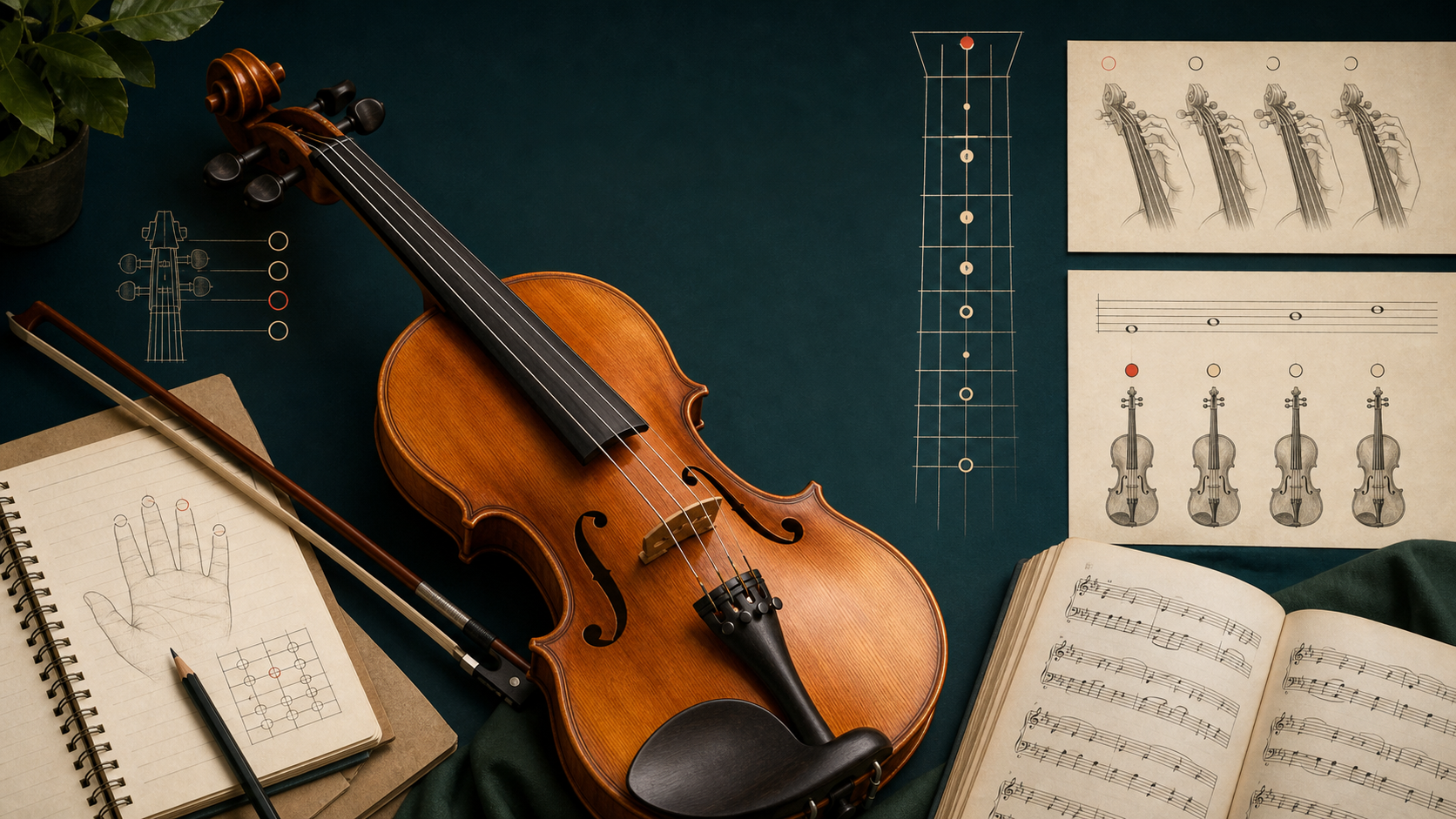
Violin Notes — 07 · Grade 7 All Positions, Harmonics, Advanced Bowing
Grade 7 ABRSM violin is conservatory-entry territory. Every position from half to 8th is required, three-octave scales in all major and minor keys, harmonics (natural and artificial), more double-stop intervals (4ths, octaves), and the bow technique vocabulary expands to martelé, ricochet, sautillé. Repertoire is full Romantic concertos and Bach solo suite movements.
Series map: 00 Beginner → 01 Grade 1 → … → 06 Grade 6 → 07 Grade 7 (this post) → 08 Grade 8.
Learning Outcome
- Play all major and minor scales (three-octave + harmonic & melodic minor).
- Use all positions half through 8th in repertoire.
- Play natural harmonics and introduce artificial harmonics.
- Use martelé ("hammered"), ricochet ("thrown bow"), sautillé (fast spiccato).
- Play octaves as double stops in selected keys.
- Identify modulations to remote keys; understand modal music.
- Perform a complete Romantic concerto movement.
Chapter 1 — Harmonics: the bell-like tones
A harmonic is a high, pure, bell-like tone produced by lightly touching the string at specific nodes (rather than pressing down).
Natural harmonics
Found at division points of the open string:
| Touch point on string | Resulting harmonic | Pitch |
|---|---|---|
| 1/2 (octave node) | 1st overtone | Open string + octave |
| 1/3 node | 2nd overtone | Octave + 5th |
| 1/4 node | 3rd overtone | Two octaves above open |
| 1/5 node | 4th overtone | Two octaves + maj 3rd |
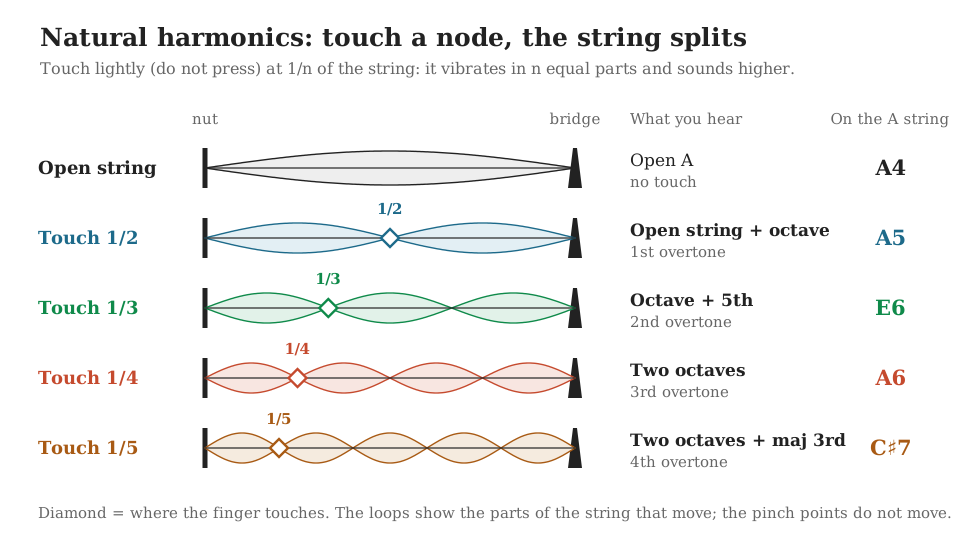
The 1/2 node on the A string is found by lightly touching with your 4th finger at the position where the 4th finger would normally play A5 (one octave above open A). The sound: a soft, ringing high A — an octave higher than expected.
Trick: harmonics need almost no finger pressure — just a feather touch. If you press, you get a muted scratchy note. If you brush, you get the pure overtone. Practise the touch on open A: bow long stroke, feather-touch where the 3rd finger sits in 1st position. The ringing high A (two octaves up) appears almost magically.
Artificial harmonics
Press one finger firmly (the "stopping finger") and touch with another finger a 4th higher (the "harmonic finger"). The pitch produced is two octaves above the stopped pitch.
1
2
3
4
1st finger: presses A on G string (= A3)
4th finger: lightly touches D on G string (= D4, a 4th above)
sounding: A5 (two octaves above A3)
Notation: diamond-shape note head for the touched note, plus regular note for the stopped note.
Used famously in: Tchaikovsky Violin Concerto, Paganini Caprices, Ravel Tzigane.
Chapter 2 — All positions: fluency target
By Grade 7, you've learned half, 1st, 2nd, 3rd, 4th, 5th, 6th, 7th positions. Now: 8th position and fluency across all of them.
8th position
On the A string: 1=B5, 2=C♯6, 3=D6, 4=E6 (right at the top of the violin's standard range for most pieces).
The left hand pivots: thumb shifts to a different angle, hand approaches the bridge.
The fluency goal
You should be able to:
- Shift to any position without looking.
- Find the correct first finger pitch within a quarter-tone, on the first try.
- Choose appropriate position for expression (tone colour) — not just to reach a note.
Trick: practise a single piece entirely in 1st position, then again entirely in 3rd, then entirely in 5th (skipping notes you can't reach). The same melody in different positions sounds different — different string vibrations, different timbre. Pick the position that suits the music.
Position landmarks (physical)
| Position | Hand landmark |
|---|---|
| 1st | Index touches the neck near the nut |
| 3rd | Thumb at the curve of the neck |
| 5th | Hand at the neck-body joint |
| 7th | Hand over the body curve |
| 8th+ | Thumb leaves the neck, sits on the shoulder of the violin |
Chapter 3 — Advanced bowings
Martelé ("hammered")
A short, percussive stroke with a strong attack and a dead stop. Bow pressure increased before the stroke begins, released through the stroke, stops abruptly.
1
2
[silent pressure build] → quick stroke → STOP → [silent pressure build] → next stroke
Used for: marching feel, accented passages, opening of dramatic phrases.
Ricochet ("rebound, thrown")
Multiple notes from a single thrown bow. The bow is dropped from above, bounces 2–4 times naturally, lifted before it stops.
1
2
↓ drop → bounce, bounce, bounce → lift
Used in: Mendelssohn Concerto last movement, Paganini Caprices, Sarasate showpieces.
Sautillé ("springing")
Very fast spiccato — so fast that the bow no longer fully lifts off; the wood "springs" rapidly. Played in the middle of the bow with a loose grip.
1
2
∾∾∾∾∾∾ at metronome 144+ per quaver
Used in: Vivaldi Four Seasons (Summer storm), Beethoven Concerto 1st mvt, Mendelssohn Concerto 1st mvt.
Where I got stuck: I couldn't transition from spiccato to sautillé. The hand wanted to "control" each bounce. Fix: extreme tempo experiment. Start a tremolo (very fast back-and-forth on one note). Gradually add finger changes. The wrist learns the bouncing speed first, then the fingers add pitches.
Chapter 4 — Octave double stops
Two notes an octave apart, played simultaneously. Fingering: 1st finger on lower string + 4th finger on the next string up (e.g., 1 on G + 4 on D for an octave).
Octaves require:
- 1st and 4th fingers to be exactly in tune with each other.
- 3rd and 4th fingers stretched apart maximally.
Practice
Slow tuner work. Tune 1st finger first; freeze it. Add 4th finger; adjust until the octave rings (no beats). Then bow the double stop.
Practise on every string pair: G+D, D+A, A+E.
Trick: octaves are the second-hardest interval to tune (after major 7ths). Beats are very audible; an octave that's even slightly off sounds painful. Practise daily for 5 minutes. Octave fluency takes 6 months minimum.
Chapter 5 — Modulations to remote keys
Grade 7 introduces modulation analysis to:
- Distant keys (e.g., C major → E major; 4 sharps' difference)
- Modal music (Dorian, Phrygian, Mixolydian, Lydian)
Modal recognition
| Mode | Built on (C major scale) | Sound |
|---|---|---|
| Ionian | C — C | Major (familiar) |
| Dorian | D — D | Minor with raised 6 |
| Phrygian | E — E | Minor with lowered 2 (Spanish/Flamenco) |
| Lydian | F — F | Major with raised 4 (dreamy) |
| Mixolydian | G — G | Major with lowered 7 (folk/rock) |
| Aeolian | A — A | Natural minor |
| Locrian | B — B | Diminished, rare |
Trick: listen to Bartók Romanian Folk Dances, Bach modal cantatas, Debussy. Modal music sounds "neither major nor minor". Train the ear to spot the characteristic interval that defines each mode (Dorian's raised 6, Phrygian's lowered 2, etc.).
Chapter 6 — Suggested Practice Pieces
Suzuki Vol. 7 staples
| Piece | Composer | Why |
|---|---|---|
| Sonata No. 3 in F major | Handel | Full Baroque sonata, four movements |
| Courante (Partita 3) | Bach | Bach solo, foundational |
| Gigue (Partita 3) | Bach | Compound rhythm, Bach mastery |
| Concerto in G minor | Bach (BWV 1056 arr.) | Bach concerto level |
ABRSM Grade 7 alternatives
| Piece | Composer | Why |
|---|---|---|
| Concerto No. 4 in D, 1st mvt | Mozart | Standard Mozart concerto |
| Concerto in E minor, 1st mvt | Mendelssohn | The Romantic concerto every violinist plays |
| Méditation (full) | Massenet | Vibrato + harmonic showcase |
| Romance in G | Beethoven | Mature Beethoven |
| Sonata in A | César Franck (excerpts) | Late Romantic chamber |
| Praeludium and Allegro | Kreisler | Style showpiece |
Étude staples
- Kreutzer — Nos. 12, 18, 30, 42 (the "famous" ones).
- Dont Op. 35 — opening.
- Rode 24 Caprices — first few.
Chapter 7 — Memorisation strategy
By Grade 7, you should perform from memory. Strategy:
- Analyse the structure first. Break the piece into sections (A-B-A, exposition-development-recap, theme + variations, etc.). Label each section.
- Memorise section by section — not start-to-finish.
- Memorise the hardest section first. Mental energy is highest at the start of practice; spend it on the toughest bars.
- Practise from any starting point. Open the score randomly; you should be able to start there from memory. This builds resilience for performance anxiety.
- Mental practice. Without the violin, mentally walk through the piece — every shift, every bow direction, every fingering. 10 minutes a day. Increases memory reliability dramatically.
- Slow performance practice. Once memorised, play the whole piece at 60% tempo from memory. Catches weak spots.
Where I got stuck: I memorised by repetition only — fingers learned the piece, but my brain didn't. Under stress (an audition), my fingers blanked. Fix: 10 minutes of mental practice daily. It feels useless at first, but after a month, memory failure rate dropped 80%.
Chapter 8 — Aural / Listening Skills
Grade 7 aural:
- Sing/play 8-bar phrases with modulations after 2 hearings.
- Identify modes (Dorian, Phrygian, etc.).
- Identify chord progressions with non-diatonic chords.
- Sight-sing 8-bar with modulation.
- Identify period (Baroque / Classical / Romantic / 20th-c) by style.
Chapter 9 — Common Grade 7 Pitfalls
| Pitfall | Fix |
|---|---|
| Harmonics fail (muted instead of ringing) | Even lighter touch; check string is at exact node |
| Octaves out of tune | 5 min daily tuner work; tune one finger, freeze, add other |
| Ricochet uneven bouncing | Find balance point on bow; relax wrist; experiment with drop angle |
| Sautillé loses speed mid-passage | Increase metronome gradually over weeks; loose grip |
| Memorisation fails in performance | Mental practice daily; random-start-point drill |
| Mode identification wrong | Listen to canonical examples; sing the characteristic interval |
| Bach Partita feels mechanical | Listen to Hahn, Mutter, Heifetz versions; absorb style |
Useful Shortcut
Cheat-sheet
| What | How |
|---|---|
| Natural harmonic | Light touch at node points (1/2, 1/3, 1/4, 1/5 of string) |
| Artificial harmonic | Press 1, touch 4 a 4th above; sound = 2 octaves above press |
| 8th position | Thumb leaves neck, hand near bridge |
| Martelé | Pressure build → stroke → stop |
| Ricochet | Drop bow, natural bounces, lift |
| Sautillé | Very fast spiccato, middle bow, loose grip |
| Octaves | 1 lower + 4 upper, exact tune |
| Modes | Each starts on different scale degree of major |
| Memory strategy | Section-by-section + mental practice + random-start |
Daily routine (120 min)
| Block | Time | Content |
|---|---|---|
| Tune | 3 min | Tuner + 5ths |
| Bow warm-up | 10 min | Long bows + spiccato + ricochet + sautillé drills |
| Vibrato + tone | 5 min | Vibrato variety (slow / medium / fast) |
| Scales (single notes) | 15 min | 2 three-octave + 2 minor (har + mel) |
| Scales (double stops) | 15 min | 3rds + 6ths + octaves |
| Chromatic + harmonics | 5 min | Chromatic up + harmonic drill |
| Étude | 15 min | Kreutzer / Rode |
| Sight-read | 5 min | New 24-bar passage |
| Repertoire | 35 min | Full concerto movement, slow + tempo |
| Memory work | 7 min | Mental practice + random-start drill |
| Cool-down | 5 min | Slow scale, listen to tone |
Suggested listening (context)
| Piece | Performer | Why |
|---|---|---|
| Mendelssohn Violin Concerto in E minor | Anne-Sophie Mutter | The Romantic concerto bar |
| Bach Partita No. 3 in E major | Hilary Hahn | Bach Partita reference |
| Tchaikovsky Violin Concerto | Hahn | Adult repertoire |
| Brahms Violin Concerto | Mutter | German Romantic |
| Ravel — Tzigane | Sarah Chang | Showcase for harmonics + every advanced technique |
| Paganini — Caprices Nos. 5, 24 | Salvatore Accardo | Aspirational pinnacle |
References
- ABRSM (current). Violin Exam Pieces — Grade 7.
- Suzuki, S. Suzuki Violin School, Vol. 7.
- Carl Flesch, Scale System.
- Kreutzer 42 Études, Dont Op. 35, Rode 24 Caprices.
- Simon Fischer, Tone and Practice.
- Galamian, Contemporary Violin Technique.
- IMSLP — Bach Sonatas & Partitas, Mendelssohn, Mozart concertos.
Note: this post is in progress. Planned additions: harmonic diagram (string nodes); ricochet/sautillé video reference; modal listening clips per mode.