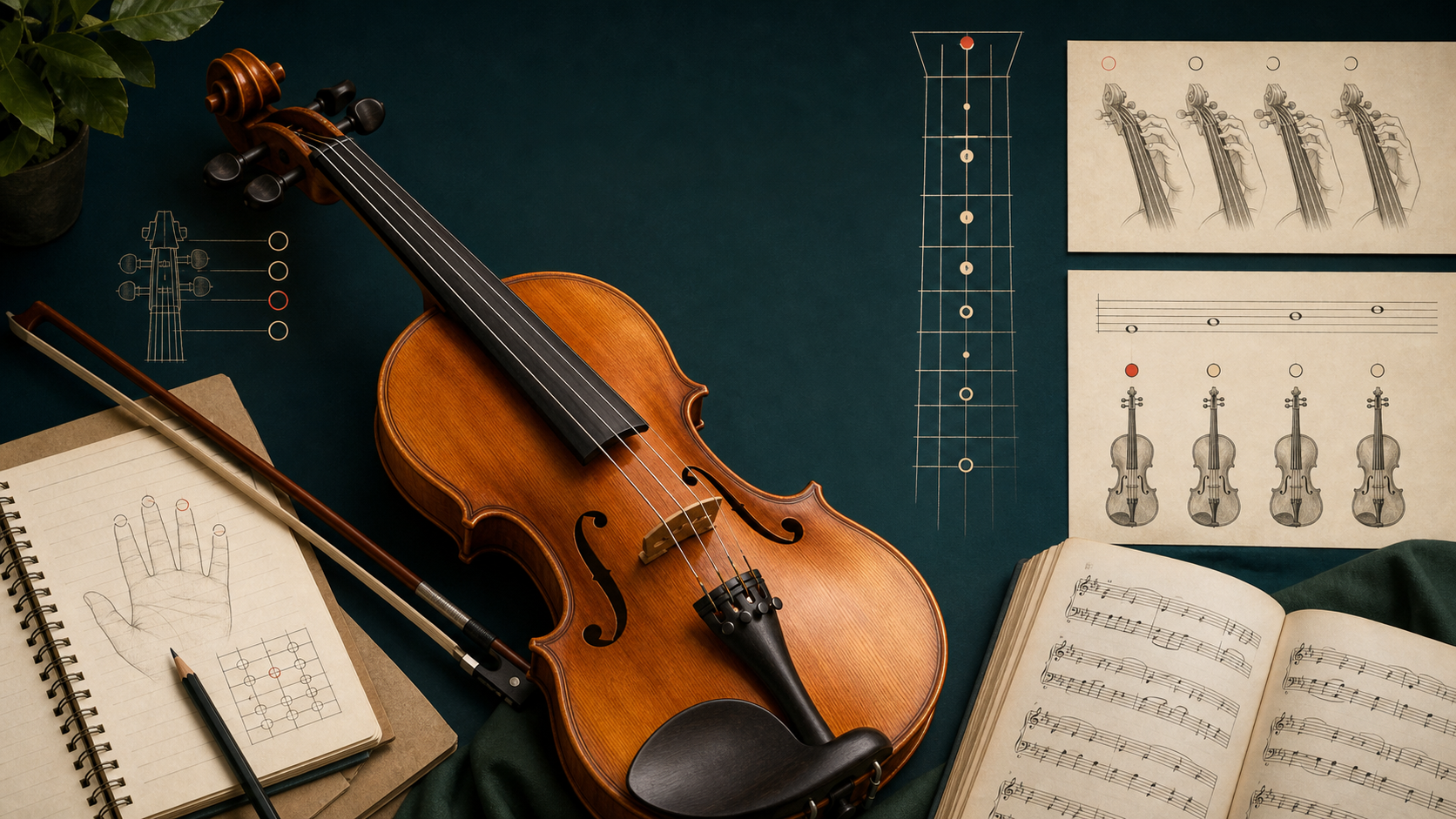
Violin Notes — 04 · Grade 4 2nd & 3rd Position, Melodic Minor, Spiccato
Grade 4 ABRSM violin is where the left hand finally leaves first position. Real 2nd and 3rd position shifting becomes required, melodic minor enters the playing syllabus, more flat/sharp keys (E♭, E, A♭) appear, and the right hand learns spiccato — the controlled bouncing bow. The repertoire moves into early concertos and substantial Baroque sonatas.
Series map: 00 Beginner → 01 Grade 1 → 02 Grade 2 → 03 Grade 3 → 04 Grade 4 (this post) → 05 Grade 5 → … → 08 Grade 8.
Learning Outcome
- Play two-octave scales in all keys up to 3 sharps and 3 flats majors.
- Play melodic minor in playing form (not just paper).
- Shift cleanly to 2nd and 3rd position and back.
- Begin spiccato (controlled bouncing bow) on open strings + simple scales.
- Identify all interval qualities at sight.
- Play 6–8 Grade 4 pieces including one early concerto movement.
Chapter 1 — Position shifting becomes routine
3rd position — the workhorse
3rd position is the second most used position after 1st. Most professional violinists spend 60–70% of playing time in 1st or 3rd.
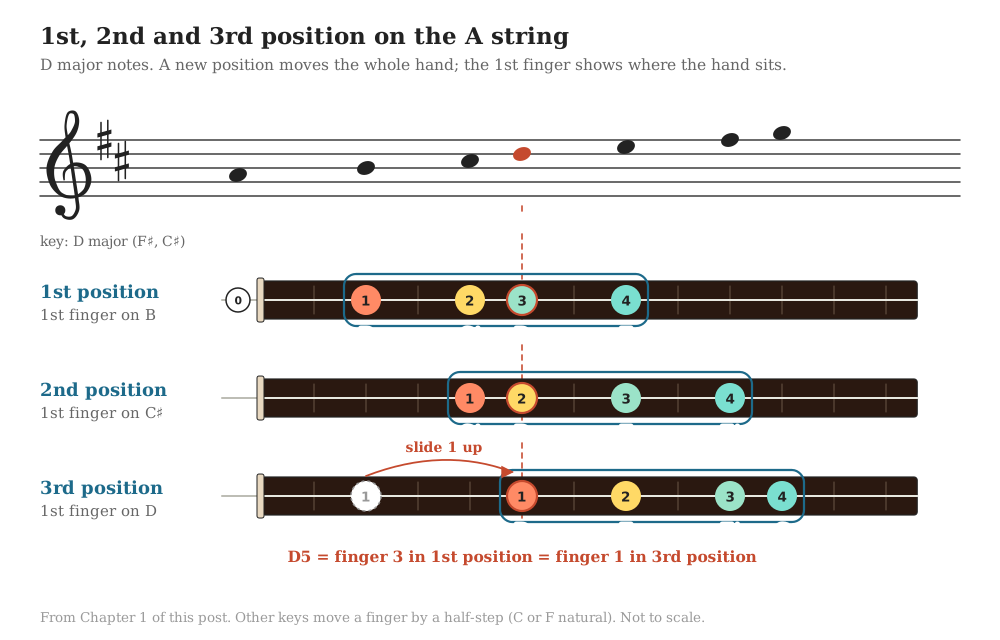
Finding 3rd position
On the A string:
- Play open A.
- Slide 1st finger up until it sounds D5 (the same pitch as 3rd finger in 1st position).
- Now: 1=D5, 2=E5, 3=F♯5 (in D major), 4=G5.
Other strings analogous:
- G string: 1=C, 2=D, 3=E (depending on key), 4=F or F♯.
- D string: 1=G, 2=A, 3=B (or B♭), 4=C.
- E string: 1=A, 2=B, 3=C♯ (or C), 4=D.
The shift motion
Three components, in this order:
- Release finger pressure (don't lift the finger — just release the press).
- Thumb and hand travel together up the neck.
- Press the new finger at the target.
The finger that leads the shift is called the guide finger. In a 1→3 shift, the guide is whichever finger is currently down — usually 1.
Trick: practise silent shifts. Bow open string, shift the left hand up and down while the bow drones the open string. You should hear no glissando — only the open string ringing. If you hear a "scrape", the guide finger is pressing too hard during the slide.
2nd position
Less common than 3rd. The hand sits halfway between 1st and 3rd. On the A string: 1=C♯/C, 2=D, 3=E, 4=F♯/F.
2nd position is the answer when a phrase sits just above 1st position but doesn't go high enough to need 3rd. Used for awkward fingerings, not new pitches.
How to choose position
| Reason | Position to use |
|---|---|
| Reach high notes | Higher position |
| Stay on same string (tone colour) | Whatever position keeps you there |
| Avoid awkward string crossing | The position that smooths the line |
| Score marks it | Composer chose; obey |
| Difficult fingering pattern | Try 2nd position |
Chapter 2 — Melodic minor in playing
Grade 3 introduced melodic minor on paper. Grade 4 requires playing.
D melodic minor (one or two octaves)
Ascending: D E F G A B C♯ D — raise 6 (B) and 7 (C♯).
Descending: D C B♭ A G F E D — back to natural.
Fingering (one octave on D + A):
1
2
3
4
5
6
7
8
Ascending:
D string: D 1=E 2=F 3=G
A string: A 1=B(normal pos) 2=C♯ 3=D
Descending:
A string: D 2=C 1=B♭(low!) A
D string: 3=G 2=F 1=E D
That B♭ on descent / B♮ on ascent on the same string is the tricky part. Same finger (1), different position.
Where I got stuck: my hand could not switch B♮ ↔ B♭ in one scale. Fix: bow only the A string portion (B♭ down, B♮ up) until the finger shape change became automatic. Don't add the rest of the scale until that bar is reliable.
All Grade 4 minors
| Minor | Form | Octaves |
|---|---|---|
| D minor | Harmonic + Melodic | 2 |
| G minor | Harmonic + Melodic | 1 (some 2) |
| A minor | Harmonic + Melodic | 2 |
| E minor | Harmonic + Melodic | 1 or 2 |
Six combinations to practise. Allocate one minor per day, rotate.
Chapter 3 — Spiccato: the controlled bounce
Spiccato is the foundation of all advanced bowing. The bow lifts off the string between notes — not because you lifted it, but because the bow's elasticity bounces it.
How spiccato works
The bow is flexible. When dropped onto the string and pulled, the wood + hair vibrate vertically — they want to bounce. Find the "sweet spot" (middle to slightly upper-middle of the bow), drop with just enough weight, draw a short stroke, and the bow rebounds for the next note.
Spiccato practice progression
- Drop test. Hold the bow over the A string, let it fall from 1 cm above, watch it bounce. Find the bow position where bounce is most controlled (usually 4–6 inches above the middle, near the balance point).
- One bounce per drop. Drop, lift, drop. Slow.
- Two bounces per drop without re-lifting. The bow bounces itself.
- Continuous bouncing on open string at metronome 60.
- Add scale notes. D major scale, spiccato.
- Speed up gradually to 100, then 120.
Trick: spiccato fails when you grip the bow. Relax thumb + pinky; let the bow do the work. If your wrist hurts after spiccato practice, you're forcing it. Stop, shake out, restart looser.
Détaché vs spiccato vs staccato — quick distinction
| Bowing | Bow contact | Sound |
|---|---|---|
| Détaché | On string | Smooth separation |
| Spiccato | Bounces off | Light, dancing |
| Staccato | On string, sharp stop | Short, dry |
| Slurred staccato | On string, multiple stops one direction | Pulsed long line |
Chapter 4 — New keys: E major, A♭ major
E major (4 sharps: F♯ C♯ G♯ D♯)
1
2
3
E string: E 1=F♯ 2=G♯ 3=A 4=B
A string: A(open) → continues up
Fingering: high 2 everywhere (F♯, C♯, G♯), plus a high 3 for G♯ on the D string and D♯ on the A string. Coming after the flat keys, E major feels easy because the fingers sit "high" and two open strings (E and A) are in the key.
A♭ major (4 flats: B♭ E♭ A♭ D♭)
The hardest playable key at Grade 4. Two "low" fingers on most strings; A♭ itself (instead of open A) creates an unusual hand position.
Most editions require A♭ for one octave only at Grade 4. Two-octave A♭ is Grade 5+.
Trick: don't memorise A♭ note-by-note. Memorise it as a modified D major shape, with low 1 on the D string and a low everywhere else. Pattern recognition over note recall.
Chapter 5 — All four cadences (theory)
Grade 4 paper requires recognition of all four cadences:
| Cadence | Chords | Sound | Example |
|---|---|---|---|
| Perfect (Authentic) | V → I | "Full stop" | End of Twinkle |
| Plagal ("Amen") | IV → I | "Settled, churchy" | "Amen" at hymn end |
| Imperfect (Half) | any → V | "Hanging question" | Mid-phrase pause |
| Interrupted | V → vi (instead of I) | "Surprise" | Romantic deception |
Identify by ear in aural: play tonic chord + the cadence chord. Listen to the resolution.
Trick: sing "Happy Birthday" — the last two chords are V → I, perfect. Sing the church "Amen" at the end of any hymn — that's IV → I, plagal. Pre-load these references; any cadence question becomes "which of my references does this match?".
Chapter 6 — Suggested Practice Pieces
Suzuki Vol. 4 staples
| Piece | Composer | Why |
|---|---|---|
| Concerto in A minor, 1st movement | Vivaldi | The Suzuki 4 capstone; first real concerto |
| Concerto No. 2 in G, 3rd movement | Vivaldi | Companion concerto, brighter mood |
| Bourrée (from Lute Suite) | Bach | Compound rhythm + cross-string slurs |
| Perpetual Motion | Bohm | Speed étude |
| Largo | Vivaldi | Slow movement; vibrato preparation |
ABRSM Grade 4 alternatives
| Piece | Composer | Why |
|---|---|---|
| Sonata in G | Telemann | Baroque sonata structure |
| Tambourin | Gossec | Famous staccato show piece |
| Andante | Mozart | Singing Classical line |
| Hungarian Dance No. 5 | Brahms (arr.) | Folk fire; rubato test |
Vivaldi Concerto in A minor: a deeper note
The first movement is the first concerto every Suzuki violinist plays. It includes:
- Energetic 16th-note passages
- A cadenza-like solo break
- Sequences (repeating patterns at different pitches)
- Multiple shifts to 3rd position
- A sense of dialogue between soloist and orchestra
Practise this slowly: 4 weeks at half tempo before any attempt at performance speed.
Chapter 7 — Aural / Listening Skills
Grade 4 adds:
- Sing back a 4-bar phrase with one or two leaps.
- Identify cadences (perfect, plagal, imperfect, interrupted).
- Identify features in a passage (modulation? change of texture?).
- Sight-sing a simple 4-bar phrase (Grade 4+ feature).
Sight-singing strategy
- Look at the time signature + key signature.
- Hum the tonic note (the examiner gives it).
- Trace the contour with your finger silently.
- Sing slowly with the rhythm correct.
- Don't worry about perfect pitch — relative shape matters more than absolute tuning at Grade 4.
Chapter 8 — Common Grade 4 Pitfalls
| Pitfall | Fix |
|---|---|
| Shift sounds like a glissando | Lighter thumb; silent practice |
| Spiccato sounds scratchy | Relax grip; find the right bow spot |
| Melodic minor uses harmonic form descending | Mark "natural here ↓" in score for first month |
| A♭ major scale fingers slip | Pattern memorise (low/normal map) rather than note-name |
| Vivaldi tempo too fast too soon | Half tempo for 2 weeks, ¾ for 1 week, full only week 4 |
| Bow arm exhausted by spiccato | Spiccato is wrist + finger, not arm. Drop arm tension |
| Position guess wrong | Pencil-mark "III" or "II" above first note of every shifted passage |
Useful Shortcut
Cheat-sheet
| What | How |
|---|---|
| 3rd position 1st finger | Plays what 3rd-finger plays in 1st pos |
| Shift mechanics | Release pressure → travel → press new finger |
| Melodic minor | Up: raise 6+7. Down: natural |
| Spiccato sweet spot | Middle to slightly upper-middle of bow |
| E major | "Easy" — high fingers; open E and A are in the key |
| A♭ major | Hardest Grade 4 key; pattern recognition |
| Perfect cadence | V → I — "full stop" |
| Plagal cadence | IV → I — "Amen" |
| Imperfect cadence | ... → V — "question" |
| Interrupted cadence | V → vi — "surprise" |
Daily routine (60 min)
| Block | Time | Content |
|---|---|---|
| Tune | 2 min | Tuner + 5ths |
| Bow warm-up | 7 min | Long bows + spiccato drill on open A |
| Scales | 15 min | 2 major + 2 minor (har + mel) two-octave |
| Shifting drill | 5 min | Silent shift 1↔3 on each string |
| Études | 8 min | Wohlfahrt or Kayser study |
| Sight-read | 5 min | New piece |
| Repertoire | 16 min | Vivaldi concerto or current piece |
| Cool-down | 2 min | Slow open string, listen to tone |
Suggested listening (context)
| Piece | Performer | Why |
|---|---|---|
| Vivaldi A minor Concerto | Anne-Sophie Mutter or Itzhak Perlman | The piece you're learning, played pro |
| Bach Double Concerto in D minor | Hahn + Lara St. John | Future repertoire (Grade 5–6) |
| Mozart Violin Concerto No. 3 in G | Anne-Sophie Mutter | Standard concerto life-goal |
| Sarasate — Zigeunerweisen | Sarah Chang | Spiccato showcase + Romantic fire |
| Paganini — Caprice No. 24 | Salvatore Accardo | Pinnacle of bow technique; aspirational |
References
- ABRSM (current). Music Theory in Practice — Grade 4.
- ABRSM (current). Violin Exam Pieces — Grade 4.
- Suzuki, S. Suzuki Violin School, Vol. 4.
- Simon Fischer, Basics — sections on shifting + spiccato.
- Wohlfahrt, 60 Studies Op. 45, Book 1 — étude staple.
- Kayser, 36 Études Op. 20 — étude alternative.
- IMSLP — Vivaldi concertos, Bach lute suites, Telemann sonatas.
Note: this post is in progress. Planned additions: spiccato video reference; shift exercises diagrams; cadence audio examples.