Piano Notes — 04 · Grade 4 Theory & Repertoire
Grade 4 is the bridge between "can read music" and "understands music". The syllabus expands keys to ±4 sharps/flats, finalises melodic minor, introduces all interval qualities including augmented and diminished, formalises cadences, and asks you to write primary triads in any key from the syllabus. Repertoire jumps too — full Bach inventions, longer sonatina movements, intermediate Romantic miniatures.
Series map: 00 → 01 → 02 → 03 → 04 Grade 4 (this post). Grades 5–8 to follow.
Learning Outcome
- All simple and compound time signatures up to 12/8, with duplets and triplets in compound time.
- All major and minor keys up to ±4 sharps/flats.
- Full melodic minor (ascending raised 6 + 7, descending revert).
- Identify and write all interval qualities including augmented and diminished (not only the tritone).
- Identify and write primary triads (I, IV, V/i, iv, V) in root position in any key from the syllabus.
- Write a perfect, plagal, imperfect, or interrupted cadence in any of those keys.
- Transpose a short passage up or down an octave, possibly with a clef change.
- Recognise broader Italian, French, and German musical terms.
- Play 3–5 Grade 4 pieces hands together at fair tempo.
Chapter 1 — Keys Up to ±4 Sharps/Flats
Adding E major (4 sharps) and A♭ major (4 flats) to the Grade 3 list.
| Key | Sharps/Flats | Relative minor |
|---|---|---|
| C | — | A m |
| G | F♯ | E m |
| D | F♯ C♯ | B m |
| A | F♯ C♯ G♯ | F♯ m |
| E | F♯ C♯ G♯ D♯ | C♯ m |
| F | B♭ | D m |
| B♭ | B♭ E♭ | G m |
| E♭ | B♭ E♭ A♭ | C m |
| A♭ | B♭ E♭ A♭ D♭ | F m |
That's 9 major keys + 9 minor keys = 18 to know fluently by Grade 4.
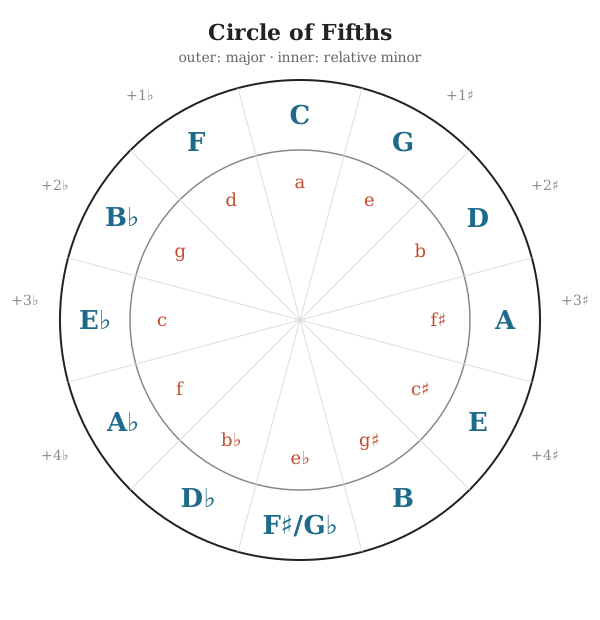
Trick: the circle of fifths is your best friend. Memorise the order clockwise from C: G D A E (each adds a sharp), counter-clockwise: F B♭ E♭ A♭ (each adds a flat). The relative minor lives 3 semitones below — so the same circle holds the minors too, offset by a third.
A small mental tool: "key family"
Group the Grade 4 keys into three families by sharps/flats. When you can derive any scale within a family fluently, the family acts as a single unit:
- Sharp family: G, D, A, E.
- Flat family: F, B♭, E♭, A♭.
- Neutral: C.
Each family has the same major-key triad pattern (M m m M M m d°). Practise one family per week; rotate; by month four you own all 9 keys.
Chapter 2 — Melodic Minor Finalised
Reminder from Grade 3: three minor flavours sharing the same key signature.
Melodic minor is the one Grade 4 wants from you in writing and playing.
1
2
3
A melodic minor ascending: A B C D E F♯ G♯ A
A melodic minor descending: A G F E D C B A
Ascending raises the 6 and 7. Descending reverts to natural (lowers the 6 and 7 back). It's the only scale in Western theory that's deliberately asymmetric between up and down.
Where I got stuck: I kept playing the ascending shape on the way down too. Fix: in slow practice, name the sharps aloud as you ascend ("F-sharp, G-sharp"), and name the naturals aloud as you descend ("G-natural, F-natural"). The voice catches the descent change before the fingers do.
Writing a melodic minor in any key
- Write the natural minor (the key signature's normal scale).
- Mark the 6th and 7th degrees.
- Ascending: raise both with an accidental (♯ or ♮ depending on whether the natural is flat).
- Descending: revert — write naturals/flats explicitly to cancel the ascending raises.
Example — C melodic minor (3 flats: B♭, E♭, A♭):
1
2
3
4
Natural: C D E♭ F G A♭ B♭ C
Melodic ↑: C D E♭ F G A B C (A♭ → A♮, B♭ → B♮)
Melodic ↓: C B♭ A♭ G F E♭ D C (revert)
Chapter 3 — All Interval Qualities
Grade 4 expands beyond the tritone to every augmented and diminished interval.
The full table (above C, ascending)
| Interval | Quality + Number | Semitones |
|---|---|---|
| C–C | Perfect unison (P1) | 0 |
| C–D♭ | Minor 2nd (m2) | 1 |
| C–D | Major 2nd (M2) | 2 |
| C–D♯ | Augmented 2nd (A2) | 3 |
| C–E♭ | Minor 3rd (m3) | 3 |
| C–E | Major 3rd (M3) | 4 |
| C–F♭ | Diminished 4th (d4) | 4 |
| C–F | Perfect 4th (P4) | 5 |
| C–F♯ | Augmented 4th (A4) | 6 |
| C–G♭ | Diminished 5th (d5) | 6 |
| C–G | Perfect 5th (P5) | 7 |
| C–G♯ | Augmented 5th (A5) | 8 |
| C–A♭ | Minor 6th (m6) | 8 |
| C–A | Major 6th (M6) | 9 |
| C–A♯ | Augmented 6th (A6) | 10 |
| C–B♭ | Minor 7th (m7) | 10 |
| C–B | Major 7th (M7) | 11 |
| C–C (oct) | Perfect 8th (P8) | 12 |
Augmented vs Diminished — the rule
- Augmented = one semitone larger than the major or perfect.
- Diminished = one semitone smaller than the minor or perfect.
| Direction | From major | From minor | From perfect |
|---|---|---|---|
| Larger | Augmented | Major | Augmented |
| Smaller | Minor | Diminished | Diminished |
Trick: the qualities form a ladder:
2
3diminished — minor — Major — Augmented (2, 3, 6, 7)
diminished — Perfect — Augmented (1, 4, 5, 8)
One step "up" the ladder = one semitone bigger. One step "down" = one semitone smaller. The 2-3-6-7 group has 4 rungs (because they have a major-minor distinction); the 1-4-5-8 group has 3 rungs (only perfect at the centre).
Counting strategy
- Count staff positions including both endpoints → number (e.g. 4th, 5th).
- Count semitones on the keyboard → cross-reference the table → quality.
Where I got stuck: I kept calling C–D♯ a minor 3rd. They sound identical (both 3 semitones), and on the piano they're the same key. But the staff number is different (C–D = 2nd, C–E♭ = 3rd). Always read the letter names first, count positions, then count semitones. Two questions, two answers, two checks.
Chapter 4 — Primary Triads, Reinforced
Now in all 9 major + 9 minor keys, written out:
Major-key triads pattern (always the same)
| Degree | I | ii | iii | IV | V | vi | vii° |
|---|---|---|---|---|---|---|---|
| Quality | M | m | m | M | M | m | dim |
Minor-key triads (harmonic minor)
| Degree | i | ii° | III+ | iv | V | VI | vii° |
|---|---|---|---|---|---|---|---|
| Quality | m | dim | Aug | m | M | M | dim |
(III+ = augmented; only applies in harmonic minor because the raised 7 alters that triad.)
Trick: memorise the major pattern first (M m m M M m d°). Then commit just this fact about minor: the V in harmonic minor is major (because of the raised 7th). For Grade 4 written work, primary triads (i, iv, V) are what you'll be asked. i and iv are minor (because they include the natural 3rd and 5th). V is major.
Worked example: write i, iv, V in F♯ minor
F♯ minor's relative major is A (3 sharps: F♯ C♯ G♯). Harmonic minor raises the 7th of natural F♯ minor → raises E to E♯.
1
2
3
4
i (F♯ minor): F♯ A C♯
iv (B minor): B D F♯
V (C♯ major): C♯ E♯ G♯ ← E♯ from harmonic minor raised 7
Notice E♯ (not F natural). The spelling matters — F♯ minor uses the letters F-G-A-B-C-D-E in order, so the raised 7 is E♯ (not F natural), even though they're the same key on the piano.
Chapter 5 — Cadences
A cadence (終止式) is a two-chord progression that ends a musical phrase. The four Grade-4 cadences:
| Cadence | Roman | Sound | Where |
|---|---|---|---|
| Perfect (Authentic) | V → I | Full closure | End of major sections |
| Plagal | IV → I | "Amen" / gentler close | End of hymns, gospel |
| Imperfect (Half) | ? → V | Pause; more to come | Mid-phrase question |
| Interrupted (Deceptive) | V → vi | Surprise — expected V→I doesn't arrive | Romantic music loves this |
Writing a cadence
For Grade 4, you'll typically be asked to write two block-chord triads in root position in a given key. Voicings are open here — the syllabus doesn't yet require correct four-part voice leading.
Example — plagal cadence in G major:
1
2
3
IV chord (C major): C E G
I chord (G major): G B D
Trick: perfect cadences are the period at the end of a sentence. Plagal cadences are the "and we're done" exhale. Imperfect is the question mark mid-phrase. Interrupted is the comma-where-you-expected-a-period — the listener feels the rug pulled. Naming the emotional function makes them memorable.
Detection by ear
- Perfect ends on the tonic with a strong "thud" of finality.
- Plagal ends on tonic but softer, "Amen"-shaped.
- Imperfect doesn't end on tonic — it leaves you hanging on V.
- Interrupted sets you up for tonic, then jolts to vi.
Where I got stuck: I confused plagal and perfect by ear because both end on the tonic. The fix: listen to the chord before the tonic. If it's a bright, leading chord with a sharpened 7th → V → perfect. If it's a softer subdominant (IV) → plagal. The lead-in chord is the give-away.
Chapter 6 — Transposition at the Octave (with clef change)
Grade 4 asks: rewrite a short passage one octave higher or lower, possibly changing clef.
Procedure
- Identify the target clef (if changing). Treble ↔ bass change requires repositioning every note.
- Shift every note by 7 staff positions (one octave) in the chosen direction.
- Key signature unchanged — transposing at the octave doesn't change key.
- Preserve all accidentals, dynamics, articulation, fingering.
Common confusion: clef change ≠ key change
Moving a treble passage into the bass clef changes how the same notes look, not what they sound like. Middle C is one ledger below the treble staff; the same note is one ledger above the bass staff. The actual pitch is identical; the notation rearranges.
Where I got stuck: I miscounted octaves on bass clef constantly. The fix that stuck: sketch the grand staff at the top of every transposition exercise during practice, with Middle C clearly marked on both sides. After two weeks the eye snaps to the right ledger without thinking.
Worked mini-example
Original (treble, C major):
1
2
C5 E5 G5 C6
Transposed one octave down, in bass clef:
1
2
C4 E4 G4 C5
Same letters, same key signature, just one octave lower in pitch and on the other clef.
Chapter 7 — Italian / French / German Terms (Grade 4 expansion)
ABRSM Grade 4 explicitly adds French and German terms. Italian remains the spine; the others are repertoire-language vocabulary.
French (Grade 4 set)
| Term | Meaning |
|---|---|
| Lent | Slow |
| Modéré | Moderate |
| Vif | Lively |
| Doux | Sweet, soft |
| Cédez | Yield, slow down |
| Pressez | Hurry, push forward |
| Mais | But |
| Sans | Without |
| Très | Very |
German (Grade 4 set)
| Term | Meaning |
|---|---|
| Langsam | Slow |
| Mäßig | Moderate |
| Schnell | Fast |
| Lebhaft | Lively |
| Süß | Sweet |
| Bewegt | Moving, agitated |
| Mit Ausdruck | With expression |
| Sehr | Very |
| Aber | But |
Trick: cluster by meaning across all three languages:
- Slow: Adagio / Lent / Langsam
- Fast: Allegro / Vif / Schnell
- Sweet: Dolce / Doux / Süß
- Very: Molto / Très / Sehr
- But: Ma / Mais / Aber
Cross-language quizzes become trivial because you anchor on the concept, not the foreign word.
Chapter 8 — Suggested Practice Pieces
Grade 4 mainstream
| Piece | Composer | Why |
|---|---|---|
| Two-Part Invention No. 4 in D minor, BWV 775 | Bach | The most popular Grade 4 Bach. Two-voice writing in minor; learn it well, you'll keep it forever |
| Two-Part Invention No. 8 in F, BWV 779 | Bach | More cheerful sister to No. 4. Fast triplets, joyful |
| Sonatina in G, Op. 36 No. 2 (I) | Clementi | Wider hand position, Alberti bass, longer phrases than Grade 3 sonatinas |
| Burgmüller, Op. 100 No. 18 ('Inquiétude') | Burgmüller | Restless RH, agile LH — a piece that sounds harder than it is |
| Album for the Young, Op. 68 No. 16 ('First Loss') | Schumann | Lyrical, expressive — a real test of voicing and rubato |
| Children's Album, Op. 39 No. 8 ('Mazurka') | Tchaikovsky | Polish dance feel; cross-rhythms; great for compound-time practice |
| Heller, Op. 47 No. 1 ('Avalanche') | Heller | A "study with personality"; relentless triplets but musical |
Stretching toward Grade 5
| Piece | Composer | Why |
|---|---|---|
| Two-Part Invention No. 1 in C, BWV 772 | Bach | Yes the most-played. Master it — Grade 5 examiners will assume you have |
| Sonata in F, K. 280 (II) | Mozart | Slow movement; expressive, beautiful, manageable hands |
| Mazurka, Op. 17 No. 4 | Chopin | Romantic mazurka feel; demanding voicing but within reach |
| Doctor Gradus ad Parnassum | Debussy | The aspirational target — start sight-reading it once a month, learn it for real at Grade 6 |
How to build a Grade 4 programme
Pick:
- 1 Baroque (Bach invention)
- 1 Classical (sonatina or Mozart minuet)
- 1 Romantic (Schumann, Burgmüller, or Tchaikovsky)
- 1 20th-century or wild card (Bartók, Heller, contemporary)
This mix is exactly what the exam syllabus expects, and it's a real musical diet — period variety is what makes a pianist, not just a key-pusher.
Chapter 9 — Voicing (the new technique)
By Grade 4 you're playing pieces where one voice (usually the soprano line, top of the RH) carries the melody while the other voices accompany. You need to make the melody louder than the inner voices, with the same hand.
Mechanics
- The melody-bearing finger uses slightly more weight and arm support.
- The accompanying fingers play softer — about 1 dynamic level below.
- Wrist relaxes between melodic strikes; the inner voices ride along.
Practice drill
- Play the chord with full RH voicing at one steady volume.
- Replay, this time bringing out the top note (finger 5, usually) — exaggerate.
- Replay, this time bringing out an inner voice (finger 2 or 3).
- Replay, this time bringing out the bottom note (finger 1).
- Now play the actual piece with the top voice highlighted naturally.
The first four steps are "isolated voicing"; the fifth is "musical voicing".
Where I got stuck: my finger 5 was too weak to project. The fix: finger 5 isolation exercises — Hanon-style 5-finger patterns where I deliberately over-strike with the pinky. Two weeks of this gave finger 5 the strength I needed. Don't skip this — finger 5 carries 80% of upper-register melodies in classical repertoire.
Chapter 10 — Aural at Grade 4
Grade 4 aural adds:
- Identify which note of a 4-note phrase has been changed in a played comparison.
- Identify cadence type: perfect, imperfect, or plagal (interrupted is Grade 5).
- Identify a stronger set of features: dynamics, articulation, rhythm change, key change (to relative minor only).
Trick: for cadence ID, the question is "did it end on the tonic, and how did it get there?"
- Tonic, with a leading-7 chord before → perfect (V → I)
- Tonic, with a softer subdominant before → plagal (IV → I)
- Not tonic, hanging on the dominant → imperfect (something → V)
Two binary tests in sequence: (a) tonic or not, (b) which chord before. Three answers cover all three cadences.
Chapter 11 — Common Grade 4 Pitfalls
| Pitfall | Fix |
|---|---|
| Calling A2 a m3 | Always read staff position first, then count semitones |
| Forgetting V is major in minor | Write the raised 7 with a coloured pencil. After 4 weeks, internalised |
| Spelling triads wrong (e.g. F natural instead of E♯) | Stay in letter-name order — F♯ minor uses F-G-A-B-C-D-E; raised 7 is E♯, not F |
| Practising all pieces at the same tempo | Pick the slowest one. Practise everything at that tempo for one full session |
| Skipping aural | 5 min daily of clap-back and sing-back. Doubles your speed at recognising rhythm and pitch |
| Reading only the notes, not the markings | Highlight every Italian, French, German term before you play. Translate each |
Useful Shortcut
Cheat-sheet
| What | How |
|---|---|
| Sharp keys | C → G → D → A → E (each +1 sharp) |
| Flat keys | C → F → B♭ → E♭ → A♭ (each +1 flat) |
| Relative minor | 3 semitones below major tonic |
| Melodic minor up | Raise 6 + 7 |
| Melodic minor down | Revert to natural |
| Interval quality | Position number + semitone count, cross-check table |
| V in minor | Major (raised leading tone) |
| Cadences | V→I perfect, IV→I plagal, ?→V imperfect, V→vi interrupted |
| Major-key triad pattern | M m m M M m d° |
Daily routine (45 min)
| Block | Time | Content |
|---|---|---|
| Five-finger warm-up | 3 min | In today's key, all four touch types (legato, staccato, portato, accent-top) |
| Scales | 12 min | Today's major + three minor flavours, hands separate then together, 2 octaves |
| Arpeggios | 5 min | I, IV, V root-position chords broken into arpeggios |
| Sight-read | 5 min | One new short piece per day |
| Repertoire | 15 min | One piece, difficult-bar loops |
| Aural | 3 min | Cadence ID from recorded fragments |
| Theory | 2 min | One past-paper question, written |
Suggested listening
| Piece | Composer | Why |
|---|---|---|
| Two-Part Inventions (full set, BWV 772–786) | Bach | Listen to all 15 if you haven't already. Each is a Grade 4-5 piece in miniature |
| Goldberg Variations, BWV 988 | Bach | Aspirational. Listen and dream |
| Songs Without Words, Op. 19 | Mendelssohn | Lyrical Romantic style. Voicing and singing line mastery |
| Children's Album, Op. 39 (full) | Tchaikovsky | Many pieces sit at Grade 4-5; immerse in the entire album |
| Nocturnes, Op. 9 No. 2 | Chopin | THE Nocturne. Aim for Grade 6-7 but get the sound in your head now |
| Préludes, Book 1, La fille aux cheveux de lin | Debussy | Modern impressionism; a future "favourite piece" candidate |
| Sonata in A, K. 331 (I) — Andante grazioso | Mozart | The famous variation theme; Grade 4-5 difficulty in the theme alone |
References
- ABRSM (current). Music Theory in Practice — Grade 4.
- ABRSM (current). Piano Exam Pieces — Grade 4.
- Eric Taylor, The AB Guide to Music Theory — Parts I & II.
- IMSLP — Bach Two-Part Inventions, Clementi Op. 36, Schumann Op. 68, Tchaikovsky Op. 39, Burgmüller Op. 100 + Op. 109, Heller Op. 45 + Op. 47.
- Walter Piston, Harmony (5th ed.) — for deeper triad / cadence understanding beyond syllabus.
- Heinrich Schenker, Five Graphic Music Analyses — for advanced curious readers.
- Czerny, Op. 599 + Op. 849 — daily technical etudes.
Note: this post is in progress. Planned additions: audio reference for each piece, a worked Roman-numeral analysis of a Mozart sonatina movement, sample exam-paper question with full written workings.