Piano Notes — 01 · Grade 1 Theory & Repertoire
ABRSM Grade 1 covers the foundations every musician needs: clefs, note values, simple time signatures, the first few keys, basic intervals, and the very first scales. This post pairs the syllabus with practice pieces graded at the same level, plus the memory tricks I wish someone had handed me on day one.
Series map: 00 Beginner Basics → 01 Grade 1 (this post) → 02 Grade 2 → 03 Grade 3 → 04 Grade 4. Grades 5–8 to follow.
Learning Outcome
- Read fluently in treble and bass clef on the five staff lines, four spaces, and one ledger line above or below.
- Identify all note values from semibreve to quaver, and matching rests.
- Use 2/4, 3/4, and 4/4 time signatures correctly.
- Name notes in C, G, F majors and their key signatures.
- Build major scales for C, G, F (one octave, hands separate).
- Identify intervals between any two notes of the C major scale (number only).
- Recognise the tonic, dominant, subdominant of those three keys.
- Play 3 to 5 short pieces hands together at Grade 1 standard.
Chapter 1 — Pitch Notation Recap
Terminology
- Pitch (音高) — how high or low a note sounds, measured in frequency.
- Accidental — sharp ♯ / flat ♭ / natural ♮ applied to a single note.
- Sharp (♯) — raise the pitch by one semitone.
- Flat (♭) — lower the pitch by one semitone.
- Natural (♮) — cancel a previous sharp or flat.
An accidental affects every occurrence of that note in the same octave for the rest of the bar — then the barline resets it. A key signature is the only "global" accidental.
Ledger lines (加線)
Grade 1 requires one ledger above and one below in each clef.
- Treble: one line above the staff = A5, one line below the staff = Middle C (C4).
- Bass: one line above the staff = Middle C (C4) as well (the same note), one line below the staff = E2.
Trick: Middle C is the connector. It sits one ledger below the treble staff AND one ledger above the bass staff. Same key on the piano, two ways to write it. Drill this until it's automatic — Grade 2 and beyond use it constantly.
Chapter 2 — Note Values (音符的時值)
English / 中文 / symbol table
| EN | 中文 | UK name | Beats in 4/4 |
|---|---|---|---|
| Whole note | 全音符 | Semibreve | 4 |
| Half note | 二分音符 | Minim | 2 |
| Quarter note | 四分音符 | Crotchet | 1 |
| Eighth note | 八分音符 | Quaver | ½ |
ABRSM uses the UK terms (semibreve, minim, crotchet, quaver). American sheet music uses whole/half/quarter/eighth. Same notes, different names. Get used to both.
Rests
Every note value has a matching rest. The same beat counts apply — a crotchet rest is 1 beat of silence in 4/4.
Trick: I confused the whole-note rest (hangs down from a line) and the half-note rest (sits on top of a line). Memory aid: "the whole rest is a hole — it falls down. The half is half full — it sits up." Silly, never forgot it again.
Dots and ties
- A dot after a note adds half its value. Dotted minim = 2 + 1 = 3 beats.
- A tie joins two notes of the same pitch — sum their durations.
- A slur joins two notes of different pitches — phrasing, not duration.
Chapter 3 — Time Signatures (拍號)
Grade 1 covers 2/4, 3/4, 4/4 only.
The top number = beats per bar. The bottom number = which note value gets one beat (4 = crotchet).
| Time signature | Beats per bar | Feel |
|---|---|---|
| 2/4 | 2 | March (left-right-left-right) |
| 3/4 | 3 | Waltz (ONE-two-three) |
| 4/4 | 4 | Pop, hymn, default (ONE-two-three-four) |
The first beat of every bar is the strongest. Place natural emphasis there; the bar lines exist precisely to tell you where to push slightly.
Bar (小節) maths
The notes in any bar must add up to the time signature's beat count. If 4/4 has only crotchets and quavers, common bars include:
1
2
3
4
4/4: ♩ ♩ ♩ ♩ = 4
♩ ♩ ♪♪ ♩ = 4 (♪♪ = two quavers, value 1)
♩. ♪ ♩ ♩ = 4 (dotted crotchet + quaver = 2)
Trick: when sight-reading, count out loud on every beat — including rests. The voice keeps the pulse even when your hands stumble. Silent counting is for performance, not learning.
Chapter 4 — Keys and Key Signatures
Grade 1 syllabus: C major, G major, F major.
| Key | Sharps/Flats | Memory anchor |
|---|---|---|
| C major | none | Easy default |
| G major | 1 sharp: F♯ | "Goes up" → sharp |
| F major | 1 flat: B♭ | "Falls down" → flat |
Scale construction reminder
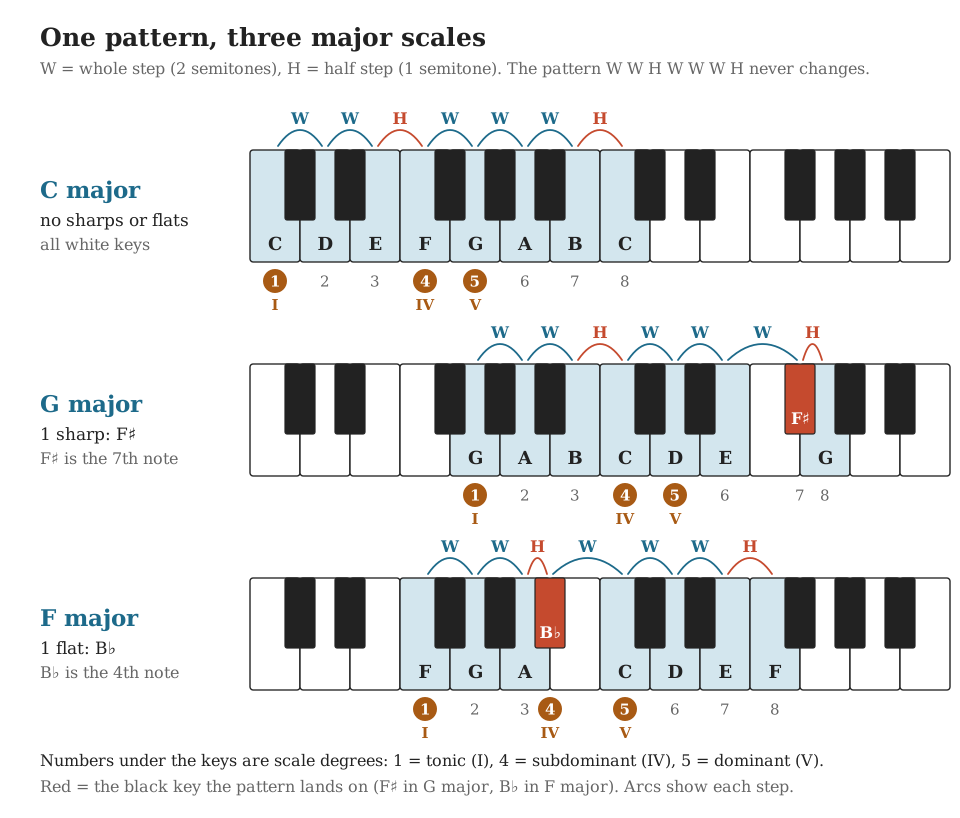
Major scale pattern in semitones: W W H W W W H (whole, whole, half, whole, whole, whole, half).
Apply from any tonic and you get a major scale. From C: all whites. From G: hits F♯ as the 7th. From F: hits B♭ as the 4th.
1
2
3
4
C major: C D E F G A B C
G major: G A B C D E F♯ G
F major: F G A B♭ C D E F
Trick: the major-scale pattern doesn't change — only the starting note does. If you can derive C major from scratch, you can derive every major scale by counting W W H W W W H with your finger on the keyboard. Don't memorise 12 scales; memorise one pattern and 12 starting points.
Tonic, Dominant, Subdominant
For any major scale:
- Tonic (I) — the 1st degree. Home note. C in C major.
- Subdominant (IV) — the 4th degree. F in C major.
- Dominant (V) — the 5th degree. G in C major.
These three notes form the primary triads of the key, the most important chords in any major piece. Half of pop and folk music is built from just I, IV, V.
Where I got stuck: I assumed "dominant" meant "loudest" or "main". It actually means the 5th, always. The label is positional, not musical. Once I stopped overthinking it, every scale fell into place.
Chapter 5 — Intervals (Number Only)
At Grade 1 you only need to identify the number of an interval (2nd, 3rd, etc.), not its quality (major / minor / perfect). Quality starts at Grade 2.
Counting
Count the lower note as 1, then count up the staff lines and spaces to the upper note. The count includes both notes.
1
2
3
4
5
C to D: C (1) D (2) → 2nd
C to E: C (1) D (2) E (3) → 3rd
C to G: C (1) D (2) E (3) F (4) G (5) → 5th
C to C: octave (8th)
| Interval | Staff positions |
|---|---|
| Unison | Same line/space |
| 2nd | Adjacent line + space |
| 3rd | Line to next line, or space to next space |
| 4th | Line to space-after-the-next-line |
| 5th | Line to second line above |
| 6th | Space to third line above, or line to third space above |
| 7th | Line to third line above, or space to third space above (one short of an octave) |
| Octave (8th) | Same letter, seven steps up (line to space, or space to line) |
Trick: 3rds and 5ths "jump white" — they go line-to-line or space-to-space, looking visually stacked. 2nds and 4ths "step black" — one note sits on a line, the other in a space. Once your eye reads these shapes, you stop counting notes one-by-one.
Chapter 6 — Hands-Together Coordination
You played hands together in Post 00 already with "Twinkle". Grade 1 expands this. The technique:
- Each hand alone, played until boring. Genuinely boring — no mistakes, no thinking.
- Hands together at half speed. Eyes on the page, not the hands.
- Pulse first, accuracy second. If one hand stumbles, don't stop the pulse. Drop the wrong-hand note rather than break the beat.
- Slow with metronome. Crotchet = 60. Once smooth, raise by 5 BPM increments.
Where I got stuck: my left hand was 6 weeks behind my right. The fix: I practised only the left hand for one full week. No right hand at all. Result: by the next week my left could play its own line cleanly, and hands-together suddenly worked.
Chapter 7 — Suggested Practice Pieces (Grade 1 level)
These are real Grade 1 / Initial Grade pieces with public domain or freely-available scores. Hunt them on IMSLP or buy the ABRSM exam book — the album also contains your audio reference.
Easier end (still inside Initial Grade)
| Piece | Composer | Why it's good for you |
|---|---|---|
| Minuet in G (BWV Anh. 114) | Bach (attr. C. Petzold) | Two-bar phrases, classic Baroque feel, hands-together at a comfortable tempo. Real music, not a "method book exercise" |
| Allegro in C | Diabelli, Op. 125 No. 1 | Pure C major, balanced hands, teaches the I-IV-V harmony pattern aurally |
| No. 9 'In Yugoslav Mode' | Bartók, Mikrokosmos Vol. 1 | Modern teaching piece; clean RH melody, sparse LH. Bartók wrote these for his son |
| Burgmüller, Op. 100 No. 1 ('La Candeur') | Burgmüller | Lyrical RH melody over a steady LH; brilliant first piece with real expression |
Slightly stretching
| Piece | Composer | Why |
|---|---|---|
| Minuet in F (K. 2) | Mozart (age 6) | Yes, six. Easy enough for Grade 1, written by a child — fun fact while you struggle |
| Russian Folk Song Op. 107 No. 3 | Beethoven | Two voices, both inside one octave. Tiny, perfect study of independent hands |
| No. 6 'Gypsy Dance' | Bartók, For Children Vol. 1 | Drone bass, melody floats above. Teaches "ostinato" by feel |
How to study a piece
- Hands separate, slow, no metronome — until you can do four bars without error.
- Hands separate, with metronome — at the slowest tempo where you're still error-free.
- Hands together, slow — half the eventual target.
- Hands together, target tempo — and only here do you allow yourself to think about expression.
- Memorise the hardest bar — play it from any cold start.
Trick: number the bars and track them on a notepad. Mark each bar with ✓ when you can play it hands-together at tempo. The unchecked bars are your next 10-minute focus, not the whole piece. You'd be amazed how few bars are actually broken — usually 3-4 out of 32.
Chapter 8 — Aural / Listening Skills
Grade 1 ABRSM practical includes an aural test. The skills:
- Clap back a rhythm — listen to a 2- or 3-bar rhythm in 2/4, 3/4, or 4/4; clap it back.
- Sing back a short phrase — three or four notes, played twice.
- Identify time signature — listen to a tune; say whether it's in 2/4, 3/4, or 4/4.
Practising aural without a teacher
- Phone metronome + clap for rhythms. Tap a 4-bar pattern on the table, then clap it back without looking.
- Sing scale degrees — call out "1, 2, 3" up the major scale while playing it. Builds the do-re-mi reflex.
- Listen to any piece and tap your foot. If your tapping settles into pairs, it's 2/4 or 4/4. If into threes, it's 3/4. Public music is your unlimited test bank.
Trick: whistling is sneaky-good for aural training. If you can whistle the tune you've been practising, you've internalised the pitch shape. If you can only "sort of" whistle it, you haven't. The whistle is a free pitch test.
Chapter 9 — Common Grade 1 Pitfalls
| Pitfall | Fix |
|---|---|
| Counting in your head, not out loud | Out loud — especially on rests. The voice doesn't lie |
| Forgetting accidentals carry through the bar | Re-write any tricky bar on paper, accidentals included |
| Reading every note individually | Train shapes (steps vs leaps, scale-fragments) — see Chapter 5 |
| Skipping the LH because RH is "the melody" | LH is half the music. Practise LH alone twice as much for a month |
| Slowing down only the hard bars | Slow down the whole piece. Speed differences mid-piece hide as nervousness in exam |
| Practising past tiredness | 25 min focused > 60 min tired. Stop when accuracy drops |
Useful Shortcut
Cheat-sheet
| What | How |
|---|---|
| Find any key in G major | Same as C, except F → F♯ |
| Find any key in F major | Same as C, except B → B♭ |
| Major scale pattern | W W H W W W H |
| Identify interval number | Count up staff positions, include both endpoints |
| Dotted note value | note + half its value |
| Bar must equal | Top number of time signature |
| Tonic / subdominant / dominant | 1st / 4th / 5th degrees |
| Whole rest hangs | Half rest sits |
Daily routine (30 min)
| Block | Time | Content |
|---|---|---|
| Five-finger warm-up | 3 min | C, G, F positions, both hands |
| Scale | 5 min | C, G, F major hands separate, one octave |
| Sight-reading | 5 min | New short piece each day |
| Repertoire | 12 min | Current piece, focus on the worst 4 bars |
| Theory | 5 min | One past-paper question, written out by hand |
Suggested listening (context, not homework)
| Piece | Composer | Why |
|---|---|---|
| Anna Magdalena Notebook (full) | Bach | Bach wrote this for his second wife — beginner-friendly but real music. Many Grade 1-3 pieces sit inside it |
| Album for the Young, Op. 68 | Schumann | Romantic counterpart to Bach's notebook. Hear what's coming in Grade 2-3 |
| Minute Waltz, Op. 64 No. 1 | Chopin | Aspirational; impossible at Grade 1 but plant the seed |
| Goldberg Variations, BWV 988 | Bach | The Mount Everest of solo keyboard. Listen for context, not to play (yet) |
| Children's Album, Op. 39 | Tchaikovsky | Russian counterpart to Schumann's; many pieces sit at Grade 3-4 |
References
- ABRSM (current). Music Theory in Practice — Grade 1.
- ABRSM (current). Piano Exam Pieces — Initial / Grade 1 (the official syllabus collection).
- Eric Taylor, The AB Guide to Music Theory — Part I.
- IMSLP — public-domain scores for every classical work mentioned.
- Bartók, Mikrokosmos Vols. 1–2 (Boosey & Hawkes).
- Burgmüller, 25 Easy and Progressive Studies, Op. 100.
Note: this post is in progress. I'll add embedded audio reference snippets per piece once I find legally-clean recordings, plus a printable practice-tracker checklist.