Piano Notes — 00 · Beginner Basics & Your First Songs
The first post in a self-study piano series. Goal: by the end of this one you can sit at any keyboard, find any note in under five seconds, and play three short pieces from memory. Skip the marketing fluff and go straight to the muscle memory.
Series map: 00 Beginner (this post) → 01 Grade 1 → 02 Grade 2 → 03 Grade 3 → 04 Grade 4. Grades 5–8 will follow.
Learning Outcome
- Sit comfortably at the keyboard with healthy posture.
- Name every white key on sight — both directions, both clefs.
- Find Middle C on any size piano without thinking.
- Play three short pieces with both hands.
- Recognise the difference between a piano, an upright, a digital, and a synth — and pick the right one for practice.
Chapter 1 — Why piano is a good first instrument
The keyboard is the clearest visual map of Western music. Every other instrument hides pitch behind a fingering chart; the piano lays the entire pitch space out in front of you, left-to-right, low-to-high. If you understand "how a scale looks" on the piano, you understand it on a guitar, a violin, or in a software synth — you just don't see it as plainly.
A second practical reason: the piano is monophonically simple but polyphonically rich. Beginners can produce a clean tone from day one (press → sound), while advanced players spend a lifetime on the same instrument. Few instruments span that range.
Where I started: I wasted my first two weeks googling "best digital piano under $500" instead of practising. The truth is any 88-key weighted keyboard from a major brand (Yamaha, Roland, Casio, Kawai) is fine for the first year. The piano you have and play every day beats the piano you research and never own.
Chapter 2 — Picking an instrument
Acoustic (real) piano
- Upright (直立式) — most homes. Footprint ~150 cm wide, depth ~60 cm. Tone is good but action is lighter than a grand.
- Grand (平台式) — long horizontal action, more responsive. Babies (~150 cm) to concert (~275 cm). Expensive, needs tuning twice a year.
Digital piano
- Weighted action (重錘鍵盤) is non-negotiable for serious practice. "Semi-weighted" and "synth action" feel different and will delay your finger development.
- 88 full keys preferred over 76 or 61 — exam pieces will eventually need the full range.
- Built-in speakers are a "nice to have"; quality varies. Headphones bypass the problem and are quieter for housemates.
What you actually need (the honest list)
| Item | Necessity | Why |
|---|---|---|
| 88-key fully-weighted digital, or any acoustic upright | Essential | Your hands form habits around action weight |
| Bench at correct height | Essential | Wrong height = wrist strain in 4 weeks |
| Metronome (app fine) | Essential | The most-skipped tool that fixes the most-common problem |
| Music stand with light | Highly recommended | You'll be reading every session |
| Headphones (digital) | Recommended | Practise at any hour without conflict |
| Pedal (sustain) | Eventually | Not for week 1; needed by week 8 |
Trick: the right bench height = your forearms parallel to the floor when fingers rest on the keys, wrists neither dropping nor arching. Sit too high → you push the keys down with extra force and tense the wrist. Sit too low → you reach up and the fingers fight gravity. Adjust this on day one. Re-check it monthly.
Chapter 3 — The keyboard map
Black-key landmarks
The black keys come in groups of 2 and 3. The 2-group anchors C-D-E; the 3-group anchors F-G-A-B.
- The white key immediately left of a 2-group is always C.
- The white key immediately left of a 3-group is always F.
These two anchors are the only ones you ever need to memorise. The other letters (D, E, G, A, B) are derived by counting in alphabetical order from C or F.
Trick: the 2-group is C-D-E; 3-group is F-G-A-B. Stack the consonants in your head: Car Drives East, Fish Goes Around Back. Cheesy works.
Middle C
The C closest to the centre of the keyboard. On an 88-key piano this is the fourth C from the bottom — C4 in scientific pitch notation. On a 61-key it's the third C. Either way, find the centre, find the 2-group nearest it, drop your right thumb on the white key to the left of that pair.
Octaves
Same letter, doubled frequency: . The keyboard pattern repeats every 12 keys (7 white + 5 black). Once you memorise the 7-white-key span (C D E F G A B), the entire 88-key keyboard is mapped.
Chapter 4 — Posture and hand mechanics
Sitting
- Bench centred on Middle C.
- Sit on the front third of the bench, not slumped back.
- Feet flat on the floor. (Smaller players: get a footstool; dangling feet cause back tension.)
- Elbows roughly at keyboard height.
- Shoulders down and relaxed. No shrugging up to the ears.
Hands
- Curved fingers, as if holding a tennis ball.
- Strike with the fingertip, not the pad.
- Wrist is level with the back of the hand — flat, not collapsed, not arched.
- Thumb plays with its side, slightly tucked under.
Finger numbering
| Hand | 1 | 2 | 3 | 4 | 5 |
|---|---|---|---|---|---|
| Right | Thumb | Index | Middle | Ring | Little |
| Left | Thumb | Index | Middle | Ring | Little |
Both hands use the same scheme — the thumb is always 1 for its own hand. Sheet music writes RH finger numbers above the staff, LH below.
Where I got stuck: I kept dropping my wrist when playing softly. Fix: I propped a coin on the back of my hand during slow practice. If it stayed put for eight bars, my wrist was level. Sounds gimmicky, fixes it in three days.
Chapter 5 — Reading the staff (just enough for now)
Only what you need for the three first songs is covered here. Full staff theory is in Post 01.
Treble (right hand)
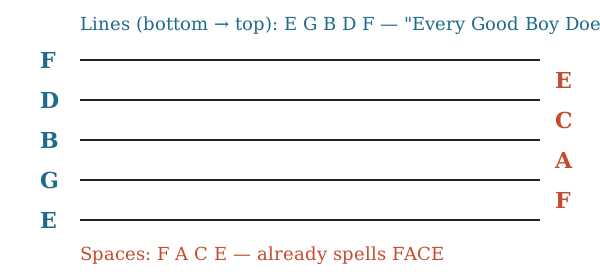
Lines bottom to top: E G B D F — "Every Good Boy Does Fine".
Spaces bottom to top: F A C E — already spells FACE.
Bass (left hand)
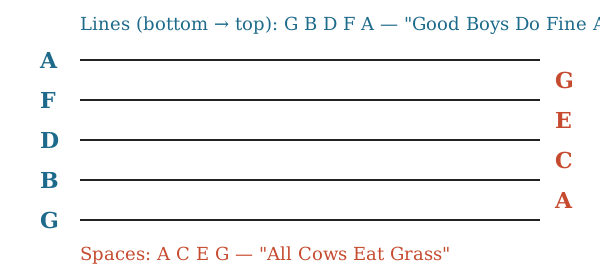
Lines: G B D F A — "Good Boys Do Fine Always".
Spaces: A C E G — "All Cows Eat Grass".
Middle C bridges both
Middle C sits on the first ledger line below the treble staff and the first ledger line above the bass staff. The same note, written two ways. The grand staff joins the two clefs with a brace — right hand on top, left hand on bottom.
Analogy: the grand staff is two ladders bolted together at Middle C. Right hand climbs the top ladder (higher pitches), left hand climbs the bottom ladder (lower pitches). Middle C is the rung they share.
Chapter 6 — Three first pieces
These are the canonical first songs. I picked them because (1) the right-hand melody fits inside one hand position, (2) the left hand uses only two or three notes, and (3) you've heard them since you were five — your ear corrects you before your brain does.
Piece 1 — "Ode to Joy" (Beethoven, Symphony No. 9)
Hand position: RH thumb on Middle C.
1
2
3
4
Fingers: 3 3 4 5 5 4 3 2 1 1 2 3 3 2 2
In notes: E E F G G F E D C C D E E D D
Repeat. Then play:
1
2
3 2 2 (E D D) ← shorter ending
Why this piece: the melody never leaves the five-finger span of one hand. You don't move your wrist. The whole song is your introduction to "fingers stay put, brain reads."
Trick: count "1 2 3 4" steadily through it — every note is one beat except the last D of each line, which is two beats. If you can clap it without playing, you can play it.
Piece 2 — "Mary Had a Little Lamb"
Hand position: RH thumb on Middle C.
1
2
3
4
5
6
3 2 1 2 3 3 3 2 2 2 3 5 5
E D C D E E E D D D E G G
3 2 1 2 3 3 3 3 2 2 3 2 1
E D C D E E E E D D E D C
Why this piece: introduces a longer arc with repetition. You'll notice the same three-note shape repeats — once you spot the pattern your eye stops reading note-by-note.
Piece 3 — "Twinkle Twinkle Little Star" — both hands
RH: thumb on Middle C.
1
2
3
1 1 5 5 6 6 5 4 4 3 3 2 2 1
C C G G A A G F F E E D D C
LH: start with the 5th finger on the C an octave below Middle C (so 5 = C3, 3 = E3, 1 = G3).
For your first attempt, just play the C3 long-held for each bar — one note per bar. Hold it under the right hand.
Once that's solid, add G3 alternating where the harmony changes (bar 3, bar 6).
Where I got stuck: hands together on day three felt impossible. Fix: don't try hands together until each hand is boring on its own. "Boring" is the right level — if you have to think, you're not ready. Each hand should run on autopilot, and only then do you stack them.
Chapter 7 — How to practise (the meta-skill)
If you take one thing from this post, take this: slow practice with full attention beats fast practice with split attention by an order of magnitude. The brain encodes accuracy, not speed. Speed comes free once accuracy is locked in.
Daily routine, ~25–30 minutes
| Block | Time | What |
|---|---|---|
| Warm-up | 3 min | 5-finger pattern, C major position, RH then LH then both |
| Note-naming | 2 min | Pick a random key, name it out loud |
| Today's piece | 15 min | One section at a time, slow, no mistakes |
| Sight-read | 5 min | Brand-new short piece, no repeats — see how far you get |
| Cool-down | 2 min | Replay your most-mastered piece for fun |
Slow practice rules
- Start at a tempo where you make zero mistakes. Mistakes at speed become mistakes at all speeds.
- Loop the section that's hard, not the whole piece. Four bars. Ten times. Then move on.
- Hands separate before hands together. Always.
- Watch your hand for one minute, then watch the page for one minute. Alternate. Eyes-on-page-only forces you to internalise the keyboard map.
- End on a success. The last attempt before you stop is the one your brain rehearses overnight.
Trick I steal from sports coaches: finish every practice session by playing the easiest passage of the day one more time, slowly and perfectly. Going to bed on a clean run reinforces the right pattern in sleep. Going to bed frustrated reinforces the wrong one.
Chapter 8 — Common beginner mistakes
| Mistake | Fix |
|---|---|
| Eyes glued to the hand | Cover the keys with a small towel for one passage; force the eye onto the page |
| Tense shoulders | Pause every 5 min; roll shoulders back; reset posture |
| Speeding through easy bars, stuttering on hard ones | Practise the hard bars at the easy bars' tempo, not the other way round |
| Skipping the metronome | The metronome reveals your fudges. Use it on slow practice. Speed practice later |
| Always practising from bar 1 | Bar 1 gets 100× practice, bar 32 gets 1×. Start from random bars |
| Quitting before recording | Record yourself once a week, even on phone audio. The recording is honest in ways your ears in the moment are not |
Useful Shortcut
Cheat-sheet
| What | How |
|---|---|
| Find Middle C | White key left of the 2-black-key group nearest the keyboard centre |
| Treble lines | E G B D F (Every Good Boy Does Fine) |
| Treble spaces | F A C E |
| Bass lines | G B D F A (Good Boys Do Fine Always) |
| Bass spaces | A C E G (All Cows Eat Grass) |
| Finger numbering | 1 = thumb (both hands) → 5 = pinky |
| Bench height | Forearms parallel to floor when fingers rest on keys |
| Practice motto | Slow + accurate > fast + sloppy |
| End each session | One perfect run of an easy passage |
When to move on
You're ready for Post 01 — Grade 1 Theory when you can:
- Play all three first songs hands together from memory.
- Name any white key in under 2 seconds.
- Identify any line or space note in either clef.
- Sit at the piano without checking your posture.
If you're not there yet, stay here another week or two. The grades build on the basics; rushing past the basics breaks every grade above.
Suggested next listening
These pieces aren't homework — they're context. Listen to them on your commute or in the background while cooking. Knowing what good piano sounds like trains your ear faster than any exercise.
| Piece | Composer | Why |
|---|---|---|
| Minuet in G (BWV Anh. 114) | Bach (attr.) | Where every classical piano student is heading; clean, simple, beautiful |
| Gymnopédie No. 1 | Satie | Modern feel, dead-easy harmony, will hook you on the instrument |
| Clair de Lune | Debussy | Aspirational — when you can read this in three years, you've arrived |
| Children's Corner — I. Doctor Gradus ad Parnassum | Debussy | A study with melody. Teaches what practice can become |
| Mikrokosmos, Vol. 1 | Bartók | Modern teaching pieces — many at Grade 1 level. Listen and you've already half-learned them |
References
- ABRSM (current edition). Piano Practical Syllabus. (Skim the Initial Grade list now.)
- Adam Sietz, Piano Lessons for Adults. (Adult-focused, no kids-book art.)
- James Bastien, Bastien Piano Basics — Primer Level. (The classic English-language beginner method.)
- Alfred's Adult All-In-One Course — Level 1. (Alternative method book — pick one and stick to it.)
- Chuan C. Chang, Fundamentals of Piano Practice. (Free online — practice technique deep dive.)
- Heinrich Neuhaus, The Art of Piano Playing. (Eventual reading; advanced philosophy.)
Note: this post is in progress. Planned: audio reference tracks per song once I find a clean-license source, and a video of correct vs incorrect posture.