Piano Notes — 02 · Grade 2 Theory & Repertoire
Grade 2 introduces three big ideas: compound time (the gallop), semiquavers (faster rhythms), and more keys (up to two sharps and two flats). The pieces start to feel like music instead of exercises — short Bach, Schumann, Bartók, all sit comfortably here.
Series map: 00 → 01 → 02 Grade 2 (this post) → 03 Grade 3 → 04 Grade 4.
Learning Outcome
- Use 2/4, 3/4, 4/4 simple time and 6/8 compound time comfortably.
- Read semiquavers and matching rests.
- Build major scales for C, G, D, F, B♭ and play them hands separate, two octaves.
- Identify intervals by quality (major / minor / perfect) up to an octave.
- Recognise the relative minor of those major keys.
- Play 3–5 short pieces hands together at Grade 2 standard.
- Understand basic articulation: legato, staccato, slurs, accents.
Chapter 1 — Two more keys
Grade 2 adds D major (2 sharps: F♯, C♯) and B♭ major (2 flats: B♭, E♭).
| Key | Sharps/Flats | Notes ascending |
|---|---|---|
| C major | none | C D E F G A B C |
| G major | F♯ | G A B C D E F♯ G |
| F major | B♭ | F G A B♭ C D E F |
| D major | F♯ C♯ | D E F♯ G A B C♯ D |
| B♭ major | B♭ E♭ | B♭ C D E♭ F G A B♭ |
Trick: the order of sharps you encounter is fixed: F♯ → C♯ → G♯ → D♯ → A♯ → E♯ → B♯. Order of flats reversed: B♭ → E♭ → A♭ → D♭ → G♭ → C♭ → F♭. Same letters, opposite ends. Mnemonics: sharps = "Father Charles Goes Down And Ends Battle"; flats = the same backwards, "Battle Ends And Down Goes Charles' Father".
Finding the key from the signature
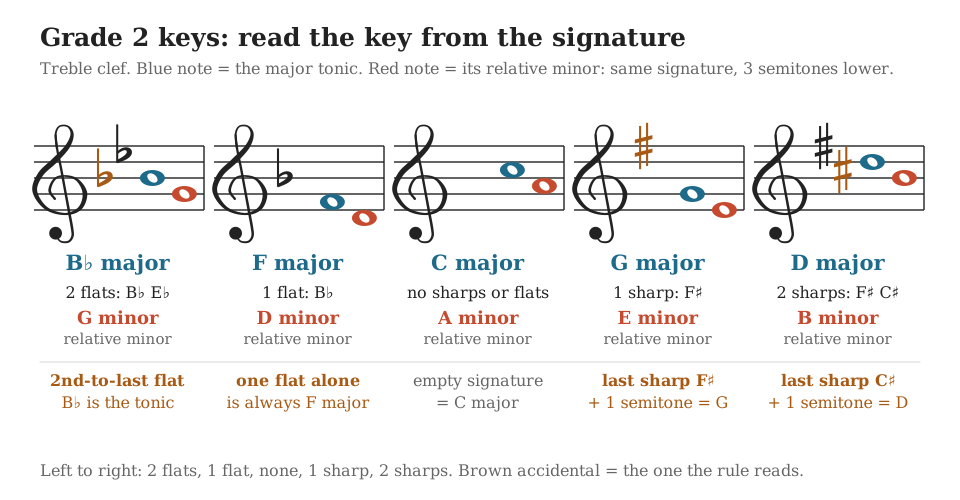
- Sharps: the last sharp is the leading tone — go up one semitone to find the tonic.
- One sharp (F♯) → up to G → G major.
- Two sharps (F♯, C♯) → last is C♯ → up to D → D major.
- Flats: the second-to-last flat is the tonic.
- Two flats (B♭, E♭) → second-to-last is B♭ → B♭ major.
- (Special case: one flat alone = F major.)
Where I got stuck: the flat-rule asks for the second-to-last, not the last. I missed this constantly. I wrote it on the cover of my notebook. After two weeks it became automatic.
Chapter 2 — Semiquavers (Sixteenth Notes)
A semiquaver / 十六分音符 = half a quaver = quarter of a crotchet. In 4/4, four semiquavers fit in one crotchet's time.
1
2
3
4
Crotchet ♩ 1 beat
Two quavers ♪ ♪ ½ + ½ = 1 beat
Four semis ♪♪♪♪ ¼ × 4 = 1 beat
Beaming groups
Semiquavers are usually beamed in groups of 4 (one full crotchet beat). Mixed quaver + semiquaver groupings appear too:
1
2
3
♪ ♪♪ = quaver + two semis = ½ + ¼ + ¼ = 1 beat (dotted quaver pattern often follows)
♪♪ ♪ = two semis + quaver = ¼ + ¼ + ½ = 1 beat
Counting semiquavers out loud
Standard system: "1 e and a, 2 e and a, 3 e and a, 4 e and a" — four syllables per crotchet beat. Each crotchet contains 4 sixteenths; each syllable maps to one sixteenth-note position.
Trick: try saying "ta-ka-di-mi" instead — many drummers use it, it's faster on the tongue than "1 e and a". As long as you commit to one consistent vocabulary, the brain locks onto the subdivision.
Dotted quaver + semiquaver pattern
The most common Grade 2 rhythm:
1
2
♪. ♪ = 3/16 + 1/16 = 4/16 = 1 crotchet
In count words: "1 . . a, 2 . . a" — the dotted quaver takes 3 sixteenths, the semiquaver takes the last 1.
Chapter 3 — Compound Time (6/8)
In 6/8 there are two beats per bar, and each beat is a dotted crotchet (= 3 quavers). Don't be fooled by the "6" — you do not count "1-2-3-4-5-6" evenly; you feel two macro-beats, each subdivided into three.
| 6/8 | 3/4 | |
|---|---|---|
| Beats per bar | 2 | 3 |
| Beat unit | dotted crotchet (3 quavers) | crotchet (2 quavers) |
| Each beat divides into | 3 | 2 |
| Feel | Gallop / lilt | Waltz |
1
2
3
4
6/8 counting: 1 - 2 - 3 | 4 - 5 - 6
^ ^
strong medium-strong
The strong beats are the 1 and the 4. The other digits are subdivisions.
Analogy: simple time is walking — left-right-left-right, two equal steps per beat. Compound time is galloping — DA-da-da, DA-da-da. The "DA" is the macro-beat (dotted crotchet); the "da-da" are the eighth-note subdivisions.
Other compound metres
Grade 2 only requires 6/8, but for context:
| Metre | Beats per bar | Each beat |
|---|---|---|
| 6/8 | 2 | dotted crotchet |
| 9/8 | 3 | dotted crotchet |
| 12/8 | 4 | dotted crotchet |
You'll meet 9/8 and 12/8 at Grade 4.
Chapter 4 — Intervals by Quality
Grade 2 upgrades intervals from number-only to quality + number.
The quality lexicon
| Quality | Applies to numbers | Example (above C) |
|---|---|---|
| Perfect | 1st, 4th, 5th, 8th | C–C unison, C–F, C–G, C–C octave |
| Major | 2nd, 3rd, 6th, 7th | C–D, C–E, C–A, C–B |
| Minor | 2nd, 3rd, 6th, 7th | C–D♭, C–E♭, C–A♭, C–B♭ (one semitone smaller than major) |
Trick: the perfect intervals (P1, P4, P5, P8) are called "perfect" because both they and their inversions (P5 ↔ P4, P8 ↔ P1) are perfect — symmetric. The major / minor pairs (2nd, 3rd, 6th, 7th) flip into each other when inverted: major 3rd ↔ minor 6th, major 2nd ↔ minor 7th, etc. The 9 - x rule: a major-3rd inverted is a minor-(9-3) = minor-6th.
Counting semitones to find quality
| Interval | Semitones |
|---|---|
| Perfect unison | 0 |
| Minor 2nd | 1 |
| Major 2nd | 2 |
| Minor 3rd | 3 |
| Major 3rd | 4 |
| Perfect 4th | 5 |
| Tritone (Aug 4 / Dim 5) | 6 |
| Perfect 5th | 7 |
| Minor 6th | 8 |
| Major 6th | 9 |
| Minor 7th | 10 |
| Major 7th | 11 |
| Perfect octave | 12 |
Method:
- Count the staff positions (line + space jumps) including both ends → gives you the number (2nd, 3rd, …).
- Count the semitones on the keyboard → cross-check against the table → gives you the quality.
Working in a key signature
Within a major scale, the intervals from the tonic to each scale degree are always:
| From tonic to | Interval |
|---|---|
| 2nd | Major 2nd |
| 3rd | Major 3rd |
| 4th | Perfect 4th |
| 5th | Perfect 5th |
| 6th | Major 6th |
| 7th | Major 7th |
| 8th | Perfect octave |
Trick: in a major key, all intervals built upward from the tonic are major or perfect. There are no naturally-occurring minor intervals from the tonic of a major key — they only appear when you alter notes with accidentals or use a different starting note.
Chapter 5 — Relative Minor
Every major key has a relative minor that shares its key signature. The relative minor's tonic sits a minor 3rd below the major tonic (or equivalently, the 6th degree of the major scale).
| Major | Relative minor | Shared sharps/flats |
|---|---|---|
| C major | A minor | none |
| G major | E minor | F♯ |
| F major | D minor | B♭ |
| D major | B minor | F♯ C♯ |
| B♭ major | G minor | B♭ E♭ |
The natural minor scale uses only those shared sharps/flats. (Harmonic and melodic minors add accidentals — Grade 3 material.)
Where I got stuck: I kept confusing relative minor with parallel minor.
- Relative: same key signature, different tonic (C major ↔ A minor).
- Parallel: same tonic, different key signature (C major ↔ C minor).
The fix that stuck: "Relative" = the related key with the same parents (signature). "Parallel" = the parallel universe with the same name (tonic). Two distinct concepts; pin them down separately.
Chapter 6 — Articulation
Grade 2 starts to care about how you play, not just what.
| Marking | Meaning |
|---|---|
| Legato | Connected, smooth (often shown with a slur) |
| Staccato (dot above/below note) | Short, detached — roughly half the written value |
| Tenuto (line above/below) | Held to full value, slight emphasis |
| Accent (>) | Played louder than surrounding notes |
| Slur (curved line over multiple notes) | Phrase boundary; play legato within |
| Fermata (eye-shaped pause) | Hold longer than written |
Trick: the staccato dot means "half the value, the rest is silence". So a staccato crotchet = a quaver of sound + a quaver of silence. Don't clip the note artificially short; just lift the finger earlier and let the air do the rest.
Touch types — the three you'll use most
- Legato — finger weight transfers from key to key without lifting. The previous finger releases as the next presses, like walking.
- Staccato — the finger bounces off the key. Wrist relaxed; energy from the fingertip, not the arm.
- Portato — between legato and staccato, marked with dots under a slur. Each note slightly separated but still "singing" through.
Chapter 7 — Suggested Practice Pieces
Grade 2 (mainstream)
| Piece | Composer | Why |
|---|---|---|
| Minuet in G minor (BWV Anh. 115) | Bach (attr. Petzold) | Companion to the famous G major minuet. Slightly more melancholy, same difficulty |
| Burgmüller, Op. 100 No. 2 ('Arabesque') | Burgmüller | The first piece beginners feel proud of. Quick, satisfying, sounds harder than it is |
| Mikrokosmos, Vol. 2 No. 47 ('Big Fair') | Bartók | Compound feel, jaunty. Real musical character |
| Album for the Young, Op. 68 No. 1 ('Melodie') | Schumann | Pure singing melody, simple two-voice texture. Romantic style introduction |
| Sonatina in C, Op. 36 No. 1 | Clementi | Movement I. The classic "first real sonatina". Hands together, real form |
Stretching toward Grade 3
| Piece | Composer | Why |
|---|---|---|
| Allegro in B♭, K. 3 | Mozart | Mozart aged 5. Hands separate, very early style |
| Minuet in F major (BWV Anh. 113) | Bach | Two voices, longer phrases than its companions |
| Burgmüller, Op. 100 No. 5 ('Innocence') | Burgmüller | Smooth RH semiquavers over walking LH — classic compound technique |
How to choose
Pick one piece that excites you (whatever the level) and one that's slightly easier than your current ability. The exciting piece pulls you forward; the easy piece is where you actually drill technique without frustration. Rotate every 4–6 weeks.
Trick: finish every learning session by playing the easiest piece you know at performance tempo, all the way through. It costs 90 seconds and reinforces what "finished" feels like. The pieces you struggle with don't get this treatment — only the ones you've already mastered.
Chapter 8 — Practice Templates
"Difficult bar" loop (10 minutes)
Pick the worst 4-bar passage in your current piece. Set metronome to half your target tempo. Play those 4 bars 10 times in a row without stopping. If you fail, slow the metronome by 10 BPM and start the count again. After 10 clean reps, raise BPM by 5. Repeat until you hit target.
This is the single highest-leverage practice technique. Twenty minutes of this beats two hours of "playing the whole piece from the top".
"Pulse robot" warm-up (5 minutes)
Set the metronome to quarter = 60. Play any scale you know, one note per click, both hands separate. Then both hands together. Then two notes per click. Then four. The point isn't the scale — it's getting your hands locked to an external clock.
"Mock exam" run (20 minutes, once a week)
Treat one full practice session per week as the exam itself. Set up your music, your phone-recorder, your metronome. Play your three current pieces back-to-back with no restarts. Then listen to the recording. Mistakes you didn't notice in the moment will jump out on playback. That's your homework for the next six days.
Chapter 9 — Aural Skills at Grade 2
ABRSM Grade 2 aural adds:
- Identify whether a phrase is in 2/4, 3/4, or now 6/8.
- Sing back a slightly longer phrase (4 notes).
- Clap back a 4-bar rhythm.
- Identify a feature: "loud", "soft", "smooth", "detached", "ending on a different note than it started" — broader description.
Trick: to tell 6/8 from 3/4, listen for the gallop. 3/4 walks evenly in threes — ONE-two-three, ONE-two-three. 6/8 lopes — DA-da-da DA-da-da. Tap your foot. If the foot lands twice per bar, it's 6/8. If three times, it's 3/4. The foot doesn't lie.
Chapter 10 — Common Pitfalls at Grade 2
| Pitfall | Fix |
|---|---|
| Counting compound time as simple (1-2-3-4-5-6 evenly) | Subdivide aloud as "1-and-a 2-and-a". Foot taps the two macro-beats |
| Forgetting which sharps/flats apply | Re-write the key signature on a sticky note at the top of every page during practice |
| Rushing fast notes | Tempo is a choice, not a test. Slow until clean. Speed comes free |
| Ignoring articulation marks | Highlight staccato dots and slur arcs with coloured pencil. The eye blocks them out otherwise |
| All practice in one big chunk | Two 20-min sessions > one 40-min. Memory consolidates between sessions |
| Stopping at the first mistake | Don't stop. Mark the bar, finish the piece, then loop the marked bar at the end |
Useful Shortcut
Cheat-sheet
| What | How |
|---|---|
| Sharps order | F♯ C♯ G♯ D♯ A♯ E♯ B♯ |
| Flats order | B♭ E♭ A♭ D♭ G♭ C♭ F♭ |
| Key from sharps | Last sharp + 1 semitone = tonic |
| Key from flats | Second-to-last flat = tonic (1 flat = F) |
| Relative minor | 3 semitones below major tonic |
| Compound feel | Macro-beats divide into 3 |
| Major-key intervals from tonic | All major or perfect |
| Inversion rule | (9 - number); major ↔ minor; perfect ↔ perfect |
| Staccato | Half the written value, rest is silence |
Daily routine (35 min)
| Block | Time | Content |
|---|---|---|
| Five-finger warm-up | 3 min | C, G, F, D, B♭ positions |
| Scales | 7 min | Today's key + relative minor, hands separate, 2 octaves |
| Sight-read | 5 min | New short piece each day, including 6/8 |
| Repertoire | 15 min | Difficult-bar loops on current pieces |
| Aural | 3 min | Clap back a rhythm from the metronome |
| Theory | 2 min | One past-paper question |
Suggested listening
| Piece | Composer | Why |
|---|---|---|
| Anna Magdalena Notebook (full set) | Bach | Several pieces sit at Grade 2; you'll meet them in the next 6 months |
| Album for the Young, Op. 68 (first 10) | Schumann | Romantic equivalent of the Anna Magdalena set |
| Pavane pour une infante défunte | Ravel | Slow, beautiful, aspirational. Listen for what compound time can feel like |
| Songs Without Words, Op. 19 No. 1 | Mendelssohn | RH melody + LH accompaniment in the canonical lyrical style |
| Sonata in C, K. 545 (Mvt. II) | Mozart | Pure singing line; what your scale-runs are eventually for |
References
- ABRSM (current). Music Theory in Practice — Grade 2.
- ABRSM (current). Piano Exam Pieces — Grade 2.
- Eric Taylor, The AB Guide to Music Theory — Part I.
- IMSLP — Bach Anna Magdalena Notebook, Schumann Album for the Young, Burgmüller Op. 100, Bartók Mikrokosmos.
- Charles-Louis Hanon, The Virtuoso Pianist in 60 Exercises, Part 1.
Note: this post is in progress. Planned additions: audio reference for each suggested piece, downloadable practice tracker PDF, common-question Q&A from real Grade 2 exams.