Real Analysis — 05 · Sequences of Functions, Uniform Convergence and Power Series
Much of analysis builds functions as limits: as a power series, as a Taylor series, the Weierstrass function of post 03 as a sum of cosines, solutions of differential equations as limits of approximations. The question is always the same: which properties survive the limit? Continuity, integrals and derivatives can all be lost under the obvious "point by point" notion of convergence. This post introduces the stronger notion that repairs most of this, uniform convergence, proves exactly what it preserves (continuity and integrals) and what it does not (derivatives, without an extra hypothesis), and then applies it to power series: radius of convergence, term-by-term calculus, Abel's theorem, and the difference between a Taylor series and the function it came from. It closes the core course with the Weierstrass approximation theorem and a map of where analysis goes next.
Series map: 00 The Real Numbers & Completeness → 01 Sequences & Series → 02 Topology of ℝ & Continuity → 03 Differentiation & Taylor's Theorem → 04 The Riemann Integral → 05 Uniform Convergence & Power Series (this post).
Learning Outcome
- Define pointwise and uniform convergence of a sequence of functions, and tell them apart with on .
- Use the sup-norm test and the Cauchy criterion for uniform convergence.
- Prove that a uniform limit of continuous functions is continuous (the argument).
- Prove that integrals commute with uniform limits, and show with an example that pointwise limits break this.
- State the theorem on limits of derivatives and give the counterexample that shows why it needs uniform convergence of the derivatives.
- State and prove the Weierstrass M-test and use it on series of functions.
- Compute the radius of convergence with the Cauchy–Hadamard formula and the ratio test, and check the endpoints.
- Prove that a power series converges uniformly on every closed interval inside its radius, and differentiate and integrate it term by term.
- State Abel's theorem and use it to show .
- Explain why a smooth function need not equal its Taylor series, and state the Weierstrass approximation theorem with the Bernstein-polynomial idea.
Chapter 1 — Pointwise versus uniform convergence
Terminology
- Sequence of functions — functions , , all on the same domain .
- Pointwise convergence — pointwise on if for each fixed , the number sequence converges to . In quantifiers: for every and every there is (which may depend on both and ) with for .
- Uniform convergence — uniformly on if for every there is (depending on only) with for all and all .
- Sup norm — for a bounded , .
- Epsilon-tube — the band of width on each side of the graph of . Uniform convergence says: from some on, the whole graph of every lies inside the tube.
The only difference between the two definitions is the order of "there is " and "for all ". Uniform convergence implies pointwise convergence; the converse fails.
Sup-norm test. uniformly on if and only if (where is finite for large ). This is the definition rewritten: " for all " gives , and gives it for all .
The key example: x to the n on [0, 1]
Let on . For , (post 01); at , . So the pointwise limit is
Every is continuous, and the limit is not. The convergence is not uniform: the point lies in and , so for every (in fact the sup over is ). The "bad point" slides towards :
| 1 | 2 | 5 | 10 | 50 | |
|---|---|---|---|---|---|
For each fixed you eventually get close to , but no single works for all at once.
On a smaller domain the problem disappears. On , , so uniformly on , and indeed on for any .
Damping the bad point. Multiply by : on . The pointwise limit is everywhere (including , where ). Setting gives the maximum at , so
So uniformly on all of . For example, . The factor kills the values near exactly where misbehaved.
A uniform example: smoothing the corner of the absolute value
Let on . With ,
with equality at . So : uniform convergence to on all of . With , every with lies inside the -tube around (its largest error is ), while (error ) does not.
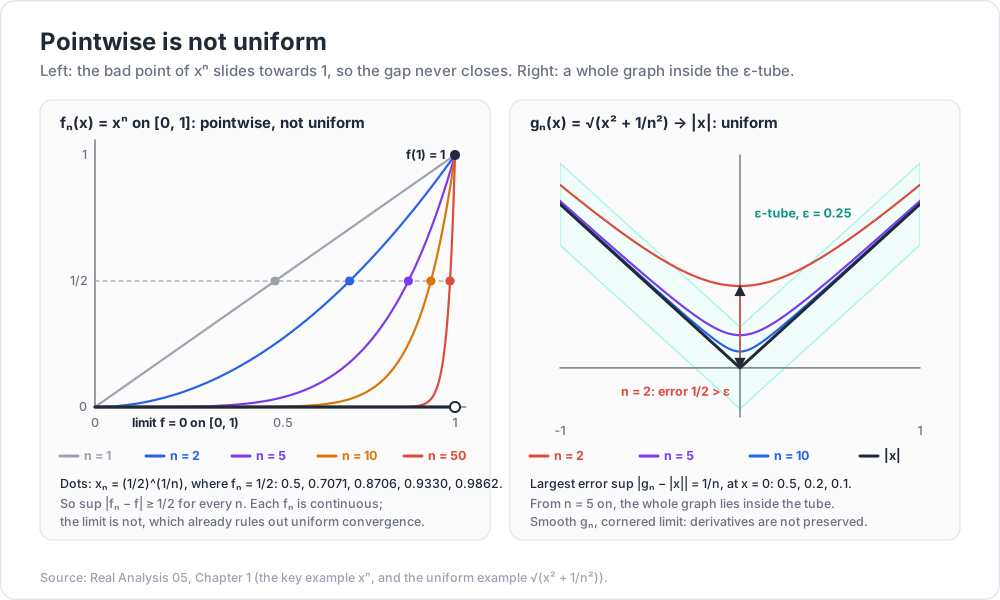
Every is smooth, and the limit has a corner. Uniform convergence preserved continuity but not differentiability. Chapter 2 explains both facts.
The Cauchy criterion for uniform convergence
Theorem. A sequence converges uniformly on if and only if for every there is with
Proof. () If everywhere for , then .
() For each fixed , is a Cauchy sequence of reals, so it converges (completeness, post 01); call the limit . Given , take from the hypothesis. For and any , let in to get . The same works for every , so the convergence is uniform.
The value of the criterion: it proves uniform convergence without knowing the limit in advance. The M-test in Chapter 3 is built on it.
Chapter 2 — What uniform convergence preserves
Continuity
Theorem. If each is continuous at and uniformly on , then is continuous at .
Proof (the argument). Let . Choose with for all . Since is continuous at , choose with for . Then for such ,
The first and third terms need the same at two different points, and . That is exactly what uniformity supplies and pointwise convergence does not. The theorem also gives a quick proof that does not converge uniformly on : the limit is discontinuous.
A partial converse (Dini's theorem). If is compact, each is continuous on , for all and , and pointwise with continuous, then the convergence is uniform. (Rudin, Theorem 7.13.) All four hypotheses are needed; on fails only "the limit is continuous".
Integrals
Theorem. If each is Riemann integrable on and uniformly on , then is integrable and
Proof. Let , which tends to . Then on (so is bounded). Upper and lower sums respect these inequalities, so the upper and lower integrals of (post 04) satisfy
The gap between the upper and lower integrals is at most , so they are equal and is integrable. The same inequalities give .
Pointwise convergence is not enough. Let on . For , (a geometric factor beats the factor ), and . So pointwise. But
The convergence is far from uniform: the maximum of , at , grows without bound (about for and for ). A travelling spike keeps area while its base shrinks.
Derivatives need more
Uniform convergence of says nothing about . Two warnings:
- uniformly (Chapter 1): smooth functions, non-differentiable limit.
- uniformly on (the sup norm is ), but , and . The derivatives do not converge to the derivative of the limit, which is .
The fix is to assume uniform convergence of the derivatives.
Theorem (limits of derivatives). Let each be differentiable on . Suppose converges for some , and converges uniformly on . Then converges uniformly on to a function , and for every . (Rudin, Theorem 7.17.)
Idea of proof (with the extra assumption that each is continuous). By FTC 2 (post 04), . The integrals converge uniformly by the integral theorem above, so with , which is continuous as a uniform limit. FTC 1 gives . The general proof uses the Mean Value Theorem instead of integrals.
Watch out: "uniformly" in this theorem is about the derivatives. Uniform convergence of alone never licenses swapping and .
Chapter 3 — Series of functions and the Weierstrass M-test
A series of functions converges pointwise or uniformly on when its partial sums do. The three theorems of Chapter 2 become:
| If the series converges uniformly on the interval and | then |
|---|---|
| each is continuous | the sum is continuous |
| each is integrable on | (integrate term by term) |
| each is differentiable, converges uniformly, converges | (differentiate term by term) |
Theorem (Weierstrass M-test). Suppose for all and all , and converges. Then converges uniformly (and absolutely) on .
Proof. For and every ,
The right side does not depend on , and it is small for large because converges (Cauchy criterion for number series, post 01). So the partial sums satisfy the uniform Cauchy criterion of Chapter 1.
Worked example. . Take ; converges (its value is ). So the series converges uniformly on and is continuous. Term-by-term differentiation would give , which diverges at (harmonic series). So the M-test gives continuity, and says nothing about differentiability.
The same test proves the continuity of the Weierstrass function in post 03: with a convergent geometric series.
Common pitfall: the M-test is sufficient, not necessary. (constant functions) converges uniformly, trivially, but no summable exists.
Chapter 4 — Power series
Terminology
- Power series about — a series with real coefficients . Below, for simplicity.
- Radius of convergence — the number such that the series converges absolutely for and diverges for . At anything can happen.
- Limit superior — , which always exists in (monotone convergence, post 01).
Radius of convergence
Theorem (Cauchy–Hadamard). Let . Then the radius of convergence is (with if and if ).
Proof. Apply the root test (post 01) to : . If the series converges absolutely; if the terms do not tend to , so it diverges.
Ratio formula. If exists (in ), it equals . When it applies it is easier; when it does not, the root formula still works.
| Series | At | At | |
|---|---|---|---|
| diverges | diverges | ||
| (from ) | diverges (harmonic) | converges (alternating) | |
| (from ) | converges | converges | |
| — | — | ||
| — | — |
The first three show that all endpoint behaviours occur with the same radius.
When the ratio test fails. Let for even and for odd . The ratios alternate between values tending to and to , so they have no limit. But is for even and for odd , so and .
Uniform convergence inside the radius
Theorem. If , the power series converges uniformly on . Consequently it converges uniformly on every compact subset of , and its sum is continuous on .
Proof. Since , the series converges absolutely at , so converges. On , . Apply the M-test. A compact is closed and bounded, so its max of is some and . Every lies in some , and continuity is local.
Watch out: the convergence need not be uniform on the whole open interval. For on the tail after is , which is unbounded as for every .
Term-by-term differentiation and integration
Theorem. Let with radius . Then on :
and both new series also have radius . Hence is infinitely differentiable on , and : a power series is the Taylor series of its own sum.
Proof sketch. Since , , so the differentiated series has the same radius (similarly for the integrated one). On any with the differentiated series converges uniformly, so the derivative theorem (Chapter 2) applies. Integration follows from the integral theorem. Repeating gives all derivatives, and evaluating the -th derivative at leaves only .
Worked example 1. From on , differentiate: . Multiply by and put :
Worked example 2. From on , integrate from to :
Worked example 3. has . Differentiating term by term gives , with . So (the function has zero derivative, hence is constant, by post 03).
Abel's theorem at the edge
The formula for was proved for . At the series converges (alternating series test, post 01), but does it converge to ?
Theorem (Abel). Suppose converges. Then converges for and
Proof. Let . Replacing by changes by the constant and makes the sum , so assume . Let ; then , so is bounded and converges for . Summation by parts () gives, for ,
Given , choose with for . Then
The first term tends to as , so for close enough to . Hence .
Apply it to : the left side is by continuity of . So
The same argument with gives . (These series converge slowly: the first 10 terms of the series sum to .)
Common pitfall: Abel's theorem needs the series at to converge. For , as , but diverges; the limit is not a sum in the ordinary sense.
Chapter 5 — Taylor series, approximation, and what comes next
Taylor series versus the function
For a function , the Taylor series at is . Two things can go wrong:
- The series can have radius (there are functions like this).
- The series can converge, to a different function.
Case 2 is the function of post 03: with . All derivatives at vanish, so its Taylor series is , with radius and sum . It equals only at .
The link to Taylor's theorem is the remainder: the Taylor series of converges to exactly when . For at any , the Lagrange remainder satisfies , so equals its Taylor series everywhere. A function is real analytic at when it equals a convergent power series on some interval around . By the term-by-term theorem, such a power series must be the Taylor series. So: analytic ⇒ , but not conversely.
The Weierstrass approximation theorem
Not every continuous function is a power series, but every continuous function is uniformly close to a polynomial.
Theorem (Weierstrass, 1885). Let be continuous on . For every there is a polynomial with for all .
Bernstein's constructive proof (idea). On , define
The weights are the binomial probabilities of successes in trials with success probability . They add up to and concentrate near as grows, so is a weighted average of values of near . Uniform continuity of (post 02) turns this into .
Worked example. For a direct computation gives
so the error is , largest at , and . An error of at most needs . The convergence is uniform but slow; Bernstein polynomials are valued for their shape-preserving properties (they are the basis of Bézier curves), not their speed.
Compare with the Weierstrass function of post 03: a continuous, nowhere-differentiable function can still be approximated uniformly, to any accuracy, by polynomials, which are as smooth as functions get. Uniform limits keep continuity and lose everything finer.
A look ahead
- Metric spaces. Uniform convergence is convergence in the metric on . Chapter 1's Cauchy criterion, together with the continuity theorem of Chapter 2, says this space is complete, and Weierstrass says polynomials are dense in it. The same words (complete, dense, compact) from posts 00–02 now describe spaces of functions.
- Lebesgue integration. The spike example shows that pointwise limits and integrals do not commute in general. Lebesgue's theory says exactly when they do (monotone and dominated convergence), without asking for uniformity.
- Fourier series. Replacing powers by and gives Fourier series. Their convergence is subtler than for power series: the Fourier series of a discontinuous square wave converges pointwise at every point but never uniformly, which ties back to the continuity theorem of Chapter 2.
Practice Exercises
Exercise 1. Show that converges uniformly on but not on .
Solution
The pointwise limit is . On , : uniform. On , for every (take to get ): not uniform.
Exercise 2. Let . Prove that uniformly on for each , and explain in one line why it cannot be uniform on even though the limit is continuous there.
Solution
On , . On , the points give , so for every . (The continuity theorem only says a discontinuous limit rules out uniformity; a continuous limit does not guarantee it.)
Exercise 3. Use the M-test to show that converges uniformly on . Is its sum continuous at ?
Solution
For , , and converges. So the series converges uniformly on and the sum is continuous there, including at the endpoint (one-sided).
Exercise 4. Find the radius of convergence of and of .
Solution
First: , so . Second, by the ratio formula: , so .
Exercise 5. Compute using term-by-term differentiation.
Solution
From for , put : .
Exercise 6. For on , compute for and explain why this does not contradict the integral theorem.
Solution
, so for it is . The pointwise limit is with integral . No contradiction: the convergence is not uniform (the maximum of is about and the maxima grow without bound), so the theorem does not apply.
Exercise 7. Show that the Bernstein polynomial of is itself for every .
Solution
. This is times the mean of a binomial distribution with trials and success probability , which is . So . (Bernstein polynomials reproduce linear functions exactly; the first error appears for .)
Cheat-sheet
| Idea | Statement |
|---|---|
| Pointwise | for each , ; may depend on |
| Uniform | ; one for all |
| Key example | on : pointwise, not uniform; uniform on , |
| Uniform Cauchy | for all , |
| Continuity | uniform limit of continuous is continuous () |
| Integrals | uniform on |
| Derivatives | need uniform plus one convergent |
| M-test | , uniform |
| Radius | ; or |
| Inside the radius | uniform on for ; not always on |
| Term by term | and by term, same ; |
| Abel | converges |
| Smooth, not analytic | : Taylor series is |
| Weierstrass approximation | continuous on ⇒ uniform limit of polynomials |
| Bernstein for | error , sup |
Course core complete — what's next
This post completes the core course: the real numbers (00), limits of sequences and series (01), topology and continuity (02), derivatives (03), integrals (04), and limits of functions (05). The series is built to grow. The posts below are planned, in roughly this order.
Planned future extensions
| Post | Topic | What it covers |
|---|---|---|
| 06 | Metric spaces and completeness | open and closed sets, compactness and sequential compactness, completeness of , the contraction mapping theorem and Picard's existence theorem for ODEs |
| 07 | Multivariable analysis | the derivative as a linear map, the chain rule in , the inverse and implicit function theorems |
| 08 | Measure theory and the Lebesgue integral | outer measure, measurable functions, monotone and dominated convergence, why is complete |
| 09 | Fourier analysis | Fourier series, Dirichlet and Fejér kernels, pointwise and convergence, Parseval's identity |
| 10 | Complex analysis | holomorphic functions, Cauchy's theorem and integral formula, why complex-differentiable implies analytic |
| 11 | Functional analysis | normed and Banach spaces, Hilbert spaces, bounded operators, the Arzelà–Ascoli theorem |
References
- Stephen Abbott, Understanding Analysis, 2nd ed., Springer (Undergraduate Texts in Mathematics), 2015 — Chapter 6, "Sequences and Series of Functions" (uniform convergence, power series, Taylor series, the Weierstrass approximation theorem).
- Walter Rudin, Principles of Mathematical Analysis, 3rd ed., McGraw-Hill, 1976 — Chapter 7 (Theorems 7.8 Cauchy criterion, 7.10 M-test, 7.12 continuity, 7.13 Dini, 7.16 integration, 7.17 differentiation, 7.26 Weierstrass) and Chapter 8 (power series, Abel's theorem 8.2).
- Robert G. Bartle and Donald R. Sherbert, Introduction to Real Analysis, 4th ed., Wiley, 2011 — Chapter 8 (sequences of functions) and Section 9.4 (series of functions and power series).
- Michael Spivak, Calculus, 4th ed., Publish or Perish, 2008 — Chapters 23–24 (infinite series; uniform convergence and power series) and Chapter 20 (Taylor polynomials).
- Jiří Lebl, Basic Analysis I: Introduction to Real Analysis, free textbook — jirka.org/ra, Chapter 6.
- MIT OpenCourseWare, 18.100A Real Analysis (Fall 2020), lecture notes on uniform convergence, power series and the Weierstrass approximation theorem.
Note: this post is in progress. Planned additions: Tauber's partial converse of Abel's theorem, a proof of the Weierstrass approximation theorem via Bernstein polynomials with the Chebyshev inequality, the Arzelà–Ascoli theorem, and a worked Fourier-series example showing the Gibbs phenomenon.