A sequence is the simplest infinite process in mathematics, and its limit is the idea on which the rest of analysis is built: derivatives, integrals and continuity are all limits in disguise. This post makes "the terms get closer and closer to a" precise with the ε–N definition, works through explicit proofs with concrete numbers, and then proves the big structural theorems that rest on the completeness of R from Real Analysis 00: the Monotone Convergence Theorem, Bolzano–Weierstrass and the Cauchy criterion. The second half turns to infinite series — sums of infinitely many numbers — with the standard convergence tests and the surprising fact that reordering the terms of some series changes the sum.
Series map: 00 The Real Numbers & Completeness → 01 Sequences & Series (this post) → 02 Topology of ℝ & Continuity → 03 Differentiation & Taylor's Theorem → 04 The Riemann Integral → 05 Uniform Convergence & Power Series.
Learning Outcome
State the ε–N definition of convergence and write complete proofs that specific sequences converge, with an explicit N.
Prove that limits are unique and that convergent sequences are bounded.
Prove the sum and product parts of the Algebraic Limit Theorem, and use the Order Limit Theorem and the squeeze theorem.
Prove the Monotone Convergence Theorem and apply it to a recursively defined sequence.
Prove the Bolzano–Weierstrass Theorem by bisection and use subsequences to show divergence.
Define Cauchy sequences, limsup and liminf, and state the Cauchy criterion.
Decide convergence of series with the divergence, comparison, ratio, root and alternating series tests.
Distinguish absolute from conditional convergence and state the Riemann rearrangement theorem.
Chapter 1 — The limit of a sequence
Terminology
Sequence — a function from N to R, written (an)=(a1,a2,a3,…).
ε-neighbourhood of a — the interval Vε(a)=(a−ε,a+ε), the points within distance ε of a.
Converges — (an) converges to a, written an→a or liman=a, if for every ε>0 there is N∈N such that ∣an−a∣<ε for all n≥N.
Diverges — does not converge to any real number.
Tail — the terms aN,aN+1,… from some index on.
Bounded — there is M>0 with ∣an∣≤M for all n.
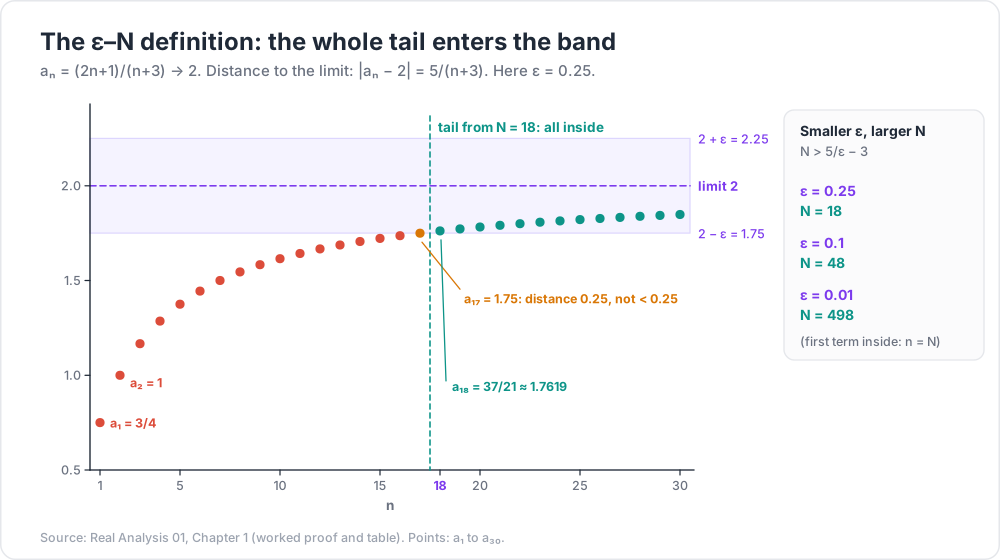
The definition says: whatever tolerance ε is demanded, the whole tail from some N on lies inside the band Vε(a). The N is allowed to depend on ε (a smaller band usually needs a larger N). Finitely many early terms never matter.
A worked proof with explicit numbers
Claim.an=n+32n+1→2.
Scratch work. Compute the distance to the limit:
∣an−2∣=n+32n+1−2(n+3)=n+35.
This is less than ε exactly when n+3>5/ε, i.e. n>5/ε−3.
Proof. Let ε>0. By the Archimedean property choose N∈N with N>5/ε−3. For n≥N,
∣an−2∣=n+35≤N+35<ε.■
Checking with numbers. The first terms are a1=43, a2=1, a3=67, a4=79, a5=811, increasing towards 2.
ε
condition n>5/ε−3
smallest N
check at N−1
check at N
0.25
n>17
18
a17=1.75, distance 0.25 (not <0.25)
a18=2137≈1.7619, distance ≈0.2381
0.1
n>47
48
a47=1.9, distance 0.1 (not <0.1)
a48=5197≈1.9020, distance ≈0.0980
0.01
n>497
498
a497=1.99, distance 0.01
a498=501997≈1.9900, distance ≈0.00998
The term a17 lands exactly on the edge of the band for ε=0.25; since the definition uses a strict inequality, the tail starts at N=18. Any larger N also works — the definition asks for someN, not the smallest.
Trick: in the scratch work, simplify ∣an−a∣ and then bound it above by something simple. You do not need the exact solution of ∣an−a∣<ε. For bn=n2n+1, for example, ∣bn−0∣=n2n+1≤n22n=n2, so any N>2/ε works.
More examples
1/n→0. Given ε>0 choose N>1/ε2. For n≥N, n≥N>1/ε, so 1/n<ε.
rn→0 for 0≤r<1. If r=0 it is trivial. Otherwise write r=1+h1 with h>0. Bernoulli's inequality (Real Analysis 00) gives (1+h)n≥1+nh>nh, so 0<rn<nh1, which is less than ε once n>hε1. The same bound on ∣r∣n covers −1<r<0.
(−1)n diverges. Suppose (−1)n→a. Take ε=1: there is N with ∣(−1)n−a∣<1 for n≥N. Using n=N and n=N+1 (one even, one odd),
2=∣1−(−1)∣≤∣1−a∣+∣a−(−1)∣<1+1=2,
a contradiction.
Uniqueness and boundedness
Theorem. A sequence has at most one limit.
Proof. Suppose an→a and an→b. Let ε>0. There are N1,N2 with ∣an−a∣<ε/2 for n≥N1 and ∣an−b∣<ε/2 for n≥N2. For n=max(N1,N2),
∣a−b∣≤∣a−an∣+∣an−b∣<ε.
Since ε was arbitrary, a=b by the equality lemma of Real Analysis 00. ■
Theorem. Every convergent sequence is bounded.
Proof. Let an→a. With ε=1 there is N such that ∣an−a∣<1, hence ∣an∣<∣a∣+1, for n≥N. Put M=max{∣a1∣,…,∣aN−1∣,∣a∣+1}. Then ∣an∣≤M for all n. ■
The converse is false: (−1)n is bounded and divergent.
Common pitfall: choosing N that depends on n. In "∀ε∃N∀n≥N" the order says N is chosen after ε but beforen. "Take N=n+1" is not a proof.
Chapter 2 — Limit theorems
The Algebraic Limit Theorem
Theorem. Let an→a and bn→b. Then
(i) can→ca for every c∈R;
(ii) an+bn→a+b;
(iii) anbn→ab;
(iv) an/bn→a/b, provided b=0 (and bn=0 for all n).
Proof of (ii). Let ε>0. Choose N1 with ∣an−a∣<ε/2 for n≥N1, and N2 with ∣bn−b∣<ε/2 for n≥N2. For n≥max(N1,N2),
(an) converges, so it is bounded: ∣an∣≤M for some M>0. Let ε>0. Choose N1 with ∣bn−b∣<2Mε for n≥N1, and N2 with ∣an−a∣<2(∣b∣+1)ε for n≥N2. (The +1 avoids dividing by zero when b=0.) For n≥max(N1,N2),
∣anbn−ab∣<M⋅2Mε+∣b∣⋅2(∣b∣+1)ε<2ε+2ε=ε.■
Part (iv) is proved by first showing 1/bn→1/b: the key step is that ∣bn∣>∣b∣/2 for all large n (reverse triangle inequality), which keeps 1/∣bn∣ bounded.
Example. Rewriting an=n+32n+1=1+3/n2+1/n, the theorem gives liman=1+02+0=2 at once, since 1/n→0. The explicit ε–N proof of Chapter 1 is what the theorem packages.
Order and squeezing
Order Limit Theorem. Let an→a and bn→b.
(i) If an≥0 for all n, then a≥0.
(ii) If an≤bn for all n, then a≤b.
(iii) If c≤bn for all n, then c≤b; if an≤c for all n, then a≤c.
Proof of (i). Suppose a<0. Take ε=∣a∣. For large n, ∣an−a∣<∣a∣, which gives an<a+∣a∣=0, a contradiction. Part (ii) is (i) applied to bn−an, and (iii) is (ii) with a constant sequence. ■
Watch out: strict inequalities are not preserved. 1/n>0 for every n, but lim1/n=0. Limits turn < into ≤.
Squeeze theorem. If xn≤yn≤zn for all n and xn→ℓ, zn→ℓ, then yn→ℓ. Example: 0≤n∣sinn∣≤n1, so nsinn→0.
Chapter 3 — Monotone sequences
Terminology
Increasing — an≤an+1 for all n. Decreasing — an≥an+1 for all n.
Monotone — increasing or decreasing.
The Monotone Convergence Theorem
Theorem. A monotone sequence converges if and only if it is bounded. An increasing bounded sequence converges to sup{an:n∈N}.
Proof. Convergent implies bounded (Chapter 1). Conversely, let (an) be increasing and bounded. The set {an} is nonempty and bounded above, so by the Axiom of Completeness s=sup{an} exists. Let ε>0. Since s−ε is not an upper bound, some aN>s−ε. For n≥N, monotonicity and s being an upper bound give
s−ε<aN≤an≤s,
so ∣an−s∣<ε. The decreasing case is the same with the infimum. ■
The theorem proves that a limit exists without knowing its value in advance — the essential use of completeness. In Q it fails: the increasing bounded sequence 1,1.4,1.41,1.414,… of decimal truncations of 2 has no rational limit.
Worked example: a recursive sequence for the square root of 2
Define x1=1 and
xn+1=21(xn+xn2).
(This is Newton's method for x2−2=0.) The first terms are
n
xn
decimal
xn2−2
1
1
1
−1
2
3/2
1.5
0.25
3
17/12
1.416667
≈6.94×10⁻³
4
577/408
1.414216
≈6.01×10⁻⁶
5
665857/470832
1.414214
≈4.51×10⁻¹²
Step 1 — bounded below by 2 from n=2 on. All xn>0 by induction. For any x>0,
21(x+x2)−2=2xx2−22x+2=2x(x−2)2≥0,
so xn+1≥2 for every n≥1.
Step 2 — decreasing from n=2 on. For n≥2, xn2≥2, so
xn−xn+1=2xn−xn1=2xnxn2−2≥0.
Step 3 — find the limit. The tail (xn)n≥2 is decreasing and bounded below, so by the Monotone Convergence Theorem xn→L for some L≥2>0. The shifted sequence xn+1 has the same limit, and the Algebraic Limit Theorem applied to the recursion gives L=21(L+2/L), i.e. L2=2. Since L>0, L=2. ■
Common pitfall: solving L=21(L+2/L)before proving the limit exists. For xn+1=2xn with x1=1 the same trick "gives" L=2L, so L=0 — but xn=2n−1 diverges. Existence first (monotone and bounded), then the equation.
The number e arises the same way: (1+n1)n is increasing and bounded above by 3, so it converges, and its limit is defined to be e (Bartle and Sherbert, Section 3.3).
Chapter 4 — Subsequences, Bolzano–Weierstrass and Cauchy sequences
Terminology
Subsequence of (an) — a sequence (ank)=(an1,an2,…) with n1<n2<n3<⋯. It keeps infinitely many terms, in order.
Cauchy sequence — for every ε>0 there is N such that ∣an−am∣<ε for all m,n≥N. The terms get close to each other, with no limit mentioned.
Limit superior — limsupan=limn→∞yn where yn=sup{ak:k≥n}. Limit inferior — the same with inf.
Theorem. If an→a, every subsequence also converges to a. (Given ε and N for (an), use the same N: nk≥k, so k≥N implies nk≥N.)
This gives the quickest divergence proofs: find two subsequences with different limits. For (−1)n, the even terms tend to 1 and the odd terms to −1.
Bolzano–Weierstrass
Theorem (Bolzano–Weierstrass). Every bounded sequence has a convergent subsequence.
Proof (bisection). Let ∣an∣≤M and I1=[−M,M]. Choose n1=1. Split I1 into two closed halves; at least one contains an for infinitely many n. Call it I2 and choose n2>n1 with an2∈I2. Continue: Ik+1 is a half of Ik containing infinitely many terms, and nk+1>nk has ank+1∈Ik+1. The intervals are closed, bounded and nested, with length 2M/2k−1 for Ik. By the Nested Interval Property there is x in every Ik. Both x and ank lie in Ik, so
∣ank−x∣≤2k−12M→0.
Hence ank→x. ■
The Cauchy criterion
Theorem (Cauchy criterion). A sequence of real numbers converges if and only if it is a Cauchy sequence.
Proof. (⇒) If an→a, choose N with ∣an−a∣<ε/2 for n≥N. For m,n≥N, ∣an−am∣≤∣an−a∣+∣a−am∣<ε.
(⇐) Let (an) be Cauchy. Bounded: with ε=1 there is N with ∣an−aN∣<1 for n≥N, so ∣an∣<∣aN∣+1 for n≥N; take the maximum with the first N−1 terms. A subsequence converges: by Bolzano–Weierstrass, ank→a for some a. The whole sequence follows: given ε>0, choose N with ∣an−am∣<ε/2 for m,n≥N, and choose k with nk≥N and ∣ank−a∣<ε/2. For n≥N,
∣an−a∣≤∣an−ank∣+∣ank−a∣<ε.■
The Cauchy criterion lets you prove convergence using only the terms themselves. In Q it fails: the Newton sequence of Chapter 3 is a Cauchy sequence of rationals with no rational limit. Completeness of R can be defined by "every Cauchy sequence converges" together with the Archimedean property; it is equivalent to the Axiom of Completeness.
Watch out: "consecutive terms get close" is not the Cauchy condition. For an=n, an+1−an=n+1+n1→0, yet an→∞. Cauchy requires ∣an−am∣ small for all pairs m,n≥N.
Limit superior and inferior
For a bounded sequence, yn=sup{ak:k≥n} is decreasing (a supremum over a smaller set) and bounded, so limsupan=limyn always exists by the Monotone Convergence Theorem; likewise liminf. Always liminfan≤limsupan.
Example.an=(−1)n(1+n1): the terms are −2,23,−34,45,…. The even terms decrease to 1 and the odd terms increase to −1, so limsupan=1 and liminfan=−1, although no term equals 1 or −1.
Theorem. A bounded sequence converges if and only if liminfan=limsupan, and then the limit is this common value.
limsup is the largest limit of any subsequence and liminf the smallest. These notions give the sharp form of the root test in Chapter 6.
Chapter 5 — Infinite series
Terminology
Series — an expression ∑k=1∞ak. Its partial sums are sn=a1+a2+⋯+an.
Converges — the sequence (sn) converges; its limit S is the sum, written ∑k=1∞ak=S.
Diverges — (sn) does not converge.
A series is a sequence in disguise: every question about ∑ak is a question about (sn).
Geometric and telescoping series
Geometric series. For r=1, sn=∑k=0n−1rk=1−r1−rn (multiply by 1−r and cancel). If ∣r∣<1, then rn→0 and
k=0∑∞rk=1−r1.
If ∣r∣≥1 the series diverges (its terms do not tend to 0). Example: ∑k=1∞(21)k=1−1/21−1=1.
Telescoping series.k(k+1)1=k1−k+11, so the partial sums collapse: sn=1−n+11→1. Hence ∑k=1∞k(k+1)1=1.
The divergence test
Theorem. If ∑ak converges, then ak→0.
Proof.ak=sk−sk−1, and both sk and sk−1 tend to the same limit S. ■
So ∑k+1k diverges, since its terms tend to 1. The converse is false, and the harmonic series is the standard counterexample.
The harmonic series diverges
Theorem.∑k=1∞k1 diverges, although k1→0.
Proof. Group the terms in blocks that end at powers of 2:
Each bracket has 2j−1 terms, each at least 2j1, so each bracket is at least 21. Hence s2m≥1+2m. The partial sums are increasing and unbounded, so the series diverges. ■
The actual values confirm the bound: s2=1.5, s4≈2.083, s8≈2.718, s16≈3.381, s32≈4.058, each at least 1+m/2. The growth is very slow — sn grows like lnn.
The Cauchy criterion for series
Applying the Cauchy criterion to (sn): ∑ak converges if and only if for every ε>0 there is N such that for all n>m≥N,
∣am+1+am+2+⋯+an∣<ε.
"The blocks far out add up to almost nothing." The harmonic series fails this: the block from m+1 to 2m is always at least m⋅2m1=21.
Chapter 6 — Convergence tests
Comparison
Comparison test. Suppose 0≤ak≤bk for all k.
(i) If ∑bk converges, so does ∑ak.
(ii) If ∑ak diverges, so does ∑bk.
Proof. The partial sums of ∑ak are increasing and bounded by ∑bk; apply the Monotone Convergence Theorem. Part (ii) is the contrapositive of (i). ■
Example: ∑1/k2 converges. For k≥2, k21<k(k−1)1=k−11−k1, a telescoping series with sum 1. So ∑k=1∞k21<1+1=2 converges. (Its exact value, π2/6≈1.645, is Euler's solution of the Basel problem.)
p-series.∑kp1 converges if and only if p>1. (Cauchy condensation or the integral test, Abbott Section 2.4.)
Ratio and root tests
Ratio test. Suppose ak=0 and limakak+1=r. If r<1, ∑ak converges absolutely; if r>1, it diverges; if r=1, the test says nothing.
Root test. Let r=limsup∣ak∣1/k. If r<1, ∑ak converges absolutely; if r>1, it diverges; if r=1, no conclusion.
Both tests compare with a geometric series: if r<1, pick q with r<q<1; eventually ∣ak∣≤Cqk.
Example.∑k=1∞2kk: akak+1=2kk+1→21<1, so it converges. (Its sum is 2.)
Watch out:r=1 is genuinely inconclusive. Both ∑1/k (divergent) and ∑1/k2 (convergent) have ratio limit 1.
Alternating series
Alternating Series Test. If (ak) is decreasing and ak→0, then ∑k=1∞(−1)k+1ak=a1−a2+a3−⋯ converges.
Proof sketch. The even partial sums s2n=(a1−a2)+⋯+(a2n−1−a2n) increase; the odd ones s2n+1=a1−(a2−a3)−⋯ decrease; and s2n≤s2n+1 with s2n+1−s2n=a2n+1→0. So the intervals [s2n,s2n+1] are nested with lengths going to 0, and all partial sums converge to the single common point. ■
The proof also gives the error bound: the sum lies between any two consecutive partial sums, so ∣S−sn∣≤an+1.
Example. The alternating harmonic series converges:
1−21+31−41+⋯=ln2≈0.6931.
(The value ln2 comes from the Taylor series of ln(1+x) evaluated at x=1; the test itself gives only convergence.)
Absolute and conditional convergence
∑akconverges absolutely if ∑∣ak∣ converges.
It converges conditionally if it converges but ∑∣ak∣ diverges.
Proof. By the triangle inequality ∣am+1+⋯+an∣≤∣am+1∣+⋯+∣an∣. If ∑∣ak∣ satisfies the Cauchy criterion, so does ∑ak. ■
The alternating harmonic series converges conditionally: it converges, but ∑k1 diverges.
Rearrangements
A rearrangement of ∑ak is ∑af(k) for a bijection f:N→N — the same terms in a different order.
Theorem. If ∑ak converges absolutely, every rearrangement converges to the same sum.
Riemann rearrangement theorem. If ∑ak converges conditionally, then for every L∈R there is a rearrangement that converges to L (and there are rearrangements that diverge).
The idea: the positive terms alone and the negative terms alone both diverge. Add positive terms until you pass L, then negative terms until you drop below L, and repeat; since ak→0, the overshoots shrink to 0.
Example. Rearrange the alternating harmonic series as "one positive term, then two negative terms":
1−21−41+31−61−81+51−101−121+⋯
Group each block of three. Since 2k−11−4k−21=4k−21, the k-th block is
4k−21−4k1=21(2k−11−2k1).
So the block sums add up to half of the alternating harmonic series: the rearranged series converges to 21ln2, not ln2. (The partial sums that stop inside a block differ from the block sums by terms tending to 0, so they have the same limit.)
Common pitfall: treating an infinite sum like a finite one. Regrouping, reordering and term-by-term manipulations are safe for absolutely convergent series, and can fail for conditionally convergent ones.
Practice Exercises
1. Prove from the definition that n+23n−1→3. Find the smallest valid N for ε=0.1.
Solution
n+23n−1−3=n+27. Given ε, choose N>7/ε−2; then for n≥N, n+27≤N+27<ε. For ε=0.1 the condition is n>68, so the smallest N is 69 (at n=68 the distance is 707=0.1 exactly, which is not <0.1).
2. Prove that if an→a then ∣an∣→∣a∣. Is the converse true?
Solution
By the reverse triangle inequality, ∣an∣−∣a∣≤∣an−a∣, so the same N works. The converse is false: an=(−1)n has ∣an∣→1 but diverges. (It is true when a=0.)
3. Let x1=3 and xn+1=21xn+1. Prove that (xn) converges and find its limit.
Solution
Claim: xn>2 and decreasing. If xn>2 then xn+1=21xn+1>2. And xn−xn+1=21xn−1=21(xn−2)>0. So (xn) is decreasing and bounded below by 2, hence converges to some L. Taking limits in the recursion: L=21L+1, so L=2. (Terms: 3,2.5,2.25,2.125,…; in fact xn=2+21−n.)
4. Use subsequences to show that an=cos(2nπ) diverges, and find its limsup and liminf.
Solution
The terms cycle 0,−1,0,1,… (for n=1,2,3,4,…). The subsequence a4k=1→1 and a4k+2=−1→−1 have different limits, so (an) diverges. Every tail contains both 1 and −1, so limsupan=1 and liminfan=−1.
5. Decide whether each series converges: (a) ∑2k+k1; (b) ∑3kk2; (c) ∑k1; (d) ∑(−1)kk1.
Solution
(a) Converges: 0<2k+k1<2k1, a convergent geometric series. (b) Converges by the ratio test: 3k2(k+1)2→31<1. (c) Diverges: k1≥k1 and the harmonic series diverges. (d) Converges by the Alternating Series Test (1/k decreases to 0), but only conditionally, by (c).
6. Show that ∑k=1∞k(k+2)1=43.
Solution
k(k+2)1=21(k1−k+21). The partial sum telescopes, leaving the first two positive and last two negative terms: sn=21(1+21−n+11−n+21)→21⋅23=43.
7. Give an example of a bounded sequence with no convergent subsequence, or explain why none exists. Then give an unbounded sequence with a convergent subsequence.
Solution
None exists: Bolzano–Weierstrass says every bounded sequence has a convergent subsequence. An unbounded example: an=n for odd n and an=0 for even n; the even terms form a constant, convergent subsequence.
Cheat-sheet
Result
Statement
Key idea
Limit
∀ε∃N∀n≥N:∣an−a∣<ε
simplify, bound, solve for n
Example
n+32n+1→2; ε=0.1 needs N=48
distance =n+35
Unique, bounded
limits unique; convergent implies bounded
ε/2 trick; ε=1
Algebraic limits
sums, products, quotients (b=0)
add and subtract a middle term
Order limits
an≤bn implies a≤b
< becomes ≤
Monotone Convergence
monotone + bounded implies convergent
the limit is the sup
Bolzano–Weierstrass
bounded implies a convergent subsequence
bisection + nested intervals
Cauchy criterion
convergent iff Cauchy
BW + one subsequence
Divergence test
ak→0 implies divergence
converse false
Harmonic
∑1/k=∞
s2m≥1+m/2
Geometric
∑k≥0rk=1−r1 for ∣r∣<1
sn=1−r1−rn
Ratio / root
limit <1: converges; >1: diverges
compare with geometric
Alternating
decreasing to 0: converges; error ≤an+1
nested partial sums
Rearrangement
absolute: same sum; conditional: any sum
21ln2 example
What's next
Real Analysis 02 moves from sequences to sets and functions: open and closed sets, compactness (where Bolzano–Weierstrass becomes Heine–Borel), limits of functions via the ε–δ definition and its sequential form, continuity, the Extreme and Intermediate Value Theorems, and uniform continuity.
References
Stephen Abbott, Understanding Analysis, 2nd edition, Springer, 2015 — Chapter 2 (sequences and series), Section 2.7 (rearrangements).
Walter Rudin, Principles of Mathematical Analysis, 3rd edition, McGraw-Hill, 1976 — Chapter 3 (numerical sequences and series; Theorem 3.54 is Riemann's theorem).
Robert G. Bartle and Donald R. Sherbert, Introduction to Real Analysis, 4th edition, Wiley, 2011 — Chapter 3 (sequences, including the number e) and Chapter 9 (infinite series).
Note: this post is in progress. Planned additions: full proofs of the quotient rule for limits and of the ratio and root tests; Cauchy condensation; and the proof of the Riemann rearrangement theorem.