Real Analysis — 00 · The Real Numbers and Completeness
Calculus teaches how to use limits, derivatives and integrals. Real analysis asks why they work at all: what a real number is, what "gets arbitrarily close" means, and which hidden assumption makes the Intermediate Value Theorem or the convergence of true. The answer, again and again, is one property of that the rationals lack: completeness, the fact that has no gaps. This course rebuilds single-variable calculus on that one axiom, with proofs. It follows the standard undergraduate route of Abbott's Understanding Analysis, with Rudin's Principles of Mathematical Analysis, Bartle and Sherbert's Introduction to Real Analysis, Tao's Analysis I and Spivak's Calculus as parallel reading. This first post sets up the language of proof, the axioms of an ordered field, the supremum and the Axiom of Completeness, and its first consequences: the Archimedean property, density of , the existence of , nested intervals, and the fact that is uncountable.
Series map: 00 The Real Numbers & Completeness (this post) → 01 Sequences & Series → 02 Topology of ℝ & Continuity → 03 Differentiation & Taylor's Theorem → 04 The Riemann Integral → 05 Uniform Convergence & Power Series.
Learning Outcome
- Read and write statements with the quantifiers "for all" () and "there exists" (), and negate nested statements such as "for every there is a …" correctly.
- Use the three core proof patterns — direct proof, proof by contradiction, and induction — and prove that is irrational.
- List the ordered field axioms and prove the triangle inequality from them.
- Define upper bound, supremum and infimum, and use the -characterization of the supremum.
- State the Axiom of Completeness and explain why fails it.
- Prove the Archimedean property, the density of in , and the existence of in .
- State and prove the Nested Interval Property.
- Show that is countable and that is uncountable (Cantor's diagonal argument), and describe the Cantor set.
Chapter 1 — Logic and proof
Analysis is written in a small, precise language. Most mistakes in a first analysis course are not mistakes about numbers; they are mistakes about quantifiers.
Terminology
- Statement — a sentence that is either true or false, e.g. " is prime".
- Implication "" — "if then ". It is false only when is true and is false.
- Converse of — the statement . It is a different statement and may be false.
- Contrapositive of — the statement . It is logically equivalent to the original.
- Universal quantifier — "for all". Existential quantifier — "there exists (at least one)".
- Counterexample — one specific object that shows a "for all" statement is false.
Negating quantified statements
The two rules are:
To negate a nested statement, move the from left to right, flipping every quantifier it passes, and negate the final condition. The definition of "the sequence converges to " (see Real Analysis 01) is
Its negation, " does not converge to ", is
In words: there is one fixed tolerance such that, however far out you go, some later term is still at least away from .
The same mechanical rule applies to continuity (see Real Analysis 02). " is continuous at " is . Its negation is
Note that the negation of an implication is " and not ", not another implication.
Watch out: the order of quantifiers matters. "" (every real number has a larger one) is true in . "" (one number is larger than all of them) is false. Swapping and changes the meaning completely. In analysis the classic example is uniform continuity (Real Analysis 02), which differs from continuity only by the position of one quantifier.
Three proof patterns
Direct proof. Assume the hypothesis, reach the conclusion by valid steps. Example: if and are even, is even. Write , ; then .
Contrapositive and contradiction. To prove you may prove instead. In a proof by contradiction you assume the statement is false and derive something impossible. Example: if is even, then is even. Contrapositive: if is odd, , then is odd.
Induction. To prove for all , prove the base case and the inductive step . This works because of the well-ordering principle: every nonempty subset of has a least element (if failed somewhere, look at the least failure).
Example (Bernoulli's inequality). For every and every , .
Proof. For both sides equal . Suppose . Since , multiplying both sides by keeps the inequality:
because .
The hypothesis is used exactly once, to multiply an inequality by a non-negative number. Bernoulli's inequality is the standard tool for showing when (Real Analysis 01).
The square root of 2 is irrational
Theorem. There is no rational number with .
Proof. Suppose, for contradiction, that with integers , , and . Cancel common factors, so that and are not both even. Then , so is even, and by the contrapositive example above is even: . Substituting, , so is even, and is even. Now and are both even, contradicting the choice of in lowest terms.
This is the first sign that has gaps: the rationals whose square is less than creep up towards a point that is not there.
Chapter 2 — Ordered fields and absolute value
Terminology
- Field — a set with two operations and satisfying the field axioms below.
- Ordered field — a field with a relation satisfying the order axioms below.
- Absolute value — if and if .
- Distance between and — the number .
The axioms
A field satisfies, for all :
| Axiom | Addition | Multiplication |
|---|---|---|
| Closure | ||
| Associative | ||
| Commutative | ||
| Identity | , with | |
| Inverse | some has | if , some has |
| Distributive | (links the two operations) |
An ordered field also has a relation such that:
- Trichotomy: for all exactly one of , , holds.
- Transitivity: and imply .
- Addition: implies .
- Multiplication: and imply .
Everything in high-school algebra follows. For example, for all , and (since and ). If and then : multiplying by a negative number flips an inequality.
Both and are ordered fields. So these axioms cannot be what distinguishes them; Chapter 3 adds the one axiom that does.
The triangle inequality
Three facts about absolute value, all checked by cases on the signs: ; ; and for , .
Theorem (triangle inequality). For all real : .
Proof. Add and :
By the third fact with , this says .
Two forms are used constantly:
- Distance form: (put , ). Going from to via is never shorter.
- Reverse triangle inequality: . (From , and the same with and swapped.)
Trick: almost every proof in this course is "add and subtract a middle term, then use the triangle inequality". When you see , write it as and split.
Proving that two numbers are equal
Lemma. Two real numbers and are equal if and only if for every , .
Proof. If then . Conversely, suppose . Then , and is false.
This is how analysis proves equalities: not by computing both sides, but by showing their distance is smaller than any positive tolerance.
Chapter 3 — Supremum, infimum and completeness
Terminology
- Upper bound — is an upper bound of if for every . is bounded above if it has one.
- Lower bound, bounded below — the same with . Bounded means bounded above and below.
- Supremum (least upper bound) — if (i) is an upper bound of , and (ii) for every upper bound of .
- Infimum (greatest lower bound) — , defined the same way with the inequalities reversed.
- Maximum — an element of that is an upper bound of . A set may have a supremum but no maximum.
A supremum is unique when it exists: if and are both least upper bounds, then and .
Examples
| Set | Attained (a max)? | ||
|---|---|---|---|
| yes | |||
| no | |||
| no | (a min) | ||
| yes | (not a min) | ||
| none (not bounded above) | — |
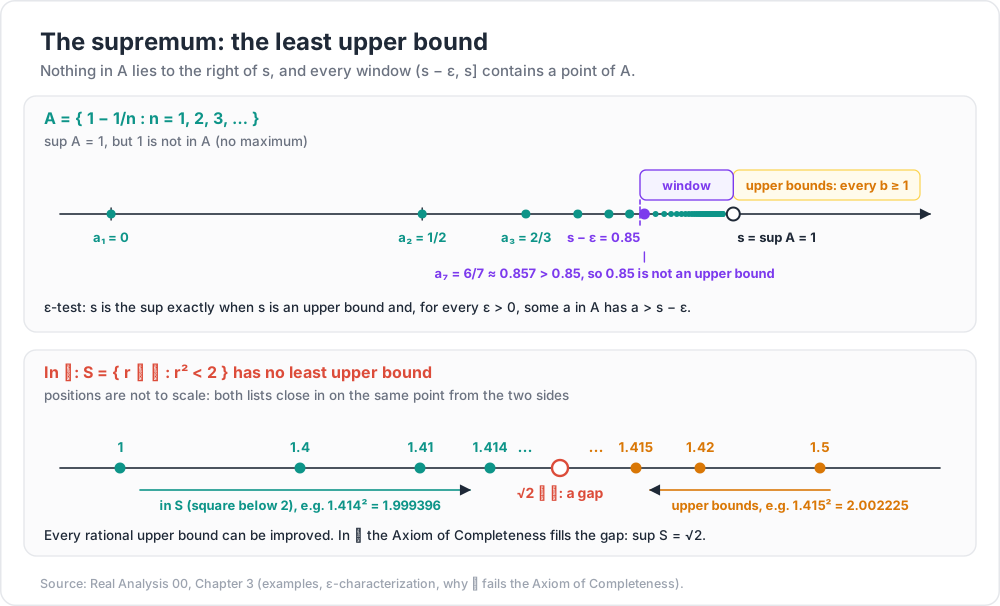
For : is an upper bound since . If , the Archimedean property (Chapter 4) gives with , so and is not an upper bound. For example, is beaten by (and is the first index that works, since ). Hence , and .
The epsilon characterization
Lemma. Let be an upper bound of . Then if and only if for every there is some with .
Proof. () Let . Since and is the least upper bound, is not an upper bound. So some has .
() Let be any upper bound with . Put . By hypothesis some has , contradicting that is an upper bound. So every upper bound satisfies , and .
In pictures: nothing in lies to the right of , but every window , however narrow, contains a point of .
The Axiom of Completeness
Axiom of Completeness (least upper bound property). Every nonempty set of real numbers that is bounded above has a supremum in .
is defined to be an ordered field that satisfies this axiom. (Such a field exists and is unique up to an order-preserving isomorphism; the standard constructions use Dedekind cuts, as in Rudin Chapter 1, or Cauchy sequences of rationals, as in Tao Chapter 5. This course takes the axiom as the starting point, as Abbott does.)
The axiom for infima follows. If is nonempty and bounded below, then is nonempty and bounded above, and .
Why fails the axiom. Let . It is nonempty () and bounded above by . Suppose it had a least upper bound in . The argument in Chapter 4 (existence of ) shows that and are both impossible, so ; but no rational squares to . So has no supremum in : the rationals have a hole exactly where should be. Concretely, are in (their squares are below ; for example ), while are rational upper bounds (). Every rational upper bound can be improved, and the two lists close in on a point that does not contain.
Working with suprema
Two small results, each proved with the lemma above, are used often.
- Shift: for , , where . (If , then is an upper bound of , and for each some gives .)
- Order: if , is nonempty and is bounded above, then . (Every upper bound of is an upper bound of .)
Common pitfall: assuming . The supremum of is , which is not in the set. Proofs that pick "the largest element of " are wrong unless is finite or known to have a maximum.
Chapter 4 — First consequences of completeness
The Archimedean property
Theorem (Archimedean property).
(i) For every there is with .
(ii) For every there is with .
Proof. (i) Suppose not: then is an upper bound of , so by completeness exists. Then is not an upper bound, so some has . But then and , contradicting that is an upper bound of .
(ii) Apply (i) to : some , so .
This property looks obvious, yet the proof needs completeness: there are ordered fields (for example suitably ordered fields of rational functions) with "infinitely large" elements, where it fails.
Density of the rationals
Theorem (density of ). For all real there is a rational with .
Proof. By the Archimedean property choose with . Let be the least integer with (it exists by the Archimedean property and well-ordering), so . Then , and
using . So .
The idea: steps of size are shorter than the interval, so one of the points must land inside.
Corollary. The irrationals are dense too: between any there is an irrational number. (Find a rational with ; then is irrational and lies in .)
Existence of the square root of 2
Theorem. There is with .
Proof sketch. Let . It is nonempty () and bounded above by (if then ). Let ; note . Show that the other two cases of trichotomy are impossible.
Case . For ,
Choose with (Archimedean property). Then , so , contradicting that is an upper bound.
Case . Now . Choose with ; then , and . Any with would have , which is impossible. So is an upper bound of smaller than — a contradiction.
So .
The same argument, with in place of , is the proof that has no supremum in : its supremum would have to square to . With more algebra it gives -th roots of every positive real.
The Nested Interval Property
Theorem (Nested Interval Property). For each let be a closed bounded interval, with . Then .
Proof. Nesting means and , and for all (with : ). So the set is nonempty and bounded above by every . Let . Then for all (upper bound) and for all (each is an upper bound and is the least). So for every .
If in addition the lengths shrink to , the intersection is exactly one point.
Watch out: both hypotheses are needed. The open intervals are nested but their intersection is empty (any is excluded once ). The closed but unbounded intervals are nested with empty intersection too. And in the property fails: intervals of rationals closing in on have no common rational point.
Together with the Archimedean property, the Nested Interval Property is equivalent to the Axiom of Completeness. It is the version used in bisection arguments (Bolzano–Weierstrass in Real Analysis 01, the Intermediate Value Theorem in Real Analysis 02).
Chapter 5 — Countable and uncountable sets
Completeness makes enormously larger than , even though both are dense. Cardinality makes "larger" precise.
Terminology
- Function — a rule assigning to each one element .
- One-to-one (injective) — implies .
- Onto (surjective) — every equals for some .
- Bijection — one-to-one and onto. and have the same cardinality, written , if a bijection exists.
- Countable — (an infinite list with every element appearing exactly once). Uncountable — infinite and not countable.
The rationals are countable
First, is countable: the list is the bijection with for odd and for even .
Theorem. is countable.
Proof. For each let be the set of rationals that can be written as in lowest terms with integers , and . For example , , . Each is finite, the are disjoint, and every rational lies in exactly one of them. List , then , then , and so on. This list contains every rational exactly once, so it is a bijection with .
The reals are uncountable
Theorem (Cantor, 1874; diagonal argument 1891). The interval , and hence , is uncountable.
Proof. Every has a decimal expansion . It is unique if expansions ending in an infinite string of s are excluded (so is written ). Suppose were onto, and write
Define by if and if . This lies in , its expansion has no s (so it is the unique allowed one), and it differs from in the -th digit for every . So for all , and is not onto.
Since (for example via ), is uncountable. Consequences:
- The irrationals are uncountable (if they were countable, would be a union of two countable sets, which is countable).
- Almost all real numbers are irrational, even though the rationals are dense. Density is about where points are; cardinality is about how many.
Common pitfall: "the diagonal number might equal some with a different expansion". That is exactly why the proof uses the digits and only and excludes trailing s: the number has only one decimal expansion, so differing in a digit really means being a different number.
The Cantor set
Start with . Remove the open middle third to get . Remove the open middle third of each piece to get , a union of intervals of length . In general is a union of closed intervals of length . The Cantor set is .
- Length removed: at step you remove intervals of length , so the total is . The Cantor set has "length zero".
- Many points survive: , , , and every endpoint stay forever. So does , which is never an endpoint: in base , , since .
- Uncountable: exactly when has a base- expansion using only the digits and . Replacing each by and reading the result in base maps onto , so is uncountable.
The Cantor set is the standard example of a set that is "small" in length but "large" in cardinality. It returns in Real Analysis 02 as a closed, compact set that contains no interval.
Practice Exercises
1. Write the negation of: "for every there is such that for all , " (the definition of ).
Solution
"There is such that for every there is with ." In words: there is a level at or below which infinitely many terms stay.
2. Prove by induction that for all .
Solution
Base: . Step: if , then , which is the formula for .
3. Prove that is irrational.
Solution
First, if divides then divides : otherwise and leaves remainder on division by . Now suppose in lowest terms. Then , so divides ; write . Then , so and divides . Both divisible by contradicts lowest terms.
4. Find and for and prove your answer for the supremum.
Solution
(the minimum, at , since increases with ). : it is an upper bound since . Given , choose with (Archimedean); then . By the -characterization, . It is not attained.
5. Let be nonempty and bounded above, and . Prove .
Solution
Let , . For , : , so is an upper bound. Given , pick and ; then . By the -characterization, .
6. Show that the intervals are nested but have empty intersection. Which hypothesis of the Nested Interval Property fails?
Solution
gives . If , . If , choose with (Archimedean); then . So the intersection is empty. The intervals are not closed (the left endpoint is missing).
7. Show that the set of all finite subsets of is countable, but the set of all subsets of is not.
Solution
Finite subsets: for each , the subsets of form a finite collection ( sets), and every finite subset of belongs to one of these collections. List the first collection, then the new sets of the second, and so on; this lists every finite subset exactly once. All subsets: suppose were onto. Let . If , then , a contradiction. (This is Cantor's theorem, the same diagonal idea.)
Cheat-sheet
| Idea | Statement | Used for |
|---|---|---|
| Negation | flip each quantifier, negate the final condition | "does not converge", "not continuous" |
| Triangle inequality | splitting every estimate | |
| Reverse triangle | lower bounds on | |
| Equality lemma | iff for all | proving limits are unique |
| Supremum | least upper bound; may not be in the set | defining limits, integrals |
| -test | upper bound , and some for each | every sup computation |
| Completeness | nonempty + bounded above gives a sup in | the one axiom lacks |
| Archimedean | unbounded; for some | choosing in limit proofs |
| Density | a rational (and an irrational) in every | Dirichlet function, approximation |
| Nested intervals | closed, bounded, nested: nonempty intersection | bisection proofs |
| Countable | , , | listing arguments |
| Uncountable | , , irrationals, Cantor set | diagonal argument |
What's next
Real Analysis 01 uses the Axiom of Completeness to study sequences and series: the – definition of a limit with an explicit , the Monotone Convergence Theorem (a supremum in disguise), Bolzano–Weierstrass (nested intervals in disguise), Cauchy sequences, and the convergence tests for infinite series, including why rearranging a series can change its sum.
References
- Stephen Abbott, Understanding Analysis, 2nd edition, Springer (Undergraduate Texts in Mathematics), 2015 — Chapter 1 (the model for this post).
- Walter Rudin, Principles of Mathematical Analysis, 3rd edition, McGraw-Hill, 1976 — Chapter 1 (ordered fields, construction of by Dedekind cuts) and Chapter 2 (countable sets, the Cantor set).
- Robert G. Bartle and Donald R. Sherbert, Introduction to Real Analysis, 4th edition, Wiley, 2011 — Chapters 1–2.
- Terence Tao, Analysis I, 4th edition, Springer (Texts and Readings in Mathematics), 2022 — Chapters 2–5 (from the natural numbers to the construction of ).
- Michael Spivak, Calculus, 4th edition, Publish or Perish, 2008 — Chapters 1–2 and 8 (least upper bounds).
- MIT OpenCourseWare, 18.100A Real Analysis, Fall 2020 (Casey Rodriguez), lecture notes: https://ocw.mit.edu/courses/18-100a-real-analysis-fall-2020/
Note: this post is in progress. Planned additions: a short construction of by Dedekind cuts; a proof that the Nested Interval Property plus the Archimedean property implies completeness; and the Schröder–Bernstein theorem.