MongoDB Course — 29 · Kubernetes Operator + mongosync + Cost + Compliance (Omnibus Final)
The final post in the advanced track combines four production topics that don't each need a full post but every working MongoDB engineer eventually faces: Kubernetes deployment via the new MongoDB Controllers for Kubernetes Operator (replacing the older Community + Enterprise operators), mongosync for cluster-to-cluster + multi-region active-active patterns, cost optimisation strategies for Atlas + self-hosted, and the compliance baselines (HIPAA, PCI-DSS, GDPR, SOC 2) every regulated workload needs.
Series map: 26 OpenTelemetry → 27 Geo → 28 Time-series extreme → 29 K8s + mongosync + cost + compliance (this post — final advanced).
Learning Outcome
- Deploy MongoDB on Kubernetes with the modern MongoDB Controllers operator.
- Use mongosync for cluster migration + multi-region sync.
- Apply cost-optimisation playbooks for Atlas + self-hosted.
- Architect for HIPAA, PCI-DSS, GDPR, SOC 2 baselines.
Part 1 — Kubernetes deployment
Chapter 1 — Operator choice in 2026
Three Kubernetes deployment options:
| Option | What | When |
|---|---|---|
| MongoDB Controllers for Kubernetes Operator | new unified operator (replaces older Community + Enterprise operators) | new self-hosted on K8s |
| MongoDB Community Operator (older) | Community editions; replica sets; basic ops | existing self-hosted on K8s; small workloads |
| MongoDB Enterprise Operator (older, deprecated) | Enterprise features + Ops Manager integration | being migrated to Controllers operator |
| Percona Operator for MongoDB | third-party; supports Community edition; sharding + backups + PITR included | self-hosted needing sharding + backups without Enterprise licence |
| Atlas on K8s? — no. Atlas is managed; don't K8s it. |
For new projects in 2026, MongoDB Controllers for Kubernetes Operator is the official path. Percona is a strong OSS alternative when you need sharding + PBM-style backups on Community.
Chapter 2 — Install the Controllers operator (Helm)
1
2
3
4
5
6
helm repo add mongodb https://mongodb.github.io/helm-charts
helm repo update
helm install mongodb-controllers mongodb/mongodb-kubernetes \
--namespace mongodb --create-namespace
Creates the operator + CRDs (MongoDBCommunity, MongoDB, MongoDBUser, etc.) in the mongodb namespace.
Chapter 3 — Deploy a replica set
1
2
3
4
5
6
7
8
9
10
11
12
13
14
15
16
17
18
19
20
21
22
23
24
25
26
27
28
29
30
31
32
33
34
35
# mongodb-replicaset.yaml
apiVersion: mongodbcommunity.mongodb.com/v1
kind: MongoDBCommunity
metadata:
name: shop-rs
namespace: mongodb
spec:
members: 3
type: ReplicaSet
version: "8.0.0"
security:
authentication: { modes: ["SCRAM"] }
users:
- name: shopuser
db: admin
passwordSecretRef: { name: shopuser-pw }
roles:
- { name: readWrite, db: shop }
scramCredentialsSecretName: shopuser-scram
statefulSet:
spec:
template:
spec:
containers:
- name: mongod
resources:
limits: { cpu: "2", memory: "8Gi" }
requests: { cpu: "500m", memory: "4Gi" }
volumeClaimTemplates:
- metadata: { name: data-volume }
spec:
accessModes: ["ReadWriteOnce"]
resources: { requests: { storage: 50Gi } }
storageClassName: ssd
1
2
3
kubectl apply -f mongodb-replicaset.yaml
kubectl get mdbc -n mongodb # watch state
The operator provisions StatefulSet, PVCs, services, runs rs.initiate(), configures users.
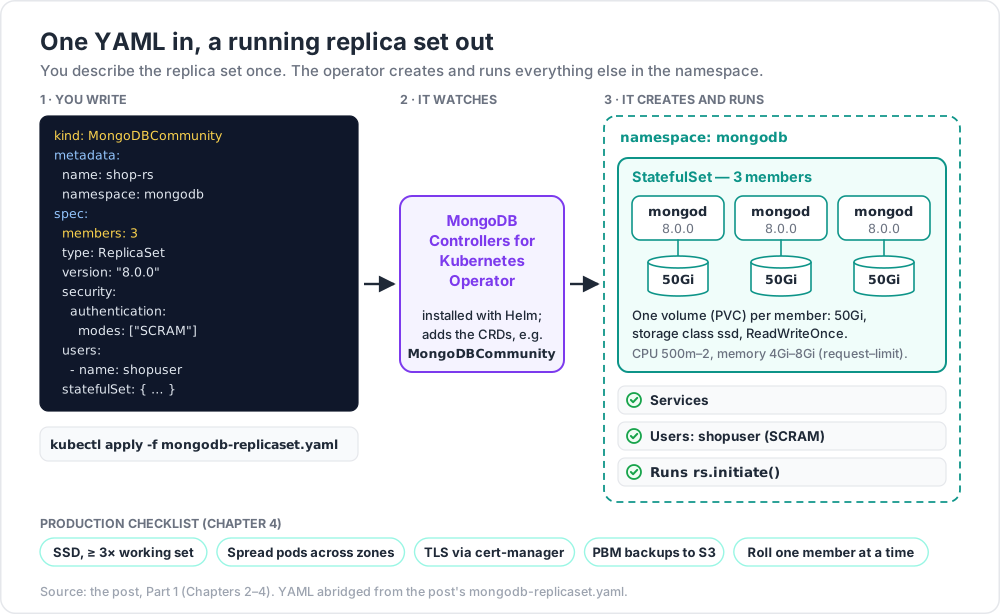
Chapter 4 — Production checklist
- Storage: SSD class, ReadWriteOnce, ≥ 3× working-set size.
- Node affinity: spread pods across nodes / zones (
podAntiAffinity). - Resource requests + limits: match instance sizing.
- PVC backup: Velero or CSI snapshots into S3.
- Monitoring: deploy
mongodb-prometheus-exportersidecar; scrape into Prometheus → Grafana. - TLS: Operator creates cert-manager-backed certs; clients use them.
- Network policies: only app namespace reaches mongod ports.
- Backups: Percona Backup for MongoDB (PBM) sidecar, schedule + offsite S3.
- Updates: roll one member at a time via Operator-managed updates.
Chapter 5 — When NOT to run Mongo on K8s
- Atlas is available and you don't have a sovereignty / on-prem requirement → use Atlas. Saves enormous ops time.
- Team has no K8s expertise → managed first, K8s later.
- Small workloads (< 100 GB, < 1k QPS) → cheaper + simpler on plain VMs or managed.
K8s pays off when: you already run K8s for everything else; you have multiple stateful workloads to operate; on-prem or sovereign cloud is required; you need infra-as-code for the DB itself.
Part 2 — mongosync
Chapter 6 — What mongosync does
Mongosync replicates data continuously from a source cluster to a destination cluster, with minimal downtime cut-over. Works between any combination of self-hosted + Atlas + clouds + regions.
Use cases:
- One-time migrations (on-prem → Atlas, AWS → GCP, cluster tier change).
- Multi-region passive-standby — destination always current; failover updates DNS.
- Pre-production environments — sync prod data nightly into staging (with PII scrubbing post-sync).
- Reverse-sync for rollback.
Chapter 7 — Mongosync basics
1
2
3
4
5
mongosync \
--cluster0 "mongodb+srv://srcuser:pw@src-cluster/" \
--cluster1 "mongodb+srv://dstuser:pw@dst-cluster/" \
--logPath /var/log/mongosync/
Then orchestrate via the REST API on localhost:27182:
1
2
3
4
5
6
7
8
9
10
# start initial sync
curl -X POST localhost:27182/api/v1/start \
-d '{"source": "cluster0", "destination": "cluster1"}'
# track progress
curl localhost:27182/api/v1/progress
# commit (cut over)
curl -X POST localhost:27182/api/v1/commit
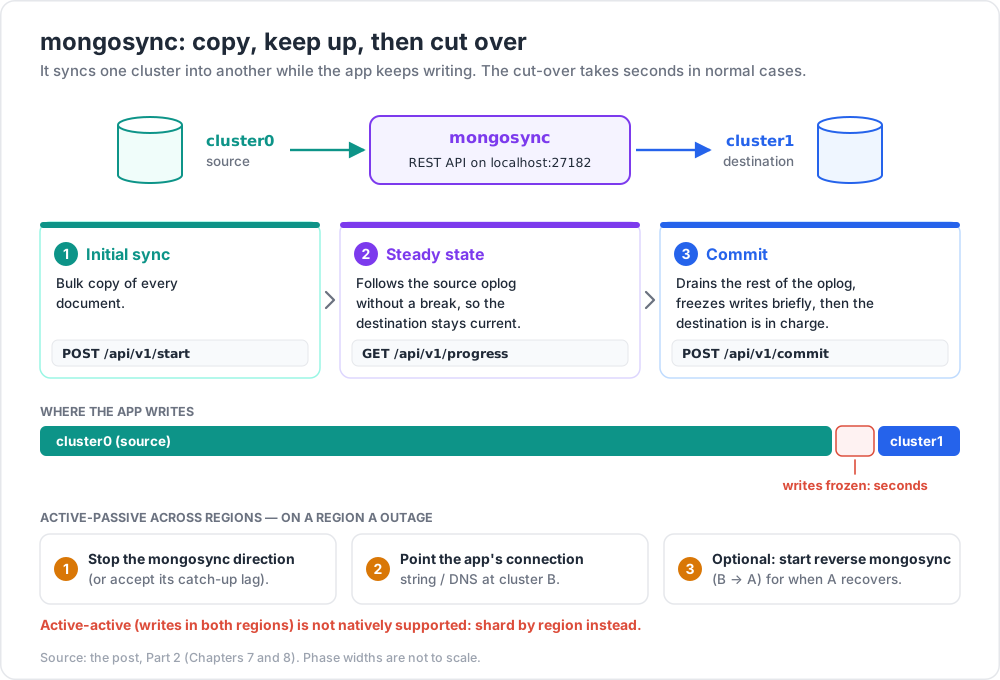
Phases:
- Initial sync — bulk copy of every doc.
- Steady state — continuous oplog tailing.
- Commit — drain remaining oplog, freeze writes briefly, declare destination authoritative.
Downtime for cut-over: seconds in normal cases.
Chapter 8 — Multi-region active-passive
1
2
3
4
5
6
Region A (primary writes) Region B (passive standby)
│ ▲
│ writes │
▼ │
Cluster A ───── mongosync ──────────► Cluster B
On region A outage:
- Stop the mongosync direction (or accept its catch-up lag).
- Flip your app's connection string / DNS to cluster B.
- Optionally start reverse mongosync (B → A) for when A recovers.
Active-active (writes in both regions) is not natively supported — last-writer-wins conflict resolution would be needed; Mongo doesn't have it. For active-active you typically shard by region (each region writes only to its own shard); mongosync isn't the right tool.
Chapter 9 — Sharded cluster sync
For sharded source + destination: run one mongosync per source shard to parallelise.
1
2
3
mongosync --cluster0 "mongodb://shard1/" --cluster1 "mongodb://destShard1/" ...
mongosync --cluster0 "mongodb://shard2/" --cluster1 "mongodb://destShard2/" ...
Coordinated commit ensures consistency on cut-over.
Chapter 10 — Mongosync vs other tools
| Tool | When |
|---|---|
| mongosync | Mongo → Mongo; one-time or continuous |
| mongodump / mongorestore | small / non-time-critical dumps; cross-version migrations |
| Debezium MongoDB connector | Mongo → Kafka → anywhere (Post 24) |
| Atlas Live Migration | one-time migration into Atlas |
| Atlas backup restore | DR scenarios |
For Mongo → Mongo, mongosync is the modern default.
Part 3 — Cost optimisation
Chapter 11 — Atlas tier sizing
Atlas pricing scales with tier (M0 free → M700+ enterprise). Cost levers:
- Right-size the cluster by working set, not by RAM × N.
- Reduce non-essential indexes (write amplification + RAM bloat).
- Online Archive old data (Post 16) — 10× cheaper than hot tier.
- Search nodes sized separately; right-size for index size + traffic.
- Backup retention — long retention = more cost. Right-size to compliance need.
- Data transfer — cross-region replication / clients in different regions = egress fees. Co-locate.
Chapter 12 — Index pruning
1
2
3
db.collection.aggregate([{ $indexStats: {} }])
// drop indexes with `ops: 0` over weeks
Hidden index pattern (Post 03) lets you test removal safely. Quarterly index review on every production collection. Easy 10-30 % storage + RAM win.
Chapter 13 — Query cost
Each slow query = wasted CPU + IOPS. The profiler + Atlas Performance Advisor (Post 04) surface them. Fix top-N slowest queries every sprint.
A query halved is two queries worth of capacity reclaimed. Index investments scale your fleet without scaling your tier.
Chapter 14 — Storage compression
- WiredTiger default is snappy. Switching new collections to zstd (Post 15) compresses ~25 % better at similar CPU.
- Old collections can be re-collected (offline) to apply new compression.
Chapter 15 — Connection cost
Each pool connection costs server-side resources. Right-size client pools by Little's Law (Post 08). Big over-pools waste Atlas tier capacity.
Chapter 16 — Hot vs cold tiers
For data that's queried rarely:
- Atlas Online Archive → cheap S3-like storage; federated query.
- Manual archive to S3 (Parquet, compressed) → cheapest, custom-query path.
- For analytics, push old data to ClickHouse (Post 28).
The two ratios that matter: hot/cold size + hot/cold cost. If 80 % of data is rarely queried, tier it; you'll cut cluster cost in half.
Chapter 17 — Atlas cost-control tactics
| Tactic | Saving |
|---|---|
| Right-size tier | up to 50 % if over-provisioned |
| Drop unused indexes | 10-30 % RAM |
| Online Archive cold data | 50 %+ on cold-heavy workloads |
| Switch to zstd | 20-30 % storage |
| Co-locate clients + cluster | data-transfer egress reduction |
| Annual commit / reserved pricing | 20-40 % discount |
| Stop dev / staging clusters off-hours | tier-hour reduction |
| Audit + cancel forgotten resources | varies; can be huge |
Chapter 18 — Self-hosted cost considerations
Cost = hardware (or cloud VMs) + storage + network + people-ops.
Compared to Atlas:
- Self-hosted hardware is often cheaper per GB-RAM at large scale.
- But operating cost (people, on-call, backup infra, monitoring) often exceeds the Atlas premium.
- Most teams break even around ~50 nodes / multi-TB; below that, Atlas wins on TCO.
The right answer depends on your ops headcount + cloud commit + sovereignty needs.
Part 4 — Compliance
Chapter 19 — HIPAA, PCI-DSS, GDPR, SOC 2 baselines
These are the four most common compliance frameworks regulated workloads hit. Mongo + Atlas provides primitives; you assemble the controls.
| Framework | Concerns |
|---|---|
| HIPAA (US healthcare) | Patient health info (PHI). Audit, encryption, access control, BAA with vendor. |
| PCI-DSS (cards) | Cardholder data (PAN). Encryption, network isolation, key rotation, logging, scanning. |
| GDPR (EU) | Personal data of EU residents. Right to be forgotten, data residency, breach notification (72 h). |
| SOC 2 (general trust) | Security, availability, processing integrity, confidentiality, privacy. Audit-based. |
Chapter 20 — Atlas + HIPAA
- Atlas enterprise tier required + Business Associate Agreement (BAA) with MongoDB Inc.
- Customer-managed KMS keys for encryption at rest.
- Audit log enabled + shipped offsite.
- TLS in transit (default).
- VPC private endpoint; no public access.
- MFA + SSO + RBAC for all users.
- BAAs with every downstream subprocessor.
Document everything for the audit.
Chapter 21 — PCI-DSS
For storing PAN (primary account number):
- CSFLE or Queryable Encryption (Post 13) so PAN is unreadable to ops staff.
- KMS-managed keys with rotation policy + access logs.
- Network isolation; no internet egress from the DB host.
- Audit log capturing every PAN access + every privileged op.
- Quarterly external scanning; annual penetration test.
- Vendor PCI attestation (Atlas has SAQ-D Service Provider).
Better: don't store PAN at all. Use a tokenisation service (Stripe / Adyen / Spreedly); store tokens.
Chapter 22 — GDPR — right to be forgotten
Article 17 — data subjects can request deletion.
Patterns:
- Hard delete via secondary key (email / customer_id). Find every collection referencing the subject; delete or anonymise. Mongo's lack of FK makes this app-side; document each collection's owner.
- Soft delete via anonymisation — replace PII with placeholders; keep aggregate analytics integrity.
- Backup considerations — backups also contain the subject's data. Most regulators accept "purged on backup rotation"; document the retention.
- Audit — log every deletion request + resolution.
- Data residency — Atlas regions match EU AWS / Azure / GCP regions to keep data in-EU.
Chapter 23 — SOC 2 controls — common requirements
- Documented security policies (you write; auditor reviews).
- Access reviews — quarterly audit of who has what role.
- Change management — every prod change reviewed + approved.
- Vendor management — Atlas + every downstream vendor reviewed.
- Incident response plan — written + practised.
- Monitoring + alerts — proven via logs.
- Backup + restore — tested (Post 14).
The audit checks evidence over a 6 or 12 month observation period. Tooling (Vanta, Drata, Secureframe) automates most of the evidence collection.
Chapter 24 — Audit logging discipline
Every privileged operation + every data access on sensitive collections should be auditable:
- Atlas audit log → SIEM (Splunk, Datadog, ELK).
- Self-hosted: Enterprise audit log feature, with filters for noise reduction.
- App-level audit: every PII-touching endpoint logs
(user, action, target_id, at)into anaudit_logcollection with TTL of regulator-required years.
Chapter 25 — Common pitfalls (compliance)
| Pitfall | Cause | Fix |
|---|---|---|
| PAN in plaintext | "we'll encrypt later" | tokenise via payment provider; never store |
| EU data in US region | accidental cluster region | always pin region for GDPR-relevant data |
| Audit log not preserved | retention too short | retention by regulator (often 7 years for HIPAA) |
| Backups not encrypted | self-hosted pipeline missed | encrypt every backup at rest |
| MFA only on humans, not service accounts | service accounts hijacked | use IAM auth where possible; rotate other secrets |
| Deletion request not honoured | backups still hold the data | document backup-rotation purge; honour as best-effort |
| Privileged role too broad | default dbOwner instead of custom |
least-privilege custom roles |
Course complete
You've covered MongoDB from the document model through CRUD, indexes, aggregation, schema design, pool + concurrency, transactions, replication, sharding, change streams, security, backup, performance, Atlas (Search + Vector + Triggers + Stream Processing), drivers, modelling case studies, Mongoose, Beanie, the outbox pattern, CQRS + Event Sourcing, production RAG, SQL→Mongo migration, Kafka + Debezium CDC, testing, OpenTelemetry, geospatial, time-series at extreme scale, Kubernetes, mongosync, cost, and compliance.
That's the working knowledge of a senior MongoDB engineer + the architectural awareness of a platform engineer. Where you go from here:
- Read MongoDB Inc. release notes per major version — the engine evolves fast.
- Build something real that exercises 5+ of these areas end-to-end.
- Contribute to OSS — drivers, operators, ODMs all welcome patches.
- Pair with a database that complements Mongo for your edge cases (ClickHouse for analytics, Redis for hot cache).
The series will get future extensions (single-post deep dives on subtopics, case studies from real production migrations, performance benchmarks). The base + advanced you have today is enough to ship serious systems.
Cheat-sheet (omnibus)
| Area | Key |
|---|---|
| K8s operator | MongoDB Controllers (new) > Community / Enterprise (older) > Percona (OSS sharding+backup) |
| K8s sizing | SSD storage class; PVC ≥ 3× working-set; podAntiAffinity across zones |
| K8s vs Atlas | Atlas almost always wins on TCO unless sovereign / on-prem |
| mongosync | source → destination; commit phase has seconds of downtime |
| Multi-region active-passive | mongosync + DNS flip on outage |
| Active-active | not native; use region-sharded writes |
| Atlas cost levers | right-size tier; drop unused indexes; archive; zstd; co-locate clients |
| Self-hosted cost | wins at large scale + headcount; loses on small/medium |
| HIPAA | BAA + CMK + audit log + private endpoint + MFA |
| PCI | CSFLE / QE + KMS + tokenise where possible |
| GDPR | right to be forgotten; data residency; document backups |
| SOC 2 | document + audit; tools like Vanta automate evidence |
| Compliance baseline | least-privilege RBAC + TLS + audit log + tested restore |
References
- MongoDB Controllers for Kubernetes Operator
- MongoDB Community Operator (older)
- Percona Operator for MongoDB
- Mongosync
- Atlas pricing + cost controls
- Atlas HIPAA / PCI documentation
- MongoDB security checklist
Note: this post is in progress. Planned additions: end-to-end K8s operator walkthrough with TLS + backups; multi-region mongosync drill; Atlas cost case studies; PCI-DSS scope-reduction patterns via tokenisation.