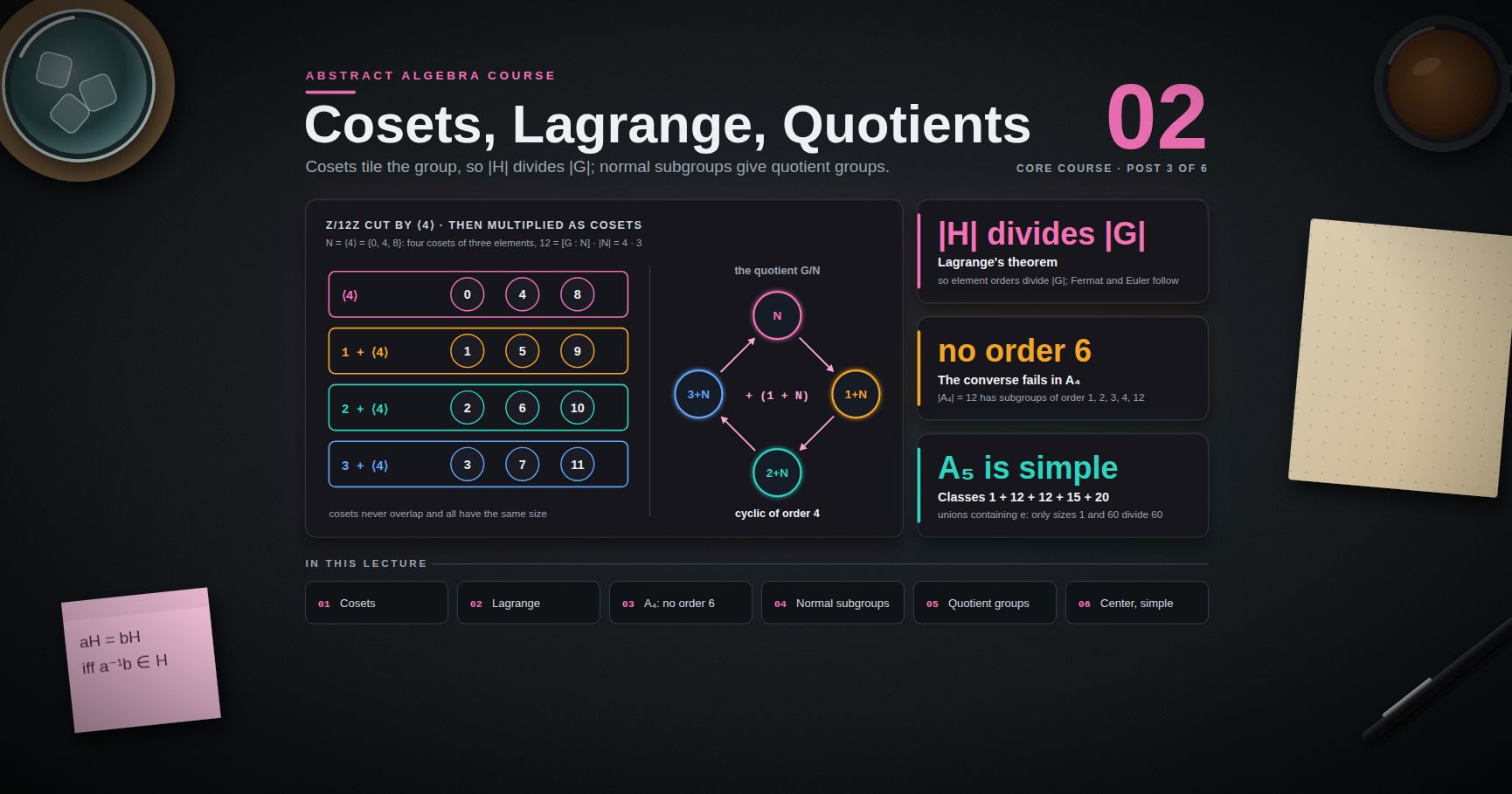
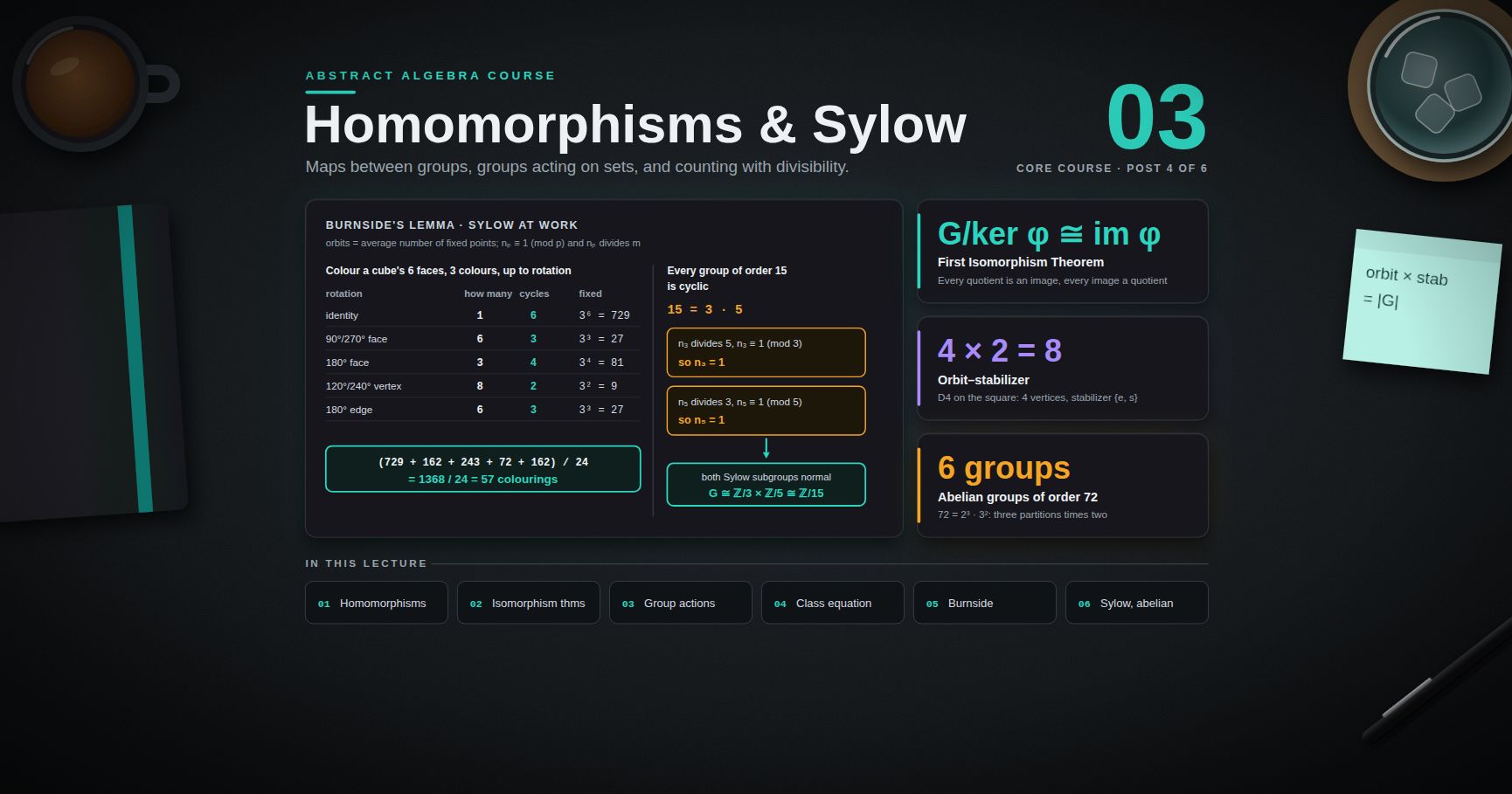
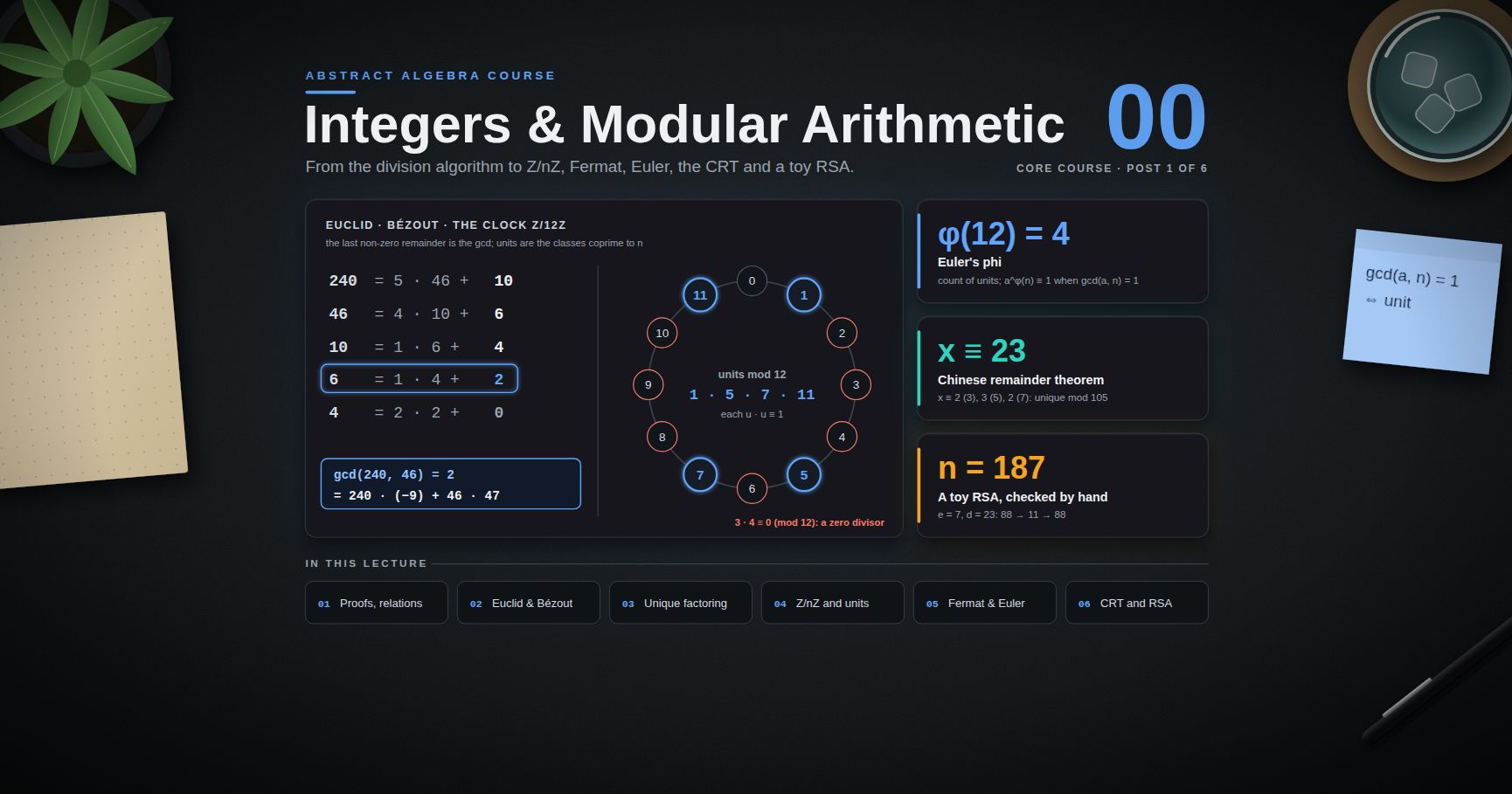
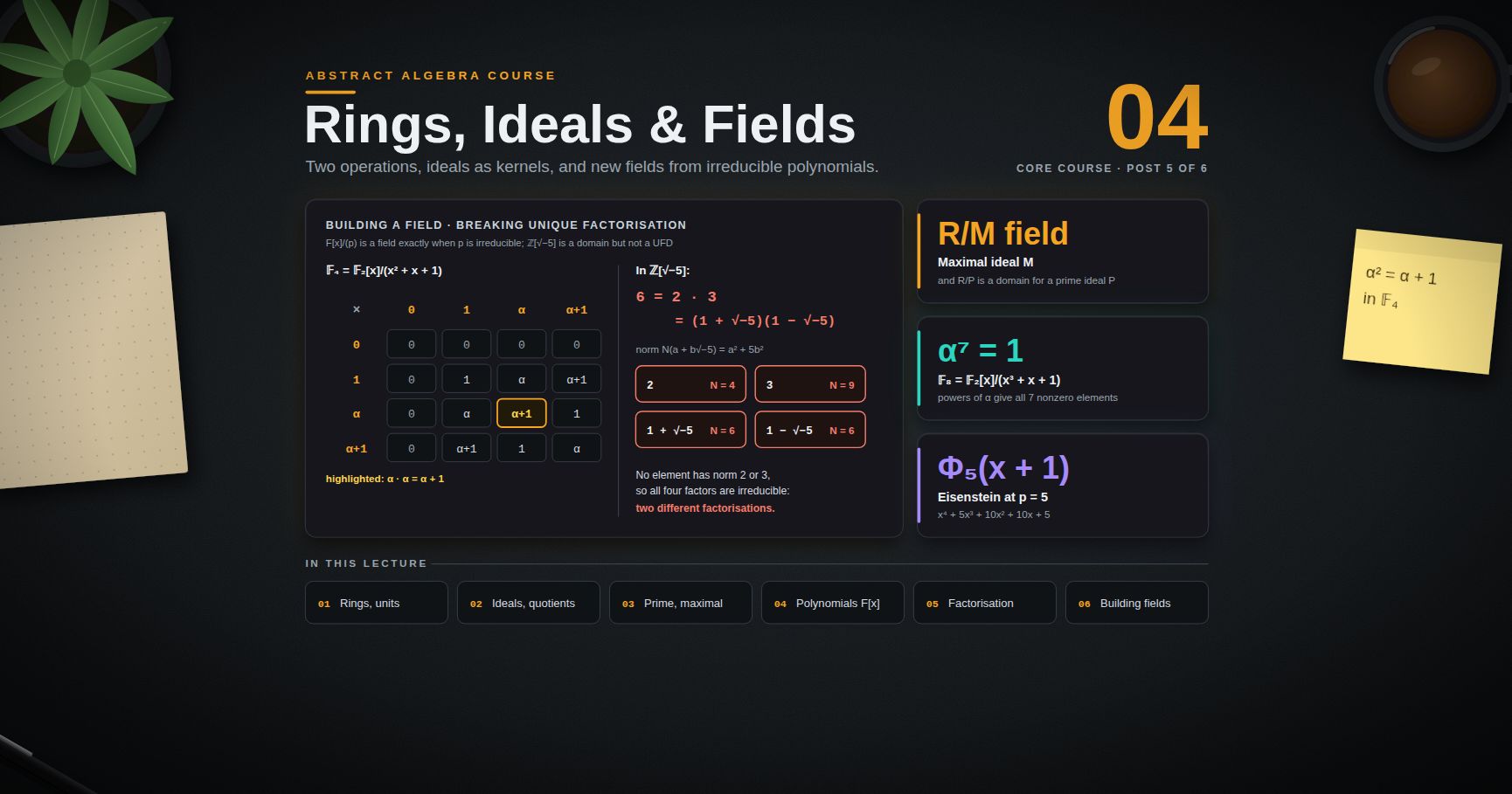
A group is a set with one operation that can always be undone. That short definition covers the integers under addition, clock arithmetic, the shuffles of a deck of cards, the rotations and reflections of a square, invertible matrices, and the unit quaternions used to rotate objects in 3D graphics. This post gives the axioms and their first consequences, builds the standard zoo of examples (symmetric, dihedral, matrix, quaternion and Klein four groups), and then studies subgroups, with a complete description of the subgroups of a cyclic group. It relies on post 00 for gcd, the division algorithm and Z/nZ; post 02 builds on it with cosets and Lagrange's theorem.
Series map: 00 Integers, Relations & Modular Arithmetic → 01 Groups & Subgroups (this post) → 02 Cosets, Lagrange & Quotient Groups → 03 Homomorphisms, Group Actions & Sylow → 04 Rings, Ideals & Fields → 05 Field Extensions & Galois Theory.
Learning Outcome
- State the group axioms and decide whether a given set and operation form a group.
- Prove the basic consequences: unique identity and inverses, cancellation, (ab)−1=b−1a−1.
- Compute in Sn with cycle notation, using a stated composition convention, and find the order and sign of a permutation.
- Work with the dihedral group Dn through its generators r,s and the relation srs=r−1.
- Recognise GLn, SLn, the quaternion group Q8 and the Klein four group, and build and check a Cayley table.
- Compute orders of elements, including ∣k∣=n/gcd(k,n) in Z/nZ.
- Apply the one-step and two-step subgroup tests.
- Prove that every subgroup of a cyclic group is cyclic, list all subgroups of Z/nZ, and draw the subgroup lattice of Z/12Z.
- Form direct products and decide when Z/mZ×Z/nZ is cyclic.
Chapter 1 — The group axioms
Terminology
- A binary operation on a set G is a function G×G→G, written (a,b)↦a∗b or just ab. "The result lies in G" is called closure; it is part of the definition of a binary operation.
- The operation is associative if (ab)c=a(bc) for all a,b,c.
- An identity is an element e with ea=ae=a for all a.
- An inverse of a is an element b with ab=ba=e.
- A group is a set with an associative binary operation that has an identity, in which every element has an inverse.
- A group is abelian (commutative) if ab=ba for all a,b. Abelian groups are often written additively: a+b, identity 0, inverse −a.
- The order of a group, ∣G∣, is the number of its elements (possibly infinite).
Examples and non-examples
| Set and operation |
Group? |
Reason |
| Z, + |
yes, abelian |
identity 0, inverse −a |
| Z, − |
no |
not associative: (1−1)−1=1−(1−1) |
| N, + |
no |
1 has no inverse in N |
| Z, × |
no |
2 has no inverse in Z |
| Q×=Q∖{0}, × |
yes, abelian |
inverse 1/a |
| Z/nZ, + |
yes, abelian, order n |
post 00 |
| Z/6Z∖{0}, × |
no |
not closed: 2⋅3=0 |
| (Z/nZ)×, × |
yes, abelian, order φ(n) |
units, post 00 |
| n×n real matrices, × |
no |
singular matrices have no inverse |
First consequences
Proposition 1.1. In any group G:
- the identity is unique;
- each element has exactly one inverse, written a−1;
- (a−1)−1=a and (ab)−1=b−1a−1;
- cancellation: ab=ac implies b=c, and ba=ca implies b=c;
- the equations ax=b and ya=b have the unique solutions x=a−1b and y=ba−1.
Proof. (1) If e and e′ are identities, e=ee′=e′. (2) If b and c are inverses of a, then b=be=b(ac)=(ba)c=ec=c. (3) a satisfies the definition of an inverse of a−1, so by (2) it is the inverse. For the product, (ab)(b−1a−1)=a(bb−1)a−1=aa−1=e, and similarly in the other order. (4) Multiply ab=ac on the left by a−1 and use associativity. (5) x=a−1b works; if x′ also works, ax=ax′ and cancellation gives x=x′. ■
Common pitfall: (ab)−1=b−1a−1, not a−1b−1 (the "socks and shoes" rule: to undo putting on socks then shoes, remove the shoes first). The two agree only when a and b commute.
Powers are defined as usual: a0=e, an=a⋯a (n factors), a−n=(a−1)n. The laws aman=am+n and (am)n=amn hold in every group, but (ab)n=anbn can fail when ab=ba. In additive notation an becomes na.
Cayley tables
A Cayley table lists every product xy, with x labelling the row and y the column. Part 5 of Proposition 1.1 says each element appears exactly once in every row and every column (a Latin square). Here is (Z/8Z)×={1,3,5,7} under multiplication mod 8:
| × |
1 |
3 |
5 |
7 |
| 1 |
1 |
3 |
5 |
7 |
| 3 |
3 |
1 |
7 |
5 |
| 5 |
5 |
7 |
1 |
3 |
| 7 |
7 |
5 |
3 |
1 |
Every element squares to 1. Compare (Z/10Z)×={1,3,7,9}: there 32=9, 33=27≡7, 34=81≡1, so the powers of 3 already give every element. Both groups have order 4, but they are not "the same group": one has an element of order 4 and the other does not.
Watch out: a Latin square is necessary but not sufficient. A table can have every row and column a permutation and still fail associativity. Checking associativity by hand means checking n3 triples, which is why groups are usually built from known ones (permutations, matrices, residues) where associativity is inherited.
Chapter 2 — The standard examples
Symmetric groups Sn
A permutation of {1,…,n} is a bijection from the set to itself. The permutations form the symmetric group Sn under composition, with ∣Sn∣=n!. Composition of functions is associative, the identity map is the identity, and a bijection has an inverse (post 00, Proposition 2.1).
Convention used in this series. στ means σ∘τ: apply τ first, then σ (right to left, like function composition). Dummit & Foote, Gallian and Artin use this convention; some books and some software (including SymPy's Permutation product) use the opposite one, so always check.
Cycle notation. The cycle (a1 a2 … ak) sends a1↦a2↦⋯↦ak↦a1 and fixes everything else. It has length k; a 2-cycle is a transposition. Every permutation is a product of disjoint cycles, uniquely up to order and up to cycling each cycle's entries. Disjoint cycles commute.
To convert two-line notation: the permutation 1↦3,2↦5,3↦1,4↦4,5↦6,6↦2 follows 1→3→1 and 2→5→6→2, with 4 fixed, so it is (1 3)(2 5 6).
Composing. In S3 let σ=(1 2 3) and τ=(1 2). For στ, follow each point through τ first, then σ: 1→2→3, 2→1→2, 3→3→1. So στ=(1 3). In the other order, τσ: 1→2→1, 2→3→3, 3→1→2, so τσ=(2 3). Since στ=τσ, S3 is not abelian, and neither is Sn for any n≥3.
A longer example in S5: (1 3 5)(1 2)(3 4). Apply (3 4), then (1 2), then (1 3 5): 1→1→2→2; 2→2→1→3; 3→4→4→4; 4→3→3→5; 5→5→5→1. The product is the 5-cycle (1 2 3 4 5).
Order of a permutation. A k-cycle has order k. For a product of disjoint cycles, the order is the least common multiple of the cycle lengths, because the cycles commute and act on separate points. So (1 2 3)(4 5) has order lcm(3,2)=6, (1 3)(2 5 6) has order 6, and (1 2 3 4)(5 6) has order 4.
Common pitfall: the lcm rule needs disjoint cycles. (1 2)(1 3) is a product of two elements of order 2, but it equals (1 3 2), which has order 3. Rewrite in disjoint form first.
The sign of a permutation
Every cycle is a product of transpositions: (a1 a2 … ak)=(a1 ak)(a1 ak−1)⋯(a1 a2), which uses k−1 transpositions. Hence every permutation is a product of transpositions, in many different ways. The number of transpositions is not fixed, but its parity is.
Theorem 2.1. Define sgnσ=∏1≤i<j≤nj−iσ(j)−σ(i). Then sgnσ∈{+1,−1}, sgn(στ)=sgn(σ)sgn(τ), and every transposition has sign −1. Consequently a permutation cannot be both a product of an even number and of an odd number of transpositions.
Proof. The numerator runs over the same unordered pairs {σ(i),σ(j)} as the denominator, each once, possibly with a sign change, so the product is ±1; it is (−1)N where N is the number of inversions (pairs i<j with σ(i)>σ(j)). For multiplicativity write
sgn(στ)=i<j∏τ(j)−τ(i)σ(τ(j))−σ(τ(i))⋅i<j∏j−iτ(j)−τ(i).
The second product is sgnτ. In the first, each factor is unchanged when its two indices are swapped, and as {i,j} runs over all pairs so does {τ(i),τ(j)}, so it equals sgnσ. Finally, the transposition (a b) with a<b has exactly 2(b−a)−1 inversions: the pair (a,b) and, for each c strictly between them, the pairs (a,c) and (c,b). That number is odd. ■
So a k-cycle has sign (−1)k−1: a 3-cycle is even, a transposition is odd. Examples: sgn((1 2 3 4)(5 6))=(−1)3(−1)1=+1; sgn((1 3)(2 5 6))=(−1)1(−1)2=−1. The even permutations form the alternating group An, of order n!/2 for n≥2.
Dihedral groups Dn
For n≥3, Dn is the group of symmetries of a regular n-gon: rigid motions of the plane that map the polygon onto itself. Convention: in this series Dn has order 2n (as in Gallian and Artin); Dummit & Foote call the same group D2n.
Label the vertices 1,…,n counterclockwise. Let r be rotation by 2π/n counterclockwise and s the reflection in the line through vertex 1 and the centre. Then
Dn={e,r,r2,…,rn−1, s,rs,r2s,…,rn−1s},rn=s2=e,srs=r−1.
The n elements rk are rotations and the n elements rks are reflections. The relation srs=r−1 (equivalently sr=r−1s) lets you move every s to the right, so any word in r and s simplifies to one of the 2n normal forms. For example srk=r−ks and (rks)2=rk(srks)=rkr−k=e: every reflection has order 2.
Acting on the vertices, D3 is all of S3: r=(1 2 3), s=(2 3), and then r2=(1 3 2), rs=(1 2), r2s=(1 3). Its Cayley table (entry = row ⋅ column, column applied first):
| ⋅ |
e |
r |
r2 |
s |
rs |
r2s |
| e |
e |
r |
r2 |
s |
rs |
r2s |
| r |
r |
r2 |
e |
rs |
r2s |
s |
| r2 |
r2 |
e |
r |
r2s |
s |
rs |
| s |
s |
r2s |
rs |
e |
r2 |
r |
| rs |
rs |
s |
r2s |
r |
e |
r2 |
| r2s |
r2s |
rs |
s |
r2 |
r |
e |
Row s, column r gives sr=r2s=r−1s, as the relation predicts. For the square, D4 acting on vertices 1,2,3,4 has r=(1 2 3 4) and s=(2 4); its eight elements are four rotations of orders 1,4,2,4 and four reflections of order 2. Unlike D3, D4 is a proper subgroup of S4 (order 8 versus 24).
Matrix groups
- GLn(R), the general linear group: invertible n×n real matrices under multiplication. Closure: det(AB)=detAdetB=0.
- SLn(R), the special linear group: matrices of determinant 1.
- Over the field Fp=Z/pZ, GL2(Fp) is finite. A matrix is invertible exactly when its columns are linearly independent: p2−1 choices for a non-zero first column, then p2−p for a second column that is not a multiple of the first. So ∣GL2(Fp)∣=(p2−1)(p2−p), giving 6 for p=2 and 48 for p=3.
Matrix groups are the standard non-abelian examples: with A=(1011) and B=(1101),
AB=(2111),BA=(1112).
The quaternion group Q8 and the Klein four group
Q8={±1,±i,±j,±k} with −1 central (commuting with everything), (−1)2=1, and Hamilton's rules
i2=j2=k2=ijk=−1,ij=k,jk=i,ki=j,ji=−k,kj=−i,ik=−j.
Orders: 1 has order 1, −1 has order 2, and the six elements ±i,±j,±k have order 4. Q8 is non-abelian of order 8 but is not D4: D4 has five elements of order 2, Q8 has only one.
The Klein four group V={e,a,b,c} has every non-identity element of order 2 and ab=c, bc=a, ca=b. The table of (Z/8Z)× above is V with a,b,c=3,5,7. Inside S4 it appears as {e,(1 2)(3 4),(1 3)(2 4),(1 4)(2 3)}.
Groups from geometry: the circle and the roots of unity
- The circle group S1={z∈C:∣z∣=1} under multiplication: ∣zw∣=∣z∣∣w∣ gives closure and z−1=zˉ. Writing z=eiθ, multiplying means adding angles.
- The n-th roots of unity μn={e2πik/n:k=0,…,n−1} form a subgroup of S1 of order n, generated by ζ=e2πi/n. They are the rotations of the regular n-gon, written as complex numbers.
- The orthogonal group O(n) of real matrices with ATA=I (distance-preserving linear maps) and its subgroup SO(n) of rotations (detA=1). SO(2) is the circle group again, with eiθ matching the rotation matrix (cosθsinθ−sinθcosθ).
These infinite groups are where group theory meets geometry and physics (Lie groups); this series stays mostly with finite groups.
Chapter 3 — Orders of elements
Terminology
- The order ∣g∣ of an element g is the smallest n≥1 with gn=e, or ∞ if no such n exists. In additive notation: the smallest n with ng=0.
- The cyclic subgroup generated by g is ⟨g⟩={gk:k∈Z}.
In Z every non-zero element has infinite order. In Z/12Z, 4 has order 3 (4+4+4=12≡0). In R×, −1 has order 2 and 2 has infinite order.
Lemma 3.1. Let ∣g∣=n<∞. Then gm=e if and only if n∣m. Also ga=gb if and only if a≡b(modn), so ⟨g⟩={e,g,…,gn−1} has exactly n elements.
Proof. Divide: m=qn+r with 0≤r<n. Then gm=(gn)qgr=gr. By minimality of n, gr=e forces r=0. The second claim applies the first to ga−b. ■
So ∣g∣=∣⟨g⟩∣: the order of an element equals the order of the subgroup it generates. This is the link that lets Lagrange's theorem in post 02 say that element orders divide group orders.
Theorem 3.2. If ∣g∣=n and k is an integer, then ∣gk∣=gcd(k,n)n. In particular, in Z/nZ the class k has order n/gcd(k,n).
Proof. Let d=gcd(k,n). By Lemma 3.1, (gk)m=e iff n∣km iff dn∣dkm. Since gcd(dn,dk)=1, Euclid's lemma turns this into dn∣m. The smallest positive such m is n/d. ■
Examples in Z/20Z: ∣8∣=20/gcd(8,20)=20/4=5, and ⟨8⟩={0,4,8,12,16}=⟨4⟩. The elements of order 20 are the k with gcd(k,20)=1: 1,3,7,9,11,13,17,19, which is φ(20)=8 elements.
Proposition 3.3. In any group: (a) ∣g−1∣=∣g∣; (b) ∣ab∣=∣ba∣; (c) if ab=ba and gcd(∣a∣,∣b∣)=1 (both finite), then ∣ab∣=∣a∣∣b∣.
Proof. (a) (g−1)m=(gm)−1, which is e exactly when gm=e. (b) ba=a−1(ab)a, and (a−1xa)m=a−1xma is e exactly when xm=e. (c) Let m=∣a∣, n=∣b∣. Since a,b commute, (ab)mn=(am)n(bn)m=e. Conversely, if (ab)k=e then ak=b−k lies in ⟨a⟩∩⟨b⟩. The order of this element divides both m and n (Lemma 3.1), so it is 1: ak=bk=e. Then m∣k and n∣k, so mn=lcm(m,n) divides k. ■
Part (c) fails without commutativity: in S3, (1 2) and (1 2 3) have coprime orders 2 and 3, but their product (1 2)(1 2 3)=(2 3) has order 2, not 6. It also fails without coprimality: in Z/4Z, 1 and 3 both have order 4, and 1+3=0 has order 1.
Trick: ⟨k⟩=⟨gcd(k,n)⟩ in Z/nZ. Both have order n/gcd(k,n), and gcd(k,n) is a multiple of k modulo n by Bézout, so one contains the other and they have the same size.
Chapter 4 — Subgroups
Terminology
- A subgroup H≤G is a subset that is a group under the same operation.
- {e} is the trivial subgroup; H=G is a proper subgroup.
The subgroup tests
Theorem 4.1 (two-step test). A non-empty subset H⊆G is a subgroup if and only if it is closed under products (a,b∈H⇒ab∈H) and under inverses (a∈H⇒a−1∈H).
Theorem 4.2 (one-step test). A non-empty subset H⊆G is a subgroup if and only if a,b∈H⇒ab−1∈H.
Theorem 4.3 (finite test). A non-empty finite subset H⊆G closed under products is a subgroup.
Proofs. Two-step: associativity is inherited from G; pick a∈H, then a−1∈H and e=aa−1∈H. One-step: take b=a to get e=aa−1∈H; then a−1=ea−1∈H; then ab=a(b−1)−1∈H, so the two-step test applies. The "only if" directions are clear. Finite test: for a∈H the powers a,a2,a3,… lie in the finite set H, so two coincide, ai=aj with i<j, and aj−i=e. If a=e its inverse is itself. Otherwise j−i≥2 and a−1=aj−i−1 is a positive power of a, hence in H. ■
Examples.
- nZ={nk:k∈Z}≤Z: na−nb=n(a−b) (one-step test, additive form a−b).
- SLn(R)≤GLn(R): det(AB−1)=detA/detB=1.
- An≤Sn: the product of even permutations is even, and σ−1 has the same sign as σ.
- The rotations {e,r,…,rn−1}=⟨r⟩≤Dn.
- {z∈C:zn=1}, the n-th roots of unity, is a subgroup of C× of order n.
Non-examples. The odd integers (no 0). {e,(1 2),(1 3)}⊆S3 (not closed: (1 2)(1 3)=(1 3 2)). N in Z (no inverses).
Proposition 4.4. The intersection of any collection of subgroups is a subgroup. The union of two subgroups is a subgroup only if one contains the other.
Proof. Intersection: one-step test in each subgroup at once. Union: if a∈H∖K and b∈K∖H, then ab∈/H (else b=a−1(ab)∈H) and ab∈/K (else a∈K). ■
For example 2Z∪3Z contains 2 and 3 but not 5. The smallest subgroup containing a set S is the intersection of all subgroups containing S, written ⟨S⟩ and called the subgroup generated by S. For instance Dn=⟨r,s⟩.
Worked example: subgroups of D4 of order 4
With r=(1 2 3 4) and s=(2 4) acting on the vertices of a square, the eight elements of D4 are
| rotations |
e |
r=(1 2 3 4) |
r2=(1 3)(2 4) |
r3=(1 4 3 2) |
| reflections |
s=(2 4) |
rs=(1 2)(3 4) |
r2s=(1 3) |
r3s=(1 4)(2 3) |
Is K={e,r2,s,r2s} a subgroup? It is finite, so by Theorem 4.3 closure is enough. Using srk=r−ks and r4=e: r2⋅r2=e, s⋅s=e, r2s⋅r2s=e (reflections have order 2), r2⋅s=r2s, s⋅r2=r−2s=r2s, r2⋅r2s=s, r2s⋅r2=r2r−2s=s, s⋅r2s=r−2=r2 and r2s⋅s=r2. Every product lands in K, so K≤D4. Every non-identity element of K has order 2, so K is a Klein four group, not cyclic.
D4 has exactly three subgroups of order 4: the cyclic ⟨r⟩={e,r,r2,r3}, and two Klein four groups, K and {e,r2,rs,r3s}. The last one, written as permutations, is {e,(1 3)(2 4),(1 2)(3 4),(1 4)(2 3)}, the copy of V inside S4 from Chapter 2.
Common pitfall: a subset is not a subgroup just because it contains e and is closed under inverses. {e,s,rs} has both properties but s⋅rs=r−1ss=r−1=r3 is missing, and in any case a subgroup of D4 cannot have 3 elements (post 02: the order of a subgroup divides the order of the group).
Chapter 5 — Cyclic groups
A group G is cyclic if G=⟨g⟩ for some g, called a generator. Cyclic groups are abelian (gagb=ga+b=gbga). Examples: Z=⟨1⟩=⟨−1⟩; Z/nZ=⟨1⟩; (Z/10Z)×=⟨3⟩; the rotation subgroup ⟨r⟩ of Dn. Non-examples: V and (Z/8Z)× (no element of order 4), Q under addition, every non-abelian group.
Two groups are isomorphic, G≅H, if there is a bijection ϕ:G→H with ϕ(ab)=ϕ(a)ϕ(b); post 03 studies such maps properly. Lemma 3.1 shows that a cyclic group of order n is isomorphic to Z/nZ via gk↦[k], and an infinite cyclic group is isomorphic to Z. So up to isomorphism, Z and the Z/nZ are the only cyclic groups.
Subgroups of cyclic groups
Theorem 5.1. Every subgroup of a cyclic group is cyclic.
Proof. Let G=⟨g⟩ and H≤G. If H={e}, then H=⟨e⟩. Otherwise H contains some gk with k=0, and also its inverse g−k, so it contains a positive power of g. Let m be the smallest positive integer with gm∈H (well-ordering). Clearly ⟨gm⟩⊆H. Conversely take gt∈H and divide: t=qm+r with 0≤r<m. Then gr=gt(gm)−q∈H, and minimality of m forces r=0. So gt=(gm)q∈⟨gm⟩, and H=⟨gm⟩. ■
Applied to Z: every subgroup of Z is nZ for a unique n≥0.
Theorem 5.2 (fundamental theorem of finite cyclic groups). Let G=⟨g⟩ have order n. For every positive divisor d of n, G has exactly one subgroup of order d, namely ⟨gn/d⟩. It has no subgroups of other orders.
Proof. By Theorem 3.2, ∣gn/d∣=n/gcd(n/d,n)=n/(n/d)=d, so a subgroup of order d exists. Now let H be any subgroup. By the proof of Theorem 5.1, H=⟨gm⟩ where m is the least positive exponent in H (if H is trivial it is the unique subgroup of order 1). Since gn=e∈H, the same division argument shows m∣n. Then ∣H∣=∣gm∣=n/gcd(m,n)=n/m. So the order of H divides n, and H is determined by its order: ∣H∣=d forces m=n/d. ■
Corollary 5.3. In a cyclic group of order n, gk is a generator if and only if gcd(k,n)=1; there are φ(n) generators. The number of elements of order d (for d∣n) is φ(d), so ∑d∣nφ(d)=n.
The subgroup lattice of Z/12Z
The divisors of 12 are 1,2,3,4,6,12, so Z/12Z has exactly six subgroups:
| order d |
subgroup ⟨12/d⟩ |
elements |
elements of order d |
| 1 |
⟨0⟩ |
0 |
0 |
| 2 |
⟨6⟩ |
0, 6 |
6 |
| 3 |
⟨4⟩ |
0, 4, 8 |
4, 8 |
| 4 |
⟨3⟩ |
0, 3, 6, 9 |
3, 9 |
| 6 |
⟨2⟩ |
0, 2, 4, 6, 8, 10 |
2, 10 |
| 12 |
⟨1⟩ |
all 12 |
1, 5, 7, 11 |
The last column has 1+1+2+2+2+4=12 entries, one for each element, matching ∑d∣12φ(d)=12. Containment follows divisibility: the subgroup of order d1 lies inside the subgroup of order d2 exactly when d1∣d2. Drawing each subgroup as a node, with a line up to each subgroup that contains it with no subgroup in between, gives the subgroup lattice (Hasse diagram):
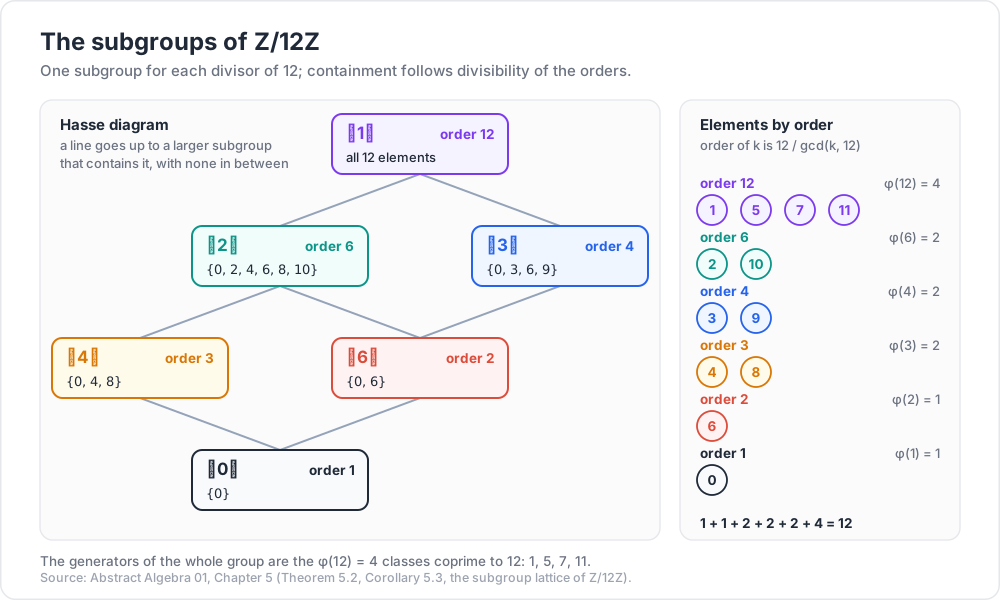
The lattice of Z/12Z is the divisor lattice of 12 turned into groups. Non-cyclic groups have richer lattices: D4, of order 8, has ten subgroups (one of order 1, five of order 2, three of order 4, one of order 8), and two different subgroups of order 4 can exist, which Theorem 5.2 forbids for cyclic groups.
Watch out: "for every divisor d of ∣G∣ there is a subgroup of order d" is a special property of cyclic groups (and, as post 03 shows, of some other families). Post 02 shows it fails for the alternating group A4, of order 12, which has no subgroup of order 6.
Cayley's theorem
Permutation groups are not just one example among many: every group is one.
Theorem 5.4 (Cayley). Every group G is isomorphic to a subgroup of the group Sym(G) of all permutations of the set G. In particular a group of order n is isomorphic to a subgroup of Sn.
Proof. For g∈G define λg:G→G by λg(x)=gx. It is a bijection, with inverse λg−1. Associativity gives λgλh(x)=g(hx)=(gh)x=λgh(x), so g↦λg respects the operations (with the right-to-left convention for composing). It is injective, because λg=λh gives g=λg(e)=λh(e)=h. So G is isomorphic to its image {λg}, which is a subgroup of Sym(G) (closed under products by the formula above and under inverses by λg−1=λg−1). ■
Example: in (Z/8Z)×={1,3,5,7}, multiplication by 3 swaps 1↔3 and 5↔7, which is the row of 3 in the Cayley table read as a permutation; multiplication by 5 is 1↔5, 3↔7. Each row of a Cayley table is exactly the permutation λg, which is another way to see why rows never repeat an entry.
Chapter 6 — Direct products and abelian groups
The (external) direct product of groups G and H is G×H with the componentwise operation (g1,h1)(g2,h2)=(g1g2,h1h2). Its identity is (e,e), inverses are (g−1,h−1), and ∣G×H∣=∣G∣∣H∣. It is abelian exactly when both factors are.
Proposition 6.1. If g and h have finite orders, then ∣(g,h)∣=lcm(∣g∣,∣h∣).
Proof. (g,h)k=(gk,hk)=(e,e) iff ∣g∣∣k and ∣h∣∣k (Lemma 3.1), iff lcm(∣g∣,∣h∣)∣k. ■
Theorem 6.2. Z/mZ×Z/nZ is cyclic if and only if gcd(m,n)=1.
Proof. Every element has order lcm(∣a∣,∣b∣), which divides lcm(m,n)=mn/gcd(m,n). If gcd(m,n)>1, no element reaches order mn, so the group is not cyclic. If gcd(m,n)=1, then (1,1) has order lcm(m,n)=mn and generates. ■
So Z/2Z×Z/3Z≅Z/6Z (this is the additive half of the Chinese remainder theorem from post 00), while Z/2Z×Z/2Z≅V is not cyclic. In Z/4Z×Z/6Z (order 24) the largest element order is lcm(4,6)=12; for example (2,3) has order lcm(2,2)=2.
Direct products describe all finite abelian groups. The fundamental theorem of finite abelian groups (stated here; proved in the references) says that every finite abelian group is isomorphic to a direct product of cyclic groups of prime-power order, uniquely up to the order of the factors. For order 8 this gives exactly three abelian groups: Z/8Z, Z/4Z×Z/2Z and (Z/2Z)3. Together with the non-abelian D4 and Q8 these are all five groups of order 8, up to isomorphism.
Trick: to tell groups apart, count elements of each order; an isomorphism preserves orders. Z/8Z, Z/4Z×Z/2Z, (Z/2Z)3, D4 and Q8 have 1,3,7,5,1 elements of order 2 respectively.
Practice Exercises
1. Show that G=R∖{−1} with a∗b=a+b+ab is an abelian group. What are the identity and the inverse of a?
Solution
Note 1+a∗b=(1+a)(1+b). Closure: if a,b=−1 then (1+a)(1+b)=0, so a∗b=−1. Associativity and commutativity follow from those of multiplication, since both (a∗b)∗c and a∗(b∗c) equal (1+a)(1+b)(1+c)−1. Identity: 0. Inverse: (1+a)(1+a′)=1 gives a′=1+a1−1=1+a−a. In fact a↦1+a is an isomorphism to R×.
2. In S6 write σ=(1 2 3)(4 5) and τ=(1 4)(2 6). Compute στ in disjoint cycle form, its order and its sign.
Solution
Apply τ first: 1→4→5, 5→5→4, 4→1→2, 2→6→6, 6→2→3, 3→3→1. So στ=(1 5 4 2 6 3), a 6-cycle: order 6, sign (−1)5=−1. Check with signs: sgnσ=(+1)(−1)=−1, sgnτ=(+1), product −1.
3. Find the order of every element of (Z/15Z)×. Is it cyclic?
Solution
The group is {1,2,4,7,8,11,13,14}, order φ(15)=8. Orders: 1 has order 1; 4,11,14 have order 2 (16,121,196 are all ≡1); 2,7,8,13 have order 4 (e.g. 22=4, 24=16≡1). No element has order 8, so it is not cyclic. (It is isomorphic to Z/4Z×Z/2Z.)
4. In Dn simplify sr3sr2 and show that rks has order 2 for every k.
Solution
sr3s=r−3 (apply srs=r−1 three times, or use srk=r−ks and s2=e). So sr3sr2=r−3r2=r−1. For the order: (rks)(rks)=rk(srk)s=rkr−kss=e, and rks=e.
5. List all subgroups of Z/20Z with a generator for each, and find all generators of the subgroup of order 5.
Solution
One per divisor of 20: ⟨0⟩ (order 1), ⟨10⟩ (2), ⟨5⟩ (4), ⟨4⟩ (5), ⟨2⟩ (10), ⟨1⟩ (20). The subgroup of order 5 is {0,4,8,12,16}; all four non-zero elements generate it (each has order 20/gcd(k,20)=20/4=5), matching φ(5)=4.
6. Show that Q8 is not isomorphic to D4, and that Z/4Z×Z/6Z is not isomorphic to Z/24Z.
Solution
Isomorphisms preserve element orders. Q8 has one element of order 2 (−1); D4 has five (r2 and the four reflections). Z/24Z has an element of order 24; every element of Z/4Z×Z/6Z has order dividing lcm(4,6)=12.
7. Prove that a group in which every element satisfies g2=e is abelian.
Solution
Every element is its own inverse. For any a,b: ab=(ab)−1=b−1a−1=ba.
Cheat-sheet
| Idea |
Statement |
| Group |
associative operation, identity, inverses |
| Inverse of product |
(ab)−1=b−1a−1 |
| Cayley table |
every row and column is a permutation |
| Composition in Sn |
στ = apply τ first |
| Order of a permutation |
lcm of disjoint cycle lengths |
| Sign |
k-cycle has sign (−1)k−1; ∣An∣=n!/2 |
| Dn (order 2n) |
rn=s2=e, srs=r−1 |
| Q8 |
i2=j2=k2=ijk=−1 |
| GL2(Fp) |
order (p2−1)(p2−p) |
| Order and powers |
gm=e iff ∣g∣∣m |
| Order of a power |
∣gk∣=n/gcd(k,n) |
| One-step test |
non-empty and ab−1∈H |
| Cyclic subgroups |
all cyclic; one per divisor d, namely ⟨gn/d⟩ |
| Generators of Z/nZ |
k with gcd(k,n)=1; φ(n) of them |
| Direct product |
∣(g,h)∣=lcm(∣g∣,∣h∣) |
| Cyclic product |
Z/m×Z/n cyclic iff gcd(m,n)=1 |
What's next
Post 02 asks how a subgroup sits inside its group. Translating a subgroup H by an element gives a coset gH; the cosets partition G into pieces of equal size, which proves Lagrange's theorem: ∣H∣ divides ∣G∣. That single fact explains Theorem 5.2's "divisors only" and re-proves Fermat and Euler from post 00. Then comes the question of when the cosets themselves form a group, which leads to normal subgroups and quotient groups such as Z/nZ, which turns out to be Z read modulo its subgroup nZ.
References
- David S. Dummit and Richard M. Foote, Abstract Algebra, 3rd edition, Wiley, 2004 — Chapters 1–2 (groups, dihedral and symmetric groups, subgroups, cyclic groups, lattices).
- Joseph A. Gallian, Contemporary Abstract Algebra, 10th edition, CRC Press, 2021 — Chapters 1–5 and 8 (groups, finite groups and subgroups, cyclic groups, permutation groups, direct products).
- Michael Artin, Algebra, 2nd edition, Pearson, 2011 — Chapter 2 (groups).
- John B. Fraleigh, A First Course in Abstract Algebra, 7th edition, Addison-Wesley, 2003 — Sections 1–11.
- Thomas W. Judson, Abstract Algebra: Theory and Applications (open textbook), judsonbooks.org — chapters on groups, cyclic groups and permutation groups.
- MIT OpenCourseWare, 18.701 Algebra I (Fall 2010) — lectures on groups, subgroups and permutations.
- Keith Conrad, Expository papers on group theory (University of Connecticut) — notes on dihedral groups, the sign of a permutation and the quaternion group.
Note: this post is in progress. Planned additions: the subgroup lattice of D4 drawn out, a proof of the fundamental theorem of finite abelian groups (or a pointer to it once post 03 has homomorphisms), and matrix representations of Q8.