Abstract Algebra — 03 · Homomorphisms, Group Actions and the Sylow Theorems
Posts 01 and 02 studied groups one at a time: their elements, subgroups, cosets and quotients. This post studies the maps between groups and the ways a group can move a set. Homomorphisms explain what quotient groups really are (every quotient is the image of a homomorphism, and every image is a quotient). Group actions turn a group into a counting machine: the orbit–stabilizer theorem, the class equation and Burnside's lemma all come from one idea. The payoff is the Sylow theorems, which let you prove facts such as "every group of order 15 is cyclic" using nothing but divisibility. The chapter closes with the classification of finite abelian groups.
Series map: 00 Integers, Relations & Modular Arithmetic → 01 Groups & Subgroups → 02 Cosets, Lagrange & Quotient Groups → 03 Homomorphisms, Group Actions & Sylow (this post) → 04 Rings, Ideals & Fields → 05 Field Extensions & Galois Theory.
Learning Outcome
- Define a group homomorphism, its kernel and its image, and prove that the kernel is a normal subgroup.
- Decide whether two groups are isomorphic by comparing invariants (order, element orders, abelian or not).
- Prove that .
- State and prove the First Isomorphism Theorem, and state the Second, Third and Correspondence theorems.
- Prove Cayley's theorem: every group is a group of permutations.
- Define a group action, orbits and stabilizers, and prove the orbit–stabilizer theorem.
- Derive the class equation and use it to prove that a -group has a nontrivial center.
- Count colourings up to symmetry with Burnside's lemma.
- State Cauchy's and Sylow's theorems and use them to analyse groups of order 12, 15 and 20.
- List all abelian groups of a given order, in both elementary-divisor and invariant-factor form.
Chapter 1 — Homomorphisms
Terminology
- Homomorphism — a map between groups with for all . The product on the left is in , the one on the right is in .
- Kernel — , the elements sent to the identity.
- Image — .
- Monomorphism / epimorphism — an injective / surjective homomorphism.
- Isomorphism — a bijective homomorphism. Write when one exists.
- Automorphism — an isomorphism . The automorphisms of form a group under composition.
- Inner automorphism — conjugation by a fixed element: .
First properties
Let be a homomorphism. Then:
- . Proof: ; multiply both sides by .
- . Proof: .
- for every integer (induction, plus property 2 for negative ).
- If has finite order , then the order of divides , because .
- is a subgroup of and is a subgroup of .
Property 4 is the workhorse for ruling maps out. There is no nontrivial homomorphism : the image of the generator would need an order dividing both 3 and 4, so it is the identity.
Examples worth knowing
| Homomorphism | Kernel | Image |
|---|---|---|
| all of | ||
| , | ||
| , | all of | |
| all of (isomorphism) | ||
| , | the unit circle | |
| , | (automorphism) |
Homomorphisms out of a cyclic group. A homomorphism is fixed by , since . The only condition is that must go to , that is . The solutions are the multiples of , so there are exactly homomorphisms. For , : holds for , which is maps.
Common pitfall: "" is not a well-defined map unless . In , , but . Always check that a map defined on representatives does not depend on the representative chosen.
Kernels are normal, and injectivity
Theorem. If is a homomorphism, then is a normal subgroup of .
Proof. It is a subgroup: ; if then . It is normal: for and any ,
so . ∎
Theorem. is injective if and only if .
Proof. If is injective, only maps to . Conversely, if and , then , so and . ∎
More precisely, the fibres of are exactly the cosets of the kernel: if and only if . This is the whole content of the First Isomorphism Theorem in Chapter 2.
Isomorphism invariants
Isomorphic groups are "the same group with renamed elements", so any property defined only from the group operation is shared. To prove two groups are not isomorphic, find a property one has and the other lacks:
- the order ;
- being abelian or cyclic;
- the number of elements of each order;
- the size of the center, the number of subgroups of a given order, and so on.
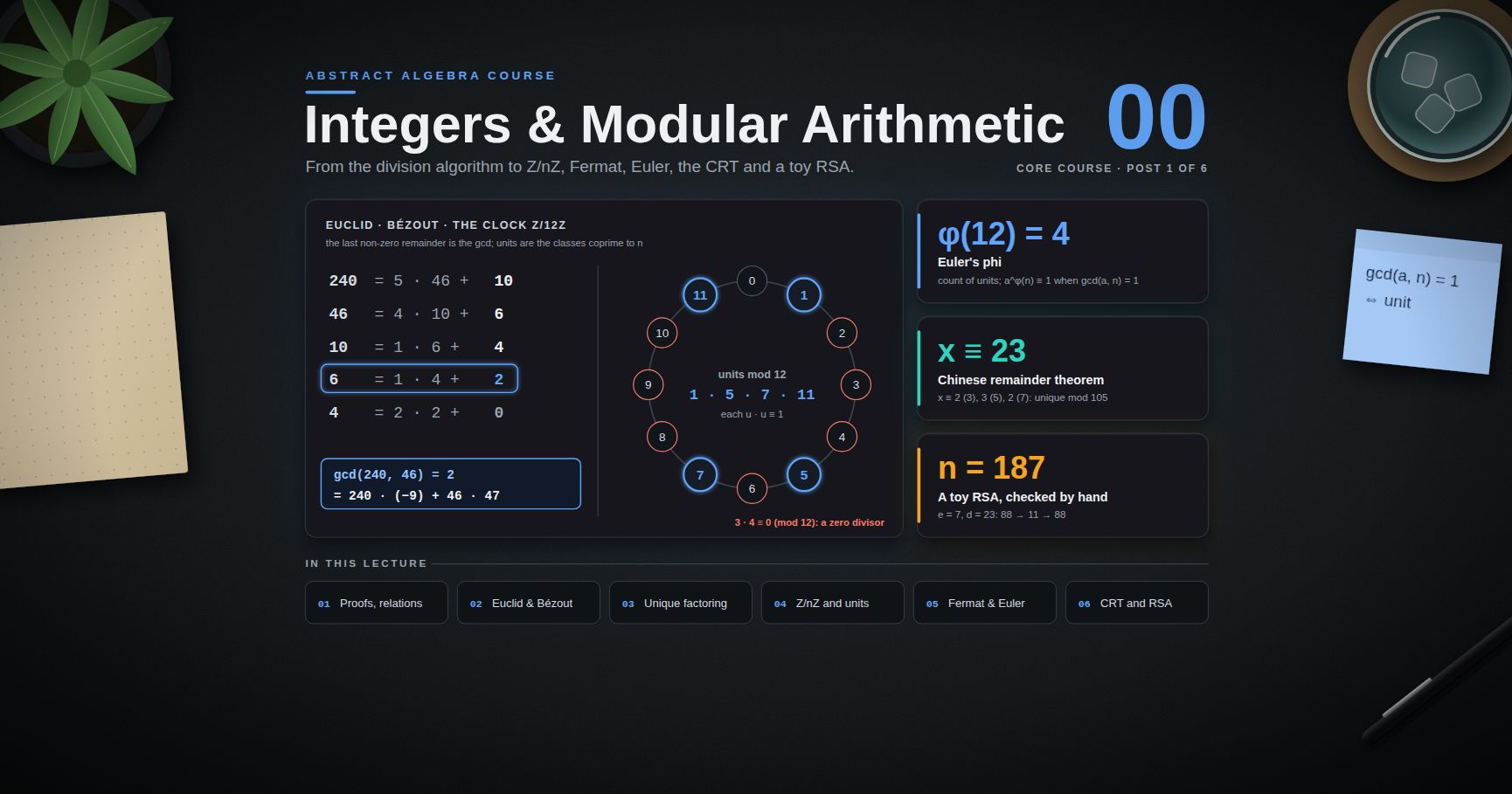
has an element of order 4; in every non-identity element has order 2. So they are not isomorphic, although both have order 4 and are abelian. On the other hand via ; this is the Chinese Remainder Theorem from post 00. In general is cyclic if and only if .
Watch out: to prove two groups are isomorphic you must produce a map and check it. Matching every invariant you can think of is evidence, not proof.
Automorphisms of cyclic groups
Theorem. , the group of units modulo . In particular , Euler's totient function from post 00. (This post writes Euler's function as to keep free for homomorphisms.)
Proof. Every endomorphism of is for (see "Homomorphisms out of a cyclic group" with ). The map is a bijection exactly when its image contains , that is when for some , that is when is a unit. Define , . It is surjective by what was just said and injective since recovers . It is a homomorphism because . ∎
Example: and each element squares to (, , are all ). So , not cyclic. In the other direction, : an automorphism may permute the three non-identity elements in any of the ways.
Inner automorphisms. The map , , is a homomorphism (). Its kernel is the set of with for all , which is the center from post 02. Its image is . By the First Isomorphism Theorem (next chapter), . For (order 8) the center is , so has order .
Chapter 2 — The isomorphism theorems
The First Isomorphism Theorem
Theorem (First Isomorphism Theorem). Let be a homomorphism with kernel . Then is normal in and
Proof. Normality of was proved in Chapter 1. Define by .
- Well defined. If then for some , so .
- Homomorphism. .
- Injective. If then , so and , the identity of . A homomorphism with trivial kernel is injective.
- Surjective. Every element of is . ∎
Read it as a factorisation: every homomorphism is "quotient map, then isomorphism, then inclusion", . For finite it also gives the counting rule .
Worked applications of the table in Chapter 1:
- (via ).
- (via ), so and .
- really is modulo the kernel of reduction.
- (via ): "the real line wrapped around a circle".
Trick: to identify a quotient , do not work with cosets directly. Find a surjective homomorphism out of whose kernel is exactly ; its target is the answer.
The Second and Third Isomorphism Theorems
Theorem (Second, or "diamond"). Let and . Then is a subgroup of , is normal in , and
(Proof idea: , , is surjective with kernel ; apply the First theorem.) For finite groups it gives .
Theorem (Third). Let be normal subgroups of . Then is normal in and
(Proof idea: , , is well defined and surjective with kernel .) Example: . The subgroup has order 3, and .
Theorem (Correspondence). Let and the quotient map. Then is a bijection between subgroups of that contain and subgroups of . It preserves inclusion, indices () and normality.
So the subgroup lattice of is exactly the part of the lattice of that sits above .
Cayley's theorem
Theorem (Cayley). Every group is isomorphic to a subgroup of the symmetric group . If , then is isomorphic to a subgroup of .
Proof. For let , . It is a bijection with inverse , so . The map , , is a homomorphism because . Its kernel is trivial: if is the identity then . By the First Isomorphism Theorem . ∎
Cayley's theorem is historically important (it says the abstract definition of a group loses nothing compared with "groups of permutations") but it is wasteful: it embeds a group of order 8 in , of order 40320. Group actions on smaller sets give much better information, which is the next chapter.
Chapter 3 — Group actions
Terminology
- Action — a group acts on a set if there is a map , , with and .
- Permutation representation — equivalently, a homomorphism , with . The two descriptions are the same thing.
- Faithful action — one whose homomorphism is injective (only acts as the identity).
- Orbit — , everywhere can be moved to.
- Stabilizer — , the elements that fix . It is a subgroup of .
- Transitive action — one with a single orbit.
- Fixed set — , the points a given fixes.
Examples
- acts on by . Transitive and faithful.
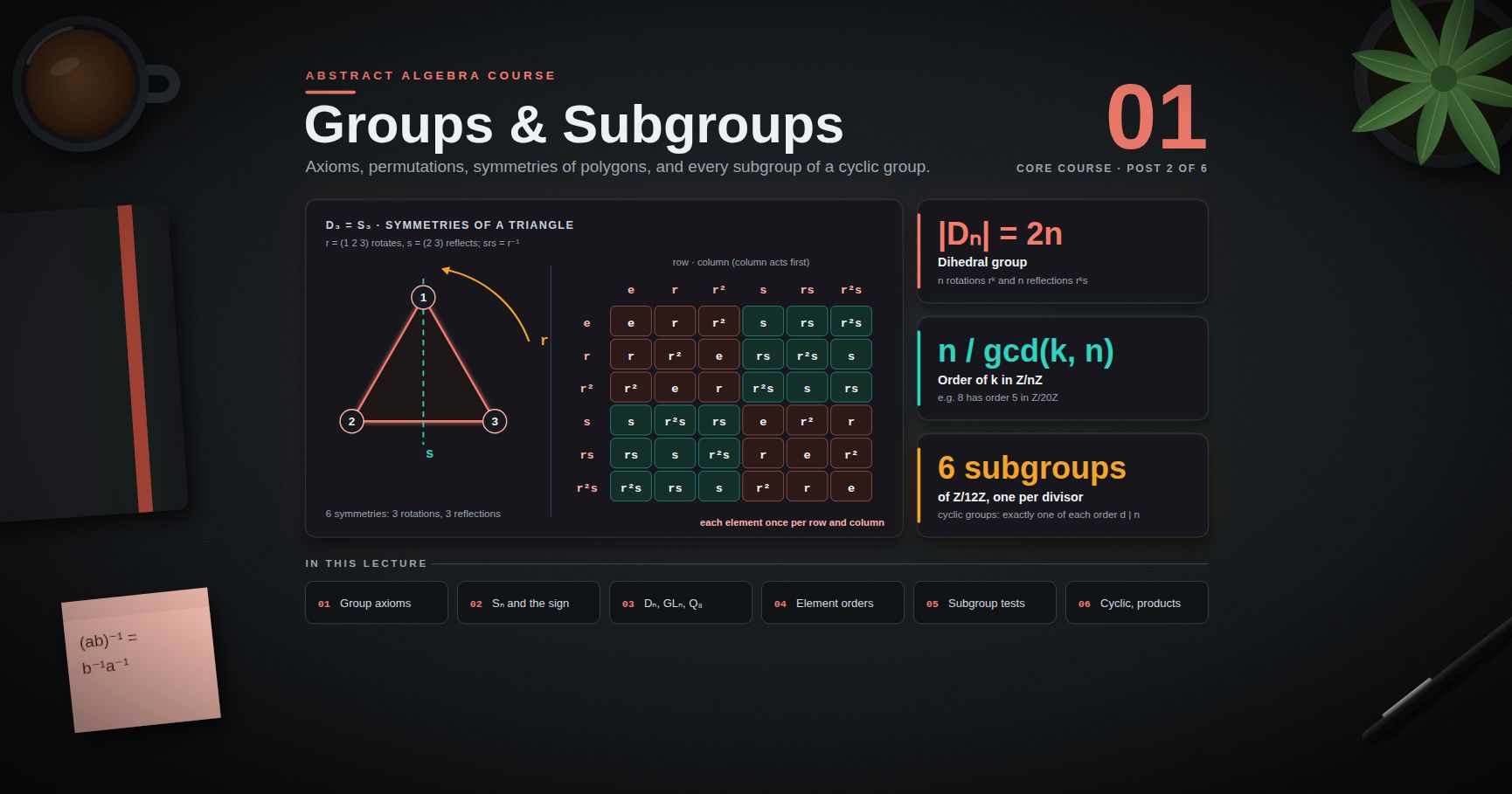
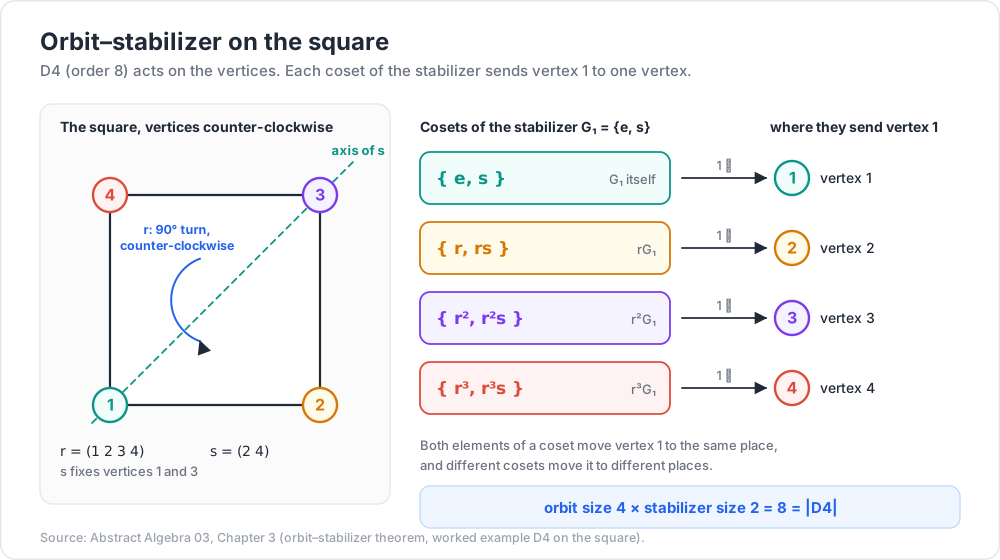
- (order 8, the symmetries of a square, notation from post 01) acts on the four vertices. Label them counter-clockwise; then and, taking to be the reflection in the diagonal through vertices 1 and 3, .
- The rotation group of a cube (24 elements) acts on the 6 faces, the 8 vertices and the 12 edges.
- Any group acts on itself by left multiplication, (this is Cayley's action), and on the left cosets by .
- Any group acts on itself by conjugation, . Orbits are conjugacy classes , and the stabilizer of is the centralizer .
The orbits of an action partition : the relation " for some " is an equivalence relation (reflexive via , symmetric via , transitive via products), and orbits are its classes (equivalence relations are from post 00).
The orbit–stabilizer theorem
Theorem (orbit–stabilizer). Let a finite group act on and let . Then
Proof. Define from the set of left cosets of to the orbit by .
- Well defined and injective. For : . Reading the chain left to right gives injectivity; right to left gives well-definedness.
- Surjective. Every orbit element is .
So the orbit is in bijection with the cosets of , and there are of them by Lagrange's theorem (post 02). ∎
Worked example: on the square. The orbit of vertex 1 is all four vertices (rotations reach each one). The stabilizer of vertex 1 is : the only non-identity symmetry fixing vertex 1 is the reflection in the diagonal through it. So . The proof's bijection is concrete here. The four cosets of are , , , , and both elements of send vertex 1 to vertex .
Worked example: the cube. The rotation group acts transitively on faces, vertices and edges. A face is fixed by the 4 rotations about the axis through its centre; a vertex by the 3 rotations about the long diagonal through it; an edge by the identity and the half-turn about the axis through its midpoint. All three counts agree:
This is also the standard way to find the order of a symmetry group: pick an object, count where it can go, and count what fixes it.
Trick: points in the same orbit have conjugate stabilizers: . So all stabilizers along one orbit have the same size, as the formula requires.
The class equation
Apply orbit–stabilizer to conjugation. The orbit of is and its stabilizer is , so , which divides . An element has a class of size 1 exactly when it commutes with everything, that is when . Splitting into classes and collecting the size-1 classes gives the class equation:
where are representatives of the classes with more than one element. Each term in the sum is a divisor of bigger than 1.
| Group | Order | Class sizes | Center |
|---|---|---|---|
| 6 | 1, 2, 3 | trivial | |
| 8 | 1, 1, 2, 2, 2 | ||
| 12 | 1, 3, 4, 4 | trivial | |
| 24 | 1, 3, 6, 6, 8 | trivial | |
| 60 | 1, 12, 12, 15, 20 | trivial |
For the classes are , , , , . In two permutations are conjugate exactly when they have the same cycle type; in the classes are the identity (1), double transpositions (3), transpositions (6), 4-cycles (6), 3-cycles (8).
p-groups have a nontrivial center
A -group is a group of order for a prime and some .
Theorem. If with , then .
Proof. In the class equation, each is a divisor of bigger than 1, so it is divisible by . The left side is divisible by . Hence is divisible by . Since , , so . ∎
Lemma. If is cyclic, then is abelian.
Proof. Let generate . Every element of has the form with . Two such elements commute: , since commute with everything. ∎
Corollary. Every group of order is abelian, hence isomorphic to or .
Proof. is or . If it were , then would have order , hence be cyclic, hence abelian by the lemma, so has order : a contradiction. So . The two possibilities come from Chapter 5. ∎
shows that the corollary stops at : it has order , is not abelian, and its center has order .
Burnside's lemma
Theorem (Burnside's lemma, also called the Cauchy–Frobenius lemma). If a finite group acts on a finite set , the number of orbits is
the average number of points fixed by an element.
Proof. Count the pairs with in two ways. By first: . By first: . Group the by orbits. An orbit contributes . So the total is times the number of orbits. ∎
The typical use is counting colourings "up to symmetry". If permutes the positions with cycles, a colouring with colours is fixed by exactly when it is constant on each cycle, so .
Worked example: necklaces. Colour 6 beads on a circle black or white; two necklaces are the same if one is a rotation of the other. The group is the cyclic group of rotations by steps. A rotation by steps has cycles on the beads: cycles for . So
If flips are also allowed (the dihedral group of order 12, so "bracelets"), the count drops to 13. With 3 colours and rotations only, the same formula gives .
Worked example: colouring a cube's faces. The 24 rotations of the cube, sorted by type, with the number of cycles each makes on the 6 faces:
| Rotation type | How many | Cycles on faces |
|---|---|---|
| identity | 1 | 6 |
| 90° or 270° about a face axis | 6 | 3 (two fixed faces, one 4-cycle) |
| 180° about a face axis | 3 | 4 (two fixed faces, two 2-cycles) |
| 120° or 240° about a vertex diagonal | 8 | 2 (two 3-cycles) |
| 180° about an edge axis | 6 | 3 (three 2-cycles) |
With 3 colours:
With 2 colours the same table gives .
Common pitfall: dividing the number of colourings by ( is not even an integer) is wrong because symmetric colourings have smaller orbits. Burnside's average of fixed points corrects for exactly this.
Chapter 4 — Cauchy and Sylow
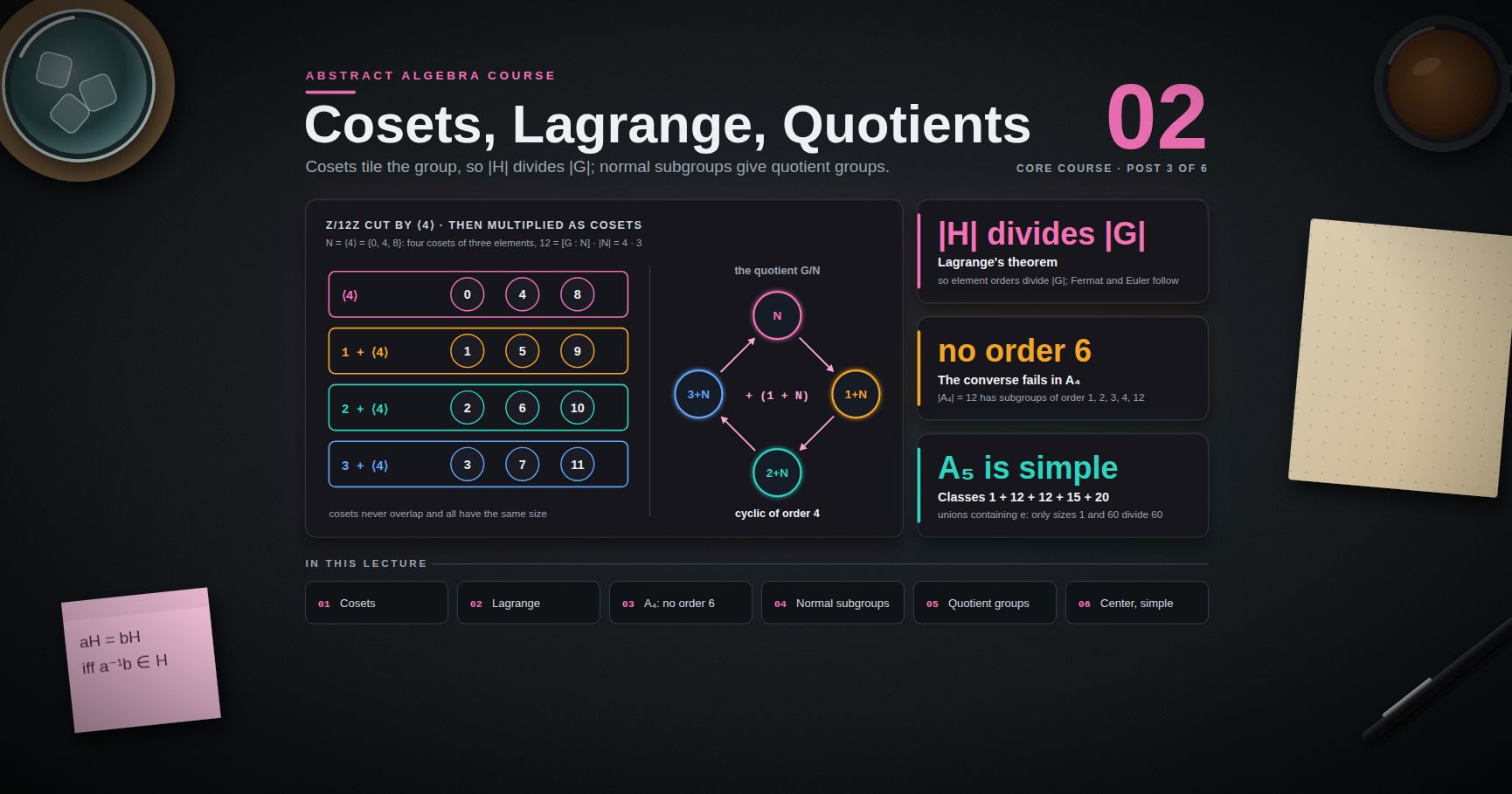
Lagrange's theorem says the order of a subgroup divides . The converse is false: has order 12 but no subgroup of order 6. The theorems in this chapter recover as much of the converse as is true, for prime powers.
Terminology
- Sylow -subgroup — if with prime and , a subgroup of order exactly (the largest power of allowed by Lagrange).
- — the number of Sylow -subgroups of .
- Normalizer — , the stabilizer of when acts on its subgroups by conjugation.
- Simple group — a nontrivial group whose only normal subgroups are and itself (post 02).
The theorems
Theorem (Cauchy). If a prime divides , then has an element of order .
(A short proof, due to McKay, lets rotate the -tuples with and counts fixed points modulo .)
Theorem (Sylow). Let with prime, and .
- Existence. has a subgroup of order . More generally, every -subgroup of is contained in some Sylow -subgroup.
- Conjugacy. Any two Sylow -subgroups are conjugate: if are Sylow, then for some .
- Counting. , and divides . Moreover for any Sylow -subgroup .
Two consequences are used constantly:
- if and only if the Sylow -subgroup is normal. (Conjugates of a Sylow subgroup are Sylow, and by part 2 all Sylow subgroups are conjugates of one of them.)
- When divides only once, the Sylow -subgroups have prime order . Two distinct subgroups of prime order meet only in , so the of them contain elements of order .
Sylow counts in familiar groups (checked by listing subgroups):
| Group | Order | |||
|---|---|---|---|---|
| 3 | 1 | — | ||
| 1 | 4 | — | ||
| 3 | 4 | — | ||
| 5 | 10 | 6 |
Every entry obeys part 3: for , and ; and .
Application 1 — every group of order 15 is cyclic
Let .
- divides 5 and . The divisors of 5 are 1 and 5, and . So .
- divides 3 and . The divisors of 3 are 1 and 3, and . So .
So has a normal subgroup of order 3 and a normal subgroup of order 5. Their intersection is a subgroup of both, so its order divides : . For , , the commutator lies in (as ) and in (as ), so it is and . Then has order , and .
The same argument proves: if are primes and , every group of order is cyclic. (For , it fails, correctly: has order 6 and .)
Application 2 — no group of order 12 is simple
Let . Then with , so ; and with odd, so .
- If , the Sylow 3-subgroup is normal and is not simple.
- If , the four subgroups of order 3 contain elements of order 3. That leaves elements. A Sylow 2-subgroup has 4 elements, none of order 3, so it must be exactly these 4 elements. There is room for only one, so and it is normal.
Either way has a proper nontrivial normal subgroup. is the second case: and , the normal subgroup being .
Application 3 — order 20
If , then and force . So every group of order 20 has a normal subgroup of order 5 and is not simple.
Trick: the recipe for "no simple group of order " is: list the allowed for each prime; if some prime forces , you are done; if not, count elements of prime order and look for a contradiction, as for order 12.
Watch out: Sylow part 3 gives only candidates. for order 12 does not mean both values occur in every group; has , while the dihedral group of order 12 has .
Chapter 5 — Finite abelian groups
For abelian groups the story is complete: they are classified by lists of numbers.
Theorem (fundamental theorem of finite abelian groups). Every finite abelian group is isomorphic to a direct product of cyclic groups of prime-power order,
and the list of prime powers (the elementary divisors) is unique up to order. Equivalently, with and , and the invariant factors are unique.
To go from elementary divisors to invariant factors, write the prime powers of each prime in decreasing order, then multiply across: the largest power of every prime gives , the next largest gives , and so on. This uses for coprime (Chapter 1).
Counting. The number of abelian groups of order is the product of the partition numbers , since each prime's part is chosen independently as a partition of its exponent.
Worked example: order 72. . The exponent 3 has three partitions (, , ) and the exponent 2 has two (, ), so there are abelian groups of order 72:
| Elementary divisors | Invariant factors |
|---|---|
(Here abbreviates .) Check one row: for the powers of 2 in decreasing order are and of 3 are ; multiplying across gives and , so , and indeed .
Common pitfall: and are the same group (both have elementary divisors ). Always reduce to one normal form before comparing.
The same theorem, stated for finitely generated modules over a principal ideal domain, is the structure theory behind the Jordan normal form; it is planned as a later post.
Practice Exercises
1. How many homomorphisms are there from to ? List the possible images of .
Solution
A homomorphism is fixed by , subject to , i.e. , i.e. even. So : four homomorphisms, which is .
2. Show that , and are pairwise non-isomorphic.
Solution
Compare the largest element order. has an element of order 8. In the order of is of the orders, at most , and has order 4. In every non-identity element has order 2. The maximal orders 8, 4, 2 differ, so no two are isomorphic. (These are the three abelian groups of order 8, from the partitions , , .)
3. acts on the set of its three "pairings" , , . Use orbit–stabilizer to find the order of the stabilizer of one pairing, and find the kernel of the action.
Solution
The action is transitive (for instance swaps the first two pairings, swaps the first and third), so the orbit has size 3 and the stabilizer has order . It is a Sylow 2-subgroup (a copy of ). The kernel is the set of permutations fixing all three pairings: . By the First Isomorphism Theorem, is isomorphic to the image in , which has order , so .
4. How many ways are there to colour the 4 vertices of a square with 3 colours, up to rotation? Up to all 8 symmetries of ?
Solution
Rotations by have cycles on the vertices: .
For add the reflections. The two diagonal reflections fix 2 vertices and swap 2: 3 cycles each. The two reflections through edge midpoints swap two pairs: 2 cycles each. Total .
5. Prove that no group of order 35 is simple, and in fact that every group of order 35 is cyclic.
Solution
. and : the divisors are 1, 7 and , so . and : the divisors are 1, 5 and , so . Both Sylow subgroups are normal, meet trivially, and commute elementwise, exactly as for order 15, so . (This is the "" criterion with .)
6. List the abelian groups of order 36 in both normal forms.
Solution
, and groups:
- →
- →
- →
- →
7. Let be a finite group and a subgroup of index . Using the action of on the cosets , show that has a normal subgroup with dividing . Deduce that a simple group of order 60 has no subgroup of index 2, 3 or 4.
Solution
The action gives a homomorphism . Its kernel is normal; anything in fixes the coset , so . By the First Isomorphism Theorem embeds in , so divides by Lagrange.
If is simple of order 60 and , then is or . is impossible since . So and divides , a contradiction.
Cheat-sheet
| Idea | Statement |
|---|---|
| Homomorphism | ; then , |
| Kernel | always a normal subgroup; trivial exactly when is injective |
| Maps between cyclic groups | homomorphisms , fixed by the image of 1 |
| Automorphisms | , order ; |
| First Isomorphism Theorem | |
| Second | when is normal |
| Third | |
| Cayley | embeds in ; order embeds in |
| Orbit–stabilizer | orbit size times stabilizer size |
| Class equation | |
| -groups | nontrivial center; order implies abelian |
| Burnside | orbits = average number of fixed points; colourings fixed by : |
| Cauchy | prime divides the order, so an element of order exists |
| Sylow | exist; all conjugate; and |
| Normal Sylow | exactly when the Sylow -subgroup is normal |
| Order , | cyclic if |
| Finite abelian groups | product of cyclic prime-power groups; count = product of partition numbers |
What's next
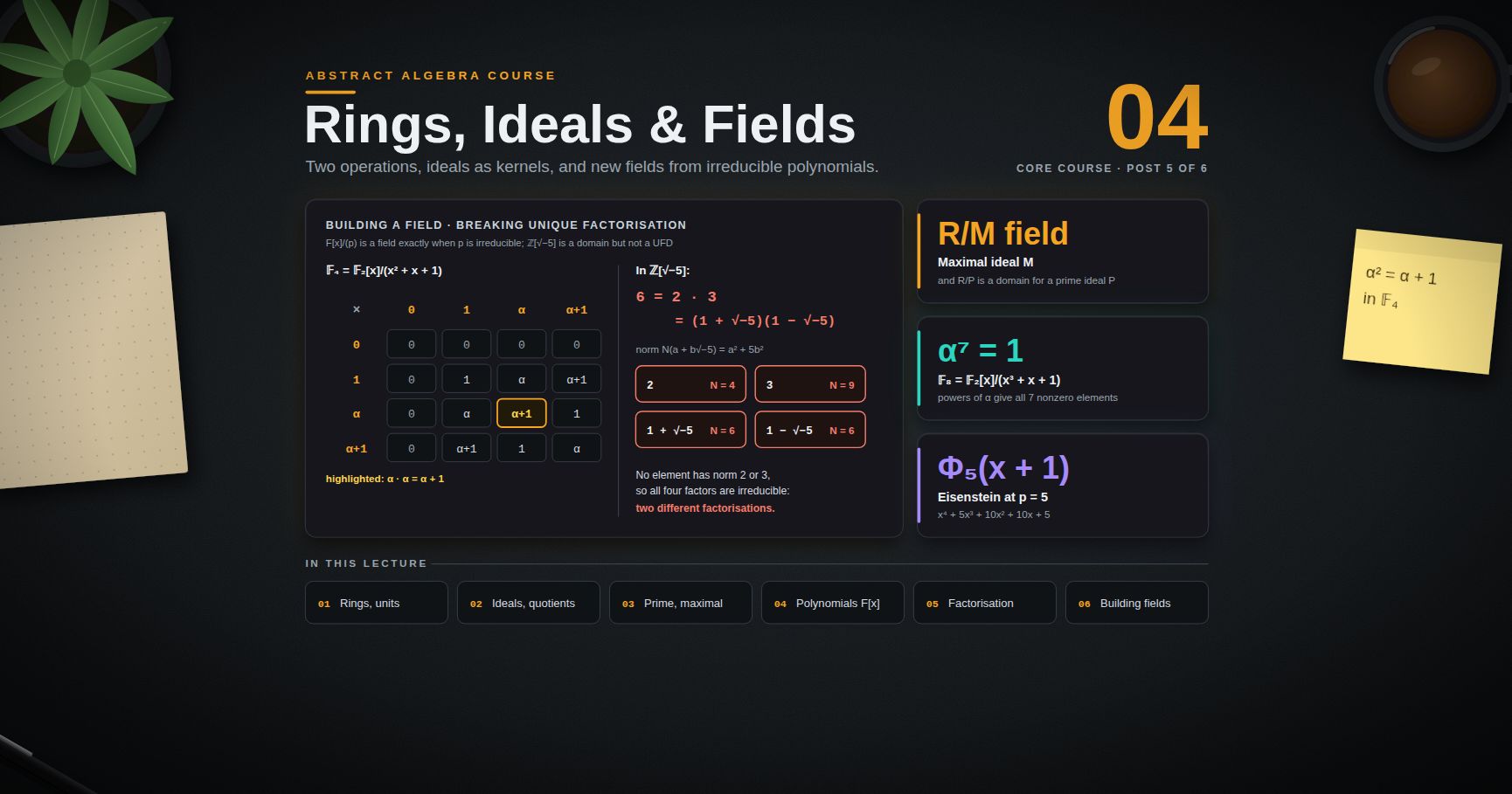
Post 04 moves from one operation to two. A ring has addition and multiplication tied by the distributive law; the integers, the integers modulo , polynomials and matrices are the models. Every idea of this post has a ring version: ring homomorphisms and their kernels (now called ideals), quotient rings, and a First Isomorphism Theorem with the same proof. Prime and maximal ideals then explain why is a field, and the same construction applied to polynomials builds and the finite fields that post 05 needs.
References
- D. S. Dummit and R. M. Foote, Abstract Algebra, 3rd edition, Wiley, 2004 — Chapters 3.3 (isomorphism theorems), 4 (group actions, class equation, Sylow) and 5.2 (finite abelian groups).
- M. Artin, Algebra, 2nd edition, Pearson, 2011 — Chapters 6 (symmetry, group actions, counting) and 7 (class equation, Sylow theorems).
- J. A. Gallian, Contemporary Abstract Algebra, 10th edition, CRC Press, 2021 — homomorphisms, Burnside's lemma worked examples, Sylow theorems.
- J. J. Rotman, An Introduction to the Theory of Groups, 4th edition, Springer GTM 148, 1995 — full proofs of Sylow and the basis theorem.
- MIT OpenCourseWare, 18.701 Algebra I (Fall 2010) and 18.702 Algebra II (Spring 2011) — lecture notes and problem sets.
- K. Conrad, Expository papers ("blurbs") — short notes on group actions, Sylow theorems and finite abelian groups.
- J. H. McKay, "Another proof of Cauchy's group theorem", American Mathematical Monthly 66 (1959), p. 119.
Note: this post is in progress. Planned additions: full proofs of the three Sylow theorems (via the action on subsets of size and on Sylow subgroups by conjugation), semidirect products and the classification of groups of order 12 and of order , and the Pólya enumeration theorem as a refinement of Burnside's lemma.