Abstract Algebra — 05 · Field Extensions and Galois Theory
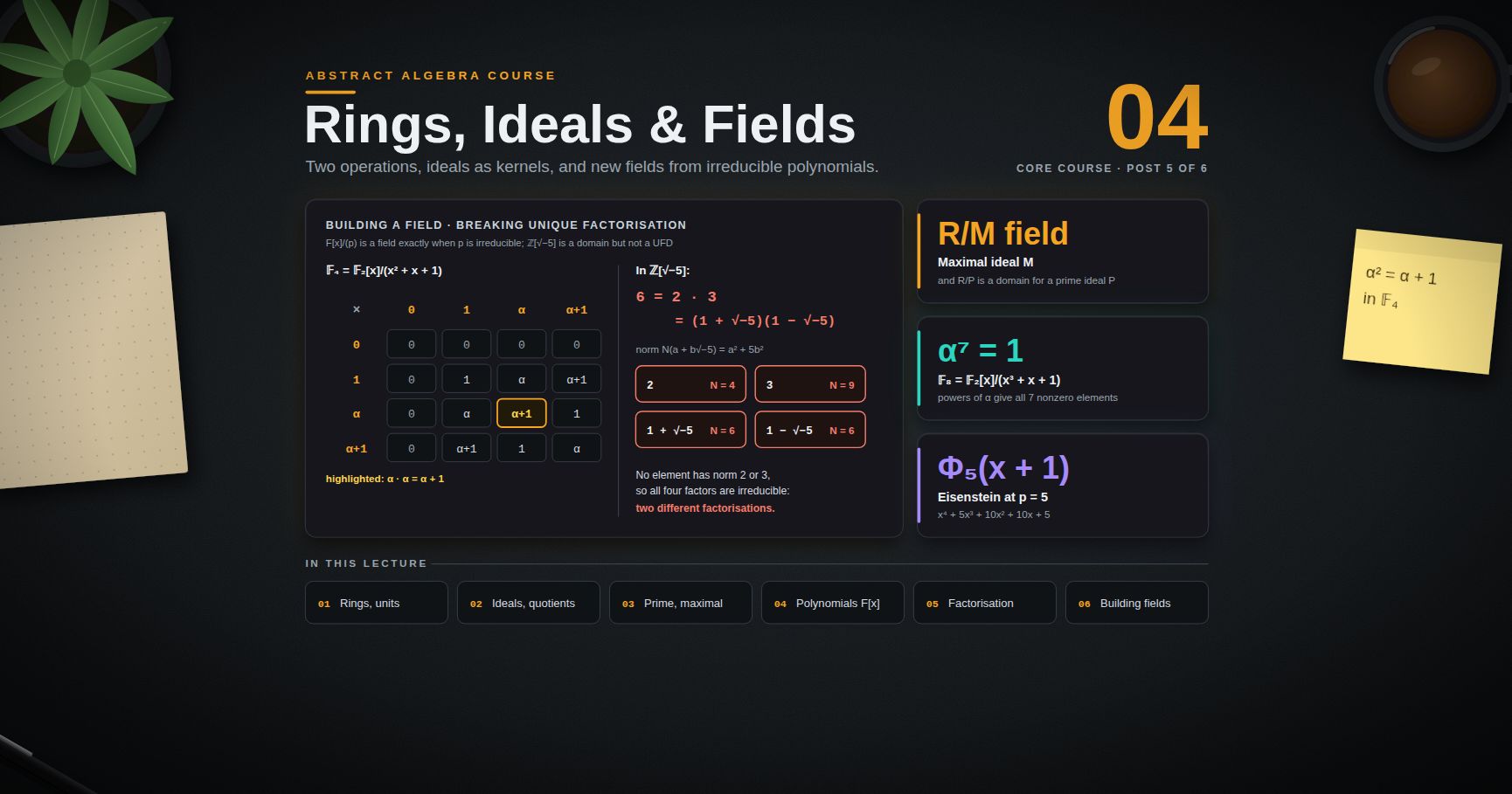
Post 04 ended by building new fields: and . This post studies such constructions systematically. A bigger field containing is a vector space over , and its dimension, the degree, turns out to be a very strong invariant: a single divisibility argument proves that no ruler-and-compass construction doubles a cube or trisects a 60° angle. Galois theory then attaches to a polynomial a finite group, the permutations of its roots that respect all algebraic relations, and the Fundamental Theorem matches the subfields of the splitting field with the subgroups of that group. Everything from posts 01–04 comes together here: groups, normal subgroups and quotients, group actions, Sylow-type counting, irreducible polynomials and quotient rings. The chapter ends with the reason there is no quintic formula.
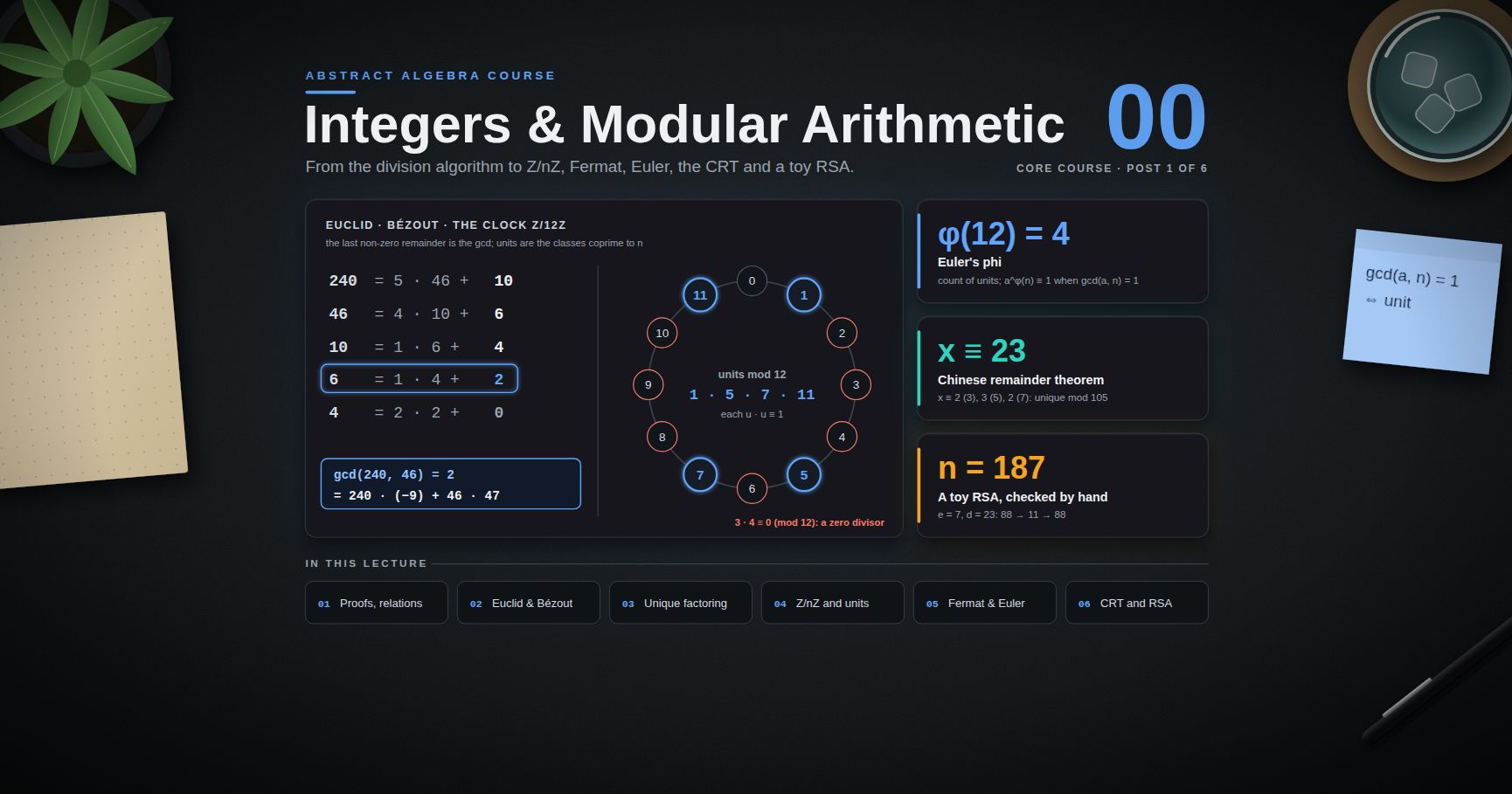
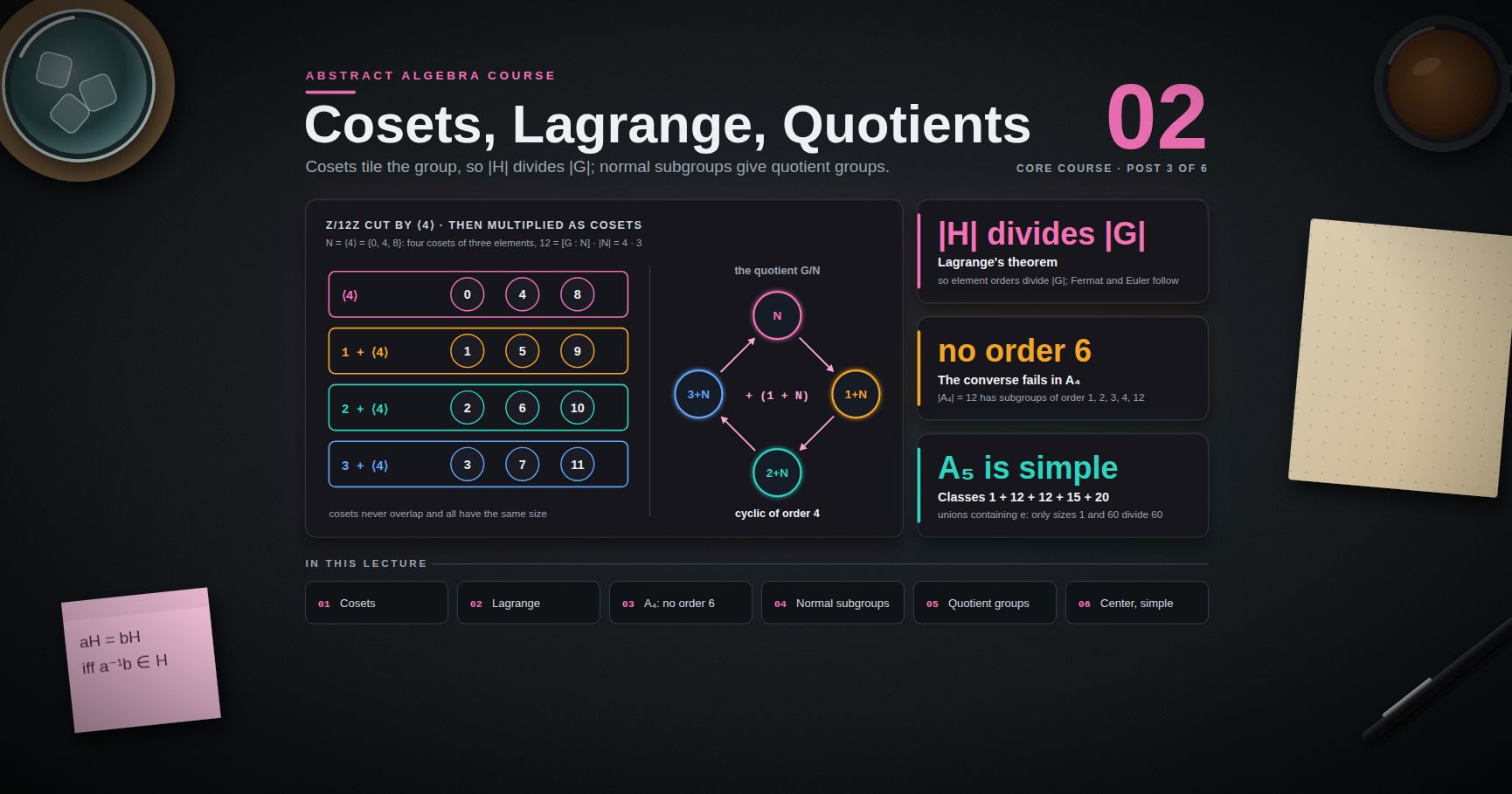
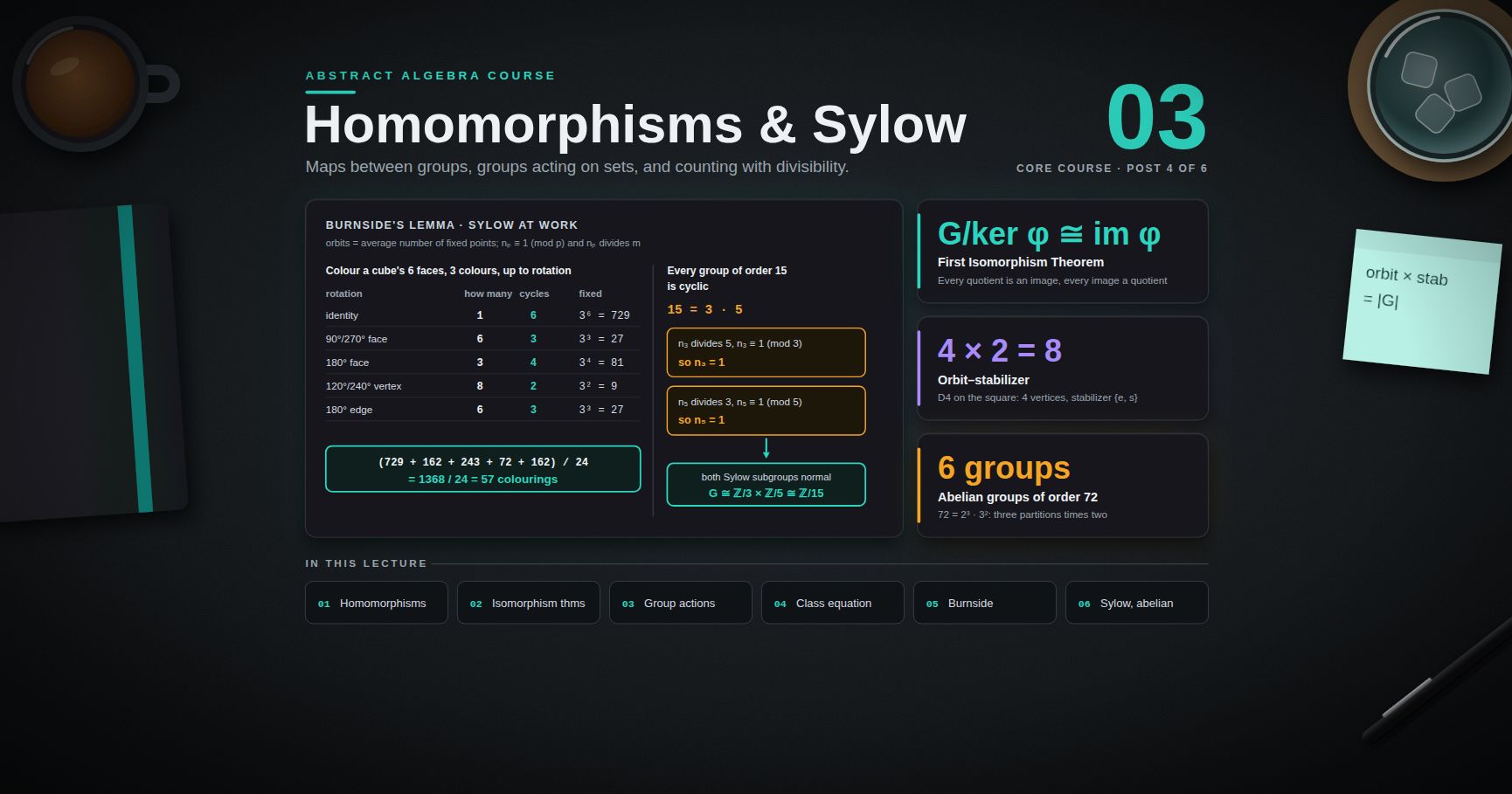
Series map: 00 Integers, Relations & Modular Arithmetic → 01 Groups & Subgroups → 02 Cosets, Lagrange & Quotient Groups → 03 Homomorphisms, Group Actions & Sylow → 04 Rings, Ideals & Fields → 05 Field Extensions & Galois Theory (this post).
Learning Outcome
- Compute the degree of a field extension, and prove and use the tower law.
- Find minimal polynomials, and prove that with degree .
- Show that has degree 4 and is generated by .
- Prove that doubling the cube and trisecting a 60° angle are impossible with ruler and compass.
- Build splitting fields, and prove that there is one finite field of each prime-power order, up to isomorphism.
- Define separable, normal and Galois extensions and the Galois group.
- State the Fundamental Theorem of Galois Theory and draw the subfield/subgroup lattices for and for the splitting field of .
- Define solvable groups and outline why the roots of cannot be written with radicals.
Chapter 1 — Field extensions and degree
Terminology
- Extension — a pair of fields , written (" over "). is the base field.
- Degree — , the dimension of as a vector space over . The extension is finite if the degree is finite.
- Generated extension — for , is the smallest subfield of containing and . Likewise . An extension is simple and is a primitive element.
- Intermediate field — a field with .
Examples: with basis . with basis , since and . is infinite (a countable field cannot span the uncountable with finitely many vectors). A field with elements that contains has where , because an -dimensional vector space over has elements.
The tower law
Theorem (tower law). If are fields, then
in the sense that the left side is finite exactly when both factors are, and then equality holds.
Proof (finite case). Let be a basis of over and a basis of over . The claim is that the products form a basis of over .
- Spanning. Any is with , and each with . So .
- Independence. If , regroup as . The inner sums are in and the are independent over , so each inner sum is . The are independent over , so every . ∎
Corollaries. (1) If is intermediate in a finite extension , then divides . (2) If is prime, there is no intermediate field other than and . (3) If , then divides .
Trick: most degree computations are "bound above by a tower, bound below by divisibility". If and are both inside , then .
Chapter 2 — Algebraic elements and minimal polynomials
Terminology
- Algebraic — is algebraic over if for some nonzero . Otherwise is transcendental over .
- Algebraic extension — every element of is algebraic over .
- Minimal polynomial — the monic polynomial of least degree with .
, , and are algebraic over . Hermite proved in 1873 that is transcendental and Lindemann in 1882 that is transcendental; both proofs are analytic and are not needed below.
The minimal polynomial
Theorem. Let be algebraic over . Then:
- exists, is unique, and is irreducible over ;
- for : if and only if ;
- , so , with basis where .
Proof. Evaluation , , is a ring homomorphism. Its kernel is nonzero because is algebraic, and is a PID (post 04), so for a unique monic ; this has least degree among nonzero elements of , so , and statement 2 is "". The image of is a subring of the field , hence a domain, so by the First Isomorphism Theorem is a domain: is prime, so is irreducible. Then is maximal (post 04, Chapter 6), so the image is a field containing and ; it is therefore . The basis claim is the division algorithm: every class has a unique representative of degree . ∎
So to find : find a polynomial with root and prove it irreducible with the tests of post 04.
Common pitfall: the minimal polynomial depends on the base field. over is ; over it is .
Arithmetic in . Let , with (Eisenstein at 2), so with basis . To invert , use :
Finite implies algebraic. If and , the elements are linearly dependent over , and a dependence relation is a nonzero polynomial with root . Consequently, if and are algebraic then is finite (tower law), so , and are algebraic too: the algebraic numbers form a field.
Worked example: Q(√2, √3)
Degree. . Next, : if with , then and . gives and gives , neither possible in . So stays irreducible over , and by the tower law
with basis (products of the two bases, as in the proof of the tower law).
A primitive element. Let . Then , so , that is
Also , which gives and . So contains and , hence has degree 4. A degree-4 monic polynomial with root must then be the minimal polynomial: , irreducible over (its four roots are ).
This is an instance of the primitive element theorem: every finite separable extension (Chapter 5; in particular every finite extension of ) is simple.
Chapter 3 — Ruler and compass
Start with the points and in the plane . A ruler draws the line through two constructed points; a compass draws a circle with a constructed centre through a constructed point. New points are intersections of lines and circles. A real number is constructible if it is a coordinate of a constructible point.
Key observation. If all points so far have coordinates in a field , then:
- the intersection of two lines solves a linear system, so it has coordinates in ;
- an intersection involving a circle solves a quadratic equation over , so it has coordinates in or in some with , an extension of degree 2.
Theorem. If is constructible, then is a power of 2.
Proof. By the observation, lies in the top field of a tower with each . By the tower law , and divides it. ∎
Doubling the cube. A cube of volume 2 needs side , whose minimal polynomial has degree 3. Not a power of 2, so impossible.
Trisecting 60°. A 60° angle is constructible (equilateral triangle). Trisecting it means constructing . From with and :
By the rational root test, a rational root would be one of ; substituting gives , never . A cubic without rational roots is irreducible, so and the trisection is impossible. (Some angles, such as 90°, can be trisected; the theorem is that no method works for every angle.)
Squaring the circle. A square of area needs side . If were constructible it would be algebraic, so would be algebraic, contradicting Lindemann.
Watch out: "degree a power of 2" is necessary, not sufficient. The exact criterion is that the splitting field of the minimal polynomial has degree a power of 2. The Gauss–Wantzel theorem answers the polygon question: a regular -gon is constructible if and only if is a power of 2 times a product of distinct Fermat primes .
Chapter 4 — Splitting fields and finite fields
Splitting fields
A splitting field of a nonconstant is an extension in which factors into linear factors, , and which is generated by the roots: .
Theorem. Every nonconstant has a splitting field , with where . Any two splitting fields of over are isomorphic by an isomorphism that fixes .
(Existence: take an irreducible factor of ; in it has a root (post 04), so gains a linear factor over an extension of degree ; repeat on the quotient, whose degree is . Uniqueness is proved by the same induction, extending an isomorphism one root at a time.)
Examples:
- over : splitting field , degree 2.
- : roots , splitting field , degree 4.
- : roots , , with and , a root of . The splitting field is (it contains ). , and , so . Hence , the maximum.
Finite fields
Let be a finite field. Its characteristic is a prime (post 04), so it contains and has elements, .
Lemma (freshman's dream). In a commutative ring of characteristic , .
Proof. Expand with the binomial theorem. For , is divisible by : divides the numerator but not the denominator. So all middle terms vanish. ∎
Hence the Frobenius map is a ring homomorphism. On a field it is injective (post 04: homomorphisms out of fields are injective), so on a finite field it is an automorphism, and it fixes exactly the elements of (the roots of ; there are at most of them, and all of qualifies by Fermat's little theorem from post 00).
Theorem (existence and uniqueness of finite fields). For every prime and there is a field with elements, and any two such fields are isomorphic. It is written .
Proof. Existence. Let be a splitting field of over , and the set of roots of in . The derivative has no common root with , so the roots are distinct and . is a subfield: if and , then (apply the lemma times), , and . A subfield containing all roots is the whole splitting field, so has elements.
Uniqueness. In any field with elements, the multiplicative group has order , so for by Lagrange, and for all . So consists of the roots of , and is a splitting field of over . Splitting fields are unique up to isomorphism. ∎
Two further facts, stated without proof: the multiplicative group is cyclic (post 04's table showed a generator), and sits inside exactly when .
Worked example. Over :
The first line lists the minimal polynomials of the 4 elements of ; the second those of the 8 elements of . The two cubics are the two irreducible cubics over , each with three roots in . No quadratic appears in the second line, matching : .
Chapter 5 — Galois extensions and the Galois group
Terminology
- -automorphism of — a field automorphism with for every . They form a group .
- Fixed field — for a subgroup , .
- Separable polynomial — one with no repeated root in its splitting field. An algebraic extension is separable if every minimal polynomial is separable.
- Normal extension — an algebraic such that every irreducible polynomial in with one root in splits completely in .
- Galois extension — a finite extension that is normal and separable. Its Galois group is .
- Galois group of a polynomial — for a splitting field of the (separable) polynomial.
Separability is automatic in the cases you meet most. Over a field of characteristic 0, and over any finite field, every irreducible polynomial is separable. (An irreducible has a repeated root only if , which forces ; in characteristic 0 that is impossible for nonconstant .) The standard inseparable example is over the field of rational functions: it is irreducible (Eisenstein at the prime ), but over its splitting field it equals .
Automorphisms permute roots
Lemma. If , is a root of , and , then is a root of .
Proof. If with , then , since fixes each . ∎
So if is a splitting field of , an -automorphism is determined by how it permutes , and is (isomorphic to) a subgroup of , an action on the roots in the sense of post 03.
Theorem (characterisations of Galois extensions). For a finite extension the following are equivalent:
- is Galois (normal and separable);
- is the splitting field over of a separable polynomial;
- ;
- the fixed field of is exactly .
In general and equality is what "Galois" means in practice.
Examples.
- .
- is not Galois. An automorphism must send to a root of inside , and the only real root is itself. So is trivial, of order . It fails normality: has one root in the field but does not split there.
- is cyclic of order , generated by Frobenius. ( fixes exactly the roots of , so has order exactly ; and the group has order because is the splitting field of the separable .)
Chapter 6 — The Fundamental Theorem of Galois Theory
Theorem (Fundamental Theorem of Galois Theory). Let be a finite Galois extension with group . Then the maps
are mutually inverse bijections between subgroups and intermediate fields , and:
- they reverse inclusion: if and only if ;
- degrees match indices: and ;
- is Galois if and only if is a normal subgroup of , and then .
So the lattice of intermediate fields is the lattice of subgroups turned upside down: the big field matches the trivial group, the base matches all of . Part 3 is where normal subgroups and quotient groups (post 02) acquire their original meaning.
Worked example 1: Q(√2, √3)
is the splitting field of the separable , so it is Galois of degree 4 and has 4 elements. Each automorphism sends and , and all four sign choices occur. Let
Each has order 2 and they commute, so . The subgroups and their fixed fields:
| Subgroup | Order | Fixed field | Degree over |
|---|---|---|---|
| 1 | 4 | ||
| 2 | 2 | ||
| 2 | 2 | ||
| 2 | 2 | ||
| 4 | 1 |
(.) By the theorem these are all the intermediate fields: exactly three quadratic subfields, which is not obvious without Galois theory. is abelian, so every subgroup is normal and every intermediate field is Galois over .
Worked example 2: the splitting field of x³ − 2
with , of degree 6 (Chapter 4). It is Galois, so , and acts on the three roots , so is a subgroup of of order 6: . Concretely an automorphism is fixed by () and or . Let
Composing right to left (apply first in ): sends and , so . Similarly fixes . The six subgroups of and their fixed fields:
| Subgroup | Order | Normal? | Fixed field | Degree over |
|---|---|---|---|---|
| 1 | yes | 6 | ||
| 2 | no | 3 | ||
| 2 | no | 3 | ||
| 2 | no | 3 | ||
| 3 | yes | 2 | ||
| 6 | yes | 1 |
Each order-2 subgroup fixes one real or complex cube root, so its fixed field contains that root; the degree count makes it equal to . fixes , and .
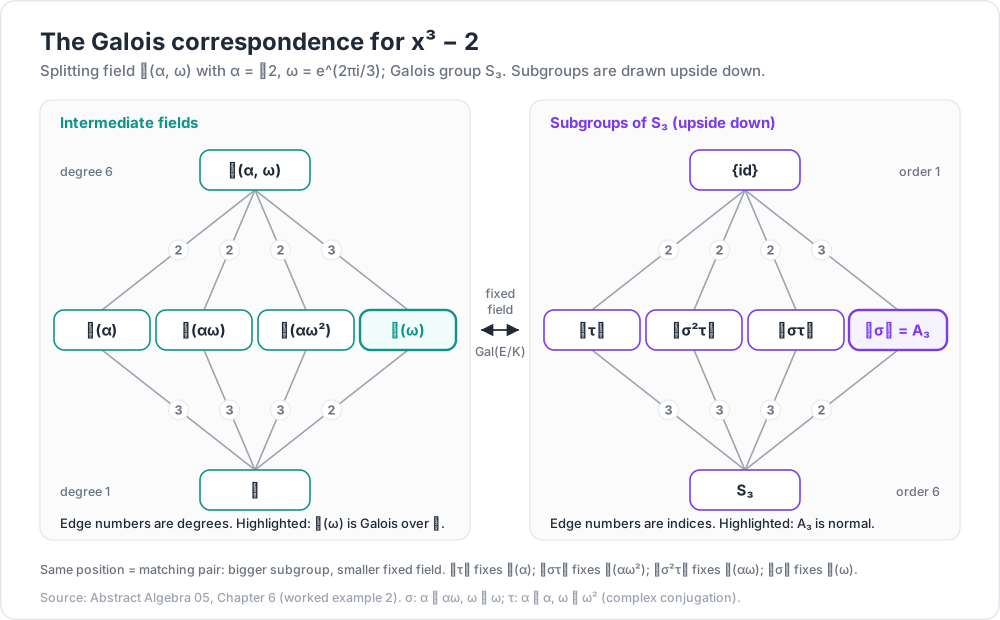
Part 3 of the theorem, checked on this example: is normal, and is Galois over (it is the splitting field of ), with . The three subgroups of order 2 are not normal (they are conjugate, like the three Sylow 2-subgroups of in post 03), and correspondingly and its two conjugate fields are not Galois over .
Common pitfall: the correspondence reverses order. A bigger subgroup fixes more conditions and so has a smaller fixed field. Draw the two lattices with at the top and at the top.
Chapter 7 — Solvable groups and the quintic
Solvable groups
A group is solvable if there is a chain of subgroups
with each normal in and each quotient abelian.
- Abelian groups are solvable ().
- : with quotients and .
- : with quotients , , . So every subgroup of is solvable too (subgroups and quotients of solvable groups are solvable).
- is not solvable. Its only normal subgroups are , , , and is simple and non-abelian (post 02). A chain would have to pass through , and the step below would need a normal subgroup of with abelian quotient; the only candidates are itself (quotient trivial, no progress) and (quotient , not abelian). Equivalently, the commutator subgroup of is , so the derived series never reaches .
Radicals
A polynomial is solvable by radicals if its roots can be written starting from rational numbers using and -th roots. The quadratic formula shows this for degree 2; Cardano's and Ferrari's formulas do it for degrees 3 and 4.
Theorem (Galois, characteristic 0). is solvable by radicals if and only if its Galois group is solvable.
(Idea of "only if": adjoining a -th root to a field that already contains the -th roots of unity gives a Galois extension with cyclic group; adjoining roots of unity gives an abelian group. A tower of such steps gives, through part 3 of the Fundamental Theorem, a chain of normal subgroups with abelian quotients.)
Since is solvable and the Galois group of a degree- polynomial embeds in , every polynomial of degree is solvable by radicals. The Abel–Ruffini theorem says the general quintic is not: the generic polynomial with independent indeterminate coefficients has Galois group over , which is not solvable, so there is no formula in radicals valid for all quintics. Galois theory gives more: specific quintics with rational coefficients have unsolvable roots.
A concrete unsolvable quintic
Lemma. Let be prime and irreducible of degree with exactly two non-real roots. Then .
Proof. View as a subgroup of acting on the roots. For a root , divides , so by Cauchy's theorem (post 03) has an element of order ; in the elements of order are the -cycles. Complex conjugation restricts to an element of that swaps the two non-real roots and fixes the real ones: a transposition. For prime , a -cycle and a transposition generate all of . ∎
Theorem. is not solvable by radicals over .
Proof. Irreducible: Eisenstein at (, , , leading coefficient 1).
Exactly three real roots: vanishes only at with . So increases, then decreases on , then increases. The local maximum and the local minimum , while as and as . So crosses zero once on each of the three monotone pieces: three real roots, approximately , and , and the other two roots are a complex-conjugate pair.
By the lemma with , , which is not solvable. By Galois's theorem, is not solvable by radicals. ∎
Watch out: "not solvable by radicals" does not mean the roots are hard to compute. Numerically they are easy (the values above). It means there is no finite expression in for them.
Practice Exercises
1. Find .
Solution
has degree 2 and has degree 3, both intermediate, so 2 and 3 divide the degree, and so does 6. On the other hand (root of ), so the degree is at most . Hence it is exactly 6.
2. Find the minimal polynomial of over .
Solution
Let . Then , so , giving . As in the example, , which has degree 4 (). So .
3. Show that the regular 7-gon is not constructible, using that is a root of .
Solution
Rational roots could only be , which give and , so the cubic has no rational root and is irreducible. Then , not a power of 2, so is not constructible, and neither is the 7-gon. (Consistent with Gauss–Wantzel: 7 is prime but not a Fermat prime.)
4. List all subfields of and draw their inclusions. What is ?
Solution
and the divisors of 6 are 1, 2, 3, 6, so the subfields are . Inclusions: and , while . The Galois group is cyclic of order 6, generated by Frobenius; its subgroups (orders 1, 2, 3, 6) match the subfields in that order.
5. In , which automorphism fixes , and what is the fixed field of ? Why does the Fundamental Theorem guarantee that is the whole field without computing ?
Solution
fixes (both signs flip). fixes , so , and both have degree 2, so they are equal. For : the non-identity automorphisms send to , , , all different from . So only the trivial subgroup fixes , and corresponds to , i.e. it is all of .
6. Explain why every polynomial of degree at most 4 over is solvable by radicals, but this argument says nothing about degree 5.
Solution
The Galois group of a degree- polynomial is a subgroup of . For , is solvable (chains above), and subgroups of solvable groups are solvable, so Galois's theorem applies. For the group may be a solvable subgroup of (for example is solvable by radicals, since is already a radical), or all of , as for . The degree alone does not decide.
Cheat-sheet
| Concept | Key fact |
|---|---|
| Degree | |
| Tower law | |
| Minimal polynomial | monic, irreducible, divides every with |
| Simple extension | , degree |
| degree 4, primitive element , min poly | |
| Constructible | degree over is a power of 2 (necessary) |
| Impossible constructions | (degree 3), (root of ), |
| Splitting field | exists, unique up to isomorphism, degree at most |
| Finite fields | one field of each order : the roots of |
| Frobenius | ; generates |
| Galois extension | normal and separable; |
| Fundamental Theorem | subgroups ↔ intermediate fields, order-reversing; normal ↔ Galois |
| splitting field degree 6, group , subfield ↔ | |
| Solvable group | chain of normal steps with abelian quotients; yes, no |
| Galois's criterion | solvable by radicals ⇔ solvable Galois group (char 0) |
| Unsolvable quintic | : Eisenstein at 2, three real roots, group |
What's next
This post completes the core course: from the integers and modular arithmetic (post 00), through groups, actions and Sylow theory (posts 01–03), rings and fields (post 04), to Galois theory. The table below lists the planned extensions. Each builds directly on the material here, so the series can grow without renumbering the existing posts.
Planned future extensions
| Post | Topic | What it covers |
|---|---|---|
| 06 | Modules and linear algebra over rings | Modules, free modules, the structure theorem for finitely generated modules over a PID; the finite abelian groups of post 03 and the rational and Jordan canonical forms as two special cases |
| 07 | Representation theory of finite groups | Group representations, Maschke's theorem, Schur's lemma, characters and orthogonality, character tables of , and |
| 08 | Algebraic number theory | Rings of integers, Dedekind domains, how unique factorisation of ideals repairs , the class group, cyclotomic fields |
| 09 | Commutative algebra and a first look at algebraic geometry | Noetherian rings, the Hilbert basis theorem, localisation, the Nullstellensatz, varieties and their coordinate rings |
| 10 | Algebra in cryptography | Finite-field arithmetic in practice (AES uses ), Diffie–Hellman and discrete logarithms, elliptic-curve groups, lattices and lattice-based cryptography |
References
- D. S. Dummit and R. M. Foote, Abstract Algebra, 3rd edition, Wiley, 2004 — Chapters 13 (field extensions, constructions, splitting fields, finite fields) and 14 (Galois theory, finite fields, Galois groups of polynomials, solvability by radicals).
- M. Artin, Algebra, 2nd edition, Pearson, 2011 — Chapters 15 (fields, ruler and compass) and 16 (Galois theory, quintic equations).
- I. Stewart, Galois Theory, 4th edition, CRC Press, 2015 — a readable, historically informed development, including Abel–Ruffini.
- J. S. Milne, Fields and Galois Theory, course notes (free).
- E. Artin, Galois Theory, Notre Dame Mathematical Lectures 2, 1942 (Dover reprint) — the classic linear-algebra approach to the Fundamental Theorem.
- MIT OpenCourseWare, 18.702 Algebra II (Spring 2011) — lecture notes on fields and Galois theory.
- K. Conrad, Expository papers ("blurbs") — short notes on Galois theory, including Galois groups of cubics and quartics.
Note: this post is in progress. Planned additions: a full proof of the Fundamental Theorem (Artin's lemma on fixed fields), cyclotomic extensions and the constructible 17-gon, the discriminant as a test for , and a worked Cardano solution of a cubic read through its Galois group.