Abstract Algebra — 04 · Rings, Ideals, Integral Domains and Fields
Groups have one operation. Most of the algebra you already use has two: integers, polynomials and matrices can be added and multiplied, and the distributive law ties the two together. A structure with both is a ring. This post builds ring theory the same way posts 01–03 built group theory: definitions and examples, then substructures (ideals play the role of normal subgroups), quotients and a First Isomorphism Theorem. Two questions then drive the rest. Which rings behave like , with unique factorisation? And how do you manufacture new fields, such as or a field with 4 elements? The answer to the second, "take polynomials modulo an irreducible polynomial", is the starting point of Galois theory in post 05.
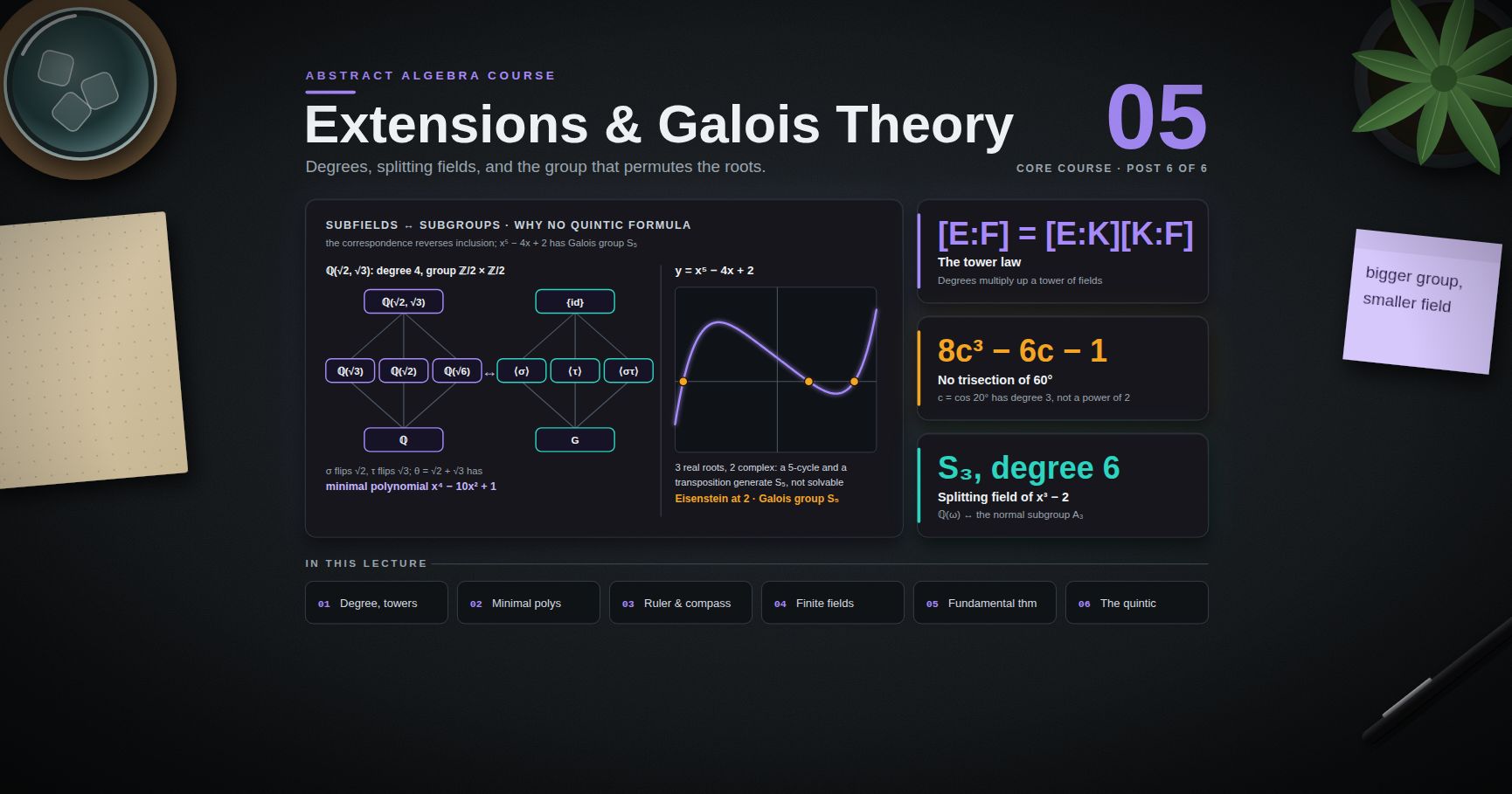
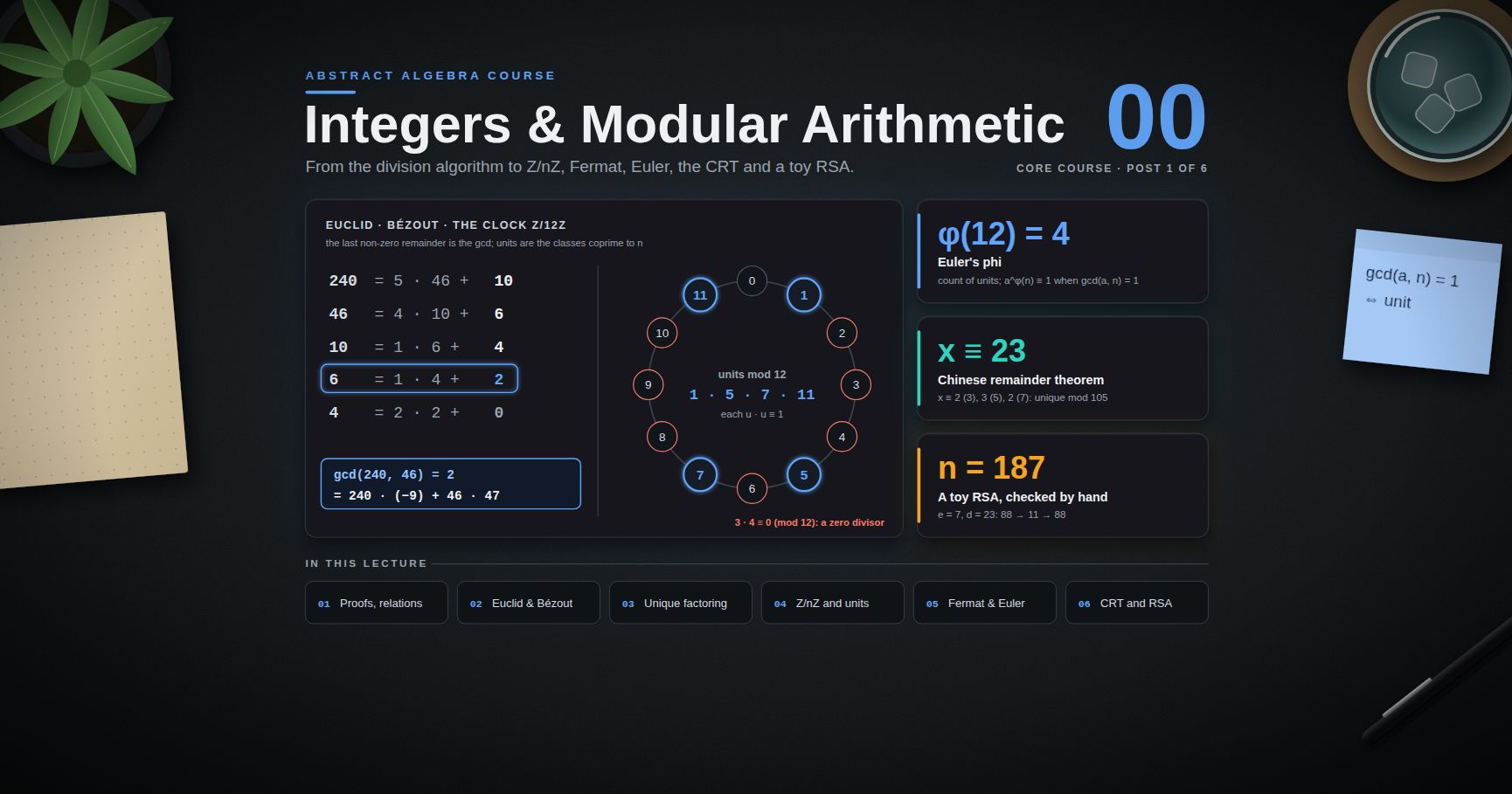
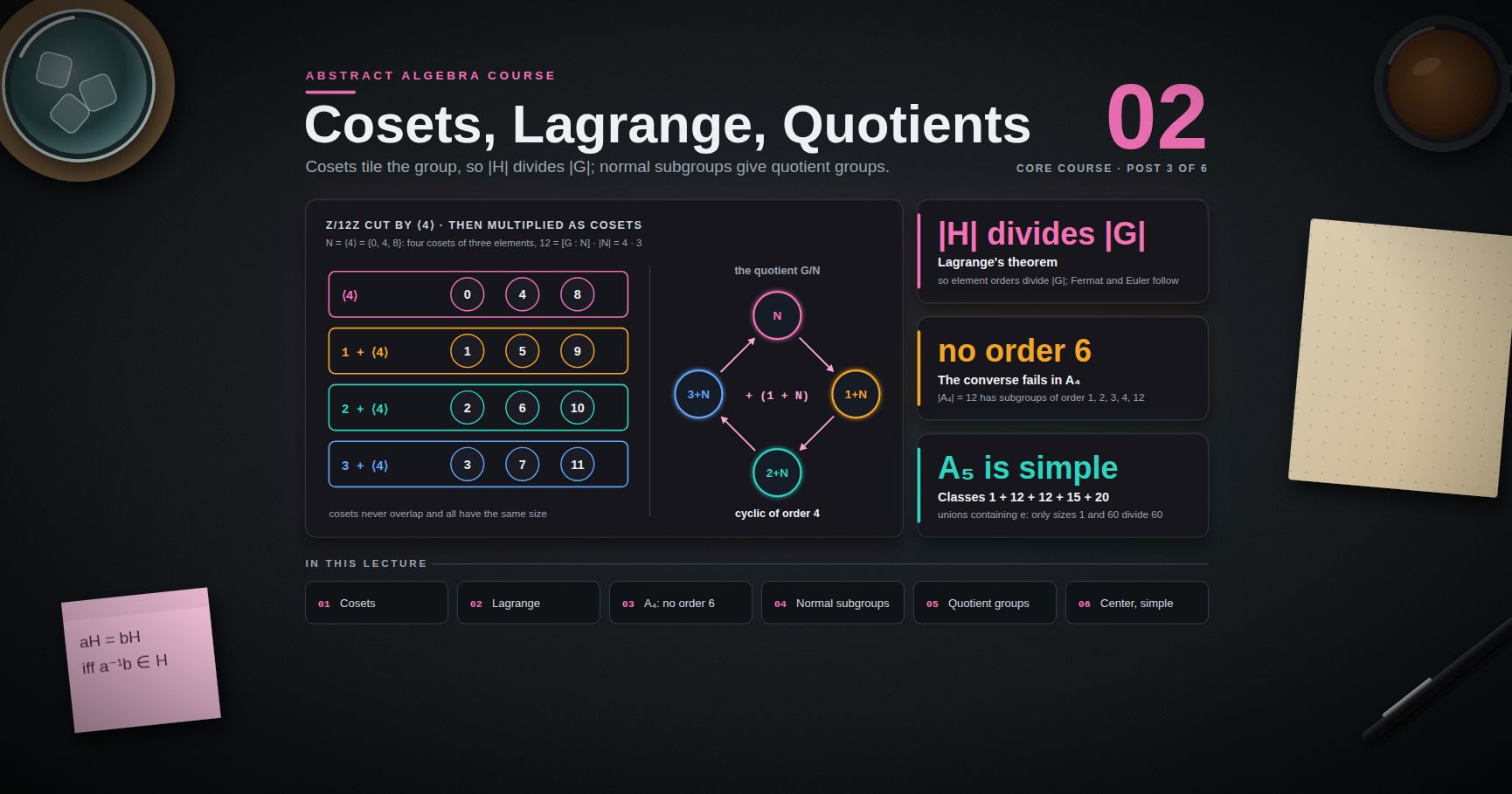
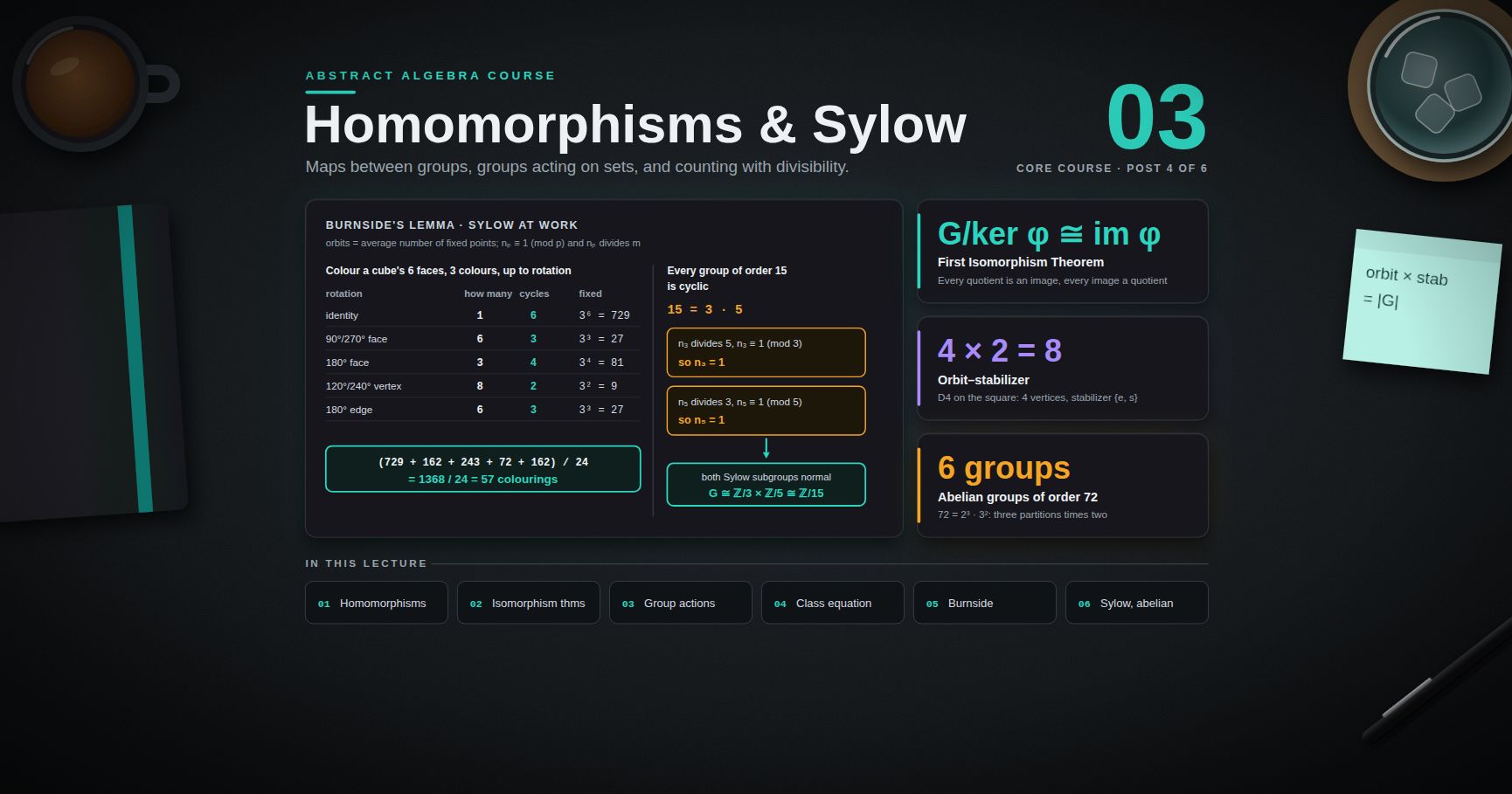
Series map: 00 Integers, Relations & Modular Arithmetic → 01 Groups & Subgroups → 02 Cosets, Lagrange & Quotient Groups → 03 Homomorphisms, Group Actions & Sylow → 04 Rings, Ideals & Fields (this post) → 05 Field Extensions & Galois Theory.
Learning Outcome
- State the ring axioms (with identity), and recognise units, zero divisors, integral domains and fields.
- Prove that a finite integral domain is a field and that the characteristic of a domain is 0 or a prime.
- Define ring homomorphisms, ideals and quotient rings, and prove the First Isomorphism Theorem for rings.
- Prove that is a domain exactly when is prime, and is a field exactly when is maximal.
- Use the division algorithm in and prove that is a principal ideal domain.
- Test polynomials for irreducibility: roots, the rational root test, Eisenstein's criterion, reduction mod .
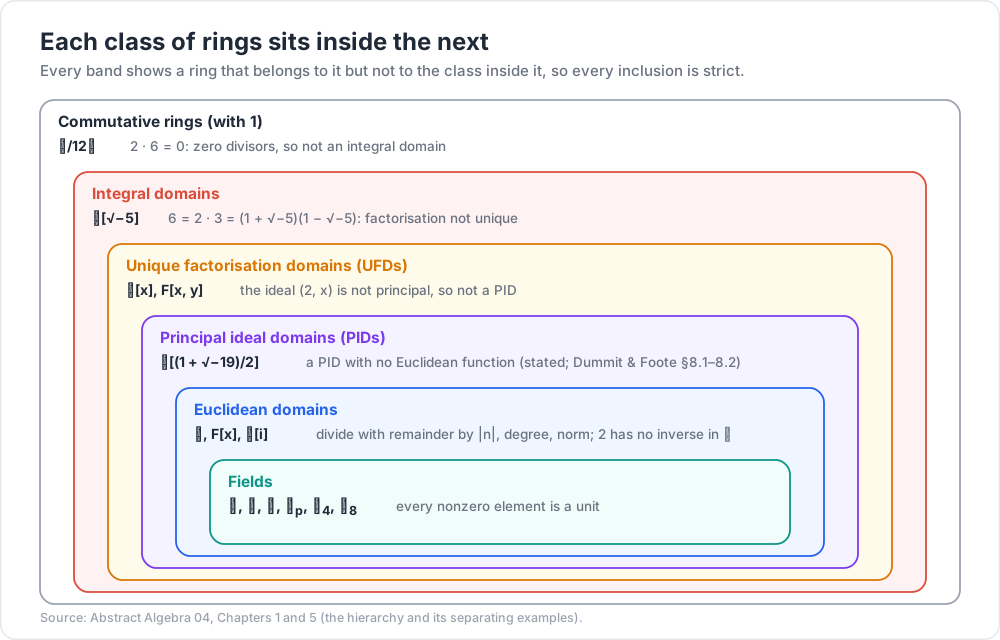
- Place a ring in the chain Euclidean domain ⊂ PID ⊂ UFD ⊂ integral domain, and show that is not a UFD.
- Build as and the finite fields and , and compute in them.
Chapter 1 — Rings
Terminology
- Ring — a set with two operations and such that:
- is an abelian group, with identity and inverses ;
- multiplication is associative: ;
- there is a multiplicative identity with ;
- the distributive laws hold: and .
- Convention. In this series every ring has a (some books call these "rings with unity" and allow rings without one). Multiplication need not be commutative.
- Commutative ring — a ring with for all .
- Zero ring — with . It is the only ring in which (if then ).
- Unit — an element with a two-sided inverse: . The units form a group under multiplication.
- Zero divisor — a nonzero for which some nonzero has or .
- Integral domain — a commutative ring with and no zero divisors.
- Field — a commutative ring with in which every nonzero element is a unit.
- Division ring — like a field but not necessarily commutative (the quaternions are the standard example).
Examples
| Ring | Commutative? | Units | Zero divisors? |
|---|---|---|---|
| yes | none (domain) | ||
| yes | all nonzero | none (fields) | |
| yes | classes with | yes, unless is prime | |
| , real matrices | no | matrices with | yes |
| , real polynomials | yes | nonzero constants | none |
| yes | none | ||
| , continuous functions, pointwise operations | yes | functions with no zero | yes |
A few of the entries, worked out:
- . The units are (coprime to 12; each is its own inverse, e.g. ). Every other nonzero class is a zero divisor: , , , and so on, giving . In every nonzero element is either a unit or a zero divisor: if , then with .
- Matrices. , although neither factor is zero.
- Gaussian integers. Use the norm , which is multiplicative: . If then in the positive integers, so , and leaves .
- Functions. Let be zero on and zero on , both continuous and not identically zero (for example , ). Then .
First consequences of the axioms
For all in a ring:
- . Proof: ; subtract from both sides.
- . Proof: .
- , and in particular .
Cancellation. In an integral domain, if and then , because forces . This is exactly what fails in : but .
Every field is an integral domain: if and , then . The converse fails (), except for finite rings:
Theorem. A finite integral domain is a field.
Proof. Let be a finite domain and . The map , , is injective by cancellation. An injective map from a finite set to itself is surjective, so for some . Since is commutative, is a two-sided inverse. ∎
Corollary. is a field if and only if is prime. (If with , then and are zero divisors. If is prime, has no zero divisors because implies or , post 00; so it is a finite domain.) This field is written .
Characteristic
The characteristic of a ring is the least with ( terms), or if there is no such . So and .
Theorem. The characteristic of an integral domain is or a prime.
Proof. Suppose and with . Then . In a domain one factor is , contradicting the minimality of . And because . ∎
Watch out: characteristic is about , not about the size of the ring. The infinite field of rational functions over has characteristic .
Chapter 2 — Homomorphisms, ideals and quotient rings
Terminology
- Subring — a subset containing that is closed under , and . Example: .
- Ring homomorphism — a map with , and .
- Kernel — .
- Ideal — an additive subgroup that absorbs multiplication: and for all , . (For commutative rings one condition suffices.)
- Principal ideal — in a commutative ring, , the smallest ideal containing . More generally .
Examples of homomorphisms: reduction ; evaluation , ; complex conjugation ; the inclusion of a subring.
Ideals are the kernels
Theorem. The kernel of a ring homomorphism is an ideal.
Proof. It is an additive subgroup, being the kernel of a homomorphism of additive groups (post 03). If then and . ∎
Ideals are to rings what normal subgroups are to groups: exactly the things you can take a quotient by. Two quick facts:
- If an ideal contains a unit , then : for any , . So a proper ideal contains no units, and in particular does not contain .
- A commutative ring with is a field if and only if its only ideals are and . (If is a field, any nonzero ideal contains a unit. Conversely, for , , so for some .) Consequently every ring homomorphism from a field to a nonzero ring is injective: its kernel is a proper ideal (it misses 1), hence .
Theorem. Every ideal of is for a unique .
Proof. Let and let be the least positive element of . For divide: with . Then , so by minimality, and . ∎
In , : for example . This is Bézout's identity from post 00 in ideal language.
Quotient rings
Let be an ideal of . The additive cosets form an abelian group (post 02). Define multiplication by .
Well defined. If and with , then , and the bracket lies in because absorbs multiplication. This is precisely where "ideal" (rather than just "subring") is needed. The ring axioms for follow from those of , with as identity, and , , is a surjective homomorphism with kernel .
Theorem (First Isomorphism Theorem for rings). If is a ring homomorphism, then via .
Proof. By the group version (post 03) the map is a well-defined isomorphism of additive groups. It is multiplicative: ; and . ∎
Worked applications:
- . Evaluation at 0, , is surjective, and its kernel is the polynomials with zero constant term, which is .
- . Evaluation at is surjective (). Its kernel contains ; Chapter 6 shows that is a maximal ideal, so the kernel (a proper ideal containing it) is exactly .
- . The map is surjective with kernel .
- Chinese Remainder Theorem. If , the map , , is a surjective ring homomorphism (surjective by post 00's CRT) with kernel . So as rings, and taking units gives for Euler's function.
Trick: the fastest way to understand is again to find a surjective homomorphism out of whose kernel is . Evaluation maps are the usual candidates for polynomial rings.
Chapter 3 — Prime and maximal ideals
From here on, "ring" means commutative ring with .
Terminology
- Prime ideal — a proper ideal such that implies or .
- Maximal ideal — a proper ideal such that no ideal lies strictly between and : if then or .
In : for a prime is prime (this is Euclid's lemma) and maximal; is prime (because is a domain) but not maximal, since ; is neither, since but .
The two quotient theorems
Theorem. is a prime ideal of if and only if is an integral domain.
Proof. is not the zero ring exactly when , i.e. when is proper. In , the product is zero exactly when , and is zero exactly when . So "no zero divisors in " says word for word " or ". ∎
Theorem. is a maximal ideal of if and only if is a field.
Proof. () Let , i.e. . The ideal strictly contains , so by maximality it is and contains : for some , . Then , so is a unit. Also because is proper.
() If is a field, is proper. Let and pick . Then has an inverse , so . Since , also and . ∎
Corollary. Every maximal ideal is prime (a field is a domain).
Examples in .
- is prime but not maximal: is a domain but not a field. Indeed .
- is maximal: , a field.
- is prime but not maximal: , a domain that is not a field.
A standard existence result (it needs Zorn's lemma): every proper ideal of a ring with is contained in a maximal ideal.
Chapter 4 — Polynomial rings over a field
Let be a field. is the ring of polynomials with . If , the degree is and is the leading coefficient; the polynomial is monic if . The zero polynomial has no degree (some books use ).
Degree, units, roots
If is a domain, the leading coefficient of is the product of the leading coefficients, which is nonzero. Hence, for nonzero :
is again a domain, and the units of are the nonzero constants (a unit has ).
Theorem (division algorithm). For with there are unique with and either or .
Proof sketch. Existence by induction on : if , subtract to kill the leading term of and apply induction to the result. Dividing by is where a field is used. Uniqueness: if then ; the right side has degree , so by the degree formula, and then . ∎
Worked example. Divide by in :
(Check: , and adding gives .)
Factor theorem. is a root of if and only if (divide by ; the remainder is the constant ). So a nonzero polynomial of degree over a domain has at most roots.
Common pitfall: over a ring with zero divisors this fails. In , has four roots: (each squares to mod 8).
F[x] is a principal ideal domain
A principal ideal domain (PID) is an integral domain in which every ideal is principal.
Theorem. If is a field, is a PID.
Proof. Let be an ideal and let be nonzero of least degree. For write . Then and, if , , contradicting minimality. So and . ∎
The proof is the one for with "size" replaced by "degree". As in , , and the Euclidean algorithm computes the gcd:
so .
Watch out: is not a PID, although is. Suppose . Then , so is a constant or . is impossible because is proper (its quotient is ). is impossible because .
Irreducibility tests
A nonzero non-unit is irreducible if it is not a product of two polynomials of smaller degree. Irreducible polynomials are the "primes" of , and whether is irreducible depends on the field: is irreducible over but factors as over ; is irreducible over but not over .
- Degree 2 or 3. A polynomial of degree 2 or 3 over a field is irreducible if and only if it has no root in the field (any factorisation includes a linear factor).
- Rational root test. If and in lowest terms is a root, then and .
- Gauss's lemma. A polynomial in that factors in into factors of lower degree already factors in into factors of those same degrees. So it suffices to look for integer factorisations.
- Eisenstein's criterion. Let and a prime with , for all , and . Then is irreducible in .
- Reduction mod . Let and let be a prime not dividing the leading coefficient. If the reduction is irreducible (of the same degree), then is irreducible in .
Worked examples:
- : Eisenstein with . Also, the rational root test leaves only , none of which is a root.
- : candidates give and , so no rational root; degree 3, so irreducible over .
- : Eisenstein with (, , ). This polynomial returns in post 05.
- Cyclotomic polynomial . Eisenstein does not apply directly, but is irreducible exactly when is, and
, which is Eisenstein at . - : reduce mod 2 to , which is irreducible in . So the original is irreducible over .
Common pitfall: "no rational roots" proves irreducibility only in degree 2 and 3. has no rational root, yet .
Common pitfall: the reduction test only works one way. is irreducible over , but mod 2 it is . A reducible reduction proves nothing; so does a failed Eisenstein check.
Chapter 5 — Unique factorisation
Terminology
In an integral domain :
- divides , written , if for some .
- and are associates if for a unit (for example and in , or and in ).
- A nonzero non-unit is irreducible if forces or to be a unit.
- A nonzero non-unit is prime if forces or (equivalently, is a prime ideal).
- Unique factorisation domain (UFD) — a domain in which every nonzero non-unit is a product of irreducibles, uniquely up to order and associates.
- Euclidean domain — a domain with a function such that for all and there are with and or .
Prime implies irreducible in any domain: if is prime and , then , say , so and ; cancelling gives , so is a unit. The converse holds in a UFD (and so in a PID) but fails in general, which is exactly how unique factorisation breaks.
The hierarchy
- Euclidean ⇒ PID: the proof that is a PID works verbatim with in place of degree.
- PID ⇒ UFD: a standard theorem (existence uses the fact that increasing chains of ideals in a PID stop; uniqueness uses "irreducible ⇒ prime" in a PID).
- Every inclusion is strict, as the diagram's examples show.
Gaussian integers are Euclidean
Take . To divide by , compute in and round each coordinate to the nearest integer to get ; the rounding error has both coordinates at most , so and has .
Worked example. Divide by :
Round to . Then , and . So is a PID and a UFD.
A domain without unique factorisation
Let with norm , again multiplicative. In ,
- Norms. , , .
- Units. forces , so .
- All four factors are irreducible. A proper factor of an element of norm 4, 9 or 6 would have norm 2 or 3. But or has no integer solutions ( gives at least 5; needs ).
- The factorisations really differ. is not an associate of (the only units are , and the norms 4 and 6 differ).
So is not a UFD. Equivalently, is irreducible but not prime: , but divides neither factor, since .
The other separating examples, stated without proof: and are UFDs (Gauss: a UFD implies a UFD) but not PIDs, as shown for above; and is a PID that is not Euclidean (Dummit & Foote, §8.1–8.2).
Chapter 6 — Building fields from polynomials
Theorem. Let be a field and nonconstant. Then is a field if and only if is irreducible.
Proof. In a PID, is maximal exactly when is irreducible. If is irreducible and , then , so is a unit (and is everything) or an associate of (and ). If with of lower degree, then . Now apply "maximal ⇔ quotient is a field" from Chapter 3. ∎
What the elements look like. By the division algorithm every class has exactly one representative of degree . So is an -dimensional vector space over with basis , where is a root of . If is finite, the field has elements. To multiply, multiply polynomials and reduce with ; to invert, use the extended Euclidean algorithm (since , there are with , so ).
The complex numbers
has no real root, so it is irreducible over and is a field whose elements are with :
That is exactly complex multiplication, and the evaluation map of Chapter 2 is the isomorphism with . Example: , matching .
A field with 4 elements
Over , has no root (, ), so it is irreducible and is a field with elements and the rule (since in characteristic 2).
Addition (coefficients add mod 2):
Multiplication:
Two entries in detail: , and . Every nonzero element has an inverse, and the multiplicative group is cyclic of order 3.
Common pitfall: is not . In , , so it is not even a domain. The additive group of is , not .
A field with 8 elements
has no root in (, ), so, being cubic, it is irreducible, and has elements with . The powers of run through all 7 nonzero elements:
| 0 | 1 | 2 | 3 | 4 | 5 | 6 | |
|---|---|---|---|---|---|---|---|
and . This "log table" makes multiplication easy: . For example ; check: .
Post 05 proves that for every prime power there is exactly one field of that size, up to isomorphism.
Practice Exercises
1. List the units and the zero divisors of .
Solution
Units are the classes coprime to 15: (there are ). The other nonzero classes, , are zero divisors: for example and .
2. Show that is a prime ideal of that is also maximal, while in it is prime but not maximal. What changes?
Solution
Evaluation at 0 gives , a field, so is maximal in . The same map gives , a domain but not a field, so is prime but not maximal in ; indeed . What changed is the coefficient ring: the quotient is the coefficient ring itself.
3. Decide whether is irreducible over and over .
Solution
Over : the rational root test leaves , giving values and ; no root, degree 3, so irreducible. Over : , , ; no root, so irreducible, and is a field with elements.
4. Use Eisenstein's criterion to show is irreducible over . Why does "it has no rational root" not suffice on its own?
Solution
With : (leading coefficient), divides , and . So it is irreducible. Absence of roots only rules out linear factors; a quartic could still split into two quadratics, as does.
5. In , compute , and .
Solution
. (the cross term is ). Since , .
6. Show that is irreducible but not prime in , using .
Solution
. A proper factor would have norm 3, and has no integer solution, so is irreducible. Next, , so divides this product. But divides neither factor, since . So is not prime.
7. Show that .
Solution
Let be the natural map. It is surjective: modulo , so , an integer. Its kernel contains . If an integer lies in , then and , so and . So the kernel is , and the First Isomorphism Theorem gives .
Cheat-sheet
| Concept | Key fact |
|---|---|
| Ring (this series) | abelian group under , associative with , distributive |
| Unit / zero divisor | invertible / nonzero with for some nonzero |
| Integral domain | commutative, , no zero divisors; cancellation holds |
| Field | every nonzero element a unit; finite domain is a field |
| Characteristic | least with ; a domain has 0 or a prime |
| Ideal | additive subgroup absorbing multiplication; exactly the kernels |
| First Isomorphism Theorem | |
| Prime ideal | is a domain |
| Maximal ideal | is a field; maximal implies prime |
| division algorithm; PID; degree- polynomial has at most roots | |
| Irreducibility | deg 2–3: no roots; rational roots; Eisenstein; reduce mod |
| Hierarchy | field ⊂ Euclidean ⊂ PID ⊂ UFD ⊂ domain, all strict |
| Non-UFD | in |
| New fields | is a field exactly when is irreducible; size |
| , | |
| , , has order 7 |
What's next
Post 05 turns the construction of Chapter 6 into a theory. If is irreducible over , the field contains a root of , so it is an extension of of degree . Degrees multiply in towers, which already settles the Greek problems of doubling the cube and trisecting an angle. Adding all the roots of a polynomial gives its splitting field, and the automorphisms of that field form its Galois group. The Fundamental Theorem of Galois Theory matches subfields with subgroups, and it explains why there is no formula in radicals for the roots of a general quintic.
References
- D. S. Dummit and R. M. Foote, Abstract Algebra, 3rd edition, Wiley, 2004 — Chapters 7 (rings, ideals, quotients), 8 (Euclidean domains, PIDs, UFDs; the example ) and 9 (polynomial rings, irreducibility criteria).
- M. Artin, Algebra, 2nd edition, Pearson, 2011 — Chapters 11 (rings) and 12 (factoring, Gauss's lemma, Gaussian integers).
- J. A. Gallian, Contemporary Abstract Algebra, 10th edition, CRC Press, 2021 — rings, integral domains, ideals and factor rings, divisibility in integral domains.
- T. W. Hungerford, Algebra, Springer GTM 73, 1974 — Chapter III for a more formal treatment (rings without 1, Zorn's lemma for maximal ideals).
- MIT OpenCourseWare, 18.702 Algebra II (Spring 2011) — lecture notes on rings, factoring and finite fields.
- K. Conrad, Expository papers ("blurbs") — short notes on ring theory, Eisenstein's criterion and finite fields.
Note: this post is in progress. Planned additions: a full proof that PIDs are UFDs, Gauss's lemma with proof, localisation and fields of fractions, and a short section on noncommutative examples (quaternions, matrix rings and their two-sided ideals).