Abstract Algebra — 02 · Cosets, Lagrange's Theorem and Quotient Groups
A subgroup of a group cuts into translated copies of itself, the cosets of . Because the cosets all have the same size and never overlap, the size of must divide the size of . That is Lagrange's theorem, the first real structure theorem of group theory, and it re-proves Fermat's and Euler's theorems from post 00 in one line. This post then asks when the cosets can themselves be multiplied to form a new, smaller group. The answer is exactly when is a normal subgroup, and the new group is the quotient group . Clock arithmetic turns out to be the quotient of by . The post closes with the center, the commutator subgroup, and simple groups, the groups that have no quotients to take. It uses the notation of post 01: permutations compose right to left, and has order .
Series map: 00 Integers, Relations & Modular Arithmetic → 01 Groups & Subgroups → 02 Cosets, Lagrange & Quotient Groups (this post) → 03 Homomorphisms, Group Actions & Sylow → 04 Rings, Ideals & Fields → 05 Field Extensions & Galois Theory.
Learning Outcome
- Compute left and right cosets and prove that the left cosets of partition into sets of size .
- State and prove Lagrange's theorem and its corollaries: element orders divide , groups of prime order are cyclic, Fermat and Euler.
- Use the index and the tower law.
- Explain why the converse of Lagrange's theorem fails, using .
- Prove the equivalent conditions for a subgroup to be normal, and test normality with the conjugation rule for cycles.
- Construct the quotient group , prove that its operation is well defined, and see exactly how it breaks for a non-normal subgroup.
- Compute the center and the commutator subgroup of small groups, and use " cyclic implies abelian".
- Define simple groups and explain what " is simple" means.
Chapter 1 — Cosets
Terminology
- For a subgroup and , the left coset is and the right coset is . In additive notation: .
- is a representative of the coset . Any element of the coset can serve.
- The index is the number of left cosets of in (possibly infinite).
First examples
In with , the cosets are , , : exactly the congruence classes mod 3 from post 00. So .
In under addition, let be a line through the origin. The coset is the parallel line through the point . The cosets are all the lines parallel to : they fill the plane and never cross. This picture — parallel copies of the subgroup, filling the group without overlap — is the right mental model in every example.
Cosets in
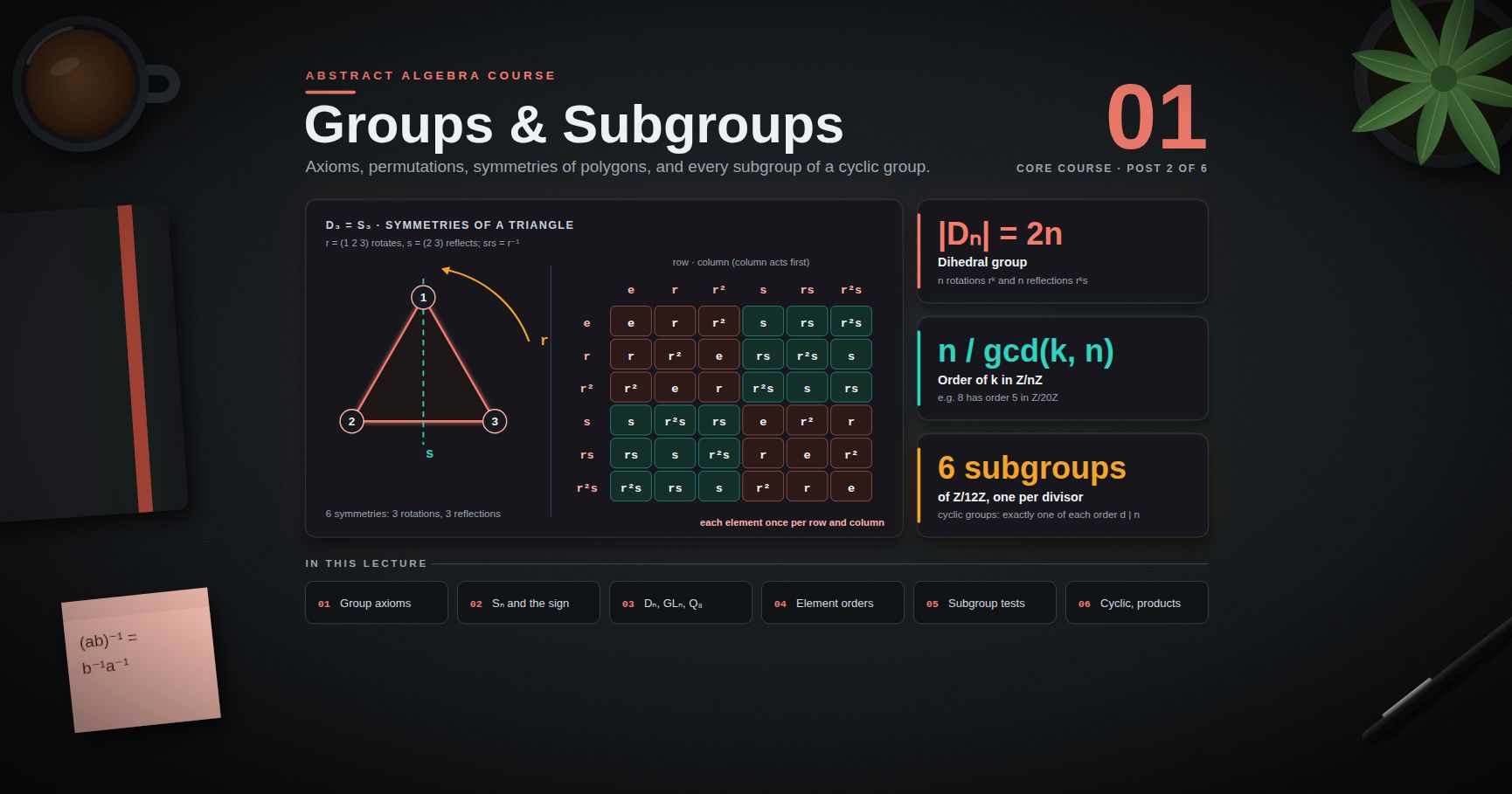
Use and as in post 01, so with , , , and .
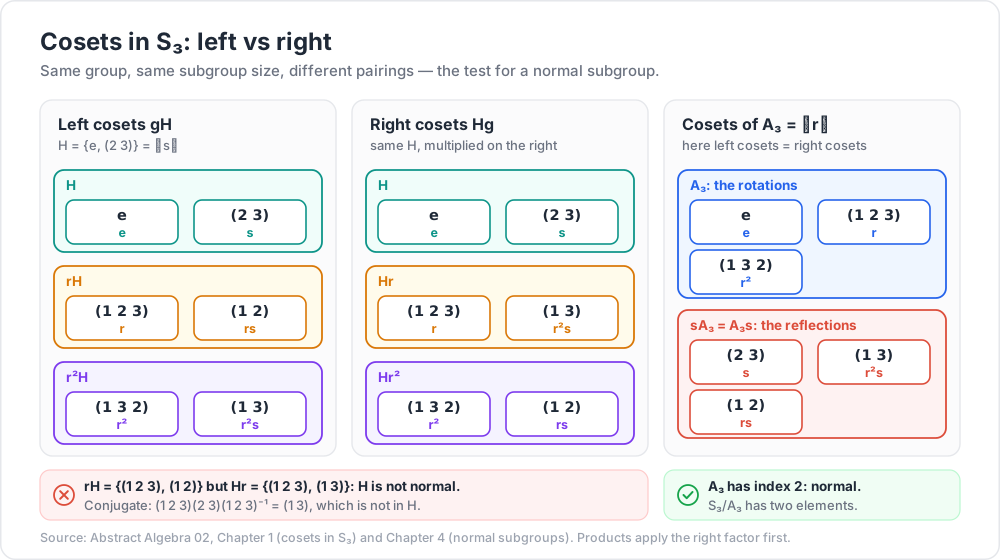
Take . The left cosets are
The right cosets are , and . Both families split into three pairs, but into different pairs: .
Now take the rotation subgroup . Its cosets are itself and , the three reflections (transpositions). Here : left and right cosets agree.
The coset lemma
Lemma 1.1. Let and .
- .
- if and only if . In particular if and only if .
- Two left cosets are either equal or disjoint.
- .
Proof. Define if . This is an equivalence relation: ; if then its inverse ; if then their product . Its class of is . So the left cosets are exactly the equivalence classes, and parts 1–3 are Theorem 2.3 of post 00 (classes partition the set; one common element makes two classes equal). For part 4, the map , , is onto by definition and one-to-one by cancellation.
The same holds for right cosets with in part 2. The map is a well-defined bijection from left cosets to right cosets (because ), so the number of left cosets equals the number of right cosets, even when the cosets themselves differ.
Common pitfall: does not mean , and it is tested by , not by (that is the test for right cosets). In above, because .
Chapter 2 — Lagrange's theorem
Theorem 2.1 (Lagrange). If is a finite group and , then divides , and
Proof. By Lemma 1.1 the left cosets of partition , and each has exactly elements. If there are of them, counting the elements of coset by coset gives .
The proof is three lines because the work was done in the coset lemma. Lagrange's theorem is a restriction: it says which subgroup orders are impossible. A group of order 12 can only have subgroups of orders 1, 2, 3, 4, 6, 12; a group of order 8 has no subgroup (and so no element) of order 3.
Corollaries
Corollary 2.2. In a finite group, the order of every element divides .
Proof. (post 01, Lemma 3.1), and is a subgroup.
Corollary 2.3. for every in a finite group .
Proof. for some integer , so .
Corollary 2.4. A group of prime order is cyclic, and every non-identity element generates it. In particular it is abelian and, up to isomorphism, it is .
Proof. Take . Then divides and is not 1, so and .
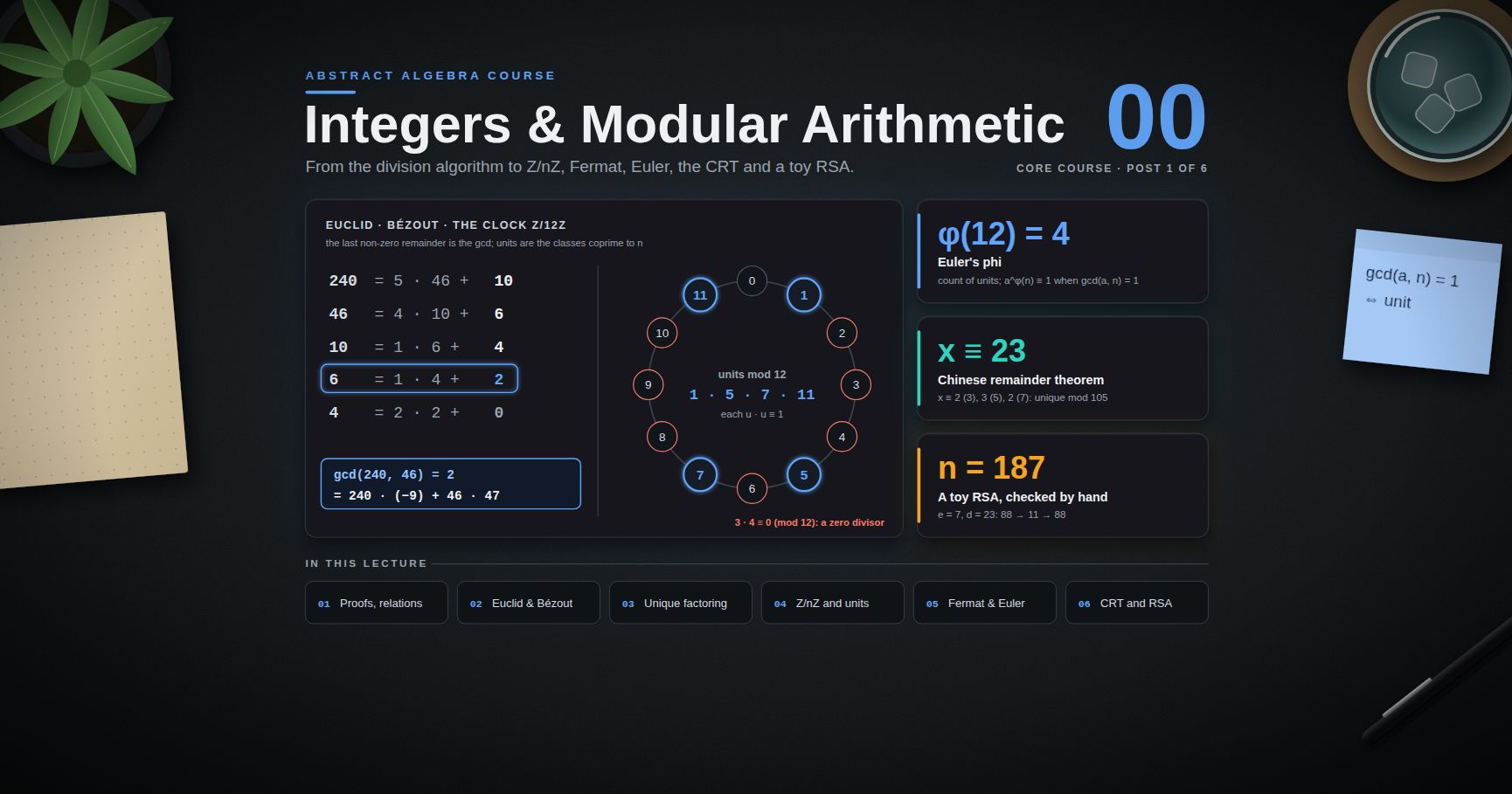
Corollary 2.5 (Euler and Fermat, again). If then ; if is prime and then .
Proof. is a group of order containing ; apply Corollary 2.3. Fermat is , .
Compare the proof in post 00, which rearranged a product of all the units: that argument is Lagrange's theorem in disguise, specialised to one group. Lagrange also explains the remark there that need not be the smallest exponent that works: the order of each element divides but can be smaller. In , of order , the elements have order 4 and have order 2, so in fact for every coprime to 20.
Application: the groups of order 4
Proposition 2.6. Every group of order 4 is cyclic or is the Klein four group .
Proof. Element orders divide 4. If some element has order 4, the group is cyclic. Otherwise every non-identity element has order 2; write . The product is not (since ), not (else ), and not (else ). So , and the same argument fills in the rest of the table: it is the table of .
Index and the tower law
Proposition 2.7 (tower law). If with finite, then .
Proof. .
(The law also holds for infinite groups when the indices are finite, by a direct coset argument.) Example: in , of orders : .
Trick: if and are finite subgroups with , then , because divides both orders. This quick consequence of Lagrange is used constantly in post 03's Sylow arguments.
Chapter 3 — The converse of Lagrange fails
Lagrange says a subgroup's order divides . The converse — "for every divisor of there is a subgroup of order " — is true for cyclic groups (post 01, Theorem 5.2) but false in general. The smallest counterexample is the alternating group .
is the group of even permutations of , of order . Sorting its elements by cycle type:
| type | elements | count |
|---|---|---|
| identity | 1 | |
| double transpositions | , , | 3 |
| 3-cycles | , , , , , , , | 8 |
Proposition 3.1. has no subgroup of order 6, although 6 divides 12.
Proof. Suppose with . Then , so there are only two left cosets, and the complement. Let be any 3-cycle. The three cosets , , cannot all be different, so two coincide: with , which by Lemma 1.1 means , with . If then also . Either way . So contains all eight 3-cycles, too many for a set of 6 elements.
In fact has subgroups of orders 1, 2, 3, 4 and 12 only: three of order 2 (one per double transposition), four of order 3 (one per pair of inverse 3-cycles), and one of order 4, the Klein four group .
Partial converses do hold, and they are the subject of post 03: Cauchy's theorem (if a prime divides , there is an element of order ) and the Sylow theorems (subgroups of every prime-power order dividing exist).
Chapter 4 — Normal subgroups
Terminology
- The conjugate of by is . For a subset, . If then is again a subgroup, of the same order.
- A subgroup is normal, written , if for every .
Equivalent conditions
Theorem 4.1. For a subgroup the following are equivalent:
- for all ;
- for all ;
- for all ;
- every left coset of is a right coset of .
Proof. (1 ⇒ 2) Apply (1) to : . Conjugating by gives . (2 ⇒ 3) . (3 ⇒ 4) Clear. (4 ⇒ 1) Suppose for some . Since , , so and are right cosets sharing , hence equal. So . Then for , , so for some and .
Watch out: is an equality of sets. It does not say for each ; it says for some possibly different . Normal subgroups need not commute elementwise with .
Examples
- Every subgroup of an abelian group is normal: .
- Index 2 subgroups are normal. If , the left cosets are and , and so are the right cosets. So for , . Hence , the rotations , and (as the coset computation in Chapter 1 showed directly).
- : .
- In every subgroup is normal. The subgroups are , , , , and ; the three cyclic subgroups of order 4 have index 2, and consists of elements that commute with everything. So is a non-abelian group all of whose subgroups are normal.
The conjugation rule for cycles
In there is a fast way to conjugate: for any ,
Proof. The right side sends . The left side does too: takes to , the cycle takes it to , and takes that to . On a point with outside the cycle, both sides give .
So conjugation relabels the entries and keeps the cycle type. Consequences:
- Non-example. is not normal in : with , . This matches the different left and right cosets found in Chapter 1.
- : consists of and all three permutations of type "two disjoint transpositions", and conjugation preserves type.
- Normality is not transitive. is normal in (index 2, or: is abelian), and , but is not normal in : .
Worked example: the normal subgroups of
has ten subgroups (post 01). Sort them by order and test each:
| order | subgroups | normal? | reason |
|---|---|---|---|
| 1 | yes | trivial | |
| 2 | yes | is in the center: commutes with , and | |
| 2 | , , , | no | , and in general |
| 4 | , , | yes | index 2 |
| 8 | yes | whole group |
So has six normal subgroups out of ten. The computation uses , which is read with replaced by .
Products of subgroups
For subgroups let .
Proposition 4.2. If and are finite, . If moreover one of is normal in , then is a subgroup.
Proof. is the union of the left cosets for , each of size . Two of them coincide, , exactly when , that is (both being in ) when , i.e. when and lie in the same left coset of in . So the number of distinct cosets is , giving the formula. If , then for each , so , and ; the one-step test applies. The case is symmetric.
Without normality can fail to be a subgroup, and Lagrange detects it. In with and : , namely . Since 4 does not divide 6, cannot be a subgroup.
Chapter 5 — Quotient groups
Let . The quotient group (factor group) is the set of cosets of with the operation
The formula uses representatives and , so the first job is to check that the answer does not depend on which representatives are chosen — the same worry as for in post 00.
Theorem 5.1. If , the operation is well defined, and it makes a group with identity and inverses . If is finite, .
Proof. Suppose and , so and with . Then
By normality , so and . The group axioms are inherited from : , , and .
Where it breaks without normality
Take the non-normal in . Two names for the same coset: . Multiply each by :
- with representative : ;
- with representative : .
Same inputs, different outputs: the "operation" is not a function. Normality is exactly what is needed. Indeed, if the coset product is well defined for , then for and , , so , and is normal.
Examples of quotients
- is the quotient of by the subgroup : the cosets are the congruence classes, and the coset sum is the addition of classes from post 00. This is where the notation comes from.
- has two elements, (rotations) and (reflections). "Rotation times reflection is a reflection; reflection times reflection is a rotation": the quotient is . Likewise records only the sign.
- : the cosets of are , , , . The coset has order 4 (the first multiple of 1 landing in is ), so the quotient is cyclic of order 4.
- has order 4. Every has , so every coset squares to the identity coset, and by Proposition 2.6 the quotient is .
- : cosets are "real numbers up to whole turns", added mod 1. It behaves like the circle group via (post 03 makes this an isomorphism with the first isomorphism theorem).
A quotient table:
The center of is (Chapter 6 below; it is the normal subgroup of order 2 found in Chapter 4). Its four cosets are
Multiply cosets through representatives, then look up which coset the product lies in:
For instance , and ; while . In , , but in the quotient the two products land in the same coset: the quotient is abelian, a copy of . Passing to forgets the information inside , here the difference between and .
The correspondence theorem (statement)
Theorem 5.2 (correspondence). Let . The subgroups of correspond one-to-one to the subgroups of that contain , via . The correspondence preserves inclusion, and is normal in exactly when is normal in .
Example: the subgroups of containing are , and the whole group, of orders 3, 6 and 12. They match the three subgroups of the quotient , of orders , and . The proof is cleanest with homomorphisms and is part of post 03.
Order of an element in . has order the smallest with , since equals exactly when . The order of therefore divides the order of .
Common pitfall: is not a subgroup of . Its elements are subsets of (cosets), and its identity is the whole of . Sometimes happens to contain a subgroup isomorphic to (for , the subgroup ), but often it does not: , while has only one element of order 2 and so contains no copy of .
Chapter 6 — Center, commutators and simple groups
The center
The center of is , the elements that commute with everything.
Proposition 6.1. is a normal subgroup of . is abelian if and only if .
Proof. . If , then (from we get ). So the one-step test passes. Normality: .
| abelian | |
| (and , ) | |
| non-zero scalar matrices |
Theorem 6.2. If is cyclic, then is abelian.
Proof. Write and let generate . Every element of lies in some coset , so has the form with . Two such elements commute: , because the commute with everything and powers of commute with each other.
So for a non-abelian group, is never cyclic; in particular is never a prime. For : , and since every has , the quotient is , not cyclic, as the theorem requires.
The commutator subgroup
The commutator of and is . It equals exactly when , so it measures failure to commute. The commutator subgroup (derived subgroup) is the subgroup generated by all commutators.
Theorem 6.3. , the quotient is abelian, and for any normal subgroup : is abelian if and only if .
Proof. Conjugation respects products and , so a conjugate of a product of commutators is again one; hence is normal. For : is abelian iff for all , iff for all . As range over so do , so this says every commutator lies in , that is . Taking shows is abelian.
is the largest abelian quotient of . Examples: exactly when is abelian; ; (for instance ); ; ; .
Simple groups
A group is simple if its only normal subgroups are and . A simple group has no non-trivial quotients: it cannot be broken into a normal subgroup and a smaller quotient group.
Proposition 6.4. An abelian group is simple if and only if it is cyclic of prime order.
Proof. Groups of prime order have no subgroups except and (Lagrange), so they are simple. Conversely let be abelian and simple; all its subgroups are normal, so it has none except and . For , , so is cyclic. It is not infinite ( would be a proper non-trivial subgroup of ), so , and must be prime since there is a subgroup for every divisor of (post 01, Theorem 5.2).
The first non-abelian simple group is , of order 60.
Theorem 6.5 (stated). is simple. More generally, is simple for every .
A sketch for , whose missing step comes in post 03: a normal subgroup is a union of conjugacy classes (sets ), and it contains the identity. The conjugacy classes of have sizes . The sums that include the class of size 1 are , and by Lagrange a subgroup's order must divide 60. Only and do. So the only normal subgroups are and .
Simple groups are the "atoms" of finite group theory: the Jordan–Hölder theorem says every finite group is built from a uniquely determined list of simple groups, much as an integer is built from primes. The classification of finite simple groups, completed through the work of many mathematicians, lists them all: the cyclic groups of prime order, the alternating groups for , the groups of Lie type (built from matrix groups over finite fields), and 26 sporadic groups. In post 05 the simplicity of is the group-theoretic fact behind the theorem that the general quintic equation cannot be solved by radicals.
Practice Exercises
1. In (order 8, , ), list the left and the right cosets of . Is normal?
Solution
Left: , , , . Right: , , , (using ). Since , is not normal. Note that , as Lagrange requires.
2. Let and be subgroups of a finite group with . Prove . Deduce that in a group of order 15, a subgroup of order 3 and a subgroup of order 5 meet only in .
Solution
is a subgroup of both and , so by Lagrange its order divides and , hence divides their gcd, 1. For the second part, 3 and 5 are coprime.
3. Without computing any powers, explain why for every with . Then show that the exponent 8 can be replaced by 4.
Solution
has order ; apply Corollary 2.3. Its elements are . By Lagrange each order divides 8. None has order 8: , ; , so ; ; ; and have fourth powers equal to those of and ; . So every order divides 4.
4. Use the conjugation rule to decide whether is normal in , and whether is.
Solution
is not normal: conjugating by gives . is normal: it consists of and all permutations with cycle type two disjoint transpositions, and conjugation preserves cycle type.
5. In , find the order of the quotient, the order of , and whether the quotient is cyclic.
Solution
has order 3, so the quotient has order . The order of is the least with modulo 18: , so . The coset has order 6 (the least with is 6), so the quotient is cyclic, isomorphic to .
6. Prove that is never a prime number.
Solution
If is prime, is cyclic (Corollary 2.4), so is abelian (Theorem 6.2). Then and , not . Contradiction.
7. Find the commutator subgroup of and identify .
Solution
, so . The quotient has order 4, and every group of order 4 is abelian (Proposition 2.6), so by Theorem 6.3 . Hence , and (every element squares into ).
Cheat-sheet
| Idea | Statement |
|---|---|
| Left coset | |
| Same coset | iff |
| Coset facts | cosets partition ; each has elements |
| Lagrange | divides ; |
| Element orders | divides ; |
| Prime order | cyclic, |
| Tower law | |
| Converse fails | (order 12) has no subgroup of order 6 |
| Normal | iff for all |
| Index 2 | always normal |
| Conjugating a cycle | |
| Quotient | , , needs normal |
| Order in | least with |
| Center | normal; cyclic implies abelian |
| Commutators | abelian iff |
| Simple | only and normal; simple |
What's next
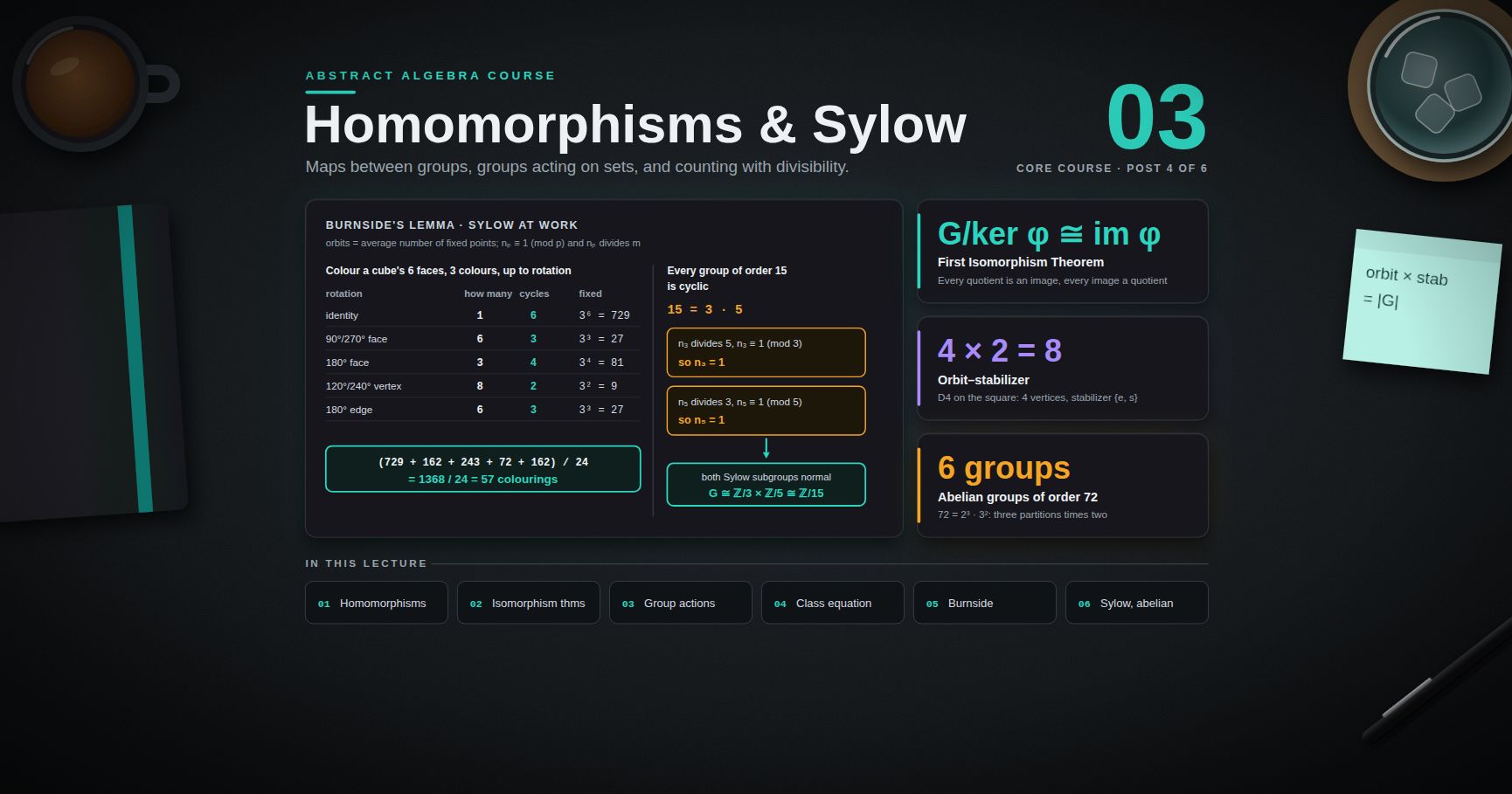
Post 03 introduces homomorphisms, maps between groups that respect the operation. Their kernels are exactly the normal subgroups, and the first isomorphism theorem says , which turns statements such as and into one-line proofs. Group actions give the orbit–stabiliser theorem and the class equation (which supplies the conjugacy class sizes used for above), and the Sylow theorems give the partial converse of Lagrange's theorem that Chapter 3 promised.
References
- David S. Dummit and Richard M. Foote, Abstract Algebra, 3rd edition, Wiley, 2004 — Sections 3.1–3.2 (quotient groups, Lagrange's theorem) and 3.4 (composition series, Jordan–Hölder).
- Joseph A. Gallian, Contemporary Abstract Algebra, 10th edition, CRC Press, 2021 — Chapters 7 (cosets and Lagrange's theorem) and 9 (normal subgroups and factor groups).
- Michael Artin, Algebra, 2nd edition, Pearson, 2011 — Chapter 2, sections on cosets, normal subgroups and quotient groups.
- John B. Fraleigh, A First Course in Abstract Algebra, 7th edition, Addison-Wesley, 2003 — Sections 10 (cosets and Lagrange), 14–15 (factor groups, simple groups).
- Thomas W. Judson, Abstract Algebra: Theory and Applications (open textbook), judsonbooks.org — chapters on cosets and Lagrange's theorem and on normal subgroups and factor groups.
- MIT OpenCourseWare, 18.701 Algebra I (Fall 2010) — lectures on cosets, Lagrange, and quotient groups.
- Keith Conrad, Expository papers on group theory (University of Connecticut) — including notes on the simplicity of and on conjugation in .
Note: this post is in progress. Planned additions: a full proof that is simple for , a proof of the correspondence theorem, and a drawing of the cosets of a line in .