MongoDB Course — 19 · Beanie + Pydantic v2 + FastAPI — Async Python ODM
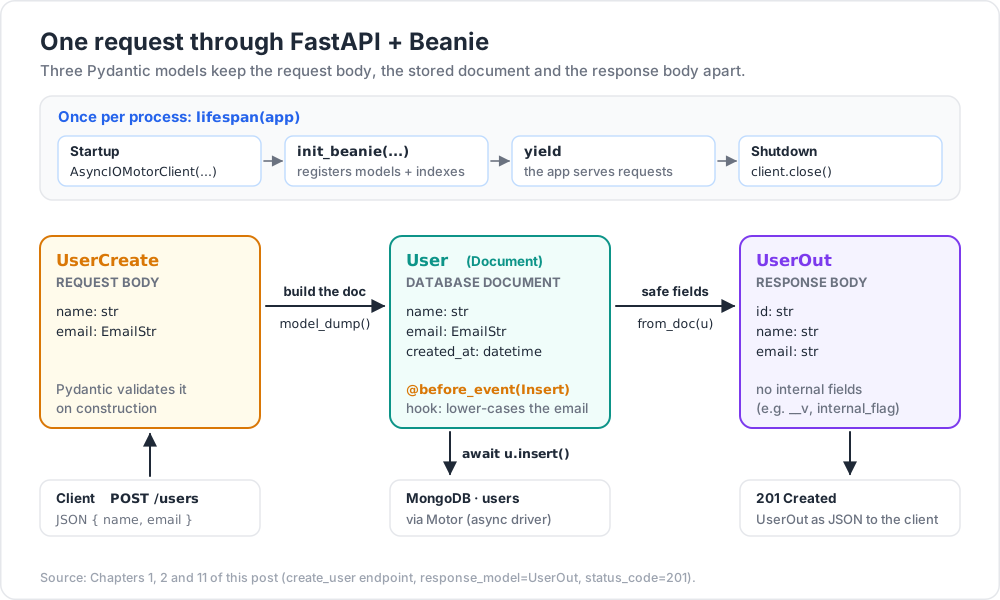
The Python equivalent of Mongoose in 2026 is Beanie — an async ODM built on Motor + Pydantic. It fits naturally into FastAPI (which is also Pydantic-based) and gives type-safe models, async I/O, validation, indexes, hooks, links (relations), aggregations, and migrations in one package. This post covers the working set: models, CRUD, indexes, links + back-links, hooks, projections, aggregations, transactions, integration patterns with FastAPI.
Series map: 17 base course → 18 Mongoose deep → 19 Beanie + FastAPI (this post) → 20 Outbox → ... → 29 K8s + mongosync + cost.
Learning Outcome
- Set up Beanie + Motor with FastAPI lifespan.
- Define models with Pydantic v2 + Indexed + relations (
Link). - CRUD with type-safe queries.
- Use projections + aggregations + bulk writes.
- Hook into events (
before_save,after_event). - Use transactions inside Beanie.
- Integrate with FastAPI dependency injection.
Chapter 1 — Install + connect
1
2
pip install beanie fastapi uvicorn[standard] pydantic
1
2
3
4
5
6
7
8
9
10
11
12
13
14
15
16
17
# main.py
from contextlib import asynccontextmanager
from fastapi import FastAPI
from motor.motor_asyncio import AsyncIOMotorClient
from beanie import init_beanie
from .models import User, Order, Product
@asynccontextmanager
async def lifespan(app: FastAPI):
client = AsyncIOMotorClient(os.environ["MONGO_URI"], maxPoolSize=50, appName="shop-api")
await init_beanie(database=client.shop, document_models=[User, Order, Product])
yield
client.close()
app = FastAPI(lifespan=lifespan)
init_beanie registers your models against the database and creates declared indexes. One call per process.
Chapter 2 — Models
1
2
3
4
5
6
7
8
9
10
11
12
13
14
15
16
17
18
19
20
21
22
23
24
25
26
27
28
29
30
31
# models.py
from datetime import datetime
from typing import Annotated, Optional
from beanie import Document, Indexed, before_event, Replace, Insert
from pydantic import BaseModel, EmailStr, Field
class Address(BaseModel):
city: str
country: str = "UK"
class User(Document):
name: str
email: Annotated[EmailStr, Indexed(unique=True)]
age: Optional[int] = Field(default=None, ge=0, le=150)
role: str = "user"
tags: list[str] = []
address: Optional[Address] = None
created_at: datetime = Field(default_factory=datetime.utcnow)
class Settings:
name = "users" # collection name
use_state_management = True # for Save / Replace
indexes = [
"created_at",
[("name", 1), ("created_at", -1)], # compound
]
@before_event(Insert)
async def normalise(self):
self.email = self.email.lower()
Key elements:
- Inherit
Document._idauto-managed as ObjectId. Annotated[Type, Indexed(...)]for index declarations.Settingsinner class for collection name + index definitions.@before_event/@after_eventhooks similar to Mongoose middleware.- Pydantic v2 validators (
Field(ge=0)) run on construction + assignment.
Chapter 3 — CRUD
1
2
3
4
5
6
7
8
9
10
11
12
13
14
15
16
17
18
19
# create
u = User(name="Ada", email="ada@x")
await u.insert()
# read
u = await User.get(some_id)
u = await User.find_one(User.email == "ada@x")
users = await User.find(User.age > 25).sort(-User.created_at).limit(20).to_list()
# update
u.age = 31
await u.save()
# or atomic via update operators
await User.find_one(User.email == "ada@x").update({"$inc": {"login_count": 1}})
# delete
await u.delete()
await User.find(User.role == "user", User.age < 18).delete()
Query expressions use the Python operators on model fields — fully type-checked.
Chapter 4 — Indexes
1
2
3
4
5
6
7
8
9
10
11
12
class Product(Document):
name: str
price: Annotated[float, Indexed()]
category: Annotated[str, Indexed()]
class Settings:
indexes = [
[("category", 1), ("price", 1)], # compound
IndexModel([("name", "text")], default_language="english"), # text
IndexModel([("location", "2dsphere")]), # geo
]
Indexes created at init_beanie. For production, disable + create via migrations (same advice as Mongoose Post 18).
Chapter 5 — Links (relations)
Beanie supports linked documents — equivalent to Mongoose populate:
1
2
3
4
5
6
7
8
9
10
11
12
13
14
15
16
17
18
19
20
from beanie import Document, Link
class User(Document):
name: str
class Order(Document):
user: Link[User] # stored as { id, collection }
total: float
# Insert
ada = User(name="Ada"); await ada.insert()
o = Order(user=ada, total=99); await o.insert()
# Fetch with link
o = await Order.get(order_id, fetch_links=True)
print(o.user.name) # populated
# or one at a time
await o.fetch_link(Order.user)
Multi-level fetch supported. Like Mongoose populate, this issues additional queries — for hot endpoints prefer aggregation $lookup.
BackLink[T] for reverse references (also fetched on demand).
Chapter 6 — Projections
1
2
3
4
5
6
7
class UserProjection(BaseModel):
name: str
email: str
users = await User.find().project(UserProjection).to_list()
# Returns UserProjection instances (slim), not full User docs
Use for list endpoints — server returns only projected fields + Pydantic constructs the typed slim object.
Chapter 7 — Aggregations
1
2
3
4
5
6
result = await User.aggregate([
{"$match": {"role": "user"}},
{"$group": {"_id": "$country", "count": {"$sum": 1}}},
{"$sort": {"count": -1}},
]).to_list()
Returns raw dicts. To get typed results, pass a projection_model:
1
2
3
4
5
6
7
8
9
class CountryCount(BaseModel):
country_id: str = Field(alias="_id")
count: int
result = await User.aggregate(
[...],
projection_model=CountryCount,
).to_list()
For aggregation builders + type-safe pipeline construction, the community pyodmongo and helpers exist. Most teams just use dict pipelines as in mongosh.
Chapter 8 — Hooks (events)
1
2
3
4
5
6
7
8
9
10
11
12
13
from beanie import Document, before_event, after_event, Insert, Save, Replace, Delete, Validate
class User(Document):
name: str
@before_event(Insert)
async def normalise(self):
self.name = self.name.strip()
@after_event(Save, Replace)
async def publish_event(self):
await publish({"type": "user.saved", "id": str(self.id)})
Events: Insert, Replace, Update, Delete, Save, Validate. Multiple events per decorator. Async or sync function bodies.
Chapter 9 — Transactions
1
2
3
4
5
6
7
from beanie import Transaction
async with await client.start_session() as session:
async with session.start_transaction():
await User.find_one(User.id == 1, session=session).update({"$inc": {"balance": -100}}, session=session)
await User.find_one(User.id == 2, session=session).update({"$inc": {"balance": 100}}, session=session)
Or with retry helper from Motor (Post 09 patterns apply).
session= must be passed to every op — same rule as Mongoose + the official driver.
Chapter 10 — Bulk writes
1
2
3
4
5
6
7
8
from beanie import BulkWriter
async with BulkWriter() as bulk:
await User(name="A").insert(bulk_writer=bulk)
await User(name="B").insert(bulk_writer=bulk)
await User.find_one(User.name == "A").update({"$set": {"role": "admin"}}, bulk_writer=bulk)
# committed on exit
Batches the operations into a single bulkWrite call — much faster than per-doc round-trips.
Chapter 11 — FastAPI integration patterns
1
2
3
4
5
6
7
8
9
10
11
12
13
14
15
16
17
18
19
20
21
22
23
24
25
26
27
28
29
30
31
from fastapi import FastAPI, HTTPException
from pydantic import BaseModel
class UserCreate(BaseModel):
name: str
email: EmailStr
class UserOut(BaseModel):
id: str
name: str
email: str
@classmethod
def from_doc(cls, u: User):
return cls(id=str(u.id), name=u.name, email=u.email)
app = FastAPI(lifespan=lifespan)
@app.post("/users", response_model=UserOut, status_code=201)
async def create_user(input: UserCreate):
u = User(**input.model_dump())
await u.insert()
return UserOut.from_doc(u)
@app.get("/users/{user_id}", response_model=UserOut)
async def get_user(user_id: str):
u = await User.get(PydanticObjectId(user_id))
if not u:
raise HTTPException(404)
return UserOut.from_doc(u)
Separation of concerns:
UserCreate— request body.User(Beanie) — database document.UserOut— response body (no internal fields).
Helps avoid leaking server-side fields (__v, internal_flag, etc.) into responses.
Dependency injection for repositories
1
2
3
4
5
6
7
8
9
10
11
12
13
from fastapi import Depends
class UserRepo:
async def by_email(self, email: str):
return await User.find_one(User.email == email.lower())
def repo() -> UserRepo:
return UserRepo()
@app.get("/by-email/{email}")
async def by_email(email: str, repo: UserRepo = Depends(repo)):
return await repo.by_email(email)
Useful when you want to mock the repository in tests.
Chapter 12 — Migrations
Beanie has beanie migrate CLI:
1
2
3
4
beanie new-migration --name add_email_index
# edit the generated python file with up() / down()
beanie migrate -uri "mongodb://..." -db shop
Migration files apply schema-evolution + index changes idempotently. State stored in migrations_log collection.
For complex schema versioning (Post 07), pair with _schema_v on documents + lazy migration in app code.
Chapter 13 — Common pitfalls
| Pitfall | Cause | Fix |
|---|---|---|
init_beanie called per request |
overhead, leak risk | call once in lifespan |
| Links populate causing N+1 | many docs each fetch_links |
aggregation $lookup |
| Projection model field name mismatch | aliases needed | use Field(alias="_id") |
EmailStr install error |
missing optional dep | pip install pydantic[email] |
| Auto-index blocks on production startup | huge collection | disable + migrate manually |
| Mixed sync + async code | accidental blocking call | wrap with asyncio.to_thread |
| Old Pydantic v1 examples | breaking changes | always use Pydantic v2 |
id vs _id confusion |
Beanie exposes .id (the str-friendly view) |
match docs |
Practice Exercises
Exercise 1 — Hello Beanie + FastAPI
Build the FastAPI skeleton in Chapter 1 + 2. Create User model. POST + GET endpoint. Test with curl.
Exercise 2 — Aggregation
Build an endpoint /stats/users-per-country that returns count per country via an aggregation projected to a Pydantic model.
Exercise 3 — Links
Create Order linking to User. Insert a few. Endpoint /orders/{id} returns the order with the linked user fetched.
Exercise 4 — Hooks
Add a before_event(Insert) hook to Order that sets created_at and validates total > 0.
Exercise 5 — Bulk + transaction
Endpoint that inserts a batch of 100 users in a single bulkWrite. Wrap in a transaction (overkill for inserts; just to practice).
Exercise 6 — Migration
Add an email_index migration. Run beanie migrate. Verify getIndexes() from mongosh shows it.
Cheat-sheet
| What | How |
|---|---|
| Install | pip install beanie motor fastapi |
| Init | await init_beanie(db, document_models=[...]) |
| Model | class X(Document): ... |
| Index | Annotated[T, Indexed(unique=True)] or Settings.indexes |
| Query | Model.find(Model.field == v) (type-safe) |
| Insert | await m.insert() or Model.insert_one(m) |
| Update | await m.save() (state-managed) or find(...).update({$set: ...}) |
| Delete | await m.delete() |
| Project | find().project(SlimModel) |
| Aggregate | Model.aggregate([...], projection_model=Out) |
| Link | Link[User] field; fetch_links=True |
| Hook | @before_event(Insert) / @after_event(...) |
| Transaction | session.start_transaction() |
| Bulk | async with BulkWriter() as bulk: m.insert(bulk_writer=bulk) |
| FastAPI | lifespan to init/close; Pydantic models for request/response |
| Migration | beanie new-migration / beanie migrate |
| Async only | use Motor under the hood |
What's next
Post 20 covers the outbox pattern + transactional event publishing via change streams — the canonical way to publish reliable events when mutating MongoDB inside a service.
References
Note: this post is in progress. Planned additions: Beanie + Strawberry GraphQL integration; ODMantic vs Beanie comparison; testing Beanie with Testcontainers (Post 25).