3D Printing Course — 04 · Materials
Posts 01–03 treated filament as an undifferentiated grey thread that melts. It is not. The material is the single largest lever over what a printed part can survive, and most of the surprises beginners hit — a bracket that sags in a car, a case that cracks on the bench, a print that curls off the plate at layer 40, a spool that spits and pops — are material physics, not printer faults. This post covers the polymer science that actually predicts printing behaviour, a family-by-family comparison of the common filaments and resins, and the operational side that nobody puts on the label: moisture, abrasion, annealing, pigment, and emissions.
Series map: 00 How 3D Printing Works → 01 First Print and Calibration → 02 Slicing in Depth → 03 Orientation, Supports and Design for Printing → 04 Materials (this post) → 05 Dimensional Accuracy and Tolerances → 06 CAD for Printing → 07 Strength, Failure Modes and Functional Parts.
Learning Outcome
- Explain glass transition temperature (Tg) and melting behaviour, and state why Tg — not the melting point — sets a printed part's real service temperature.
- Distinguish amorphous from semi-crystalline polymers and predict warping, shrinkage and enclosure requirements from that distinction alone.
- Read a filament comparison table as typical published ranges and know that the spool's own datasheet overrides every table, including this one.
- Diagnose wet filament by sound, surface and cross-section, and dry and store it correctly.
- Choose nozzle hardware for abrasive filaments and pick a soluble support material that is compatible with the model material.
- Decide whether annealing helps or ruins a given part, and account for the shrinkage it causes.
- Select a material from a stated requirement rather than from habit, and print it with appropriate ventilation.
Chapter 1 — The polymer physics that predicts printing behaviour
Almost everything a filament does on the machine follows from two thermal transitions and one question about molecular order.
Terminology
- Glass transition temperature (Tg) — the temperature range over which an amorphous polymer (or the amorphous fraction of a semi-crystalline one) changes from a rigid, glassy solid into a soft, rubbery one. It is not a phase change with latent heat; it is a change in molecular mobility. Tg is a range, and the number a datasheet reports depends on the measurement method (DSC, DMA) and the heating rate.
- Melting temperature (Tm) — the temperature at which crystalline regions melt. Only semi-crystalline polymers have a true Tm. Purely amorphous polymers soften progressively and have no sharp melting point.
- Amorphous polymer — chains arranged with no long-range order, frozen in a tangle. Examples used in printing: ABS, ASA, PC, PETG (largely amorphous by design), most photopolymer resins after cure.
- Semi-crystalline polymer — contains ordered crystalline domains embedded in amorphous regions. Examples: PLA (slow-crystallising, usually printed nearly amorphous), the nylons (PA6, PA12), PP, PEEK.
- Heat deflection temperature (HDT) — the temperature at which a standard test bar deflects a specified amount under a specified load. A load-dependent engineering figure, not a material constant; always quoted with its stress level (commonly 0.45 MPa or 1.8 MPa).
- Crystallinity — the mass fraction of the polymer that is in ordered crystalline domains. It changes with cooling rate and with annealing, and it drives stiffness, chemical resistance, opacity and shrinkage.
Why Tg, not Tm, sets the service temperature
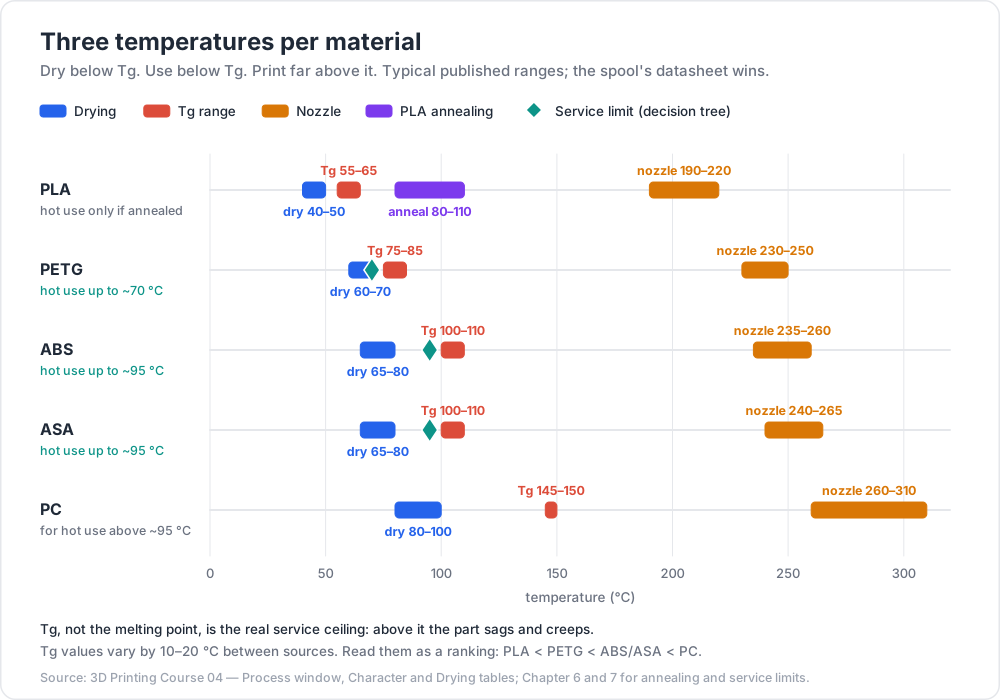
A printed part carries load through solid polymer. Above Tg the amorphous fraction becomes rubbery: modulus drops by orders of magnitude, and a part that was rigid at room temperature will sag, creep and lose dimensional stability long before anything melts. This is why a PLA phone mount fails in a car parked in the sun even though PLA does not melt until far higher: the interior of a closed car in direct sun readily reaches the low end of PLA's Tg range.
Three consequences worth internalising:
- Compare service temperature against Tg, with margin. Treat Tg as the ceiling, and derate further if the part is loaded — polymers creep faster as they approach Tg (Post 07).
- Tm is a printing parameter, not a service parameter. It tells you roughly where the extruder must operate. It tells you nothing useful about whether a bracket survives on an engine bay.
- HDT is closer to what you want but still not it. HDT is measured at a specific stress on a specific bar geometry, in a solid moulded specimen — not a 3-perimeter, 15 %-infill print with anisotropic layer bonding.
Watch out: the Tg values circulating in the hobby community for a given material vary by 10–20 °C between sources, because different grades, different additives and different measurement methods genuinely give different numbers. Use them as a family ranking (PLA < PETG < ABS/ASA < PC), and use the specific spool's technical datasheet for anything that matters.
Amorphous vs semi-crystalline, and what it predicts
| Behaviour | Amorphous (ABS, ASA, PC, PETG) | Semi-crystalline (PA, PP, PLA when crystallised, PEEK) |
|---|---|---|
| Transition on cooling | gradual stiffening through Tg | crystallisation, with a volume step |
| Shrinkage on cooling | lower, mostly thermal contraction | higher — crystallisation densifies the material |
| Warping tendency | moderate to high (ABS) | high (PA, PP), or low if crystallisation is suppressed (PLA) |
| Chamber/enclosure benefit | large — keeps the part above the stress-relief range | large, and often needed for even crystallisation |
| Optical | typically transparent-capable | typically opaque or translucent |
| Solvent resistance | lower (ABS dissolves in acetone) | usually higher |
| Layer bonding | good — chains interdiffuse readily near Tg | can be poorer; crystals resist interdiffusion |
PLA is the instructive special case: it is chemically semi-crystalline but crystallises slowly, so a normally-printed PLA part is mostly amorphous. That is exactly why PLA barely warps and why annealing (Chapter 6) can change its properties so dramatically — annealing is what finally lets the crystals form.
Chapter 2 — The filament families
Everything below is a published typical range across common grades, not a specification. Different vendors, different additives and different colours of nominally the same material move these numbers. The datasheet supplied with the spool overrides this table without exception. Where you need a number for a design decision, take it from the datasheet; where the datasheet is silent, measure (Post 05 gives the procedure for dimensions; Post 07 for strength).
Process window
| Material | Nozzle (°C, typical) | Bed (°C, typical) | Enclosure | Cooling fan | Notes |
|---|---|---|---|---|---|
| PLA | 190–220 | 50–60 | not required; a hot enclosure can cause heat creep | high, often 100 % | most forgiving material in existence |
| PETG | 230–250 | 70–85 | optional | low–moderate (30–50 %) | too much cooling kills layer adhesion |
| ABS | 235–260 | 90–110 | strongly recommended | off or minimal | warps badly without one |
| ASA | 240–265 | 90–110 | strongly recommended | off or minimal | ABS-like, formulated for UV |
| TPU (85A–95A) | 210–240 | 30–60 | not required | low–moderate | slow, direct drive strongly preferred |
| Nylon / PA12 | 240–270 | 60–100 | recommended | low | extremely hygroscopic |
| Nylon / PA6 blends | 250–290 | 80–110 | recommended | low–off | higher Tm, worse moisture behaviour |
| PC / PC blends | 260–310 | 100–120 | required | off | high temperature, high warp |
| CF / GF composites | base polymer's window, often +5–15 | as base polymer | as base polymer | as base polymer | hardened nozzle mandatory |
Character
| Material | Tg (typical range) | Shrinkage / warp | Stiff vs tough | UV | Chemical | Contact caveats |
|---|---|---|---|---|---|---|
| PLA | ~55–65 °C | very low | stiff, low impact, notch-sensitive | poor long-term outdoors | poor vs solvents; hydrolyses when hot+wet | often food-safe as a polymer; the printed part is not — see below |
| PETG | ~75–85 °C | low–moderate | moderately stiff, noticeably tougher than PLA | fair | good vs water and dilute acids | same caveat; PET family is common in food packaging |
| ABS | ~100–110 °C | high | moderate stiffness, good impact | poor — yellows and embrittles | soluble in acetone (feature for smoothing) | not for food contact; styrene emissions |
| ASA | ~100–110 °C | high | similar to ABS | good — the reason ASA exists | similar to ABS | outdoor parts |
| TPU | varies widely with hardness | low | flexible; energy-absorbing, high elongation | fair | good vs oils/greases (grade-dependent) | skin contact grades exist; verify per grade |
| Nylon / PA | grade-dependent, and drops sharply when wet | high | tough, ductile, abrasion-resistant | fair | excellent vs oils/fuels | absorbs water in service, not just on the spool |
| PC | ~145–150 °C | high | very stiff and strong, good impact | poor unless UV-stabilised | attacked by some solvents; stress-cracks | high service temperature |
| CF composite | base polymer's Tg | lower than base — fibre restrains contraction | much stiffer, less ductile, more brittle | as base | as base | abrasive; fibres at broken edges |
| GF composite | base polymer's Tg | lower than base | stiffer than base, less brittle than CF | as base | as base | abrasive |
Watch out — "food safe" is a system property, not a material property. Even where the base polymer is approved for food contact, a printed part is not: the layer lines are a colonisable surface that cannot be reliably cleaned, the brass in a standard nozzle may contain lead, and the pigments and processing aids in a hobby spool are rarely documented to food-contact standards. If a part must contact food or skin, the defensible routes are a documented food-contact-certified filament plus a food-safe coating or liner, or printing a mould and casting the contact part in a certified material. "PLA is made from corn" is not an argument.
Trick: TPU is sold by Shore hardness, not by a trade name — the scale is what to shop by. Shore 85A is soft and gasket-like and is genuinely hard to print; 95A is the common general-purpose grade; 98A prints almost like a stiff plastic; Shore 60D is harder still and behaves close to a rigid filament. If a TPU print fails on retraction and stringing, the fix is usually a lower Shore number needing a shorter, more constrained filament path — or moving up in hardness.
Chapter 3 — Warping, shrinkage and the enclosure question
Warping is not a mystery and it is not a bed-adhesion problem in origin — bed adhesion is only where the symptom appears.
The physics
Every polymer contracts as it cools. In a printed part, that contraction happens unevenly in time: the layer being deposited is at nozzle temperature, the layer below is somewhere between, and the first layer has been sitting on a heated plate for an hour. Each new layer solidifies and then tries to contract while bonded to a layer beneath that has already finished contracting and will not move. The result is a stress field locked into the part, tensile in the newer material, and it grows with every layer.
That locked-in stress has to go somewhere. It is relieved by:
- Curling — the free edges of the part lift, which is geometrically the cheapest way to relieve it. Corners lift first because they have two free directions.
- Delamination — a layer interface splits, usually on a tall thin part or at a stress raiser.
- Bed release — the whole part peels off the plate.
Two independent quantities drive the magnitude: the total contraction from nozzle to room temperature (roughly the coefficient of thermal expansion times the temperature drop, plus any crystallisation shrinkage) and the temperature gradient through the part while printing.
Why ABS needs an enclosure and PLA does not
Run the comparison:
- PLA is printed around 200 °C and, being effectively amorphous as printed, contracts modestly. Its Tg is around 55–65 °C, so the part becomes rigid at a temperature only a little above the bed, meaning the stress-accumulating window is short and the accumulated stress is small. An enclosure adds nothing and can hurt: it raises the temperature around the heatsink and hotend, promoting heat creep and jams.
- ABS is printed around 250 °C, has a Tg around 100–110 °C, and contracts substantially. Its Tg is far above room temperature, so the part spends a long stretch of its cooling path below Tg — rigid, storing stress rather than relaxing it. An enclosure holds the chamber high enough that the part stays near or above Tg — mobile, able to relax stress — for longer, and it removes the gradients caused by room draughts. That is the mechanism: the enclosure is a stress-relief oven, not a heater for the plastic.
Consequences that follow directly:
| Symptom | Mechanism | Fix in order of leverage |
|---|---|---|
| Corners lift on a large flat ABS part | high contraction plus draught-driven gradients | enclosure; raise chamber temperature; brim; reduce part footprint or split the part |
| Part releases mid-print, PLA | adhesion, not warp | clean the plate (IPA, then soap and water for oils); first-layer squish (Post 01) |
| Tall PC part delaminates near the top | chamber cools with height; interface bonding falls | enclosure with an actively warm chamber; raise nozzle temperature; reduce cooling |
| Nylon curls despite an enclosure | crystallisation shrinkage plus moisture | dry the filament (Chapter 4) before blaming warp |
| Fibre-filled version of the same polymer warps less | fibres restrain matrix contraction | expected — this is a genuine benefit of CF/GF grades |
Common pitfall: adding a brim or raft to fight ABS warp. It buys a little and hides the cause. The stress is still in the part; you have merely bonded it harder to the plate, which converts corner lift into internal stress or a delamination crack higher up. Fix the thermal environment.
Trick: you can see the locked-in stress. Print a thin ABS bar without an enclosure, let it cool fully, then cut it lengthwise with a sharp blade. The two halves spring apart. A bar printed in a warm enclosure moves much less. This is a five-minute experiment that makes the whole chapter concrete.
Chapter 4 — Moisture, the invisible variable
Which polymers care
Hygroscopic means the polymer absorbs water from air into its bulk, not just onto its surface. In rough order of severity for printing filaments:
| Severity | Materials | Practical consequence |
|---|---|---|
| Extreme | PVA, PA (nylon), PC | unprintable within hours to days of open-air exposure in a humid room |
| High | TPU, PETG, ASA | visible surface and strength degradation over days to weeks |
| Moderate | ABS, PLA | degrades over weeks to months; PLA additionally hydrolyses when hot and wet, permanently shortening chains |
| Low | dried, sealed, unopened spools of anything | the state you want to maintain |
The hydrolysis point matters and is often missed: for PLA and the polyesters, water is not just a bubble source. At extrusion temperature, absorbed water chemically cleaves the polymer chains. Drying removes the water but does not undo the chain scission. Wet-then-dried PLA prints acceptably and is measurably weaker than it should be.
What wet filament looks and sounds like
| Sense | Signature |
|---|---|
| Sound | intermittent popping, crackling, hissing at the nozzle — steam escaping |
| Extrusion | visible steam or micro-bubbles; the strand from a hand-purge is foamy or wavy rather than smooth |
| Surface | rough, matte, pitted; PETG turns hazy and blistered rather than glossy |
| Stringing | dramatically worse, and unresponsive to retraction tuning |
| Dimensions | inconsistent extrusion width; unpredictable flow calibration (this contaminates the Post 05 measurements) |
| Strength | reduced, often severely, especially interlayer |
| Cross-section | cut a purged strand: voids and bubbles inside the bead |
Common pitfall: tuning retraction for hours to chase stringing that is caused by moisture. Before any retraction tuning session, do the hand-purge test: extrude 100 mm by hand and look and listen. If it pops, dry the spool first and start the tuning session over.
Drying
Drying is a diffusion process: temperature sets the rate, time lets the water get out of the core of the spool. Getting the temperature wrong in the other direction fuses the spool.
Published starting points — again, the spool's own datasheet wins, especially for filled and specialty grades:
| Material | Typical drying temperature | Typical time | Note |
|---|---|---|---|
| PLA | ~40–50 °C | 4–8 h | stay well below Tg or the spool welds to itself |
| PETG | ~60–70 °C | 4–8 h | |
| ABS / ASA | ~65–80 °C | 4–6 h | |
| TPU | ~45–55 °C | 4–8 h | soft; low temperature, longer time |
| PVA | ~45–55 °C | 6–12 h | re-wets almost immediately after |
| Nylon / PA | ~70–90 °C | 8–12 h+ | manufacturers commonly specify the upper end |
| PC | ~80–100 °C | 6–12 h |
The universal rule that makes those numbers safe: dry below the material's Tg, with margin, or the spool deforms and the windings fuse. That is why nylon tolerates 80–90 °C and PLA does not — nylon's amorphous fraction is not the load-bearing part of a spool wound from a semi-crystalline polymer, while PLA at 70 °C is above Tg and structurally soft.
Equipment, ranked by how well it works:
- Purpose-built filament dryer — controlled temperature, adequate airflow, can print directly from the box. The right answer if you print hygroscopic materials at all.
- Food dehydrator — cheap, good airflow, often needs the shelves cut out to fit a spool. Verify the actual temperature with a separate thermometer; dial markings on cheap units are frequently wrong by 10 °C or more.
- Convection oven — workable if it can hold a low temperature accurately. Many domestic ovens cannot regulate below 70–80 °C and cycle far above the setpoint. Verify with a thermometer before trusting it with a spool.
- The printer's heated bed with a box over it — a last resort, poorly controlled.
Silica gel in a sealed box maintains dryness; it does not dry a wet spool in any reasonable time. Dry first, then store.
Storage that actually works
- Sealed container (vacuum bag or gasketed box) with indicating desiccant, plus a cheap hygrometer inside so you can see whether the system works. Target the lowest relative humidity you can maintain and hold; single digits is achievable in a good sealed box with fresh desiccant.
- Regenerate desiccant on a schedule (bake per its instructions) — spent desiccant looks identical to fresh unless it is the indicating kind.
- Dry boxes that feed the printer directly, for nylon, PC, PVA and TPU. For these materials, "dry it before printing" is not enough; a 20-hour print will re-absorb moisture from the room.
- Sealed bags on unopened spools are only as good as the desiccant packed with them. A spool that has sat in a warehouse for two years is not automatically dry.
Chapter 5 — Abrasives, multi-material adhesion, and soluble supports
Abrasive filaments and nozzle wear
Carbon fibre, glass fibre, metal-filled, wood-filled, glow-in-the-dark (glass or strontium aluminate particles) and many "sparkle" or "silk-matte" filaments contain hard particles. A standard brass nozzle is soft; those particles cut it. The failure is insidious: the orifice grows and goes out-of-round gradually, so extrusion width drifts, first layers degrade, and dimensional accuracy quietly gets worse over weeks — exactly the sort of slow drift that invalidates the calibration you did in Post 01.
| Nozzle material | Abrasion resistance | Thermal conductivity | Notes |
|---|---|---|---|
| Brass | poor | excellent | fine for PLA/PETG/ABS; wears fast on any filled filament |
| Hardened steel | good | lower — may need +5–10 °C | the common budget answer |
| Steel with wear coating | good | lower | varies enormously by product |
| Tungsten carbide / ruby-tipped | excellent | varies by construction | expensive; the long-run answer for a fibre-heavy workflow |
Trick: keep one nozzle dedicated to abrasives and one to everything else, and label them. Swapping a nozzle is a ten-minute job; re-running the whole flow and dimension calibration because a nozzle silently opened up is not.
Glow-in-the-dark filament deserves a specific warning: it is often more abrasive than carbon fibre, and it is frequently bought by beginners who have no idea it is abrasive at all.
Adhesion between materials
Multi-material printing (two extruders, a tool-changer, or a single-nozzle multi-material unit) only works if the two polymers bond at their interface, and polymer-to-polymer bonding is chemistry, not wishing.
| Pair | Bonding | Use |
|---|---|---|
| PLA + PLA (different colour) | perfect | colour changes |
| PLA + PETG | poor — bonds weakly | exploited deliberately: PETG makes a good breakaway support interface for PLA, and vice versa |
| PETG + PETG | perfect | |
| ABS + ABS / ASA | perfect | |
| TPU + PLA/PETG | moderate; mechanical interlocking helps more than chemistry | overmoulded grips — design a dovetail or through-hole so the bond is mechanical |
| PLA + PVA | good | soluble supports for PLA |
| ABS/HIPS | good | HIPS is the classic soluble support for ABS |
| Nylon + almost anything else | poor | nylon bonds well to nylon and little else |
Trick: the poor PLA/PETG bond is the single most useful multi-material trick available. Print a support interface layer in the other material and supports peel off by hand with a genuinely clean surface underneath — no solvent, no dissolving tank.
Soluble supports and their own moisture problems
- PVA (polyvinyl alcohol) — dissolves in plain water. Compatible with PLA and (with care) PETG. It is the most hygroscopic common filament by a wide margin: it will absorb enough moisture to become unprintable within hours in a humid room, and wet PVA foams, oozes, jams and clogs. PVA requires a dry box feeding the printer, not merely a dried spool. It also degrades in the hotend if held hot and idle.
- HIPS (high-impact polystyrene) — dissolves in d-limonene, not water. Compatible with ABS, and prints under ABS-like conditions. The solvent is flammable, has a strong odour, and needs ventilation and a sealed dissolving container.
- Breakaway supports — proprietary non-soluble support filaments designed to bond weakly and snap off. No solvent, no tank, no moisture management; they cost geometry flexibility versus a truly soluble support.
Practical decision: soluble supports are worth their cost and hassle when the geometry is genuinely internal — enclosed channels, captive mechanisms, deep undercuts. For everything else, revisit orientation (Post 03) first. Support material is a solution to a geometry problem you may not need to have.
Chapter 6 — Properties you set after the print: annealing, post-cure, pigment
Annealing
Annealing is holding a printed part at an elevated temperature — above Tg but below the melting/softening point — for a period, then cooling it slowly. For a semi-crystalline polymer printed too fast to crystallise (PLA is the archetype), it does three things at once:
- Increases crystallinity. Chains gain mobility above Tg and organise into crystalline domains. Stiffness, heat resistance and chemical resistance rise. Annealed PLA can retain useful stiffness meaningfully above its as-printed service ceiling — how much depends on the grade, the additives (nucleating agents in "HT" PLA grades are there specifically to make this work) and the schedule.
- Relieves internal stress. The locked-in stress from Chapter 3 relaxes. Good for stability, and it is why the part changes shape.
- Improves interlayer bonding somewhat. Chains interdiffuse across layer interfaces given mobility and time, reducing the Z-direction weakness of Post 07 — reducing, not eliminating.
The cost is dimensional change, and it is not small. Crystallisation densifies the polymer, so the part shrinks — and it shrinks anisotropically, because the print's own layer structure and residual stress field are anisotropic. Parts also sag under their own weight if unsupported above Tg.
Practical annealing procedure, if you decide the part needs it:
- Decide first whether it does. Annealing is worth it for heat-exposed and stiffness-critical PLA parts. It is not worth it for anything that has to fit something else, unless you are prepared to re-measure and iterate.
- Support the part fully — bury it in dry sand, salt or plaster, or lay it on a flat plate with nothing overhanging.
- Hold above Tg but below softening: a common starting window for PLA is roughly 80–110 °C. Longer at a lower temperature is safer than shorter at a higher one.
- Cool slowly in the oven. Quenching re-introduces the stress you just removed.
- Measure the same features before and after and record the change as a percentage. That percentage is your machine-plus-material-plus-schedule constant, and you scale the CAD model by it next time. It is not a number anyone can give you — Post 05 gives the measurement discipline.
Watch out: annealing an amorphous polymer (ABS, PETG, PC) does not increase crystallinity, because there is no crystalline phase to grow. It still relieves stress, which can be useful, and it still causes dimensional change. Do not expect the stiffness gain that PLA shows.
Resin families and post-cure
Vat photopolymerisation (Post 08 in the extension plan will go deep) has a materials landscape of its own. The critical structural fact: for photopolymer resin, a large share of the part's final mechanical properties is set by post-processing, not by printing. A green part straight out of the vat is under-polymerised, soft, and full of uncured monomer. Wash and post-cure are part of the process, not optional finishing.
| Family | Character | Typical use |
|---|---|---|
| Standard / "general purpose" | high detail, hard, brittle | display models, miniatures, figures |
| Tough / "ABS-like" | more impact energy absorbed, lower detail fidelity, softer | prototype functional parts |
| Water-washable | cleans in water instead of IPA | convenience — but generally lower mechanical properties, and the wash water is contaminated waste, not drain-safe |
| Engineering (high-temp, rigid, castable, flexible, dental) | narrow, specified properties | the specified job, per the vendor's validated workflow |
Post-cure variables that change the result: cure time, cure temperature (warm post-cure typically outperforms room-temperature cure), wavelength, whether the part is cured in water or in air (oxygen inhibits surface cure — curing submerged is a common trick), and part thickness. Vendors publish validated schedules; deviating from them makes their published mechanical data inapplicable to your part.
Common pitfall: treating resin mechanical datasheets as if they described your part. Those numbers come from specimens cured on the vendor's validated schedule. An under-cured part is dramatically weaker; an over-cured part is more brittle. Post-cure is the variable, and it is yours to control.
Colour, pigment and additives
The single most under-appreciated fact about filament: colour is not cosmetic. The pigments, fillers and processing aids change the polymer's behaviour.
- Thermal behaviour. Pigment loading changes melt viscosity and thermal conductivity. It is normal for two colours from the same vendor and the same product line to want different nozzle temperatures — sometimes by 10 °C or more.
- Crystallisation. Some pigments act as nucleating agents. This changes crystallisation rate, which changes shrinkage and warping. Black and white parts of the same nominal material genuinely do not always behave the same.
- Abrasion. Metallics, "silk", glitter and glow additives are abrasive. See Chapter 5.
- Strength. High filler loading dilutes the polymer matrix. Heavily filled decorative filaments are usually weaker than the plain version of the same material.
- Surface finish. Matte finishes come from filler particles that scatter light; they also hide layer lines, which is genuinely useful and is a materials effect, not a slicer effect.
- UV behaviour. Carbon black is an effective UV absorber; black parts often outlast light-coloured ones of the same polymer outdoors. This is not a reason to skip ASA for an outdoor part, but it is a real effect.
Trick: when you switch colour within the same product line, re-run a temperature tower and a flow check before assuming your profile transfers. It costs twenty minutes and explains a surprising number of "the printer suddenly got worse" reports.
Chapter 7 — Choosing a material, and printing it safely
The decision tree
Start from the requirement, not the material. Read down until a branch matches.
1
2
3
4
5
6
7
8
9
10
11
12
13
14
15
16
17
18
19
20
21
22
23
24
25
26
27
28
29
30
31
32
33
34
35
36
37
38
39
40
41
42
43
44
45
46
What does the part actually have to do?
├─ Just look right / verify a shape / check a fit
│ → PLA. Cheapest, fastest, most accurate, most forgiving.
│ Do not overthink a prototype.
│
├─ Live outdoors (sun, rain, temperature swings)
│ → ASA first choice. PETG acceptable for moderate exposure.
│ Never PLA (creeps and embrittles). Never plain ABS (yellows, embrittles).
│
├─ Get hot — car interior, near a motor, near electronics, dishwasher
│ ├─ up to ~70 °C → PETG
│ ├─ up to ~95 °C → ABS / ASA
│ ├─ above that → PC, or a high-temp engineering polymer,
│ │ which means an enclosure and a hot chamber
│ └─ PLA is an option ONLY if annealed, and only with measured
│ dimensional compensation
│
├─ Take impact / be dropped / be a living hinge
│ ├─ moderate → PETG
│ ├─ high → ABS, PC, or nylon
│ └─ needs to flex → TPU (choose the Shore hardness)
│
├─ Be stiff and hold shape under load
│ ├─ room temperature only → PLA (genuinely the stiffest common
│ │ filament — but see creep, Post 07)
│ └─ with heat or long-term load → CF-filled PETG / PA / PC
│
├─ Slide, wear, or run against another part
│ → nylon (PA), or a PA-CF grade. Excellent abrasion resistance.
│ Accept the moisture management burden.
│
├─ Flex, seal, grip or damp vibration
│ → TPU. Pick by Shore: 85A soft gasket · 95A general purpose
│ · 98A stiff · 60D nearly rigid.
│
├─ Contact food or skin
│ → treat as a system problem, not a filament problem:
│ certified filament + certified coating, or print a mould
│ and cast the contact part.
│
└─ Be dimensionally precise and fit something else
→ whatever material you can measure and repeat (Post 05).
Low-shrinkage materials (PLA, PETG, fibre-filled grades)
make this far easier than ABS or nylon.
Two meta-rules that outrank the tree:
- Prototype in PLA regardless of the final material. Iterate the geometry cheaply and fast, then reprint the final version in the material the job needs. Changing material changes dimensions, so re-verify the fit (Post 05) — but do the geometry iteration in the easy material.
- Prefer the easiest material that meets the requirement. Every step up in material difficulty costs enclosure, drying, nozzle hardware, tuning time and failed prints. Only pay that when the requirement demands it.
Safety
Printing polymers releases ultrafine particles (UFPs) and volatile organic compounds (VOCs). This is measured, published science, not speculation. Peer-reviewed work characterising desktop FDM printers (Azimi et al., Environmental Science & Technology, 2016) found that emission rates and species depend strongly on filament and nozzle temperature: styrene dominates for ABS and HIPS, caprolactam for nylon-based and composite filaments, and lactide for PLA — with ABS emitting substantially more overall than PLA, and lower nozzle temperatures producing lower emission rates. ANSI/CAN/UL 2904 is the standard test method for characterising these emissions, and some printers and filaments are certified against it.
The proportionate response:
| Situation | Measure |
|---|---|
| Any printer, any material | do not print in a bedroom or an unventilated occupied room |
| PLA/PETG in a well-ventilated workshop | adequate room ventilation is a reasonable baseline |
| ABS/ASA/nylon/PC, or any long print | enclosure with a filter (HEPA for particles plus activated carbon for VOCs — a HEPA filter alone does nothing for VOCs), or vent the enclosure outdoors |
| Printing near where people sleep or work all day | vent outdoors, or move the printer |
| Any material, any enclosure | run the fan, and note that an enclosure without filtration concentrates emissions and then releases them when opened |
Resin adds a different and more direct hazard class:
- Uncured resin is a skin sensitiser. Nitrile gloves, always. Sensitisation is cumulative and can be permanent: people who handled resin carelessly for a year and then developed a reaction do not get to go back.
- Eye protection when handling resin or IPA.
- Ventilation — resin and IPA vapour both need it.
- Never pour uncured resin, resin-contaminated IPA, or water-washable rinse water down a drain. Cure the waste solid under UV or sunlight first, then dispose of it as solid plastic waste, per local rules.
- Cure everything, including failed prints, supports, drips and the paper towels. Cured resin is inert; uncured resin is not.
Also mechanical and thermal, and easy to forget: hotends run at 200–300 °C, beds at up to 120 °C, and a printer with an unattended thermal runaway is a fire source. Verify that thermal runaway protection is enabled in firmware, keep the machine off carpet and away from anything flammable, and treat a smoke alarm in the print room as mandatory equipment rather than an optional extra.
Practice Exercises
Exercise 1 — Locate and read a real datasheet
Take a spool you own. Find the manufacturer's technical datasheet (TDS) for that exact product, not a generic material page. Extract: recommended nozzle range, bed range, Tg or HDT (with its load), drying schedule, and any mechanical data with the test standard cited. Compare each entry against Chapter 2's table and note every disagreement.
Solution
1
2
3
4
5
6
7
8
9
10
11
12
13
14
What you should find, and what it means:
- The TDS ranges are NARROWER than the table's family ranges. That is correct:
the table spans grades; the TDS describes one.
- Mechanical numbers are cited against a standard (commonly ISO 527 for tensile,
ISO 179/180 for impact). Numbers with no standard cited are marketing.
- Many TDS mechanical figures come from INJECTION MOULDED specimens.
Those do not describe a printed part — no layer interfaces, no infill,
isotropic. Some vendors publish printed-specimen data and state the
print orientation; those are the useful ones.
- The drying schedule, if present, overrides Chapter 4's table.
- If no TDS exists for the product at all, that is itself information about
the vendor.
Exercise 2 — The wet-filament A/B
Take a small quantity of PETG or nylon. Deliberately leave part of it exposed in the most humid place available for several days while the rest stays sealed with fresh desiccant. Print the same small test object from each. Record: audible popping (yes/no), surface finish, stringing, and whether the two objects measure the same. Then dry the wet sample per Chapter 4 and print a third.
Exercise 3 — Make the residual stress visible
Print the same thin bar (roughly 100 × 10 × 3 mm) in PLA and in ABS, both without an enclosure. Cool fully. Slit each lengthwise with a sharp blade and observe how far the halves spring apart. Repeat the ABS bar inside an enclosure (or a cardboard box over the printer) and compare. Write one sentence explaining the result in terms of Tg.
Solution
1
2
3
4
5
6
7
8
9
10
11
12
PLA bar: halves barely move.
ABS bar, open: halves spring apart visibly.
ABS bar, enclosed: intermediate — clearly less than the open ABS bar.
Explanation: ABS is printed ~50 °C hotter and contracts more, and its Tg
(~100-110 °C) is far above the ambient, so the part spends a long stretch of
its cooling path below Tg — rigid, and therefore storing rather than relaxing
the contraction stress of each new layer. An enclosure keeps the part near or
above Tg for longer, so more of that stress relaxes instead of being locked in.
PLA's low print temperature, low contraction and low Tg mean little stress
accumulates in the first place.
Exercise 4 — Anneal and measure
Print two identical PLA parts with at least one dimension over 50 mm and at least one hole. Measure every feature on both, five times each (Post 05 gives the method). Anneal one, supported, per Chapter 6. Re-measure. Tabulate percentage change per axis (X, Y and Z separately). Then check whether the annealed part still fits whatever the original fitted.
Solution
1
2
3
4
5
6
7
8
9
10
11
12
13
14
15
Expected structure of the result (your numbers will differ — that is the point):
Feature Before After Change %
X length .. .. negative (shrunk)
Y length .. .. negative, similar magnitude to X
Z height .. .. often DIFFERENT sign or magnitude from X/Y
Hole diameter .. .. usually shrinks with the surrounding material
Key findings to record:
1. Shrinkage is anisotropic — X/Y and Z do not match. The print's layer
structure and residual stress field are anisotropic, so the relaxation is too.
2. The change is large enough to break a fit that previously worked.
3. To use annealing on a part that must fit, scale the CAD model by the
MEASURED per-axis factor and re-verify. There is no universal factor.
Exercise 5 — Pigment is not cosmetic
Take two colours of the same product line from the same vendor. Run an identical temperature tower on each. Note the temperature at which each first bridges cleanly and each first shows stringing. Then print an identical 20 mm cube in each and compare measured dimensions.
Exercise 6 — Write a selection memo
Pick a real part you want to print — describe its actual loads, temperatures, environment and lifetime in one paragraph. Walk Chapter 7's decision tree and write down which branch you landed on and why. Then name the second choice and state the specific trade-off that made you reject it. If you cannot name a second choice, the requirement is not yet specified precisely enough.
Exercise 7 — Audit your ventilation
Write down: where the printer is, what shares that air, how many hours a day it runs, who is in the room, and what materials you print. Compare against Chapter 7's table and name the one change with the biggest effect. Implement it.
Cheat-sheet
| What | How |
|---|---|
| Real service temperature ceiling | the material's Tg, with margin — not Tm, not the nozzle temperature |
| Predict warping | high print temperature + high Tg + high contraction ⇒ needs an enclosure |
| Why an enclosure works | keeps the part near/above Tg so contraction stress relaxes instead of locking in |
| PLA does not need an enclosure | low print temperature, low contraction, low Tg — and a hot chamber causes heat creep |
| Wet filament, fastest test | hand-purge 100 mm and listen for popping / look for foam |
| Drying rule that never fails | dry below Tg, with margin, for hours not minutes |
| Storage that works | dry first, then sealed box + indicating desiccant + a hygrometer you actually read |
| PVA / nylon / PC | dry box feeding the printer, not just a dried spool |
| Abrasive filaments | CF, GF, metal-fill, wood-fill, glow, glitter, some silks ⇒ hardened nozzle |
| Nozzle wear symptom | gradual loss of dimensional accuracy and first-layer quality over weeks |
| Soluble supports | PVA dissolves in water (PLA); HIPS dissolves in d-limonene (ABS) |
| Free breakaway trick | PLA and PETG bond poorly — use one as the other's support interface |
| TPU is sold by | Shore hardness: 85A soft · 95A general · 98A stiff · 60D near-rigid |
| Annealing | raises crystallinity and heat resistance in PLA; always changes dimensions anisotropically |
| Annealing amorphous polymers | relieves stress, does not add crystallinity — no stiffness gain |
| Resin properties are set by | post-cure, not printing — follow the vendor's validated schedule |
| Colour changes behaviour | pigment alters melt viscosity, crystallisation, abrasion and strength |
| Outdoor part | ASA. Not PLA, not plain ABS |
| Food or skin contact | a system problem: certified filament + certified coating, or print a mould |
| Prototype material | PLA, always, whatever the final material will be |
| Emissions | UFPs + VOCs; enclosure with HEPA and activated carbon, or vent outdoors |
| Resin handling | nitrile gloves, eye protection, ventilation, cure all waste before disposal |
What's next
Post 05 is the intellectual core of the series: Dimensional Accuracy and Tolerances. It separates accuracy from precision from resolution, builds an honest error budget for a printed dimension, and gives a reproducible procedure for deriving your own machine's offsets rather than trusting anyone else's numbers — including the ones in this post. Everything in Chapter 6 about annealing shrinkage, and everything in Chapter 3 about material contraction, feeds directly into that error budget.
References
- ISO/ASTM 52900:2021 — Additive manufacturing: general principles, fundamentals and vocabulary — the terminology standard for the field.
- ANSI/CAN/UL 2904 — standard method for testing and assessing particle and chemical emissions from 3D printers.
- Azimi, P. et al., "Emissions of Ultrafine Particles and Volatile Organic Compounds from Commercially Available Desktop Three-Dimensional Printers with Multiple Filaments", Environmental Science & Technology (2016) — DOI 10.1021/acs.est.5b04983.
- NIOSH / CDC research on reducing ultrafine particulate emission from 3D printers — occupational-hygiene perspective and control measures.
- Prusa Knowledge Base — materials — per-material printing guidance from a printer vendor with published profiles.
- Voron Design documentation — materials selection — a well-reasoned engineering comparison written for printer parts under thermal load.
- Your filament's own technical datasheet (TDS) and safety data sheet (SDS) — the only sources that describe the material actually on your spool.
Note: this post is in progress. Planned additions: a measured warp-test artefact with a printable STL, a comparison of desiccant regeneration methods with measured RH curves, a survey of high-temperature engineering filaments (PPS, PEI, PEEK) and the hardware they demand, and a worked food-contact coating evaluation.