MongoDB Course — 28 · Time-Series at Extreme Scale — vs ClickHouse, Timescale, Influx
MongoDB's native time-series collections (Post 17 Ch 9) cover small-to-medium telemetry workloads beautifully — IoT fleets in the thousands of devices, observability for a single product, financial ticks for a few symbols. Past that, dedicated columnar / time-series engines pull ahead by an order of magnitude on price-performance. This post is the comparative guide: how Mongo time-series collections actually work internally, where their limits are, and how they compare to ClickHouse, TimescaleDB, InfluxDB, QuestDB, Druid. The goal — give you the decision matrix so you know when to stay on Mongo and when to add (or move to) something else.
Series map: 26 OpenTelemetry → 27 Geo → 28 Time-series extreme (this post) → 29 K8s + mongosync + cost.
Learning Outcome
- Explain how MongoDB time-series collections store + query data.
- Recognise the workload ceiling — when Mongo time-series stops scaling.
- Compare with ClickHouse, TimescaleDB, InfluxDB, QuestDB, Druid on the dimensions that matter.
- Pick a stack — pure Mongo / Mongo + hot analytics engine / replace Mongo for this workload.
- Design hybrid architectures (Mongo OLTP + external OLAP).
Chapter 1 — How Mongo time-series collections work
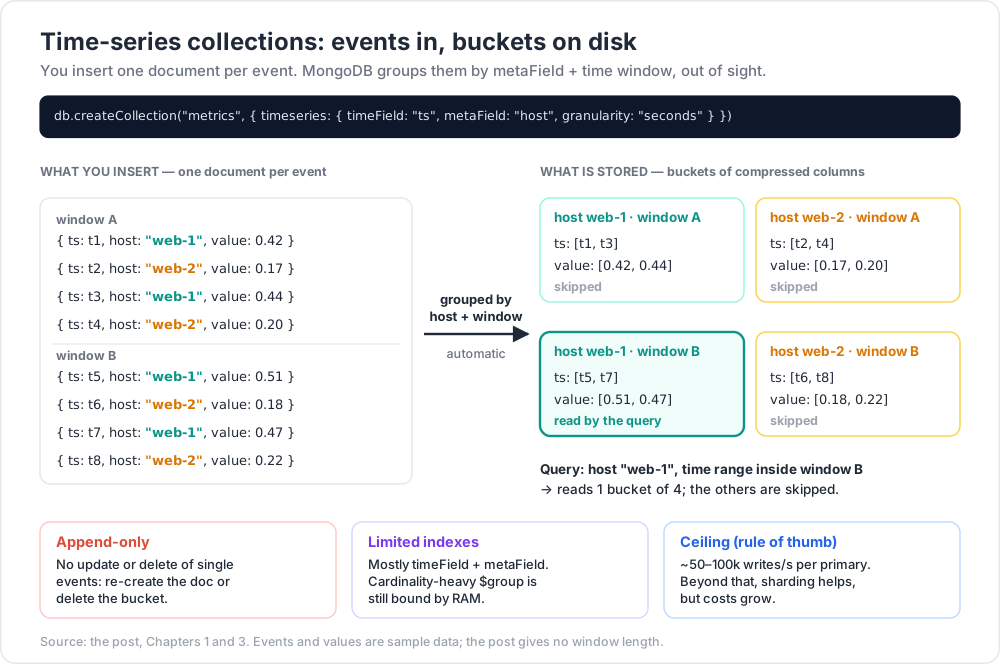
You create a TS collection with a timeField, optional metaField, and granularity:
1
2
3
4
db.createCollection("metrics", {
timeseries: { timeField: "ts", metaField: "host", granularity: "seconds" }
})
Under the hood:
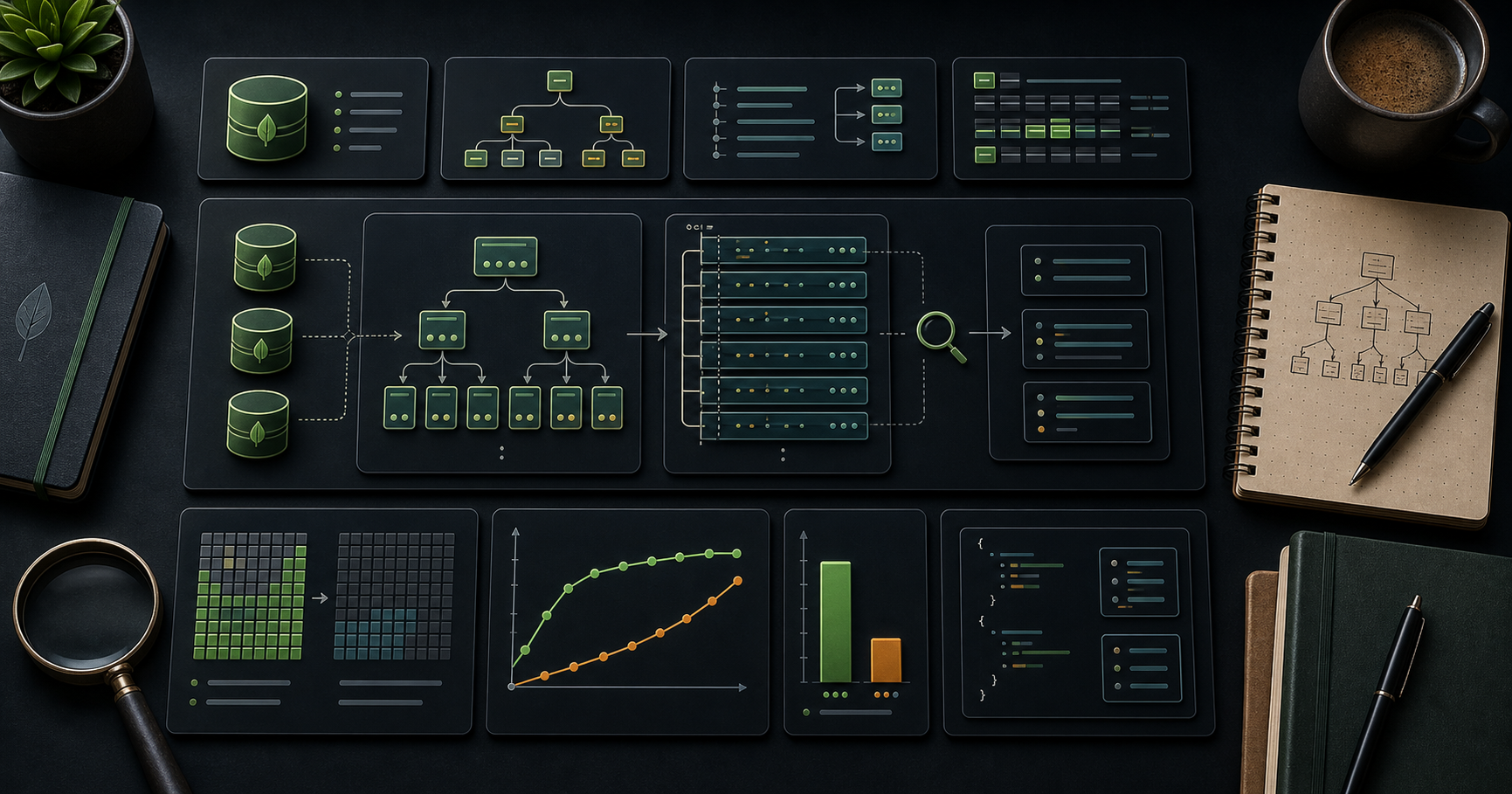
- Documents you insert are invisibly bucketed by
metaField+ time window. The visible API is one-doc-per-event, but on disk it's many events per bucket document. - Buckets use columnar compression — much smaller than 1-doc-per-event.
- Queries by time range + metaField are fast because they touch only matching buckets.
Trade-offs vs hand-rolled bucket pattern (Post 07 Ch 5):
- No manual schema to maintain.
- Better compression than naive.
- TTL works out of the box.
Limits to be aware of:
- No update / delete of individual events (you can re-create the doc or delete the bucket; old events were immutable).
- Indexing limited (mostly
timeField+metaField; partial multi-key support). - Aggregations work but cardinality-heavy
$groupis still RAM-bound.
For most telemetry use cases this is fine. Workloads where Mongo TS starts to crack: 100k+ writes/sec sustained on a single node, deep aggregations over years of data, sub-100 ms query latency on billions of rows.
Chapter 2 — Where Mongo TS shines
| Workload | Why Mongo TS fits |
|---|---|
| Mid-volume IoT (thousands of devices, 1-10 Hz each) | one collection; no extra infra |
| Observability for one product | metrics + tags fit Mongo doc model; index by host + time |
| Financial ticks for handful of symbols | bucket per symbol + minute |
| Audit / event log with TTL | TS + expireAfterSeconds purges automatically |
| Workloads that mix transactional + analytics | one DB; no ETL |
If you're already on Mongo + the workload is in this band, don't add a new DB. The operational simplicity wins.
Chapter 3 — Where Mongo TS struggles
- Very high write throughput — single primary saturates around 50-100k writes/sec on a strong shard. Beyond that, sharding helps but costs grow.
- Very deep aggregations — averaging across billions of rows with cardinality-heavy
$groupis slower than columnar engines built for it. - Sub-50ms p99 on huge ranges — columnar formats with vectorised execution win.
- Compression at extreme scale — ClickHouse / Parquet typically achieves 5-20× the compression ratio of Mongo TS for time-series-shape data.
- Cost per TB of cold data — Atlas hot storage isn't cheap; archive helps but specialist engines compress more aggressively.
When the workload hits any of these, look at alternatives below.
Chapter 4 — Alternatives — quick reference
| System | Storage model | Strengths | Weaknesses |
|---|---|---|---|
| MongoDB TS | document buckets w/ columnar compression | flexible schema, mixed workload, one DB | scale ceiling, slower deep analytics |
| ClickHouse | columnar, MergeTree variants | extreme analytics speed; great compression; SQL | append-mostly; weaker on point updates; ops complexity |
| TimescaleDB | Postgres extension; chunked time-partitioned tables | full SQL + Postgres tooling; PostGIS friends | not columnar core; scaling beyond 1 node harder |
| InfluxDB v3 | Apache Arrow + Parquet | purpose-built for metrics; PromQL-like Flux/SQL | rewrite history; ecosystem smaller |
| QuestDB | columnar, SIMD-vectorised | very fast ingest + queries; small footprint | newer ecosystem; less feature coverage |
| Apache Druid | columnar, segment-based | sub-second on huge datasets + dashboards | heavy ops; complex schema |
| Apache Pinot | columnar, segment-based | sub-second; ad-tech / event use cases | heavy ops |
| Prometheus + Mimir/Thanos | TSDB | metrics monitoring | not for arbitrary analytical queries |
For pure analytics over time-series, ClickHouse is the dominant 2026 choice for new builds. Operational complexity dropped with managed offerings (Altinity Cloud, ClickHouse Cloud).
Chapter 5 — ClickHouse — when + how
ClickHouse is a columnar OLAP database. Strengths for time-series:
- Sub-second aggregation over billions of rows.
- 10-50× compression vs row-store.
- Materialized views update incrementally.
- Native S3 + Parquet integration for cold storage.
1
2
3
4
5
6
7
8
9
10
11
12
13
14
15
CREATE TABLE metrics (
ts DateTime CODEC(Delta, ZSTD),
host LowCardinality(String),
metric LowCardinality(String),
value Float64
) ENGINE = MergeTree()
PARTITION BY toYYYYMM(ts)
ORDER BY (host, metric, ts);
SELECT host, avg(value)
FROM metrics
WHERE metric = 'cpu' AND ts >= now() - INTERVAL 1 HOUR
GROUP BY host
ORDER BY 2 DESC LIMIT 20;
Inserts: millions of rows / second per node.
Queries: tens of milliseconds over millions of rows.
Trade-offs:
- Append-mostly; updates + deletes are expensive (mutations queue).
- Schema is rigid (vs Mongo's flexibility).
- Operational complexity higher than managed Mongo.
Use ClickHouse when: pure analytical queries dominate; workload exceeds Mongo TS ceiling; you can devote eng time to running it or pay for managed.
Chapter 6 — Hybrid — Mongo for OLTP, ClickHouse for OLAP
The common 2026 pattern for serious scale:
1
2
3
4
5
6
7
8
Application
│ writes (transactional)
▼
MongoDB (OLTP: orders, users, sessions, recent telemetry)
│ change stream / outbox / Kafka
▼
ClickHouse (OLAP: years of history, dashboards, BI)
Mongo handles user-facing reads + writes with rich queries on recent data. Events flow to ClickHouse via Kafka (Post 24) or a periodic batch ($merge + S3 → ClickHouse). Dashboards / BI hit ClickHouse for big analytics.
Each tool does what it's best at; you pay the cost of running two systems but neither is asked to do the other's job poorly.
Chapter 7 — When TimescaleDB fits better
If your team is already deep on Postgres + your analytical queries are still SQL-shape (joins, complex predicates, transactions over recent slices), TimescaleDB keeps you on one engine.
1
2
3
4
5
6
7
CREATE TABLE metrics (
ts TIMESTAMPTZ NOT NULL,
host TEXT,
value DOUBLE PRECISION
);
SELECT create_hypertable('metrics', 'ts');
Strengths:
- Full Postgres feature set + PostGIS + extensions.
- Multi-tier storage (recent on SSD, old compressed to columnar).
- Familiar to SQL teams.
Weaknesses:
- Not as fast as pure columnar for huge analytics.
- Scaling horizontally still harder than Atlas + Mongo or ClickHouse.
Pick when: SQL-first team, mixed transactional + analytical SQL workload, < ~1 TB per dataset.
Chapter 8 — InfluxDB v3 — metrics-focused
InfluxDB v3 (formerly IOx) is rebuilt on Apache Arrow + Parquet. Strengths for metrics:
- Native to monitoring workflows (Prometheus-compat ingest, Grafana plugin).
- Fast on time-series math (rates, moving averages, derivatives).
- Self-managed or cloud.
Weaknesses:
- Less general-purpose than ClickHouse.
- Schema evolution gotchas inherited from earlier versions.
Pick when: pure monitoring workload + you want a metrics-first DB rather than a general analytical engine.
Chapter 9 — QuestDB — fast + small
QuestDB is a young, fast columnar TS database. Strengths:
- Tiny footprint; runs on a laptop and on a server.
- Very fast ingest + SQL queries.
- Compatible with Postgres wire protocol.
Weaknesses:
- Smaller community + ecosystem than ClickHouse.
- Fewer enterprise features.
Pick when: greenfield project, dev-friendliness > ecosystem.
Chapter 10 — Druid / Pinot — sub-second dashboards over huge data
For ad-tech, real-time analytics, leaderboard-style dashboards over billions of rows with millisecond response:
- Apache Druid — operational complexity high; sub-second analytical queries shine.
- Apache Pinot — similar story; LinkedIn / Uber heritage.
Not the first choice for general workloads; reserve for when you genuinely need that latency at that scale.
Chapter 11 — Decision matrix
1
2
3
4
5
6
7
8
9
10
11
12
13
14
15
16
17
18
19
20
21
Mongo TS already in use + workload < 50k writes/sec sustained?
→ stay on Mongo TS.
Mongo TS but slow analytics over years of data?
→ keep Mongo for OLTP, add ClickHouse for OLAP (Chapter 6 hybrid).
Greenfield project, SQL team, mixed workload, < 1 TB / dataset?
→ TimescaleDB.
Greenfield project, NoSQL friendly, time-series only, very high throughput?
→ ClickHouse or QuestDB.
Pure metrics monitoring?
→ InfluxDB v3 or Prometheus + Mimir/Thanos.
Sub-second dashboards over billions of rows?
→ Druid or Pinot.
Already on Postgres + small scale?
→ TimescaleDB.
The right answer is rarely "one engine for everything" past a certain scale.
Chapter 12 — Migration paths
Mongo TS → ClickHouse
- Continue ingesting into Mongo.
- Stream from Mongo to ClickHouse via Kafka (Post 24) or
$mergeto S3 → ClickHouse S3-table. - Switch dashboards + BI to ClickHouse.
- Optionally cut writes to Mongo if it no longer serves a transactional purpose.
Atlas Online Archive as a half-step
For "old data costs too much in Mongo", Atlas Online Archive (Post 16) moves cold data to cheap S3-like storage, still queryable via federation. Cheaper than ClickHouse for archive-then-occasionally-query patterns. Faster path than a full migration.
Chapter 13 — Common pitfalls
| Pitfall | Cause | Fix |
|---|---|---|
| Started with Mongo TS, blew the ceiling | optimistic capacity planning | hybrid with ClickHouse for analytics |
| Adopted ClickHouse for OLTP | wrong tool | use it only for OLAP; keep Mongo for OLTP |
| Schema rigid in ClickHouse, painful to add columns | underestimated evolution cost | always design ALTER-friendly schemas |
| Big bills running both Mongo + ClickHouse | parallel storage of same data | smarter retention (raw in CH, summaries in Mongo) |
| TS collection updates rejected | by design — TS is append-only | re-architect to event-shape |
| Cross-engine joins required | one shouldn't be the source of truth for the other | sync via Kafka; or materialise into one |
| New DB before proving the need | premature optimisation | scale-test Mongo TS first |
Practice Exercises
Exercise 1 — Benchmark Mongo TS
Insert 10M rows into a Mongo TS collection (single device). Time random-time-range aggregations.
Exercise 2 — ClickHouse PoC
Stand up ClickHouse local. Insert the same 10M rows. Run the same aggregations. Compare.
Exercise 3 — Hybrid sync
Build the Mongo→Kafka→ClickHouse path for one collection. Verify rows land in both.
Exercise 4 — Compression compare
Disk size: Mongo TS 10M rows vs ClickHouse 10M rows vs raw JSONL. Note the ratios.
Exercise 5 — Atlas Online Archive
For an existing TS collection, set up Online Archive moving data older than 90 days. Query via federation; confirm transparency.
Exercise 6 — Decision exercise
Pick a real or imagined product. Walk Chapter 11's matrix. Justify the stack you'd pick.
Cheat-sheet
| What | How |
|---|---|
| Mongo TS | one DB; mixed workload; up to mid-volume |
| Mongo TS ceiling | ~50-100k writes/s per primary; sharding helps |
| ClickHouse | extreme analytics; OLAP only |
| TimescaleDB | Postgres-native; SQL team friendly |
| InfluxDB v3 | metrics-focused; Arrow/Parquet |
| QuestDB | fast, small, greenfield |
| Druid / Pinot | sub-second over billions; ops-heavy |
| Hybrid | Mongo OLTP + ClickHouse OLAP via Kafka |
| Atlas Online Archive | cheap cold storage; still queryable |
| Never | use ClickHouse as OLTP |
| Always | benchmark before adopting a second engine |
| Migration path | dual-write or stream into the new engine first |
What's next
Post 29 — the final post in the advanced series — covers Kubernetes (MongoDB Controllers + Operator), mongosync for cluster-to-cluster sync + multi-region active-active, cost optimisation on Atlas, and compliance patterns (HIPAA, PCI-DSS, GDPR, SOC 2).
References
- Time Series Collections
- ClickHouse docs
- TimescaleDB docs
- InfluxDB v3
- QuestDB docs
- Apache Druid
- Atlas Online Archive
Note: this post is in progress. Planned additions: live benchmark on representative dataset; cost-comparison tables across cloud regions; dedicated migration scripts.