MongoDB Course — 23 · Migrating from SQL / Postgres to MongoDB
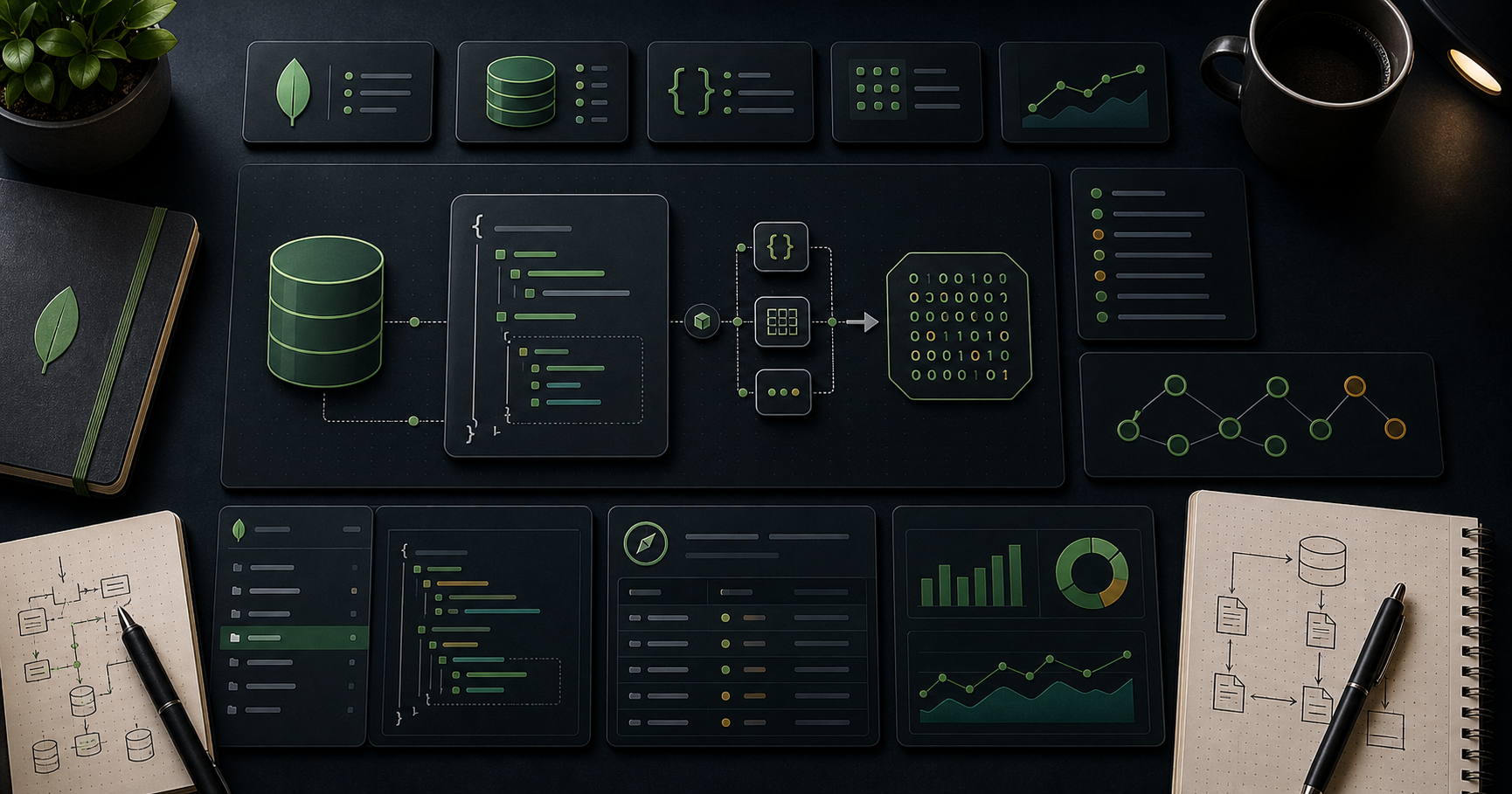
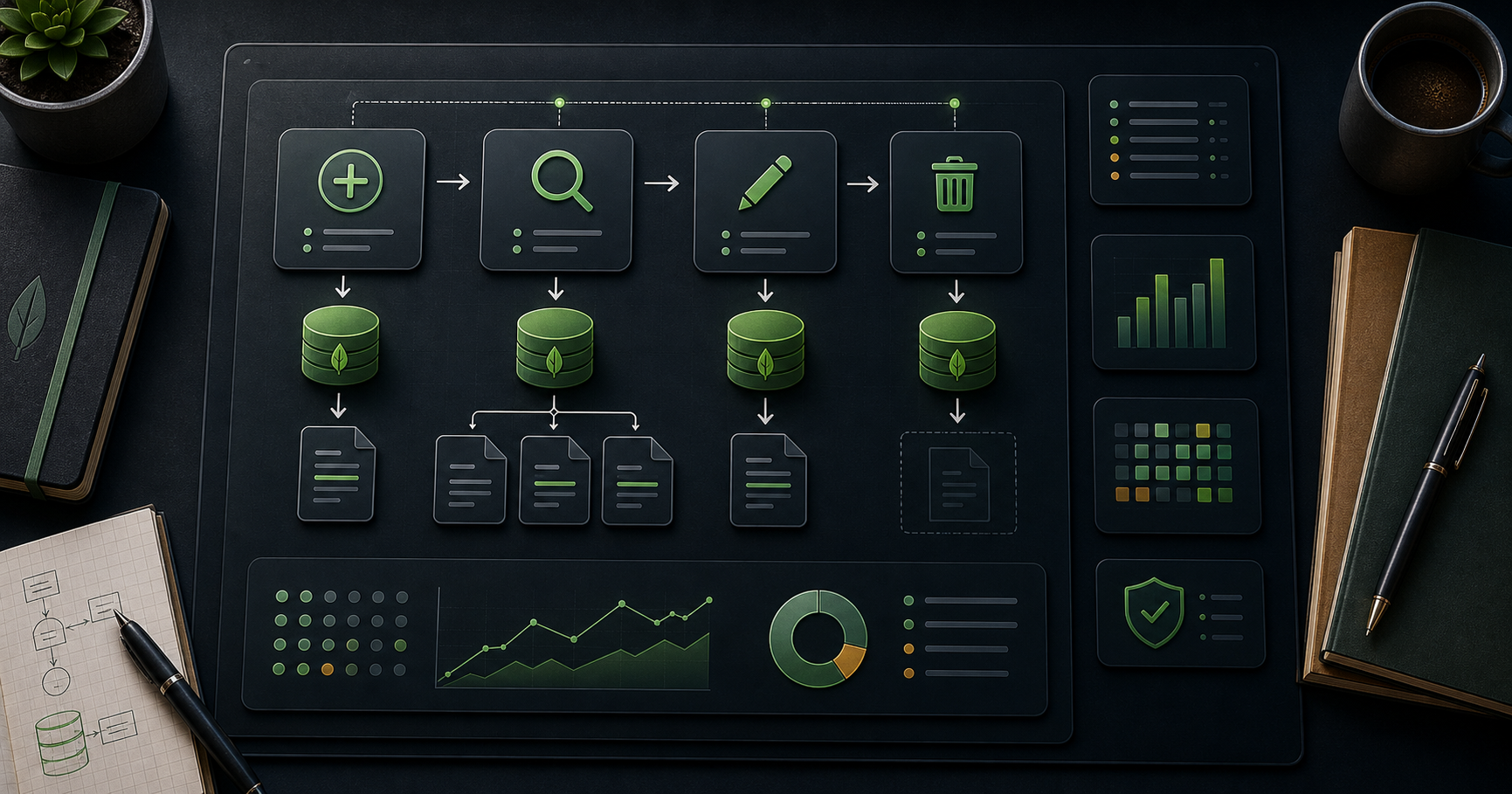
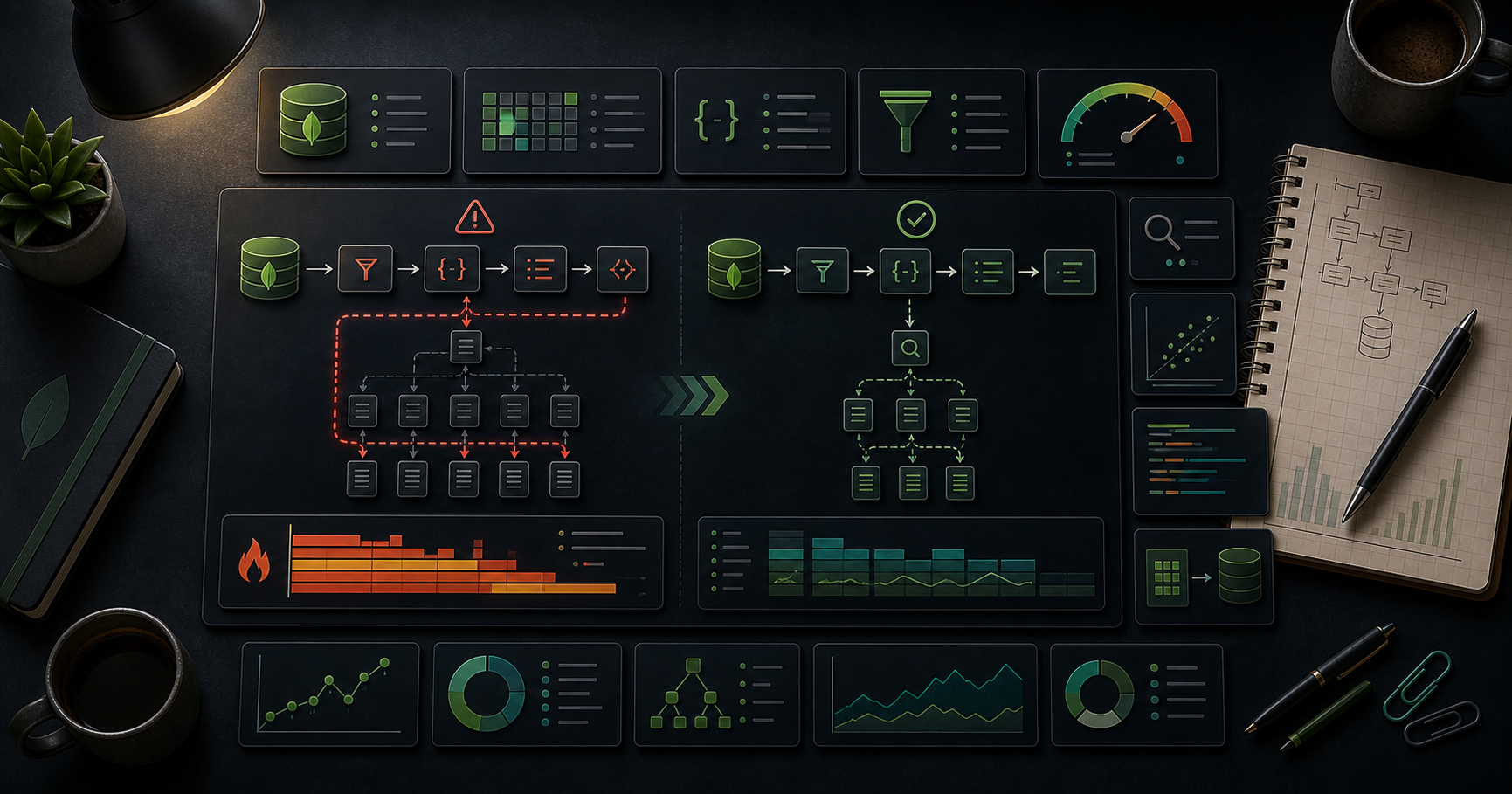
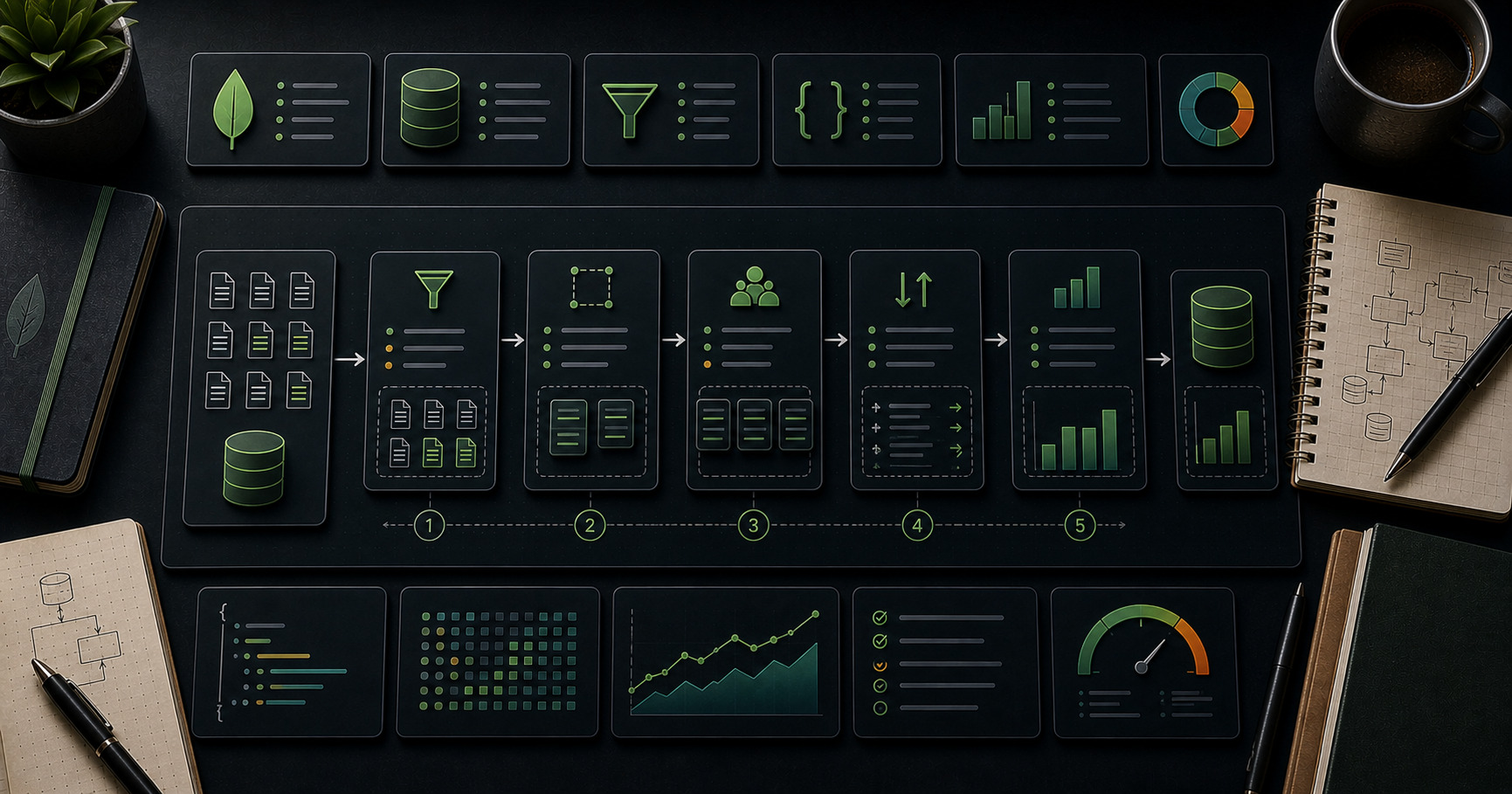
You have a Postgres / MySQL / Oracle workload. You want to move it to MongoDB — perhaps because the access pattern is document-shaped, the schema is changing too fast for migrations, or scaling write throughput requires sharding. The migration is half schema redesign, half data movement, half cut-over choreography. This post is the playbook: schema-mapping principles, data-load tooling (mongoimport, AWS DMS, Striim, custom ETL), dual-write strategies, staged cut-over, rollback plan, and the common traps.
Series map: 20 Outbox → 21 CQRS+ES → 22 RAG → 23 SQL→Mongo migration (this post) → 24 Kafka + Debezium → … → 29 K8s + mongosync + cost.
Learning Outcome
- Decide whether the workload should move at all (and which parts).
- Map relational schema to document model using Post 07's patterns.
- Choose a data-movement strategy (full reload, dual-write, change-data-capture).
- Implement the staged cut-over with rollback gates.
- Avoid the 6 most common migration disasters.
Chapter 1 — Should you migrate?
Honest answer first: most SQL workloads should stay on SQL. Migration is expensive + risky. Strong reasons to move:
- Schema flexibility required (per-tenant custom fields, fast product iteration, polymorphic items).
- Write throughput beyond what Postgres can vertical-scale.
- Hierarchical / document-shaped data (forms, content, configs, complex products) that's painful to join.
- Horizontal scaling + multi-region + sharding required.
- Operational simplicity at low ops headcount (Atlas managed > self-hosted Postgres cluster).
Weak reasons:
- "NoSQL is modern."
- "We want to avoid joins" (you'll write joins as
$lookupeither way). - "We need higher performance" (often a Postgres index would have fixed it).
Often the right answer is migrate a subset — the parts where the document model genuinely fits — and keep the rest in Postgres. The two coexist via outbox / CDC / app-side composition.
Chapter 2 — Schema mapping principles
Re-read Post 07 (Schema Design). Then map:
| SQL pattern | MongoDB pattern |
|---|---|
| 1:1 child table | embed sub-document |
| 1:few (≤ 100) child rows | embed array |
| 1:many (unbounded) child rows | separate collection + ref |
| many:many through join table | references both ways (+ counts denormalised) |
| polymorphic via STI (single table inheritance) | polymorphic pattern (Post 07 Ch 4) — discriminator field |
| polymorphic via CTI (class table inheritance) | one collection with discriminator |
| tree (adjacency list) | parent ref or ancestor array (Post 07 Ch 9) |
| audit history table | separate immutable history collection or Event Sourcing (Post 21) |
| timestamps columns | embedded or top-level Date fields |
| JSON column in Postgres | top-level fields directly |
| sequence / SERIAL primary key | ObjectId (Mongo default) or keep numeric per use |
| view | materialised view via $merge (Post 06) |
| trigger | change stream (Post 12) or Atlas Trigger (Post 16) |
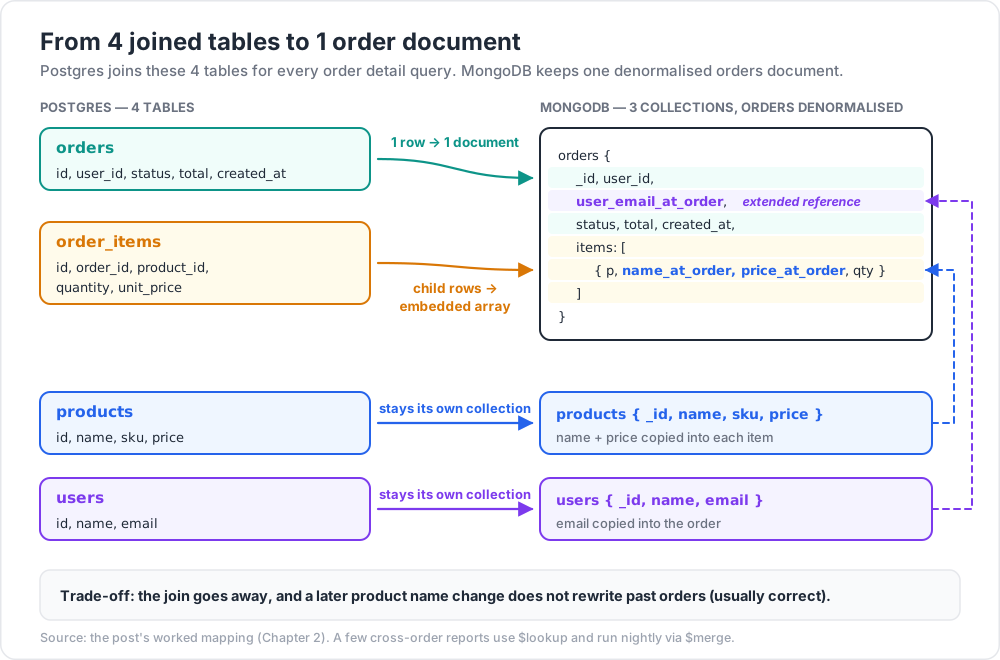
Worked mapping — e-commerce orders
Postgres:
1
2
3
4
5
6
-- 4 tables, joined for every order detail query
orders(id, user_id, status, total, created_at)
order_items(id, order_id, product_id, quantity, unit_price)
users(id, name, email)
products(id, name, sku, price)
MongoDB:
1
2
3
4
5
6
7
8
9
10
11
12
// one collection, denormalised
orders {
_id, user_id,
user_email_at_order: "...", // extended reference
status, total, created_at,
items: [
{ p: product_id, name_at_order: "...", price_at_order: ..., qty: ... }
]
}
users { _id, name, email }
products { _id, name, sku, price }
The trade-off: the join you ran 1,000× per second goes away; product name changes don't retroactively rewrite past orders (which is usually correct anyway). A handful of cross-order reports use $lookup now and run nightly via $merge.
Chapter 3 — Data movement strategies
Pick by downtime tolerance + data size + complexity tolerance.
Strategy A — Full reload (hours of downtime)
- Freeze writes to source.
- Extract source → transform → load into Mongo.
- Cut DNS / connection string over.
- Resume writes against Mongo.
OK for: < 100 GB and you can take a maintenance window.
Strategy B — Dual-write at app layer (low downtime)
- App writes to both Postgres + Mongo for new operations.
- Backfill historical data via ETL.
- Read-shadow: in parallel with reads from Postgres, fetch from Mongo + log differences.
- Switch reads to Mongo when shadow shows parity.
- Stop writes to Postgres.
OK for: medium-size apps where you control the write path.
Strategy C — CDC-driven (best for large, can't-downtime)
- Tail Postgres WAL via Debezium (or AWS DMS, Striim, Estuary, Airbyte).
- Transform + write to Mongo continuously.
- After sync catches up + remains in sync for a while, cut reads over.
- After cut-over, drain Postgres writes; flip back-flow off.
OK for: large databases, strict uptime requirements, polyglot teams.
Strategy D — Strangler fig
- New features write to Mongo only.
- Old features stay on Postgres.
- Migrate one feature at a time over months.
OK for: legacy systems where a big-bang move is too risky.
Chapter 4 — Tooling
mongoimport
CSV / TSV / JSONL → MongoDB.
1
2
3
mongoimport --uri "..." --db shop --collection products \
--type csv --headerline --file products.csv
For one-shot loads of dumps.
mongosh load
Run JS scripts against the cluster:
1
2
mongosh "$MONGO_URI" --file migrate_orders.js
Useful for transforming on insert.
AWS DMS (Database Migration Service)
Continuously replicates Postgres / MySQL / Oracle / SQL Server → MongoDB Atlas. Configurable transformations (rename columns, denormalise child rows into arrays via "JSON-encoded selectors").
Pros: managed; one of the easiest CDC paths to Atlas. Cons: AWS-only; transformations limited.
Debezium + Kafka + Mongo Kafka Sink Connector
Debezium reads Postgres WAL → Kafka → MongoDB Kafka Connector applies events to Atlas. Most flexible (any transformations via Kafka Streams). More moving parts.
Post 24 covers this stack.
Custom ETL
For non-trivial denormalisation (joining 5 tables into one document), write a script:
1
2
3
4
5
# pseudo
for batch in stream_postgres("SELECT * FROM orders LIMIT ... OFFSET ..."):
docs = transform(batch) # joins + reshape
db.orders.bulk_write([InsertOne(d) for d in docs], ordered=False)
Use bulk_write for throughput; chunk to memory-safe batches; checkpoint progress so resumes are cheap.
Striim, Airbyte, Estuary, Hevo, Fivetran
Managed ETL platforms that handle Postgres → Mongo with UI-driven transformations + monitoring. Cost money; save weeks.
Chapter 5 — Dual-write strategy walk-through
1
2
3
4
5
6
7
8
9
10
11
12
13
14
15
16
def create_order(input):
# 1. write to Postgres (system of record during migration)
pg_id = pg.insert("INSERT INTO orders (...) VALUES (...) RETURNING id", input)
# 2. write to Mongo (idempotent: include source id)
try:
db.orders.insert_one({
"_id": ObjectId(),
"pg_id": pg_id, # link back to source
...
})
except Exception as e:
log.warning("mongo write failed", e) # don't fail the request
return pg_id
Properties:
- Postgres is still source of truth — Mongo failures don't break the user request.
- Mongo writes are idempotent (linked by
pg_id) — re-runnable. - Backfill script picks up rows in Postgres not yet in Mongo.
Read-shadow phase
1
2
3
4
5
6
7
8
9
10
11
12
13
14
def get_order(order_id):
pg_order = pg.fetch_order(order_id)
# in parallel, fetch from Mongo + compare
threading.Thread(target=shadow_compare, args=(order_id, pg_order)).start()
return pg_order
def shadow_compare(order_id, pg_order):
mongo_order = db.orders.find_one({"pg_id": order_id})
diff = compute_diff(pg_order, mongo_order)
if diff:
log.warning("diff", order_id=order_id, diff=diff)
Run for days/weeks until diffs are rare + understood. Then flip reads to Mongo for some endpoints; eventually all.
Chapter 6 — Staged cut-over (CDC strategy)
1
2
3
4
5
6
7
8
9
T0 — CDC pipeline live; replicating writes from Postgres to Mongo
T1 — Backfill historical data complete (script ran once)
T2 — Validate parity (row counts + sampled deep-equals + queries return same answers)
T3 — Read traffic split: 1% → Mongo, 99% → Postgres
T4 — Slowly raise % to Mongo; watch error rates + latency
T5 — 100% reads on Mongo; still dual-writing (or CDC still active)
T6 — Stop writes to Postgres; CDC drained; cut over
T7 — Postgres becomes read-only / archive
Gates between steps: error budget; latency budget; data-parity assertions. Don't proceed without crossing them.
Rollback plan at each gate:
- T3-T4: trivial — route reads back to Postgres.
- T5: still possible — Postgres data is fresh until T6.
- T6+: harder — need reverse CDC or accept the cut.
Chapter 7 — Validation
After load (or continuously during CDC):
1
2
3
4
5
6
7
8
9
10
11
12
13
14
// counts match
db.orders.countDocuments();
// vs SELECT COUNT(*) FROM orders;
// per-key check (random sample)
db.orders.find().limit(100).forEach(doc => {
const pg = pg.fetch(doc.pg_id);
assert.deepEqual(slimMongo(doc), slimPg(pg));
});
// aggregate sanity
db.orders.aggregate([{ $group: { _id: null, sum: { $sum: "$total" } } }]);
// vs SELECT SUM(total) FROM orders;
Automate. Run in CI. Alert on regressions.
For large collections use statistical sampling + checksums per shard / per day rather than full equality.
Chapter 8 — Application-layer changes
The migration isn't just data movement — your code changes too.
| SQL idiom | MongoDB equivalent |
|---|---|
JOIN |
embed first; $lookup only when must |
WHERE x IN (subquery) |
$lookup + $match or 2-step query |
GROUP BY + window functions |
$group + $setWindowFields |
ORDER BY + LIMIT + OFFSET |
sort + skip (small) or range pagination (big) |
| Transactions across many tables | rethink with single-doc atomicity + embedded data first |
| Stored procedures | service-layer code |
| Triggers | change streams |
| Views | aggregation pipelines + $merge materialised views |
LIKE '%x%' |
text index, regex (left-anchored), Atlas Search |
| ORMs | Mongoose / Beanie / Prisma / official driver |
Plan the code refactor in parallel with the data move. Don't try to make Mongo behave like Postgres — you'll get worst of both.
Chapter 9 — Common pitfalls
| Pitfall | Cause | Fix |
|---|---|---|
| Lift-and-shift schema | one Mongo collection per SQL table | redesign for document shape |
50 $lookups per request |
over-normalised | denormalise / embed |
| ObjectId vs numeric ID mismatch | app expects integer | keep numeric IDs during transition |
| Date type conversion fails | timezone / format inconsistencies | normalise to ISO 8601 UTC |
| Foreign-key constraints lost silently | Mongo doesn't enforce | app-layer validation + tests |
| Sequence ID gaps | new ObjectIds vs SERIAL | use new sequence or rely on ObjectId ordering |
| Migration script OOM on big tables | not batching | chunk + checkpoint |
| Forgot indexes on Mongo | full collection scans in prod | create indexes BEFORE traffic |
| CDC lag during big writes | undersized destination | scale Atlas tier before cut-over |
| No rollback plan | got stuck after T6 | dual-write until you're 100% sure |
| Bigger bill than expected | wrong tier sizing | benchmark + size with safety margin |
Chapter 10 — Rollback patterns
If Mongo turns out wrong (worse perf, missing feature, business decision change):
- During dual-write window: trivial. Switch back, drop Mongo data.
- After cut-over but Mongo still has CDC back to Postgres: route reads back to Postgres, stop write CDC, keep Mongo as warm standby until decision.
- After full cut: you need a reverse migration. Same playbook, opposite direction. Cost as much as the original.
Plan rollback explicitly before T0. Document the decision points.
Practice Exercises
Exercise 1 — Schema mapping
Take a Postgres schema you know (e.g., from a previous project). Map to Mongo collections following Post 07. Note which tables embed and which stay as references.
Exercise 2 — mongoimport
Export one table to CSV from Postgres. mongoimport into Mongo. Verify counts + spot-check.
Exercise 3 — Dual-write
Implement Chapter 5's create_order dual-write. Insert 1000 orders; confirm both DBs have them. Kill Mongo connectivity mid-test; confirm Postgres still works + Mongo is backfillable.
Exercise 4 — Read-shadow
Implement the shadow comparator. Run 1000 reads; surface diffs. Fix any.
Exercise 5 — CDC PoC
Set up Debezium reading from a local Postgres into Kafka. Configure a Mongo sink. Insert into Postgres; see in Mongo within seconds. (Detailed walkthrough in Post 24.)
Exercise 6 — Staged cut-over plan
For a hypothetical 500 GB Postgres workload, write the full cut-over runbook with T0…T7 + rollback at each step.
Cheat-sheet
| What | How |
|---|---|
| First | should you migrate at all? |
| Map schema | follow Post 07 patterns |
| Strategy | A (full) / B (dual-write) / C (CDC) / D (strangler) |
| Tools | mongoimport / DMS / Debezium / Airbyte / custom ETL |
| Dual-write | source-of-truth source; mirror to Mongo idempotent |
| Read-shadow | parallel read; log diff; build trust |
| CDC | Debezium WAL → Kafka → Mongo Sink |
| Cut-over | gradual % shift on reads; gated by error/latency budget |
| Validation | counts + sampled equality + aggregate sums |
| Indexes | create before traffic |
| Rollback | dual-write window keeps it cheap |
| Code changes | as much work as data move |
| Strangler fig | for legacy systems |
What's next
Post 24 covers Kafka + Debezium MongoDB CDC — how to plug MongoDB into Kafka topics in both directions (source + sink) and the patterns that power the migrations + CQRS architectures.
References
- AWS Database Migration Service to MongoDB
- Debezium Postgres connector
- MongoDB Kafka Connector
- Airbyte Postgres → MongoDB
- NoSQL Distilled by Pramod Sadalage + Martin Fowler — classic schema-modeling perspective.
Note: this post is in progress. Planned additions: full DMS task config example; reverse-migration playbook; multi-region migration considerations.