MongoDB Course — 22 · Production RAG Build — Atlas Vector + LangChain + OpenAI
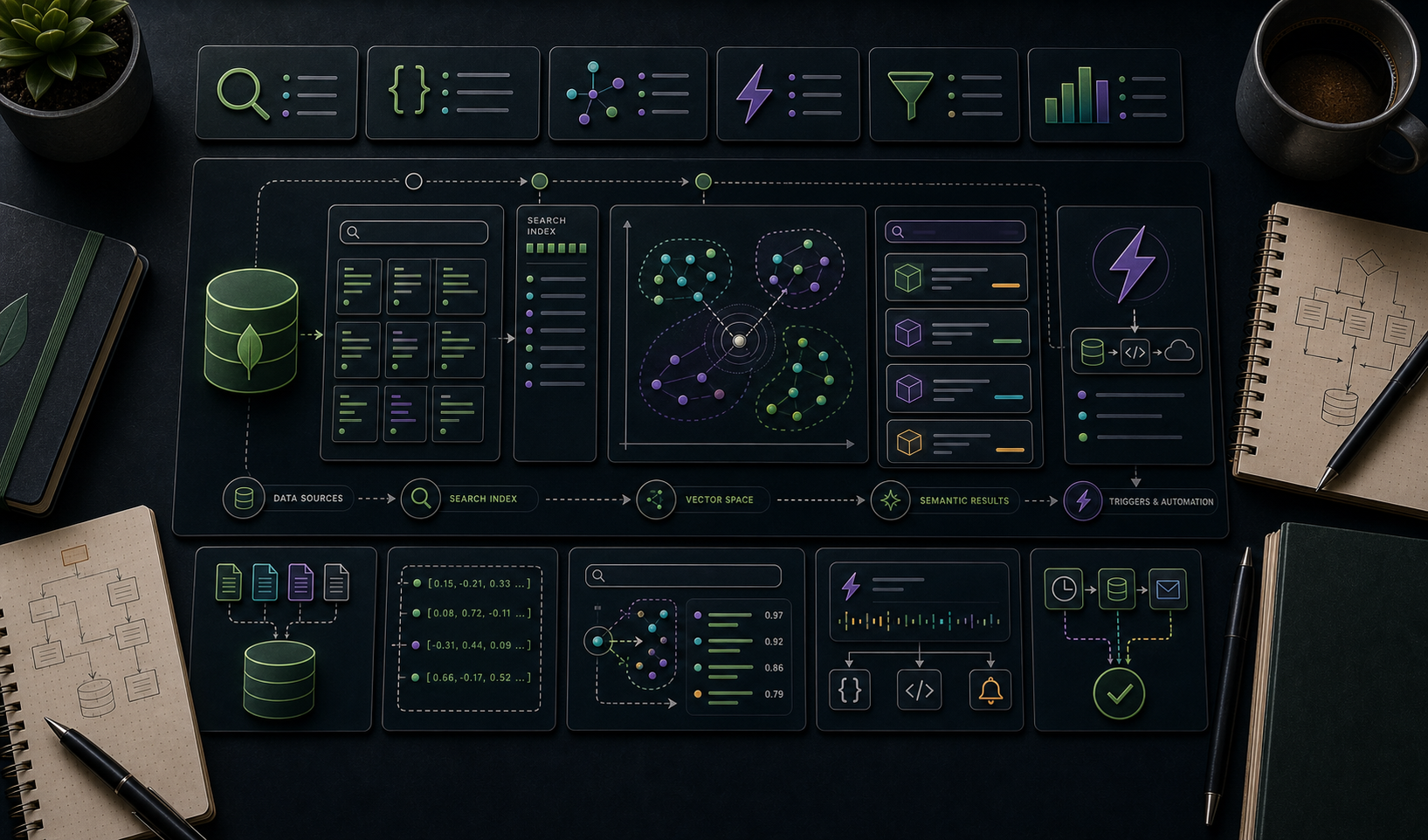
Post 16 introduced Atlas Vector Search. This post builds an end-to-end production-shaped RAG (Retrieval-Augmented Generation) app on top of it: chunking + embedding the corpus, indexing into Atlas, querying with hybrid (lexical + semantic) retrieval, optional reranking, prompt assembly, streaming the LLM response, observability + cost tracking, and the production guardrails (rate limits, citation, evaluation). The framework is LangChain (Python); the embedder is OpenAI text-embedding-3-large; the LLM is GPT-4o (any equivalent works).
Series map: 19 Beanie+FastAPI → 20 Outbox → 21 CQRS + ES → 22 RAG Production Build (this post) → 23 SQL→Mongo migration → … → 29 K8s + mongosync + cost.
Learning Outcome
- Chunk + embed + index a document corpus into Atlas Vector Search.
- Retrieve with vector + lexical + filter (hybrid).
- Rerank with a cross-encoder when needed.
- Assemble prompts with citations.
- Stream the LLM response back to clients.
- Track cost + latency + relevance per query.
- Evaluate retrieval quality with a small offline eval set.
Chapter 1 — Why MongoDB for RAG
The naïve RAG stack is:
1
2
documents → embedder → vector DB → retrieval → LLM
Mongo + Atlas Vector Search replaces a separate vector DB:
- Documents + their embeddings + their metadata live in one collection in one database.
- Hybrid search (lexical + vector) is one pipeline (Post 16 Ch 2).
- Filter on metadata (tenant, recency, category) alongside vector search.
- Same backup / monitoring / connection-pool patterns as the rest of your Mongo workload.
- No data sync between document store + vector store.
Trade-off vs Pinecone / Weaviate / pgvector: Atlas Vector Search is HNSW only (no IVF or hybrid index types in 2026); cluster cost scales with index size. For < a few hundred million vectors, Atlas wins on operational simplicity.
Chapter 2 — Ingest pipeline — chunk + embed + insert
1
2
3
4
5
6
7
8
9
10
11
12
13
14
15
16
17
18
19
20
21
22
23
24
25
26
27
28
29
30
# ingest.py
from typing import Iterable
from openai import OpenAI
from pymongo import MongoClient
from langchain_text_splitters import RecursiveCharacterTextSplitter
oa = OpenAI()
db = MongoClient(os.environ["MONGO_URI"])["docs"]
splitter = RecursiveCharacterTextSplitter(chunk_size=800, chunk_overlap=120)
def embed(texts: list[str]) -> list[list[float]]:
resp = oa.embeddings.create(model="text-embedding-3-large", input=texts)
return [d.embedding for d in resp.data]
def ingest(source_id: str, text: str, metadata: dict):
chunks = splitter.split_text(text)
vectors = embed(chunks)
docs = [
{
"source_id": source_id,
"chunk_index": i,
"text": chunk,
"embedding": vec,
"metadata": metadata,
"indexed_at": datetime.utcnow(),
}
for i, (chunk, vec) in enumerate(zip(chunks, vectors))
]
db.chunks.insert_many(docs)
Chunking guidelines:
- 800-1200 tokens per chunk for general documents. Smaller for FAQs (200-400); larger for narrative text (1500-2000).
- Overlap of 10-15 % to preserve context across boundaries.
- For code / structured docs, split at structural boundaries (functions, sections).
Embedding batch size: OpenAI accepts up to ~2048 inputs per call; tune to your rate limit. Batch dramatically reduces cost + latency.
Index the embedding (Atlas UI or API)
1
2
3
4
5
6
7
8
9
10
11
12
13
14
// once, on the chunks collection
db.chunks.createSearchIndex({
name: "chunks_vec",
type: "vectorSearch",
definition: {
fields: [
{ type: "vector", path: "embedding", numDimensions: 3072, similarity: "cosine" },
{ type: "filter", path: "metadata.tenant" },
{ type: "filter", path: "metadata.category" },
{ type: "filter", path: "indexed_at" }
]
}
})
Also create an Atlas Search lexical index on text for hybrid (Chapter 4).
Chapter 3 — Retrieval — vector
1
2
3
4
5
6
7
8
9
10
11
12
13
14
15
16
17
18
19
20
21
22
def retrieve_vector(query: str, k: int = 10, tenant: str | None = None) -> list[dict]:
q_vec = embed([query])[0]
pipeline = [
{
"$vectorSearch": {
"index": "chunks_vec",
"path": "embedding",
"queryVector": q_vec,
"numCandidates": 200, # search width
"limit": k,
**({"filter": {"metadata.tenant": tenant}} if tenant else {}),
}
},
{
"$project": {
"_id": 1, "text": 1, "metadata": 1,
"score": {"$meta": "vectorSearchScore"},
}
},
]
return list(db.chunks.aggregate(pipeline))
Knobs:
numCandidates: HNSW search width. Higher = better recall + slower. Start 200; raise to 500-1000 if recall is bad.limit: top-k to return.filter: pre-filters narrow the search space. Big wins for multi-tenant or category-scoped queries.
Chapter 4 — Hybrid retrieval (lexical + vector)
Vector search misses exact-keyword hits; lexical misses semantic paraphrases. Combine for best recall.
1
2
3
4
5
6
7
8
9
10
11
12
13
14
15
16
17
18
19
20
21
22
23
24
25
26
27
28
29
30
31
32
33
34
35
36
37
38
39
40
41
42
43
44
45
46
47
48
49
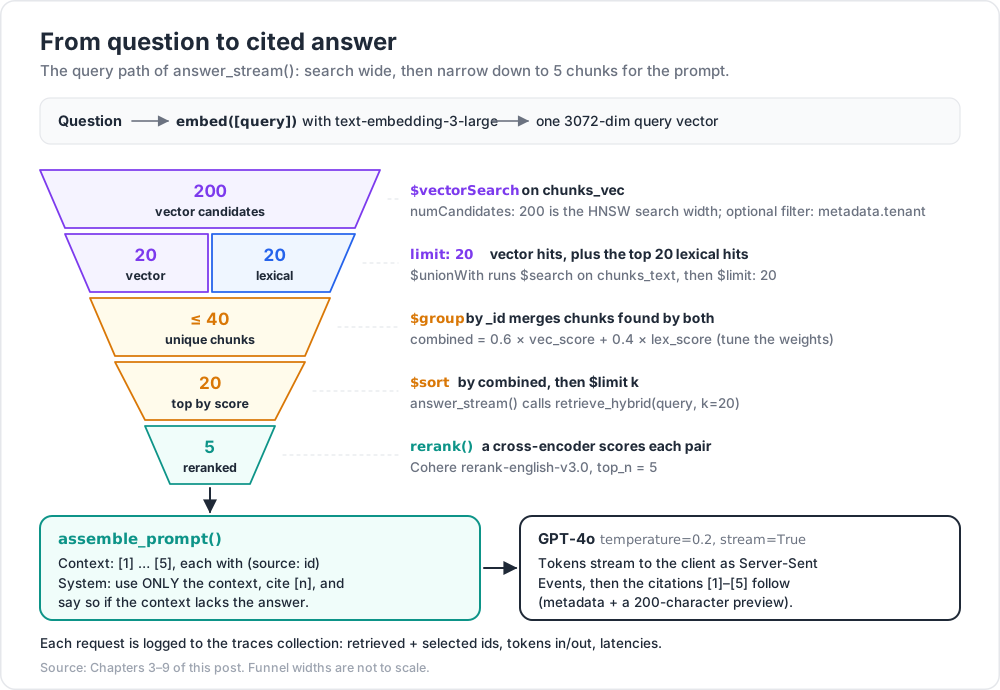
def retrieve_hybrid(query: str, k: int = 10, tenant: str | None = None) -> list[dict]:
q_vec = embed([query])[0]
pipeline = [
{
"$vectorSearch": {
"index": "chunks_vec",
"path": "embedding",
"queryVector": q_vec,
"numCandidates": 200,
"limit": 20,
**({"filter": {"metadata.tenant": tenant}} if tenant else {}),
}
},
{"$addFields": {"vec_score": {"$meta": "vectorSearchScore"}, "lex_score": 0}},
{"$unionWith": {
"coll": "chunks",
"pipeline": [
{
"$search": {
"index": "chunks_text",
"compound": {
"must": [{"text": {"query": query, "path": "text"}}],
**({"filter": [{"text": {"query": tenant, "path": "metadata.tenant"}}]} if tenant else {}),
}
}
},
{"$limit": 20},
{"$addFields": {"lex_score": {"$meta": "searchScore"}, "vec_score": 0}},
]
}},
# Reciprocal Rank Fusion
{"$group": {
"_id": "$_id",
"text": {"$first": "$text"},
"metadata": {"$first": "$metadata"},
"vec_score": {"$max": "$vec_score"},
"lex_score": {"$max": "$lex_score"},
}},
# weighted combination — tune per workload
{"$addFields": {"combined": {"$add": [
{"$multiply": ["$vec_score", 0.6]},
{"$multiply": ["$lex_score", 0.4]}
]}}},
{"$sort": {"combined": -1}},
{"$limit": k},
]
return list(db.chunks.aggregate(pipeline))
The weights (0.6 / 0.4) are workload-dependent — tune with an eval set (Chapter 8).
A better scoring approach is Reciprocal Rank Fusion (RRF) — combine ranks, not raw scores:
1
2
rrf_score = sum_over_rankings(1 / (k + rank))
Atlas + the LangChain integration provide hybrid retriever helpers that do this for you.
Chapter 5 — Optional reranking
Hybrid retrieval typically returns 20-50 candidates. A cross-encoder reranker scores each candidate against the query more accurately (slow per pair, fast on small batches).
1
2
3
4
5
6
7
8
9
# pseudo — using cohere reranker
from cohere import Client as Cohere
co = Cohere()
def rerank(query: str, candidates: list[dict], top_n: int = 5) -> list[dict]:
texts = [c["text"] for c in candidates]
r = co.rerank(model="rerank-english-v3.0", query=query, documents=texts, top_n=top_n)
return [candidates[ri.index] for ri in r.results]
When to add reranking:
- Quality matters more than 50-100 ms latency.
- You're already calling Cohere / OpenAI / Jina for embeddings.
- Hybrid alone isn't returning the right doc top-1.
Skip when latency matters more than relevance lift.
Chapter 6 — Prompt assembly with citations
1
2
3
4
5
6
7
8
9
10
11
12
13
def assemble_prompt(query: str, chunks: list[dict]) -> list[dict]:
context = "\n\n".join(
f"[{i+1}] {c['text']} (source: {c['metadata'].get('source_id', '?')})"
for i, c in enumerate(chunks)
)
system = (
"You answer questions using ONLY the provided context. "
"Cite sources by their bracketed numbers, e.g. [1][3]. "
"If the context doesn't contain the answer, say so."
)
user = f"Context:\n{context}\n\nQuestion: {query}"
return [{"role": "system", "content": system}, {"role": "user", "content": user}]
Key rules baked into the prompt:
- Use only context.
- Cite numerically (cheap to render in UI).
- Refuse when context is insufficient (mitigates hallucination).
The UI then maps [1][3] to the actual source_id URLs from chunks.
Chapter 7 — LLM call + streaming
1
2
3
4
5
6
7
8
9
10
11
12
13
14
15
16
17
18
19
def answer_stream(query: str, tenant: str | None = None):
candidates = retrieve_hybrid(query, k=20, tenant=tenant)
top = rerank(query, candidates, top_n=5)
messages = assemble_prompt(query, top)
stream = oa.chat.completions.create(
model="gpt-4o",
messages=messages,
temperature=0.2,
stream=True,
)
for delta in stream:
token = delta.choices[0].delta.content
if token:
yield token
# after streaming finishes, return citations
yield {"citations": [{"i": i+1, **c["metadata"], "preview": c["text"][:200]} for i, c in enumerate(top)]}
In FastAPI:
1
2
3
4
5
6
from fastapi.responses import StreamingResponse
@app.post("/ask")
async def ask(q: AskBody):
return StreamingResponse(answer_stream(q.query, q.tenant), media_type="text/event-stream")
Stream as Server-Sent Events (SSE) for a chatty UI feel.
Chapter 8 — Evaluation
A small eval set is the difference between "I think it's good" and "I know it's improving".
Build 50-200 queries with the expected source(s). Run retrieval; measure:
- Recall@k — was the right doc in the top-k?
- MRR — mean reciprocal rank of the first correct doc.
- End-to-end accuracy — manually + via LLM-judge on a sample.
1
2
3
4
5
6
7
8
9
10
11
12
13
def evaluate(eval_set):
metrics = {"recall@1": 0, "recall@5": 0, "mrr": 0}
for ex in eval_set:
results = retrieve_hybrid(ex["query"], k=10, tenant=ex.get("tenant"))
gold = set(ex["expected_chunk_ids"])
ranks = [i for i, r in enumerate(results) if r["_id"] in gold]
if ranks:
metrics["recall@1"] += int(ranks[0] == 0)
metrics["recall@5"] += int(ranks[0] < 5)
metrics["mrr"] += 1 / (ranks[0] + 1)
for k in metrics: metrics[k] /= len(eval_set)
return metrics
Run on every PR that touches retrieval. CI gate on regression > X %.
LangChain ships an eval module; LangSmith provides hosted eval + traces; ragas is a popular OSS framework for RAG-specific metrics.
Chapter 9 — Observability + cost
Track per request:
- Query string + tenant + filters.
- Embedding tokens (input length).
- Retrieved chunk IDs + scores (for offline replay).
- Reranker latency.
- LLM input + output tokens.
- End-to-end latency.
Persist to a traces collection or use LangSmith / Helicone / Langfuse. Use this data to:
- Identify slow queries.
- Estimate per-query cost (embedding tokens × embedding price + LLM tokens × LLM price).
- Find queries with low retrieval quality (no high-score matches).
1
2
3
4
5
6
7
8
9
10
11
12
13
14
15
16
17
18
19
20
@app.post("/ask")
async def ask(q: AskBody):
t0 = time.time()
candidates = retrieve_hybrid(q.query)
t1 = time.time()
top = rerank(q.query, candidates)
answer, in_tokens, out_tokens = llm_call(top, q.query)
t2 = time.time()
await db.traces.insert_one({
"query": q.query, "tenant": q.tenant,
"retrieved_ids": [str(c["_id"]) for c in candidates],
"selected_ids": [str(c["_id"]) for c in top],
"in_tokens": in_tokens, "out_tokens": out_tokens,
"lat_retrieve_ms": int((t1-t0)*1000),
"lat_llm_ms": int((t2-t1)*1000),
"at": datetime.utcnow(),
})
return {"answer": answer, "citations": [...]}
Atlas Charts on the traces collection gives quick dashboards.
Chapter 10 — Production guardrails
| Guardrail | Why |
|---|---|
| Rate limit per user / tenant | LLM calls are slow + expensive |
| Max input length validation | refuses crafted huge inputs |
| PII / secret scrubbing in inputs + outputs | privacy + compliance |
| Citation enforcement | hallucination mitigation; user trust |
| Refusal on low-confidence retrieval | "I don't have the information" beats wrong answers |
| Logging with masking | debug without leaking |
| Eval-gated deploys | CI on RAG quality |
| A/B test retrieval strategies | data-driven tuning |
| Cost alerts per tenant | catch runaway usage |
| Streaming | better UX, lower perceived latency |
| Cache identical question answers per tenant (with TTL) | cost saver |
Chapter 11 — Common pitfalls
| Pitfall | Cause | Fix |
|---|---|---|
| Embeddings dimension mismatch | swapped model didn't rebuild index | rebuild index when changing embedder |
Low recall with high limit |
numCandidates too small |
raise to 500-1000 |
| Mixed tenants in results | no filter on metadata | add filter to $vectorSearch |
| LLM ignores context, hallucinates | weak system prompt | strengthen "USE ONLY context"; refusal instruction; eval |
| Latency spikes | reranker on every query | rerank top-20 only; or skip when not needed |
| Cost spike | one user spamming | rate-limit + cache identical Qs |
| Stale answers after document update | embeddings not updated | change-stream-driven re-embed (Post 12) |
| Long context blowing token limit | too many chunks in prompt | smaller top_n; smaller chunks |
| Reranker different lang than docs | language mismatch | use multilingual rerank model |
| Eval set drift | new feature areas not covered | grow eval set quarterly |
Practice Exercises
Exercise 1 — Ingest a small corpus
Download ~50 markdown docs (your repo's docs / Wikipedia subset). Chunk + embed + insert. Build the vector index.
Exercise 2 — Vector-only retrieval
Endpoint that takes a query, runs $vectorSearch, returns top-5 chunks + scores. Test 10 questions; rate manually.
Exercise 3 — Hybrid retrieval
Add lexical ($search text) to the pipeline. Compare top-5 across vector / lexical / hybrid for the same 10 questions.
Exercise 4 — Reranker
Add Cohere rerank step after hybrid. Confirm top-1 quality improves on questions where exact keywords matter.
Exercise 5 — Streaming endpoint
Wire the streaming pipeline into FastAPI SSE. Render in a small HTML page that progressively displays tokens.
Exercise 6 — Eval harness
Build a 20-question eval set with known gold chunks. Run recall@1 / recall@5 / MRR. Tune numCandidates, chunk size, reranker on/off; track which combination wins.
Cheat-sheet
| What | How |
|---|---|
| Embedder | OpenAI text-embedding-3-large (3072 dim) or -small (1536) |
| LLM | GPT-4o / Claude / Gemini — interchangeable |
| Chunk size | 800-1200 tokens, 10-15 % overlap |
| Index | Atlas Vector Search HNSW + filter fields |
| Pre-filter | metadata.tenant / category / date inside $vectorSearch.filter |
| Hybrid | $vectorSearch + $unionWith lexical + RRF combination |
| Rerank | cross-encoder (Cohere, Jina, etc.) on top-20 |
| Prompt | system="use only context"; cite with [n] |
| Stream | SSE / chunked HTTP |
| Eval | Recall@k / MRR / end-to-end accuracy |
| Trace | persist per request → traces collection |
| Cost | track input + output tokens; rate-limit; cache |
| Guardrails | refusal on low-confidence; citations; PII scrub |
| Re-embed on doc change | change stream → re-embed → upsert chunks |
What's next
Post 23 covers migrating from SQL / Postgres to MongoDB — schema-mapping principles, data-load tooling (mongoimport, AWS DMS, custom ETL), dual-write strategies, and the staged cut-over playbook.
References
- Atlas Vector Search docs
- LangChain MongoDB integration
- LlamaIndex MongoDB integration
- LangChain × MongoDB partnership announcement
- ragas — RAG evaluation framework
- Anthropic + OpenAI prompt engineering guides — system prompt patterns.
Note: this post is in progress. Planned additions: full chat UI in Next.js; GraphRAG with
$graphLookup; agentic loop (tool-use) example; cost dashboards.