MongoDB Course — 20 · Outbox Pattern + Transactional Event Publishing
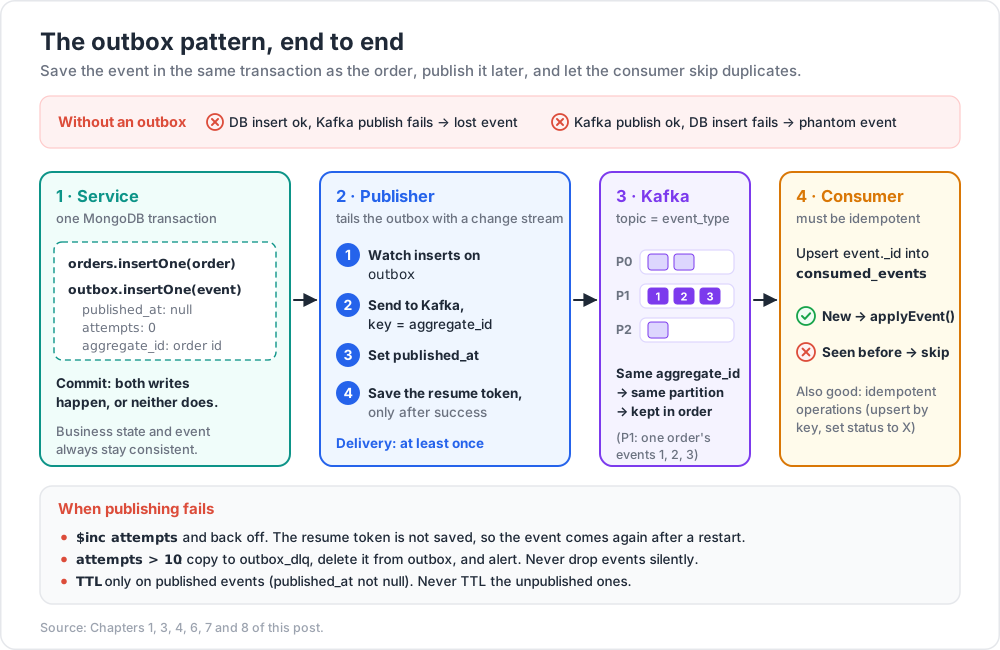
You write to the database. You also need to publish an event ("order placed → send confirmation email"). If those two steps aren't atomic, you'll either lose events (DB committed, queue publish failed) or send duplicates (publish succeeded, DB rolled back). The outbox pattern solves this by treating the event as part of the same DB transaction, then publishing from the outbox to your message bus asynchronously. With MongoDB change streams (Post 12), the publisher is one process tailing the outbox collection — no Kafka Connect, no extra infrastructure. This post covers the full pattern, retry + idempotency + ordering, and the deduplication strategies downstream consumers need.
Series map: 18 Mongoose → 19 Beanie+FastAPI → 20 Outbox (this post) → 21 CQRS + ES → 22 RAG → ... → 29 K8s + mongosync + cost.
Learning Outcome
- Recognise the dual-write problem.
- Build an outbox collection alongside business writes inside one transaction.
- Build a change-stream-driven publisher with resume tokens.
- Handle at-least-once delivery + downstream idempotency.
- Pick between outbox + change streams vs Debezium / Kafka Connect.
Chapter 1 — The dual-write problem
1
2
3
4
# WRONG — not atomic
await db.orders.insert_one(order)
await kafka.publish("orders.created", order)
Two failure modes:
- DB insert succeeds, Kafka publish fails → lost event.
- Kafka publish succeeds, DB insert fails → phantom event (consumers act on data that doesn't exist).
Neither is acceptable for systems that need consistency between their database state + downstream consumers.
Naive fixes that don't work
- Try-catch + retry: same race, just longer odds.
- 2-phase commit across MongoDB + Kafka: not supported across systems.
- Eventual consistency + reconciliation: complex; high latency.
The outbox
Write the event as a row in the same database, same transaction as the business mutation. A separate process publishes from the outbox to Kafka / RabbitMQ / SQS / SNS, marking each event as published (or deleting it).
Because the business write + outbox write are in one transaction, they're atomic. The publisher is async + retryable; downstream consumers handle duplicates idempotently.
Chapter 2 — Outbox schema
1
2
3
4
5
6
7
8
9
10
11
12
13
14
15
16
17
18
19
// collection: outbox
{
_id: ObjectId(),
aggregate: "order", // entity type
aggregate_id: "o123", // entity id (for partitioning)
event_type: "order.created",
payload: { order_id: "o123", user_id: 1, total: 50 },
version: 1, // schema version
occurred_at: ISODate(),
published_at: null, // set when publisher acks
attempts: 0,
}
// indexes
db.outbox.createIndex({ published_at: 1, occurred_at: 1 })
db.outbox.createIndex({ aggregate_id: 1, occurred_at: 1 })
// optional TTL on published events
db.outbox.createIndex({ published_at: 1 }, { expireAfterSeconds: 60 * 60 * 24 * 7 })
published_at: null means unprocessed. The publisher claims, processes, marks.
Chapter 3 — Producer side — transactional write
1
2
3
4
5
6
7
8
9
10
11
12
13
14
15
16
17
18
19
20
const session = client.startSession();
try {
await session.withTransaction(async () => {
await db.collection('orders').insertOne(order, { session });
await db.collection('outbox').insertOne({
aggregate: 'order',
aggregate_id: order._id,
event_type: 'order.created',
payload: { order_id: order._id, user_id: order.user_id, total: order.total },
version: 1,
occurred_at: new Date(),
published_at: null,
attempts: 0,
}, { session });
});
} finally {
await session.endSession();
}
Both writes commit together or neither does. The business state and the to-be-published event are forever consistent.
Chapter 4 — Publisher — change-stream-driven (the cheap option)
1
2
3
4
5
6
7
8
9
10
11
12
13
14
15
16
17
18
19
20
21
22
const cs = db.collection('outbox').watch(
[{ $match: { operationType: 'insert' } }],
{ fullDocument: 'updateLookup' }
);
let lastToken = await loadResumeToken();
const stream = lastToken ? db.collection('outbox').watch([], { resumeAfter: lastToken }) : cs;
for await (const change of stream) {
const event = change.fullDocument;
try {
await kafka.send({ topic: event.event_type, key: event.aggregate_id, value: JSON.stringify(event) });
await db.collection('outbox').updateOne({ _id: event._id }, { $set: { published_at: new Date() } });
await persistResumeToken(change._id);
} catch (err) {
// log + back off; do NOT persist the token until success → consumer will re-receive on restart
await db.collection('outbox').updateOne({ _id: event._id }, { $inc: { attempts: 1 } });
await sleep(backoff(event.attempts));
}
}
Properties:
- At-least-once delivery — on crash before token persist, we replay.
- Resume token persisted after successful publish + mark.
- Network blip → retried with backoff, attempts incremented.
This pattern needs no external infrastructure beyond your existing MongoDB. The publisher can run anywhere — a sidecar, a long-running container, a dedicated tiny pod.
Chapter 5 — Publisher — polling fallback
If change streams aren't available (standalone Mongo, very old versions, or a multi-region setup with restricted secondary access):
1
2
3
4
5
6
7
8
9
10
11
12
13
14
15
16
17
18
19
20
21
async function publishLoop() {
while (true) {
const events = await db.collection('outbox')
.find({ published_at: null })
.sort({ occurred_at: 1 })
.limit(100)
.toArray();
if (!events.length) { await sleep(1000); continue; }
for (const ev of events) {
try {
await kafka.send({ topic: ev.event_type, key: ev.aggregate_id, value: JSON.stringify(ev) });
await db.collection('outbox').updateOne({ _id: ev._id }, { $set: { published_at: new Date() } });
} catch {
await db.collection('outbox').updateOne({ _id: ev._id }, { $inc: { attempts: 1 } });
}
}
}
}
Higher latency (poll interval) + more DB queries; rock-solid. Use change streams when available, polling as fallback.
Chapter 6 — At-least-once → consumer must be idempotent
Once a publisher delivers at-least-once, consumers will eventually see duplicates (publisher crashed mid-ack, network duplicate, replay after rebuild).
Idempotency patterns:
1. Event ID dedup
Every outbox event has a unique _id. Consumers track processed IDs (in a "consumed_events" collection, Redis set, etc.). Skip if already processed.
1
2
3
4
5
6
7
8
const r = await db.collection('consumed_events').updateOne(
{ _id: event._id },
{ $setOnInsert: { processed_at: new Date() } },
{ upsert: true }
);
if (r.upsertedCount === 0) return; // already processed; skip
await applyEvent(event);
2. Idempotent operations
Make the consumer's side-effect itself idempotent: INSERT ... ON CONFLICT DO NOTHING, upsert by key, "set status to X" rather than increment.
3. Optimistic versioning
Event carries version; consumer rejects updates with version <= current_version.
Combine 1 + 2 for belt-and-braces.
Chapter 7 — Ordering guarantees
Kafka topics + partitions preserve order within a partition. Choose your partition key to match the ordering you need.
1
2
3
4
5
6
await kafka.send({
topic: event.event_type,
key: event.aggregate_id, // events for the same order land on same partition → ordered
value: ...
});
For "all events on this order, in order" → key on aggregate_id.
For "every event in occurrence order globally" → single-partition topic (low throughput).
Most outbox usage cares about per-aggregate ordering — keying by aggregate_id is the right default.
What if you don't have Kafka?
SQS doesn't preserve order across the queue (unless FIFO with MessageGroupId). SNS doesn't (FIFO topics do). RabbitMQ exchanges + queues do preserve order per queue.
Match destination to the ordering requirement.
Chapter 8 — Backpressure + DLQ
When the downstream is down for hours:
- Outbox grows. Disk usage climbs.
- If you have TTL on
published_at: null, you'll lose unpublished events — don't TTL the unpublished portion. - The publisher must implement exponential backoff to avoid hammering a downed downstream.
Dead Letter Queue pattern:
1
2
3
4
5
6
if (event.attempts > 10) {
await db.collection('outbox_dlq').insertOne({ ...event, dlq_at: new Date() });
await db.collection('outbox').deleteOne({ _id: event._id });
alert("outbox event moved to DLQ", event);
}
Alert + investigate. Don't silently drop.
Chapter 9 — Outbox + sagas (cross-service workflows)
For workflows spanning services (order → payment → inventory → shipping), combine outbox events with a saga orchestrator. Each step is one service's local transaction + outbox publication. The next service's consumer triggers its step.
If a step fails, the orchestrator publishes a compensating action event → previous services undo.
Outbox makes each step atomic + reliable. The saga adds the cross-step orchestration. Together they're the standard pattern for distributed workflows on document databases.
Chapter 10 — When to use outbox + change streams vs Debezium
| Outbox + change streams | Debezium MongoDB connector | |
|---|---|---|
| Sync vs async | async publisher process | Kafka Connect cluster |
| Infrastructure | minimal (just Mongo) | Kafka + Connect |
| At-least-once | yes | yes |
| Event format | yours | Debezium envelope (uniform across DBs) |
| Schema migrations | app-aware | DB-shape only |
| Best for | one service, simple ops | many services, polyglot DBs into Kafka |
If you already run Kafka + Connect, Debezium is a thin add. If you don't, outbox + change-stream publisher is a cheap, self-contained pattern that scales to many millions of events/day.
Post 24 covers Kafka + Debezium specifically.
Chapter 11 — Common pitfalls
| Pitfall | Cause | Fix |
|---|---|---|
| Lost events | non-transactional dual-write | use outbox |
| Phantom events on rollback | publish before commit | publish only from outbox post-commit |
| Duplicates downstream | at-least-once delivery | idempotent consumers |
| Publisher process crash → unbounded replay | no resume token persistence | save token after each ack |
| Outbox bloats | publisher down for long | alert on size; DLQ chronic failures; back-pressure |
| Wrong partition ordering | random key | partition by aggregate_id |
| Outbox writes blocked by transaction lifetime cap | huge transactions | smaller business transactions |
| Forgot to mark published | infinite loop re-publishing | always $set: published_at post-ack |
Practice Exercises
Exercise 1 — Build the outbox
Implement placeOrder from Post 09 that also writes an outbox entry inside the transaction. Confirm both rows appear or neither.
Exercise 2 — Build the publisher
A Node script that change-streams the outbox + prints events to stdout (simulating Kafka). Mark them published.
Exercise 3 — Idempotent consumer
A second script consuming "Kafka" (file or stdin) that dedupes by event _id against a consumed_events collection. Replay the same events twice; confirm the side effect runs once.
Exercise 4 — Crash recovery
Kill the publisher mid-batch. Restart. Confirm no event is lost (you may see duplicates — the consumer dedups them).
Exercise 5 — DLQ
Make the consumer fail for a specific event_type. After 10 attempts, move to outbox_dlq. Confirm.
Exercise 6 — Compare to Debezium
(If Kafka available.) Set up Debezium MongoDB source on the same outbox collection. Compare event shape + ordering + ops surface.
Cheat-sheet
| What | How |
|---|---|
| Problem | DB write + external publish not atomic |
| Solution | write event to outbox collection inside same transaction |
| Publisher | tail outbox via change stream → publish → mark published_at |
| Persistence | save resume token AFTER successful publish + mark |
| Delivery | at-least-once |
| Consumer | idempotent — dedup by event _id or use idempotent ops |
| Ordering | partition by aggregate_id in Kafka |
| Backpressure | back-off; alert on outbox size; DLQ chronic failures |
| TTL | only on published_at: { $ne: null } |
| Alt: Debezium | when Kafka + Connect already in your infra |
| Sagas | outbox per service + cross-service orchestrator |
What's next
Post 21 covers CQRS + Event Sourcing on MongoDB — separate read + write models, event-stream as source of truth, materialised projections, and the patterns that make them work without overengineering.
References
- Outbox Pattern (microservices.io)
- Debezium Outbox Event Router
- MongoDB Change Streams
- Designing Data-Intensive Applications by Martin Kleppmann — Ch 11 (stream processing).
Note: this post is in progress. Planned additions: full TypeScript example service with outbox + publisher + idempotent consumer; Kafka topic partitioning rules; outbox + sagas worked example.