C++ Course — 04 · Templates and the Standard Library (STL)
The Standard Template Library — vectors, maps, strings, algorithms — is C++'s killer app. Master it and you can replace 80% of hand-written loops with <algorithm> calls, get tested-by-millions code for free, and gain measurable performance from compiler-optimised templates. This post covers function templates, class templates, and the most-used STL containers + algorithms.
Series map: 00 Setup → 01 Syntax & Types → 02 Pointers & Memory → 03 Classes & OOP → 04 Templates & STL (this post) → 05 Modern C++ → (future).
Learning Outcome
- Define and call function templates and class templates.
- Use the main STL containers:
vector,array,deque,list,map,unordered_map,set,string. - Use iterators to traverse and mutate containers.
- Use
<algorithm>:sort,find,count,transform,for_each,accumulate. - Understand iterator categories (forward / bidirectional / random-access).
- Pick the right container based on access patterns.
Chapter 1 — Function templates
1
2
3
4
5
6
7
8
9
template <typename T>
T max_value(T a, T b) {
return (a > b) ? a : b;
}
max_value(3, 4); // T deduced as int
max_value(3.5, 2.1); // T deduced as double
max_value(std::string{"abc"}, std::string{"abd"}); // T as std::string
The compiler generates a separate version of the function for each T you use. This is compile-time code generation — no runtime cost.
Multiple parameters
1
2
3
4
5
6
7
template <typename T, typename U>
auto add(T a, U b) {
return a + b;
}
add(3, 4.5); // returns double
Explicit specialisation
1
2
3
4
5
6
template <typename T>
std::string describe(T x) { return "generic"; }
template <>
std::string describe(int x) { return "an int"; } // specialised
Rare in modern code — usually function overloading is clearer.
Chapter 2 — Class templates
1
2
3
4
5
6
7
8
9
10
11
12
template <typename T>
class Box {
T value_;
public:
Box(T v) : value_(std::move(v)) {}
const T& get() const { return value_; }
void set(T v) { value_ = std::move(v); }
};
Box<int> bi(5);
Box<std::string> bs("hello");
Each Box<T> is a distinct type generated at compile time.
C++17 added CTAD (class template argument deduction):
1
2
3
Box b1(5); // deduces Box<int>
Box b2(std::string{"x"}); // deduces Box<std::string>
Chapter 3 — std::vector (the workhorse)
1
2
3
4
5
6
7
8
9
10
11
12
13
14
15
16
17
18
19
20
21
22
#include <vector>
std::vector<int> v;
v.push_back(10);
v.push_back(20);
v.push_back(30);
v[0]; // 10 — no bounds check
v.at(0); // 10 — throws if out of bounds
v.size(); // 3
v.empty(); // false
v.front(); // 10
v.back(); // 30
v.clear(); // empty
std::vector<int> w{1, 2, 3, 4, 5};
w.pop_back(); // remove last
w.insert(w.begin() + 1, 99); // insert at position
w.erase(w.begin()); // remove first
for (int x : w) std::cout << x << " ";
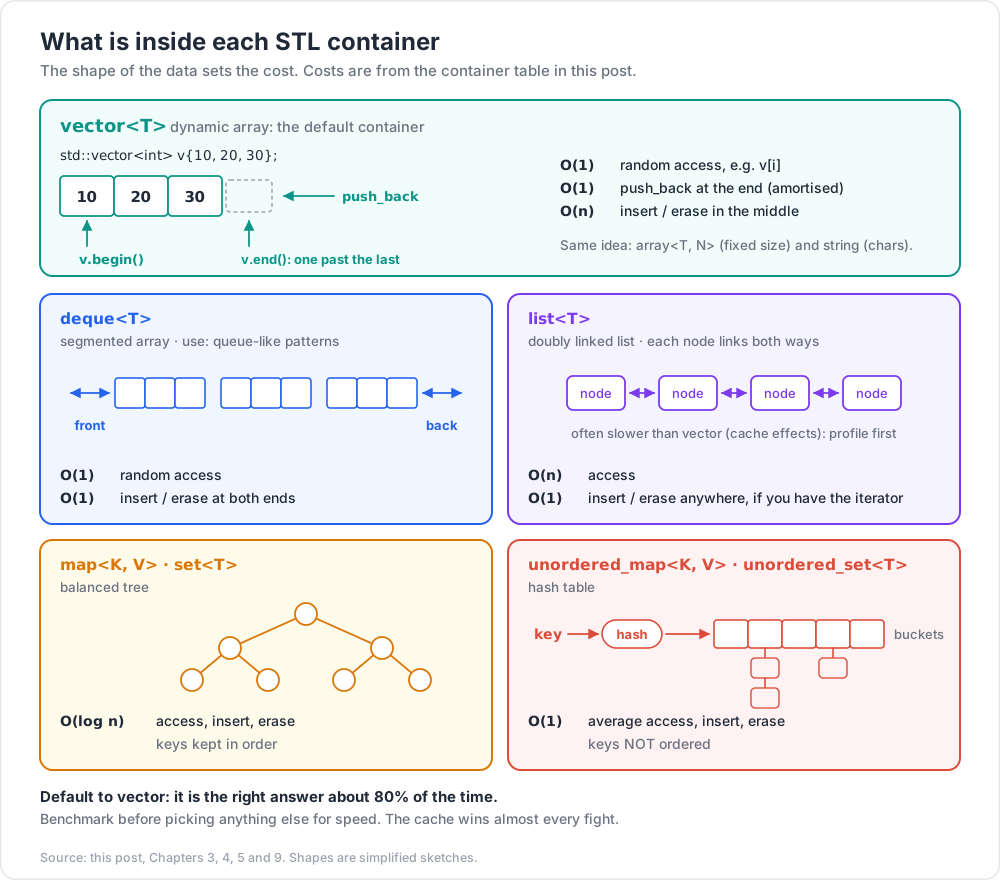
Internally a dynamic array. Amortised O(1) push_back, O(1) random access, O(n) insert/erase in middle.
Trick: if you know the final size,
v.reserve(N)ahead of time to prevent reallocations.
Chapter 4 — Other key containers
| Container | Underlying | Access | Insert/erase | When to use |
|---|---|---|---|---|
vector<T> |
dynamic array | O(1) random | O(1) at end, O(n) middle | default container |
array<T, N> |
fixed array | O(1) | n/a | size known at compile time |
deque<T> |
segmented array | O(1) random | O(1) both ends | queue-like patterns |
list<T> |
doubly linked | O(n) | O(1) anywhere if iterator known | rarely useful |
map<K, V> |
balanced BST | O(log n) | O(log n) | keys ordered |
unordered_map<K, V> |
hash table | O(1) avg | O(1) avg | keys NOT ordered |
set<T> |
balanced BST | O(log n) | O(log n) | sorted unique values |
unordered_set<T> |
hash table | O(1) avg | O(1) avg | fast membership |
string |
dynamic array of chars | O(1) | O(n) middle | text |
std::map example
1
2
3
4
5
6
7
8
9
10
11
12
13
#include <map>
std::map<std::string, int> ages;
ages["Ada"] = 30;
ages["Bob"] = 25;
if (auto it = ages.find("Ada"); it != ages.end()) {
std::cout << it->second; // 30
}
for (const auto& [name, age] : ages) { // C++17 structured binding
std::cout << name << ": " << age << "\n";
}
std::unordered_map (hash table — usually faster)
1
2
3
4
5
6
#include <unordered_map>
std::unordered_map<std::string, int> counts;
for (const auto& word : words) {
counts[word]++;
}
Default to unordered_map unless you need keys in sorted order.
Chapter 5 — Iterators
Every STL container has begin() and end(). end() is one past the last element.
1
2
3
4
5
std::vector<int> v{10, 20, 30};
for (auto it = v.begin(); it != v.end(); ++it) {
std::cout << *it << " "; // dereference like a pointer
}
Categories (most→least powerful):
- Random-access:
vector,array,deque. Supportsit + n,it[i],it1 - it2. - Bidirectional:
list,map,set. Supports++it,--it. - Forward: forward-only.
- Input / Output: single-pass only (e.g., reading from a stream).
Range-based for is iterators under the hood
1
2
for (auto& x : v) { ... } // syntactic sugar for an iterator loop
Use range-for. The classic iterator loop is for cases where you need the iterator itself.
Const iterators
1
2
3
4
for (auto it = v.cbegin(); it != v.cend(); ++it) {
// *it is const — can't modify through it
}
Chapter 6 — std::string
1
2
3
4
5
6
7
8
9
10
11
12
13
14
15
16
#include <string>
std::string s = "Hello";
s += ", World";
s.size(); // 12
s.length(); // same
s.empty(); // false
s[0]; // 'H'
s.substr(0, 5); // "Hello"
s.find("World"); // 7 (or npos if not found)
// integer ↔ string
std::string n = std::to_string(42);
int i = std::stoi("123");
double d = std::stod("3.14");
C++17 added std::string_view — a non-owning view into a string. Use for function parameters when you don't need to own/modify:
1
2
3
4
5
#include <string_view>
void print(std::string_view sv) { // takes string, char*, literal, etc.
std::cout << sv << "\n";
}
Chapter 7 — The <algorithm> header
The single most underused header. Replaces hand-written loops with descriptive, optimised one-liners.
1
2
3
4
5
6
7
8
9
10
11
12
13
14
15
16
17
18
19
20
21
22
23
24
25
26
27
28
29
30
31
32
33
34
35
36
37
38
39
40
41
42
43
#include <algorithm>
#include <numeric> // accumulate
#include <vector>
std::vector<int> v{5, 2, 8, 1, 9, 3};
// sort
std::sort(v.begin(), v.end()); // ascending
std::sort(v.begin(), v.end(), std::greater{}); // descending
// find
auto it = std::find(v.begin(), v.end(), 8);
if (it != v.end()) { /* found */ }
// count
int n_evens = std::count_if(v.begin(), v.end(), [](int x){ return x % 2 == 0; });
// sum
int total = std::accumulate(v.begin(), v.end(), 0);
// transform
std::vector<int> squares(v.size());
std::transform(v.begin(), v.end(), squares.begin(), [](int x){ return x * x; });
// for_each
std::for_each(v.begin(), v.end(), [](int x){ std::cout << x << " "; });
// any / all / none of
bool has_neg = std::any_of(v.begin(), v.end(), [](int x){ return x < 0; });
bool all_pos = std::all_of(v.begin(), v.end(), [](int x){ return x > 0; });
// min / max element
auto mn = std::min_element(v.begin(), v.end());
auto mx = std::max_element(v.begin(), v.end());
// reverse
std::reverse(v.begin(), v.end());
// unique (after sort)
std::sort(v.begin(), v.end());
auto last = std::unique(v.begin(), v.end());
v.erase(last, v.end());
Trick: before writing a loop on a container, search cppreference's algorithm list — there's almost always a standard one.
Lambdas (recap)
1
2
3
4
5
6
7
8
9
10
11
auto is_even = [](int x){ return x % 2 == 0; };
auto add = [](int a, int b){ return a + b; };
// with capture
int threshold = 10;
auto over = [threshold](int x){ return x > threshold; };
// capture by reference
int count = 0;
std::for_each(v.begin(), v.end(), [&count](int){ ++count; });
[ ] is the capture list. [=] captures everything by value, [&] by reference. Be explicit when possible.
Chapter 8 — C++20 ranges (brief)
C++20 introduced ranges — algorithms that take the container directly + composable views.
1
2
3
4
5
6
7
8
9
10
11
12
13
14
15
16
#include <ranges>
#include <vector>
#include <algorithm>
std::vector<int> v{1, 2, 3, 4, 5, 6};
// pipeline
auto result = v
| std::views::filter([](int x){ return x % 2 == 0; })
| std::views::transform([](int x){ return x * x; });
for (int x : result) std::cout << x << " "; // 4 16 36
// direct algorithm
std::ranges::sort(v); // no begin()/end() needed!
Cleaner than iterator-pair style. Worth learning if your compiler supports C++20.
Chapter 9 — Choosing a container
Decision tree:
- Default =
std::vector. Right answer ~80% of the time. - Need keys → values?
std::unordered_map(ormapif you need sorted iteration). - Need unique-set membership?
std::unordered_set(orsetif sorted). - Inserting at both ends?
std::deque. - Fixed-size?
std::array(zero overhead, size in the type). - Lots of middle insertions and you have iterators?
std::list— but profile first; it's often slower thanvectordue to cache effects.
Rule: benchmark before choosing anything other than
vectorfor performance reasons. The cache wins almost every fight.
Practice Exercises
Exercise 1 — Template min3
Write a function template min3(a, b, c) that returns the minimum of three values of the same type.
Solution
1
2
3
4
5
template <typename T>
T min3(T a, T b, T c) {
return std::min({a, b, c}); // braced-list overload
}
Exercise 2 — Word count
Read words from stdin until EOF; print each unique word and its count, sorted by count descending.
Solution sketch
1
2
3
4
5
6
7
8
9
10
11
12
13
14
15
16
17
18
19
20
#include <iostream>
#include <unordered_map>
#include <vector>
#include <algorithm>
#include <string>
int main() {
std::unordered_map<std::string, int> counts;
std::string w;
while (std::cin >> w) counts[w]++;
std::vector<std::pair<std::string, int>> sorted(counts.begin(), counts.end());
std::sort(sorted.begin(), sorted.end(),
[](auto& a, auto& b){ return a.second > b.second; });
for (const auto& [word, n] : sorted) {
std::cout << word << ": " << n << "\n";
}
}
Exercise 3 — Sum of squares of even numbers
Given std::vector<int>, return the sum of squares of even values. Use STL only — no manual loop.
Solution
1
2
3
4
5
int sum_sq_even(const std::vector<int>& v) {
return std::accumulate(v.begin(), v.end(), 0,
[](int acc, int x){ return x % 2 == 0 ? acc + x * x : acc; });
}
Exercise 4 — Stack template
Implement template <typename T> class Stack with push, pop, top, empty, size. Internally use std::vector<T>.
Exercise 5 — Find duplicates
Given std::vector<int>, return a std::vector<int> of values that appear more than once (each duplicate listed once).
Solution sketch
1
2
3
4
5
6
7
8
std::vector<int> dups(const std::vector<int>& v) {
std::unordered_map<int, int> count;
for (int x : v) count[x]++;
std::vector<int> r;
for (const auto& [k, n] : count) if (n > 1) r.push_back(k);
return r;
}
Cheat-sheet
| What | How |
|---|---|
| Function template | template<typename T> T f(T a, T b) |
| Class template | template<typename T> class Box { T v; }; |
| CTAD | Box b(5); // deduces Box<int> |
| Vector | std::vector<int> v; |
| Map (sorted) | std::map<K, V> |
| Map (hash) | std::unordered_map<K, V> |
| Set | std::set<T> / std::unordered_set<T> |
| String | std::string |
| Iterator | auto it = v.begin(); |
| End iterator | one past last |
| Algorithm sort | std::sort(v.begin(), v.end()) |
| Algorithm find | std::find(b, e, value) |
| Algorithm accumulate | std::accumulate(b, e, init) |
| Lambda | [capture](args){ body } |
| Structured binding | for (auto& [k, v] : m) |
| Range pipe | v | views::filter(p) | views::transform(f) |
What's next
Post 05 — the final base post — covers modern C++ essentials: std::unique_ptr / std::shared_ptr, move semantics in practice, auto, range-based for, lambdas in depth, constexpr, and a glimpse of C++20 concepts.
References
- cppreference / container library
- cppreference / algorithm
- A Tour of C++ — Ch. 9–12.
- Effective STL by Scott Meyers — classic STL guide.
Note: this post is in progress. Planned additions: iterator-invalidation rules; emplace vs insert; benchmark comparing
vectorvslist.