Data Structure & Algorithm (C++)
Data Structure & Algorithm is the fundamental knowledge of programming. Learning how to store, organize, sort, search data allow us to code more efficiently and concisely.
Learning outcome
Apply structural programming approach to solve more complex computation problems.
Demonstrate applications of standard data structures such as linked list, stack, queue and tree.
Solve computation problems using recursion where appropriate.
Understand different sorting and searching algorithms.
Chapter 1 - Basic Concepts of C++
Terminology
Abstract Data Type (ADT)
Common Standard Library Header
<cstdio>
Support Standard I/O functions:printf(),scanf(),getchar(),fopen(),fclose(), etc..<cstdlib>
Support Standard utility functions:malloc(),free(),rand(), etc..<cstring>
Support String functions:strcpy(),strcmp(),memset(), etc..<iostream>
Perform both input and output operations with the stream objects :cinandcout
Comments
1
2
3
4
5
6
7
8
/* Block Comment */
/*
* Block comment
*/
// Single line comment
Primitive Data types
| Data type | Size (byte) | Representation | Range of values |
|---|---|---|---|
| bool | 1 | Boolean | |
| char | 1 | Signed number (2's complement) | |
| unsigned char | 1 | Unsigned number | |
| int | 4 | Signed number (2's complement) | |
| unsigned int | 4 | Unsigned number | |
| short | 2 | Signed number (2's complement) | |
| unsigned short | 2 | Unsigned number | |
| long | 4 | Signed number (2's complement) | |
| unsigned long | 4 | Unsigned number | $\textnormal{0 to } 2^{32}-1 $ |
| long long | 8 | Signed number (2's complement) | |
| unsigned long long | 8 | Unsigned number | $\textnormal{0 to } 2^{64}-1 $ |
| float | 4 | IEEE 32-bit floating point number | |
| double | 8 | IEEE 64-bit floating point number | |
| pointer | 4 | Memory address |
C++ File Structure
Header file (.h) Program file (.cpp)
Functions Declaration Functions Implementation
Chapter 2 - Computation Complexity (Big-O)
There are two types of complexity
- Time Complexity (Time spent)
- Space Complexity (Memory space spent)
They both use three asymptotic notation to descript the complexity
Big-O
Upper bound of the complexity
Big-Omega
Lower bound of the complexity
Big-Theta
Exact bound of the complexity
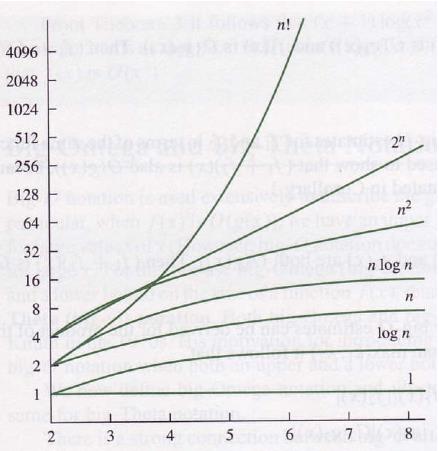
Common Complexity Classes
- Constant time -
- Logarithmic time -
- Linear time -
- Log-linear time -
- Quadratic time -
- Cubic time -
- Polynomial time -
- Exponential time -
- Factorial time -
Slope of Complexity Classes
TIme Complexity
Simple operations such as
- declaration, assignment
- cin, cout
- function call
- return
take constant amount of time
The overall time complexity = O(Constant),
and constant time costs almost zero influence no matter the size.
Therefore the overall time complexity is
Only looping will cost longer time complexity
Single nested loop usually takes constant time * size of loop as the operations C inside the loop will run n times.
1
2
3
for (int i = 0; i < n; i++)
sum += i;
The overall time complexity is
While for more than one nested loop usually takes constant time * (n ^ depth of nest) as the operations C inside the loop will run n * n * ... times.
1
2
3
4
for (int i = 0; i < n; i++)
for (int j = 0; j < n; j++)
sum += i + j;
The overall time complexity is
Best case
To be added..
Average case
To be added..
Worst case
To be added..
Space Complexity
To be added..
O()
Chapter 3 - Linked Lists
A linked list is an object that only contains head node of the list.
Each node is created with parameter [next] linked to next node or necessaryly [prev] linked to previous node.
Terminology
- Predecessor
- Successor
Josephus Problem
People are standing in a circle waiting to be executed.
Counting begins at a specified point in the circle and
proceeds around the circle in a specified direction. After
a specified number of people are skipped, the next
person is executed. The procedure is repeated with the
remaining people, starting with the next person, going in
the same direction and skipping the same number of
people, until only one person remains, and is freed
The problem — given the number of people (n), starting
point, direction, and number to be skipped (k) — is to
choose the position in the initial circle to avoid execution.
(guessing who is the survivor)
Linear List
Unordered / Random List
Ordered List
General List
Restricted List
Common Operations
Find length of linked list
1
2
3
4
5
6
7
8
int len = 0;
node *cur = head; //traverse the list using cur
while (cur != NULL) { // cur points to a valid node
len++;
cur = cur->link; //move to the next node
}
Search element x from the beginning of list
1
2
3
4
5
6
node *cur = head;
while (cur != NULL && cur->info != x) { // search x
cur = cur->link;
}
// cur now points to target x or is NULL (x not exist)
Insert new element x at the front of list
1
2
3
4
5
6
node *p = new node; // create the node dynamically for storing x
p->info = x;
p->link = head; // step 1
head = p; // step 2
Remove the first element x found in the list
1
2
3
4
5
6
7
8
9
10
11
12
13
14
15
16
node *cur = head;
node *prev = NULL; // prev points to the predecessor of cur
while (cur != NULL && cur->info != x) { // search x
prev = cur;
cur = cur->link;
}
// if cur == NULL, x is not found in the linked list
if (cur != NULL) { // cur->info == x
if (prev != NULL) // why checking this?
prev->link = cur->link; // skip cur node
else // cur is the first node in the list
head = cur->link; // x is the first node
delete cur; //free the storage of the removed node
}
Insert new element x in an ordered list
1
2
3
4
5
6
7
8
9
10
11
12
13
14
15
16
17
18
19
20
node *p = new node;
p->info = x;
if (head == NULL || x <= head->info) {
p->link = head; //insert at front
head = p;
} else { //head != NULL && x > head->info
node *prev = head; // x to be inserted between prev and cur
node *cur = head->link; // i.e. prev->info < x <= cur->info
while (cur != NULL && x > cur->info) { // search position
prev = cur;
cur = cur->link;
}
// end-of-list OR x <= cur->info, so insert node p after node prev
p->link = prev->link;
prev->link = p;
}
Common Issues
Null-pointer exception
Memory leak
Variants of Lists
Singly Linked List with Header Node
- Sentinel node
Circularly Linked List
- Last node points back to first node
Doubly Linked List
- Each node has next and back pointers
Circular Doubly Linked List
- Boundary-tag method
Orthogonal List
- ...
Chapter 4 - Stacks and Queues
To be added..
Terminology
To be added..
Stack
Last In First Out (LIFO)
Queues (FIFO)
First In First Out (FIFO)
Chapter 5 - Recursion
To be added..
Terminology
To be added..
Chapter 6 - Binary Trees
To be added..
Terminology
To be added..
Chapter 7 - Sorting and Searching Algorithms
To be added..
Terminology
To be added..
Chapter 8 - Hashing
Terminology
- Indexing
- Perfect Hashing
- Minimal Perfect Hashing
- Hash Collision
- Open Addressing
- Closed Addressing
- Design of Hash function
Introduction of Hashing
Hashing is generally [ Indexing ].
If you have learnt what [ index ] is, you may understand it as positioning or classifying objects with duplicated meaning for a smaller size of data and better searching.
Steps for Indexing
- Define an array with a specific purpose.
- Define meaning for each index in the array.
- Classify the input and determine the size of the array.
- Map the input to the array.
Example of Indexing (Minimal Perfect Hashing)
Given A string [foo] = "abacbdef".
Precondition: there will only be alphabets inside the string.
If you want to find how many 'a' occured inside the string, you may use Indexing.
- Define an array for storing the occurrence of letters.
- Each index represents an alphebet.
- There are a total of 26 alphabets as potential input, so the size of array will be 26.
- Similar to the ASCII table, we can take index [0] representing the occurrence of 'a', index [1] representing the occurrence of 'b', and so on...
- Loop over the string and map the character to corresponding index.
However, there are still some differences between Hashing and Indexing.
In Hashing, we convert ASCII char to key directly with array[i] - 'a' so that 'a' = 0, 'b' = 1, and so on...
which allows us to map the data easier and faster.
Hash function
A function f(k) is known as defined with specific formula,
it can be either One-to-one, or Many-to-one,
Under this property,
it can convert a large variable-sized amount of data into a small datum by transforming data into keys.
A Hash table arr[ ] is an array that will be created to hold the keys after conversion.
A Hash value is usually an integer that may serve as an index to an array.
Example of Hash function
Hashing Student ID k using Modulo, where h is the function, h(k) is the hash value of k, n is an arbitrary key.
The size of the array will be reduced significantly due to the limited range of the modulus [0 to n-1].
Take k = 5000, n = 5, the function will be
In Hash table, the value k will be updated to the index of hash value, arr[h(k)] = k
arr[0] = 5000, arr[1] = 5081, arr[2] = 5072, arr[3] = 5023, arr[4] = 5014
You may now be thinking of what if the index collides, it should happen frequently as the function is many-to-one.
Yes, and therefore, I am going to introduce the solution against collision.
Hash Collision
Collision occurs when two distinct data own the same hash value.
Collisions are usually unavoidable when a large set of data is mapped into small datum.
It will increase the average cost of lookup operations.
Solutions to Hash Collision
- Open Addressing
- Closed Addressing
Load factor represents the length of data in each index,
larger load factor brings lower performance
Open Addressing
Place the key in other free slot when collisions occured.
An index only maps to 1 key.
Theoretical max load factor = 1
Advantages
- No size overhead apart from the hash table array
- Better memory locality and cache performance. Memory allocation is laid out linearly
- Performs better when the number of keys is known in advance and the churn is low.
Example of Open Addressing:
- Linear Probing
- Quadratic Probing
- Double Hashing
- Hopscotch hashing
- Robin Hood hashing
- Cuckoo hashing
- 2-Choice hashing
Linear Probing
To be added..
Quadratic Probing
To be added..
Double Hashing
To be added..
Closed Addressing
Place the key in the same slot even when collisions occured.
An index can map to multiple keys.
Theoretical max load factor = depends
To achieve placing multiple keys in same slot
- Separate chaining using linked lists
- Separate chaining using dynamic arrays
- Using self-balancing binary search trees
Advantages
- Easier removal
- Assign quicker with high load factor
- No issues with Clustering
Example of Closed Addressing:
- Chaining Buckets
Chaining Buckets
To be added..
After dealing with collision, there will be two general types of Hashing.
Minimal Perfect Hashing (Best)
A hash function that maps each valid input to a different hash value.
Every index is taken in the hash table.
Perfect Hashing
A hash funciton that maps n input keys to n consecutive hash values.
But not every index is taken in the hash table.
Designing Hash Functions
Ideal properties
- Low Cost
- Easier and faster to compute the result
- Variable Range
- Able to transform [words], [symbols] into [numbers]
- Uniformity
- Distribute the keys evenly
- Minimize the chance of collisions
Common types of Hash Functions
-
Division
-
Mid-Square
-
Folding
-
Radix Transformation
Division
hashValue = key % tableSize
Try to use prime number as the hash table size to reduce collisions
For non integer keys, transform them into integer with ASCII code
1
2
3
4
5
6
7
8
int hash(char key[size]){
int k = 0;
for (int i = size; i > 0; i--)
k += key[i]; // Sum of the ASCII
// or k ^= key[i]; // XOR of ASCII
return k % tablesize;
}
Mid-Square
- Transform keys into integer
- Sqaure the number
- Pick some digits from the middle to hash
Take tableSize = 5
| 99 | 9801 | 80 | 80 % 5 = 0 |
| 145 | 21025 | 102 | 102 % 5 = 2 |
| 342 | 116964 | 69 | 69 % 5 = 4 |
Folding
- Split key into 3 parts [ Left, Middle, Right ] as you wish,
left and right should have the same size - Fold keys and sum the keys
Shift-folding
Sum the splitted keys directly
Take tableSize = 5
| 5829 | 58-29 | 58 + 29 = 87 | 87 % 5 = 2 |
| 452642 | 45-26-42 | 45 + 26 + 42 = 113 | 113 % 5 = 3 |
| 1234567 | 123-4-567 | 123 + 4 + 567 = 694 | 694 % 5 = 4 |
Boundary-folding
Invert the left and right part of each splitted part except middle one
Then sum the keys
Take tableSize = 5
| 5829 | 58-29 | 85 + 92 = 177 | 177 % 5 = 2 |
| 452642 | 45-26-42 | 54 + 62 + 24 = 140 | 140 % 5 = 0 |
| 1234567 | 12-345-67 | 21 + 345 + 76 = 442 | 442 % 5 = 2 |
Radix Transformation
Define same key with new radix then convert back to original radix
Given $ k = 358345_{10} $
Define $ k_2 = 358345_{9} h(k) = k_2 \space mod \space tableSize k_2 = 358345_{9} = 216068_{10} h(k) = 216068_{10} \space mod \space tableSize $
Useful shortcut
Convenient Mathematics formulas for programming
Gauss Summation
Calculate the sum of integers from 1 to n inclusively
Calculate the sum of natural numbers from a to b inclusively
To be added..